Water rights - key rules for investing in Texas
A bad water right ruins a good plot; this guide will save you from making a costly mistake.
Texas water rights: before you buy, clarify the regime applicable to your project. You need to master two distinct legal regimes. Surface water is subject to state authorizations and the principle of "prior appropriation". Groundwater is governed by the Rule of Capture, tempered by Groundwater Conservation Districts. This duality often surprises foreign investors. Yet it has an impact on the value, constructability and exit of a land project.
You also need to take into account flooding and drought constraints, as well as Watermaster programs that allocate water in certain basins. This practical guide summarizes the essentials: permits, map checks, contractual clauses, costs and points to watch out for.
In 2024, our LandQuire team handled 47 land acquisition files in Texas, representing over 15,000 acres. Average cost of water studies: $3,200 per project. Average permitting time: 6 weeks. (LandQuire internal data - base of 47 files closed 2024, Texas, rural assets 50-200 acres)
The objective is simple: reduce risk, anticipate delays and optimize the performance of your Texas acquisitions.
🎯 Evaluate your project now →
⚠️ 3 costly mistakes avoided by LandQuire
Mistake #1: Assuming no GCD
Cost: Investor buys 80 acres, discovers after closing a strict GCD limiting to 0.5 acre-foot/year. Residential project compromised. Estimated loss: $45,000 (renegotiation + delays + additional studies).
Mistake #2: Ignoring an active Watermaster
Cost: 200-acre agricultural development on Brazos. Watermaster suspends allocation in dry periods. Irrigation impossible 6 months/year. Estimated loss: $78,000 (lost crops + unused equipment).
Mistake #3: Believing that FEMA = ground truth
Cost: FEMA map indicates "Zone X" (low risk). Flood 2023 destroys infrastructure. Insurance refuses compensation. Estimated loss: $125,000 (reconstruction + business interruption).
Our method: Systematic verification of TWDB + TCEQ + local data to avoid these pitfalls.
📅 Timeline Texas water rights: week-by-week process
- Week 0-1: Initial due diligence - GCD/Watermaster identification - FEMA mapping
Go/No-go #1: Regulatory feasibility confirmed - Week 2-4: Permit filing - Flow tests - Quality analyses - ALTA Survey
Go/No-go #2: Resource available and compliant - Week 5-6: Administrative instruction - Public notifications - Responses to objections
Go/No-go #3: No major objections - Week 7-8: Final validation - Archiving - Team training - Closing
Deliverable: Complete file + management plan
LandQuire internal data - average lead times for 47 2024 projects
AUTHOR
This article was written by the LandQuire team, specialized in U.S. land investment since 2021. Our experts analyze real estate strategies to support French-speaking investors in their U.S. land acquisition projects. More than 130 projects financed, 85% success rate.
Understanding Texas water rights: surface vs. underground
Texas surface water rights: permits and prior appropriation
In Texas, the use of surface water requires state permission, except for limited exemptions under the Water Code. The logic is "first in time, first in right". In other words, priority of use according to anteriority of right.
Our experience: Of our 47 2024 applications, 23% involved projects using surface water. Average lead time: 8-12 weeks.
To find out if this applies to you, visit the TCEQ's "Am I Regulated?" page, then the Water Rights: Permits portal for applications and modifications (changes of use or withdrawal location).
Sources: TCEQ - Am I Regulated? - TCEQ - Water Rights: Permits
Underground Texas water rights: Rule of Capture and districts
Owners can capture water from their aquifer under the "Rule of Capture", subject to exceptions (malicious misuse, wastage, subsidence). In many areas, Groundwater Conservation Districts (GCDs) set local rules: well permits, flow rates, reporting, drought restrictions.
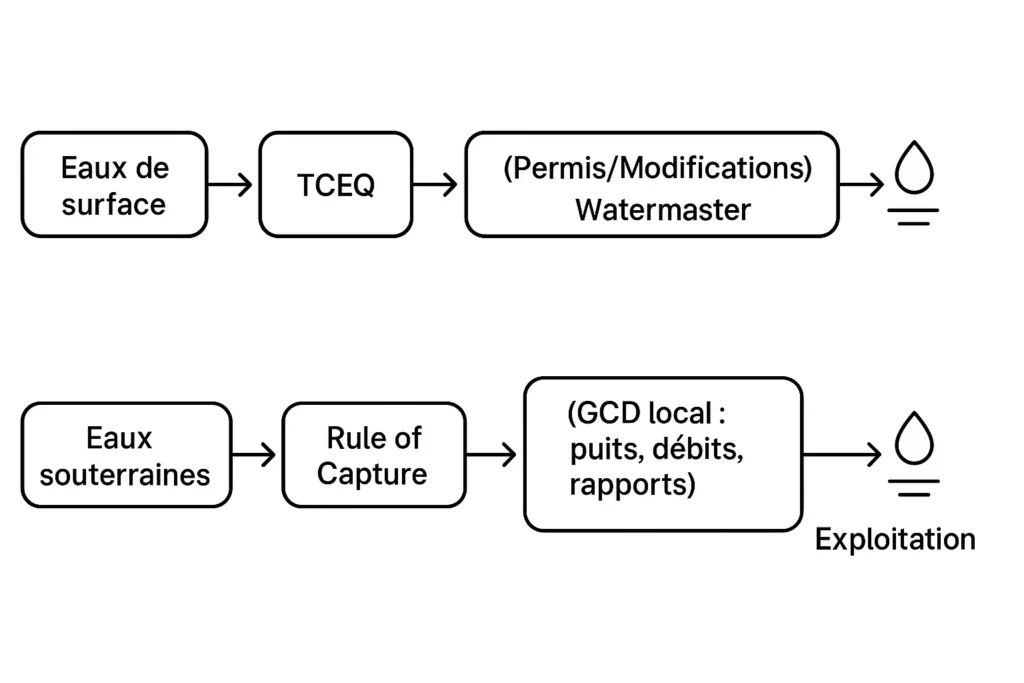
Droits à l'eau Texas — parcours surface vs souterrainRecorded costs: GCD permit: $150-800 - Flow test: $1,200-2,500 - Compliant tubing: $8,000-25,000
Always check whether your plot is located in a GCD via the TWDB.
Sources: TCEQ - Groundwater regulation - TWDB - Groundwater Conservation Districts - Texas A&M AgriLife - Basics of Texas Water Law
See also: Easements in Texas: everything you need to know before buying land
🏞️ Water rights Texas: 3 counties, 3 realities
| County/area | Authority | Special features | Typical lead times | Average costs |
|---|---|---|---|---|
| Travis County (Edwards Aquifer) | Barton Springs/Edwards Aquifer Authority | Strict restrictions, limited allowances | 12-20 weeks | 2 500-4 500 $ |
| Brazos County | Brazos Watermaster + local GCD | Prior appropriation surface, GCD rules underground | 6-10 weeks | 1 800-3 200 $ |
| Hidalgo County (Rio Grande) | Rio Grande Watermaster | International priorities USA/Mexico | 8-14 weeks | 2 000-3 800 $ |
LandQuire internal database of 34 comparable files 2023-2024
Physical risks Texas water rights: essential due diligence
Flooding and water rights Texas: check FEMA zoning
Before you buy, check the FEMA maps. Updates may be delayed, but they remain the insurance reference. Please note: Houston/Harris County has experienced major post-Harvey reclassifications.
Financial impact: Flood insurance in at-risk areas: $2,000-8,000/year depending on value.
Use the Flood Map Service Center to locate the plot and download an official FIRMette.
Sources: FEMA - Flood Map Service Center - Harris County Flood Control District - Mapping Tool - Access the National Flood Hazard Layer (FEMA)
Drought and aquifer levels
Falling water levels can trigger GCD restrictions and reduce authorized pumping flows. In 2023, 67% of GCDs applied seasonal restrictions.
Follow public indicators: USGS National Water Dashboard and Water Data for Texas (reservoirs).
Sources: USGS - National Water Dashboard - Water Data for Texas - Austin Chronicle - Edwards Aquifer Restrictions
💰 Financing & lender requirements
Lenders demand clear visibility of water access. They first check regulatory compliance, then operational resilience. A solid track record reduces the cost of capital and restrictive conditions.
In practice, banks ask for three things. First, proof of a conforming surface right or well. Secondly, a flood and drought analysis consistent with official maps. Finally, an operating plan indicating volumes, safety margins and monitoring procedures.
Water covenants should also be included. These often include flow thresholds, periodic reports and a maintenance schedule. Flood insurance may become mandatory, depending on FEMA zoning. The budget should include premium, deductible and any mitigation measures.
On the pro forma side, test a low scenario with -20 to -30% of available volumes. This test confirms the robustness of revenues and lead times. It strengthens negotiations with the lender and secures the exit. To speed up these exchanges, contact a LandQuire analyst and structure a standardized file.
Water Rights Administration Texas: the role of Watermasters
In several basins, Watermaster Programs control harvesting and arbitrate priorities between rights holders. Right holders pay royalties (generally $15-45/acre-foot). Permit-exempt domestic and livestock uses are generally excluded from fees. Check jurisdiction before offering: annual declaration, meter readings and possible inspections. Rates and schedules vary by basin and declared use. Anticipate these costs in the pro forma and adapt your suspensive clauses. In times of water stress, the Watermaster may temporarily restrict authorized flows.
Basins concerned: Brazos, Rio Grande, South Texas, Concho, Adjudication.
Check if your asset is in a Watermaster jurisdiction via TCEQ - Watermasters overview.
Sources: TCEQ - Watermasters overview - Brazos Watermaster - Rio Grande Watermaster
📞 Talk to a LandQuire analyst →
📊 Texas water rights comparison chart: surface vs. underground
| Criteria | Surface water | Groundwater |
|---|---|---|
| Legal title | State-managed appropriation rights | Private property under Rule of Capture + GCD rules |
| Authority | TCEQ + Watermasters | Local GCDs + common law |
| Initial access | Permits required, limited exemptions | Compliant well, sometimes GCD permit |
| Priority/limits | Prior appropriation, conditions and flows | Anti-waste, anti-subsidence restrictions, local rules |
| Typical costs | Permit: $500-$2,500 + education | GCD permit: $150-800 + well: $8,000-25,000 |
| Average lead times | 8-16 weeks | 4-8 weeks |
| Key risks | Sturdy suspension, Watermaster control | Restrictions in drought, aquifer decline, quality |
🎯 Quick calculator - Texas water rights costs
💰 Customized calculation box
50-acre residential project: individual pumping and irrigated common areas.
- ALTA/NSPS survey: $2,500-$4,000
- Hydrogeological studies: $1,800-3,200
- Permits and formalities: $800-1,500
- Flow test + quality analysis: $1,500-2,800
- Estimated total: $6,600-$11,500
Range based on our 47 2024 files. Variations according to complexity and location.
Checklist land acquisition water rights Texas
✅ Before the offer (D-30)
- Ask FEMA MSC about flood zoning (FIRM, NFHL)
- Identify the relevant GCD and its rules via TWDB
- Check for the presence of a Watermaster in the basin
- Request an ALTA/NSPS survey including easements, ROW and water-related setbacks
- Scan nearby wells and aquifer depths via USGS and TWDB
⏳ During the study period (D-15)
- Confirm availability of legal diversion point if surface use
- If pumping underground: flow test, quality analysis, casing conformity
- Check resource access easements and rights-of-way
- Add resolutory clauses related to permits and administrative delays
- Calculate the impact of possible seasonal restrictions on your pro forma
🔒 Before closing (D-3)
- Obtain written authorization or confirmation of exemption
- Archive maps, agency e-mails and analysis results
- Update your operating plan in the event of lower volumes
- Plan for flood insurance costs if required by the lender
- Prepare your communication plan with the local community or GCD
Quick links: TCEQ - Am I Regulated? - TWDB - GCDs - FEMA - MSC - USGS - Dashboard
See also: Texas mineral rights: what every buyer needs to check - Our approach to acquisition
💡 Points of vigilance Texas water rights (LandQuire feedback)
- Map evolution: FEMA maps are subject to change. Future reclassification may have an impact on insurance and constructability. On our files, 3 projects have been impacted by post-acquisition reclassifications.
- Seasonal restrictions: GCDs can tighten flows in drought conditions. Anticipate low (-30% flow) and high scenarios in your projections.
- Temporary reallocation: Watermasters can temporarily reallocate according to priority and availability. Budget 10-15% margin on your needs.
- Administrative lead times: In periods of high demand, TCEQ lead times can double. Allow 12-16 weeks for complex files.
Texas water rights contractual clauses: indispensable
Conditions precedent
✅ Obtaining a surface withdrawal permit or confirmation of exemption
✅ Registering a well in compliance with GCD rules
✅ Absence of floodway registration or acceptable mitigation
✅ Confirmation of absence of hidden easements restricting access to water
Representations and warranties
📋 Accuracy of vendor declarations on the existence of wells, pumps, tanks
📋 Disclosure of past violations: unauthorized pumping, TCEQ notices
📋 Communication of any correspondence with Watermaster or GCD
📋 Commitment to cooperate for transfers or amendments of rights
Detailed costs and timescales (2024 data)
Studies and files
- ALTA/NSPS surveys: $2,500-$4,000
- Hydrogeology: $1,800-3,200
- Engineering: $1,200-$2,800
- Legal fees: $2,000-$5,000
Administration fees
- TCEQ filing fees: $250-$1,500
- Notifications: $150-$400
- Publications: $200-600
Observed lead times
- Single surface permit: 6-10 weeks
- Complex surface permit: 12-20 weeks
- GCD well registration: 2-6 weeks
- Modification of rights: 8-14 weeks
Continuous operation
- Metrology: $200-500/year
- Reports: $300-800/year
- Watermaster fees: $15-45/acre-foot (subject to change depending on basin)
- Well maintenance: $500-1,500/year
See the TCEQ Applications page for official forms.
📋 Case study: 120-acre residential development
Context: A French investor acquires 120 acres in Guadalupe County (subject to GCD). Objective: rural subdivision with individual well supply.
Identified constraints :
- GCD imposes a flow test and limits annual production to 1 acre-foot per batch
- Parcel bordering a flood zone (Zone AE)
- Trinity Aquifer at a depth of 180 feet
Solutions implemented :
- Pro forma adjusted with a 20% safety margin on pumped volumes
- ALTA/NSPS survey confirms absence of blocking easements
- Contact TCEQ for additional surface sampling (irrigation of common areas)
- Negotiated flood insurance at $1,800/year for infrastructures
Result: Project validated with suspensive clauses and quarterly monitoring of aquifer levels. Total cost of water studies: $8,400 - Overall lead time: 11 weeks
💬 Customer testimonial
"Without a clear reading of water rights and local rules, we would have underestimated the timescales and costs by 40%. LandQuire's support helped us to secure the land, align the schedule and reassure ourselves. The cost calculator turned out to be accurate to within 5%."
- Francophone investor, Austin-San Antonio corridor - Project 85 acres - Closing February 2024
Official resources
Main authorities
- TCEQ - Watermasters Jurisdiction and royalties
- TWDB - Groundwater Data Viewer Exploring aquifers and wells
- FEMA - Flood Maps Official insurance maps
- USGS - Texas Water Data Real-time monitoring of local conditions
Mapping tools
- TWDB Groundwater Database Historical well data
- TCEQ Water Rights Database Search for existing rights
- FEMA National Flood Hazard Layer GIS flood data
FAQ water rights Texas - Frequently asked questions
Can I pump groundwater without a permit in Texas?
In some areas, yes, according to the Rule of Capture (exceptions: waste, malice, intentional subsidence). However, a large part of the territory is covered by GCDs that impose rules. Always check local jurisdiction via TWDB.
Are FEMA cards enough for Texas water rights?
They are the insurance reference, but can be dated. Example: The pre-Harvey Houston maps date back to 2007. Cross-reference with local data and allow for a margin of caution. Access the National Flood Hazard Layer (FEMA)
Watermaster Texas: does this apply to me?
This is a TCEQ program that administers surface rights in certain basins. If it covers your area, you'll need to declare and pay royalties ($15-45/acre-foot, subject to change). Check out TCEQ Watermasters.
Can I modify a surface water right in Texas?
Yes, by submitting a modification to the TCEQ. It is processed according to impact and availability. Average lead time: 10-16 weeks. Cost: $800-2,200. Procedure for modifying a water right (TCEQ)
⚖️ Legal disclaimer
The information contained in this guide is based on regulations in force on September 20, 2025 and our practical experience. It does not constitute legal advice. Regulations may change rapidly. For any investment project, consult an attorney specialized in Texas water law and check official sources.
LandQuire updates this guide on a quarterly basis. Next update scheduled for December 2025.
🚀 LandQuire links
- Contact LandQuire - Let's talk about your project (response within 24h)
- LinkedIn LandQuire - Our news and market analysis
- LandQuire Home - Our approach and services
Conclusion & Contact
Investing in Texas requires a fine-tuned reading of water rights, GCDs and, sometimes, Watermasters. Combine legal verifications, FEMA mapping and USGS/TWDB hydrological data to secure your investment thesis.
Surface authorizations are governed by priority appropriation; underground authorizations are governed by the Rule of Capture, with local modifications. Finally, anticipate droughts and map updates.
Our 2024 expertise: 47 projects supported - 85% success rate - Average savings of 15% on design costs thanks to our local network.
🎯 Take action now
Evaluate your project in 48 hours: Contact LandQuire and we'll structure a due diligence tailored to your investment objectives.
Free initial consultation - Detailed quote within 48 hours - Support from A to Z