Landlocked Parcels – Breaking the Legal Deadlock
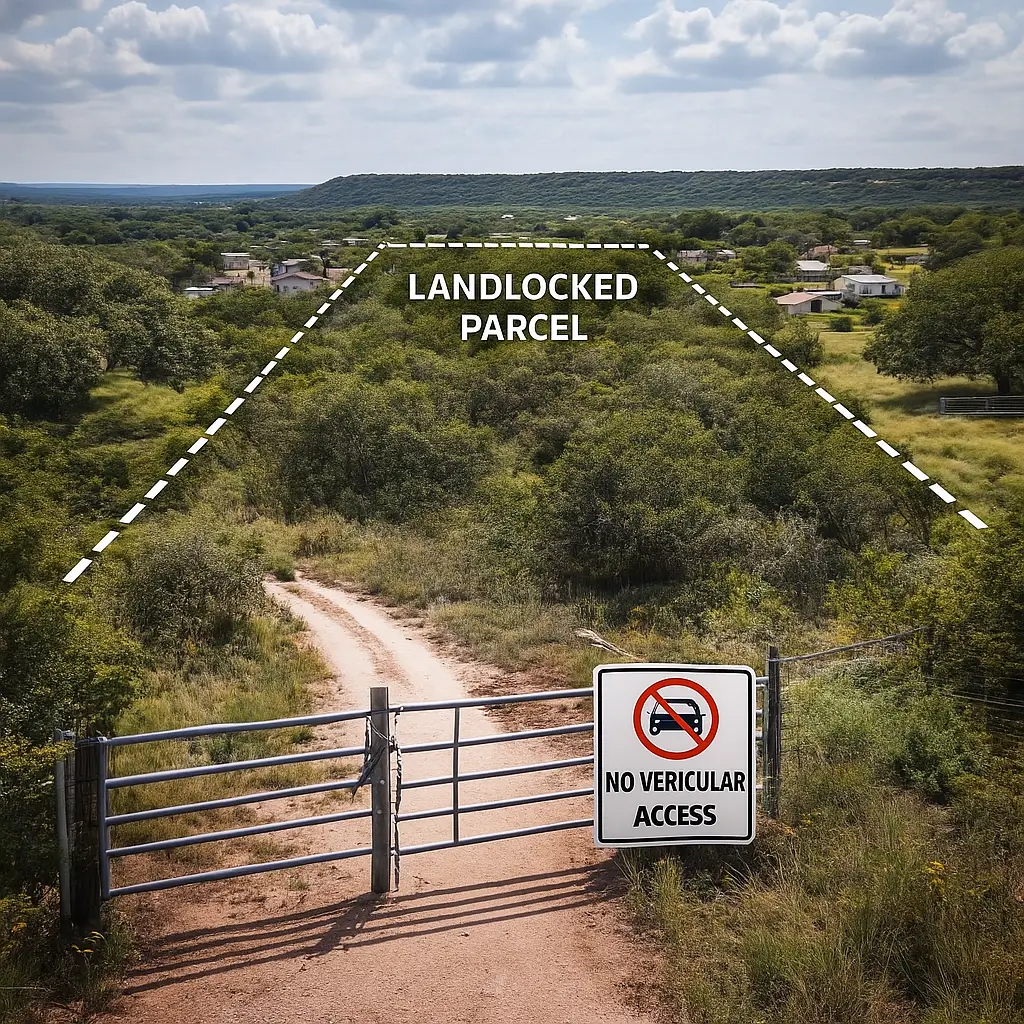
The acquisition of a parcel of land without legal access to a public road is one of the most formidable pitfalls of American real estate investment. Landlocked parcels —land surrounded entirely by private property—represent a complex legal issue that can turn an investment opportunity into a financial nightmare. Understanding the legal solutions to this impasse is essential for any French-speaking investor interested in the Texas real estate market.
Author
This article was written by the LandQuire team, which specializes in real estate investment in the United States. Our experts assist French-speaking investors in their purchases of American land.
🔗 Follow LandQuire on LinkedIn
✉️ "Easements & buildability" audit: Specialized contact for land in Texas
📌 Key takeaways in 30 seconds
- A landlocked parcel is a piece of land without legal access to a public road: no permits or construction are possible until access is regularized.
- Solutions exist: express easement, necessity easement, implied easement, acquisitive easement, or administrative procedure.
- Texas imposes strict rules: MUD, PUD, and ETJ directly influence access and buildability.
- A comprehensive legal analysis (title search, ALTA survey, endorsements) is essential before any purchase.
- Landlocked parcels can offer high returns, but only for investors who are well supported.
- That's why LandQuire verifies, secures, and clears each project before opening it up to investors: no land is offered without legal access, a full audit, and prior legal validation.
What is a landlocked parcel?
An enclosed parcel refers to land that has no direct legal access to a public road. In practical terms, this means that the owner is unable to reach their property without crossing someone else's land. This situation often arises in cases of poorly planned subdivisions, inheritance divisions, or sales of interior portions of a large plot of land without reserved access.
In Texas, this issue particularly affects rural areas where old subdivisions, divisions between heirs, or sales of interior parcels regularly create land without access. Contrary to popular belief, there is no automatic right of access for landlocked properties in Texas.
The financial consequences of isolation
Landlocked properties suffer significant depreciation, and landlocked plots generally sell for between 50% and 80% less than comparable accessible lots. This discount can be explained by several practical and legal factors:
Financing limitations: Banks systematically refuse to grant mortgages on landlocked parcels, even with a substantial down payment. Title insurance companies generally refuse to insure the title to land that lacks legal access. Without this insurance, potential buyers cannot obtain financing, and cash sellers are very hesitant.
Impossibility of development: Without legal vehicular access, local authorities refuse to issue building permits. The installation of public utilities (electricity, water, sewerage) becomes extremely difficult, if not impossible.
Legal risks: Using an existing path without a formal easement exposes the owner to prosecution for trespassing. Even a verbal agreement with a neighbor is not sufficient to create an enforceable legal right.
Legal solutions to break out of isolation
Several legal strategies can be used to resolve the issue of landlocked parcels. Their applicability depends on the historical and geographical context and on relations with adjacent owners.
1. Negotiating an express easement
The most straightforward solution is to negotiate a written easement with a neighboring property owner. This approach requires diplomacy and often financial compensation:
Negotiation strategies:
- Search the land registry archives for any trace of historical use of the adjacent land, even informal use.
- Offer reasonable compensation covering the costs of installing a driveway, property taxes on the strip of land, and maintenance.
- For seasonal or limited use, consider a lease agreement rather than a permanent easement.
- Offer reciprocal benefits, such as maintaining hunting rights on your land in exchange for access.
The permanent purchase of easement rights generally requires offering 10 to 20% above the estimated market value to encourage neighbors to sell. This solution, although costly, guarantees permanent access without legal battles.
2. Easement by necessity
Texas law recognizes necessity easements in specific circumstances. This legal doctrine allows the court to impose an easement when certain strict conditions are met.
Eligibility criteria in Texas: To obtain a necessity easement, the owner must prove: (1) the prior unity of ownership of the dominant and servient lands prior to their division, (2) that the claimed access is a necessity and not merely a convenience, and (3) that this necessity existed at the time of the division of the two properties.
Required evidence:
- Prove that your property and the adjacent land once belonged to the same owner.
- Establish that no other reasonable access route exists
- Prove that the enclave already existed when the land was divided.
A recent case illustrates the difficulty of these procedures. In 1STR, LLC v. White, the Austin Court of Appeals demonstrated that establishing a necessity easement remains legally complex, even when certain elements are proven. The landlocked owner cannot always choose the exact route of the easement—that right initially belongs to the owner of the servient land.
3. Implied easement
An implied easement may be recognized when an access route existed prior to the subdivision of the land. This easement differs mainly from an easement of necessity in that it requires the prior existence and use of the access, which must have been apparent, permanent, continuous, and necessary.
This option is particularly suitable for situations where:
- A path or driveway was used before the sale.
- The parties simply did not formalize this access in the deed of sale.
- Witnesses can attest to the historical use of the path.
4. Prescriptive easement (acquisitive easement)
An acquisitive easement is established by continuous use without objection from the owner, generally for at least 10 years in Texas. The use must be:
- Open and obvious: The owner of the adjacent property must have been able to observe your use.
- Continuous and exclusive: Use must have been uninterrupted during the required period.
- Adverse: Without explicit permission from the owner
This doctrine is similar to adverse possession in French law. However, it presents significant evidentiary difficulties, particularly in establishing the adverse nature of the use.
5. The administrative procedure (Statutory easement)
Texas provides an administrative procedure for landlocked property owners. The Texas Transportation Code allows a landlocked property owner to petition the commissioners court to establish a public road across private property.
Required steps:
- Filing of a sworn petition with the county commissioners court
- Notification of all affected owners
- Public hearing to determine whether the land is truly landlocked
- If approved, the county will finance the initial opening of the road.
This procedure is not guaranteed—the court has discretionary power. If granted, the county will cover the costs of opening the road but not necessarily subsequent maintenance.
The crucial importance of title insurance
Title insurance plays a fundamental role in US real estate transactions, particularly for potentially landlocked parcels. Understanding standard coverage and its limitations is essential.
Standard coverage versus enhanced coverage
Basic ALTA title insurance policies include coverage against lack of legal right of access in Covered Risk 4, while enhanced policies such as the ALTA Homeowner's Policy offer additional protection for vehicular and pedestrian access.
Critical distinction: A standard policy only guarantees the existence of a legal right of access, not necessarily physically usable access. You could have a theoretical legal right that is unusable in practice—the road may exist on paper without having been opened or maintained.
ALTA Endorsements 17 and 17.1
For optimal protection, savvy investors request specific endorsements:
ALTA 17-06 (Access and Entry): Confirms the existence of direct usable access when the property adjoins a public road.
ALTA 17.1-06 (Indirect Access and Entry): Covers situations where access is via an easement on an adjacent parcel.
These endorsements generally require:
- A complete ALTA/NSPS topographic survey
- Registered maps or plans confirming access routes
- Verification of road maintenance by public authorities
To learn more about protecting your interests when buying property, see our guide to Title insurance USA – protecting your interests when buying.
Specific considerations for the Texas market
Texas has specific regulatory features that directly influence the issue of landlocked parcels. Understanding these specific features can help avoid costly mistakes.
The impact of MUDs and PUDs on access
Municipal Utility Districts (MUDs) and Planned Unit Developments (PUDs) create utility structures that can complicate or facilitate access to parcels. These districts influence the viability of seemingly landlocked properties by determining the available infrastructure.
A technically enclosed lot located in an active MUD may offer better prospects than an accessible lot in an unserviced area. To understand these financial and practical implications, refer to our detailed analysis: MUD and PUD – Understanding Taxes and Services Before You Buy.
ETJ zones and their influence
The Extra-Territorial Jurisdiction (ETJ) of Texas municipalities directly affects subdivision requirements and building permits. Land located within a city's ETJ is subject to stricter rules than traditional rural property.
This distinction becomes critical when evaluating access solutions, as road standards and platting requirements differ substantially. For an in-depth analysis of these effects, see: ETJ Texas – Effects on Subdivision and Permitting.
Essential checks to perform before purchasing
Before purchasing a plot of land in Texas, several checks are necessary:
Full title audit:
- Careful examination of all previous deeds of ownership
- Search for registered easements, even old ones
- Verification of subdivision maps approved by the authorities
- Analysis of usage restrictions (covenants, conditions, and restrictions)
Physical inspection of the land:
- Identification of existing access routes, even if not formalized
- Survey of physical obstacles (slopes, waterways, flood zones)
- Observation of access points used by neighboring property owners
Talking with neighbors:
- Informal discussion on historical access arrangements
- Assessment of potential willingness to cooperate
- Identification of existing or past conflicts
Professional consultation:
- Expertise of a lawyer specializing in Texas real estate law
- Professional ALTA/NSPS survey
- Analysis by a local expert of development opportunities
Investment strategies for landlocked plots
Despite their challenges, landlocked parcels can represent lucrative opportunities for informed investors with patience and capital.
Suitable investor profile
Enclosed plots are particularly suitable for investors who:
- Have legal experience or work closely with specialized professionals
- Have sufficient liquidity to resolve access issues without bank financing
- Consider long-term detention rather than a quick turnaround
- Accept the risk of investing capital without any guarantee of a favorable outcome
Calculation of potential return on investment
The profitability of an enclosed plot depends on three variables:
- Purchase price: Generally 50-80% below market value
- Cost of resolving access issues: Variable depending on the method (negotiation, legal proceedings, purchase of easement)
- Final value: Normal market value once secure access has been established
Concrete example:
- Comparable lot with access: $50,000
- Enclosed plot: $15,000 (70% discount)
- Negotiated easement cost: $10,000
- Legal and surveying fees: $5,000
- Total cost: $30,000
- Potential capital gain: $20,000 (67% return)
A real estate investor in Oregon filed a quiet title action to obtain a legal right of way and tripled the value of his property. However, this type of success requires expertise, patience, and capital.
Alternative uses without complete resolution
Some investors value landlocked plots without fully resolving the issue of access:
- Recreational use: Hunting, off-grid camping, nature observation
- Land conservation: Sale of carbon credits or conservation credits
- Very long-term speculation: Anticipation of changes to regional infrastructure
- Grouping with adjacent parcels: Opportunity for subsequent acquisitions of neighboring land
These strategies work particularly well for large plots of land that can be accessed on foot, or for investors who already own adjacent properties.
Pitfalls to avoid at all costs
Several common mistakes turn a potential opportunity into a dead loss.
Relying solely on online maps
Apps such as Google Maps, LandGlide, or LandGrid provide useful but insufficient information. The most accurate way to establish property boundaries is to review your deed and hire a licensed surveyor.
A road visible on a satellite map may be private property. A public-looking road may cross several private parcels without a registered easement.
Accepting verbal promises
Verbal agreements with neighbors do not create any enforceable rights. Even an agreement made in good faith can be revoked upon the sale of the adjacent land, the death of the cooperative neighbor, or simply a change of heart.
Absolute rule: All easements must be formalized in writing, registered with the County Clerk, and specified in your title insurance policy. No exceptions to this rule will protect your long-term interests.
Neglecting future maintenance costs
Obtaining an easement is only the first step. The owner benefiting from the easement generally bears the costs of construction, maintenance, and use of the access road.
For a 400-meter driveway on Texas soil:
- Initial construction (gravel): $8,000–$15,000
- Annual maintenance: $500–$1,500
- Major repairs (every 5–10 years): $3,000–$8,000
These costs must be included in your initial financial analysis.
Underestimating legal deadlines
Legal proceedings to obtain a necessity easement generally take between 12 and 36 months, sometimes longer in the event of an appeal. During this period:
- Your capital remains tied up
- Legal fees are mounting ($10,000–$50,000 depending on complexity)
- The outcome remains uncertain
Plan for a minimum investment horizon of 3 to 5 years for plots requiring judicial resolution.
FAQ – Frequently asked questions about landlocked parcels
Can you get a bank loan to buy a landlocked plot?
No, financial institutions systematically refuse to finance the purchase of landlocked parcels. Lenders require title insurance, which companies generally refuse to issue without verified legal access. Buyers of landlocked parcels must have full liquidity.
How long does it take to obtain a necessity easement through the courts in Texas?
The legal process typically takes between 12 and 36 months, sometimes longer in the event of an appeal. The time frame depends on the court's workload, the complexity of the historical evidence to be established, and the cooperation (or opposition) of adjacent property owners.
Does a verbal easement granted by a neighbor have legal value?
No. In Texas, all easements must be formalized in writing and registered with the County Clerk to create an enforceable right. A verbal agreement, even if documented by witnesses, does not sufficiently protect your rights and can be revoked at any time.
What are the typical costs for negotiating and registering an express easement?
Costs vary considerably depending on the situation. Expect:
- Compensation to adjacent owner: $5,000–$50,000 (10–20% above the value of the strip of land)
- Legal fees for drafting and negotiation: $2,000–$8,000
- Topographic survey: $1,500–$5,000
- Registration and formalities: $500–$1,000
Does the fact that a path physically exists mean that I have the right to use it?
Absolutely not. The physical existence of a path does not create any legal right of use. Without a registered easement, using this path constitutes a violation of private property and is subject to legal action, even if the path has existed for decades.
Can landlocked parcels be developed?
Technically yes, but in practice very difficult. Local authorities generally refuse building permits without legal vehicular access. Utility companies are reluctant to install electricity, water, and sewer services without a guarantee of permanent access. Resolving the issue of access therefore becomes a prerequisite for any development.
How can you check whether a parcel of land has a registered easement?
Three complementary methods:
- Order a full title report from a title insurance company
- Consult the archives of the County Clerk where the property is located
- Hire a real estate lawyer to review the chain of title.
Never rely solely on information from the seller or online maps.
What happens if the neighbor who verbally granted me access sells their property?
The new purchaser is under no obligation to honor this informal arrangement. Without a registered easement, you immediately lose your access. This situation illustrates the critical importance of formalizing any access agreement in writing and registering it officially.
Conclusion
Landlocked parcels represent one of the most complex legal situations in American real estate investment, particularly in Texas. While these landlocked properties offer opportunities for acquisition at significantly reduced prices, they require in-depth legal expertise, meticulous due diligence, and often substantial financial resources to resolve access issues.
The available legal solutions—express easement, easement by necessity, implied easement, prescriptive easement, or administrative procedure—each have specific advantages, constraints, and costs. Direct negotiation of a formalized easement in writing generally remains the fastest and safest approach, despite its initial cost.
Title insurance plays an absolutely central role in these transactions. Without appropriate coverage including ALTA 17 or 17.1 endorsements, investors expose themselves to considerable risks. The specificities of the Texas market, particularly the impact of MUDs/PUDs and ETJs, add additional layers of complexity requiring expert analysis.
For French-speaking investors interested in the Texas real estate market, working with experienced local professionals—specialized lawyers, surveyors, title insurance experts—is not optional but absolutely essential. The apparent savings on these services often turn into much greater losses when problems arise.
Landlocked parcels can indeed generate exceptional returns for informed and patient investors. However, this asset class remains unsuitable for beginners or those seeking simple and liquid investments. The golden rule remains: never invest in landlocked land without first developing a clear and financially viable strategy to resolve the access issue.
Need assistance with your land project in Texas?
The LandQuire team helps you avoid the pitfalls of landlocked parcels with comprehensive legal audits covering easements, legal access, and buildability. Contact our experts for a personalized analysis of your investment project: Easement & Buildability Audit
Official resources and references (in English)
To verify or learn more about the legal issues discussed in this article, you can consult:
- Texas Department of Transportation (TxDOT) – General information about roads, rights-of-way, and easements.
- Texas A&M Real Estate Center – Analysis and resources on land law, easements, and access to property.
- Texas Constitution and Statutes – Transportation Code and provisions relating to public roads and rights of way.