Tenant Owned Home: a profitable real estate strategy in the United States
Breaking out of the traditional real estate investment pattern
Tenant Owned Home is one of the most promising land investment models in the United States today. Unlike the classic Park Owned Home system, where the investor owns both the land and the mobile homes, TOH is based on a much simpler and more sustainable logic: residents buy their own mobile home and pay only rent to occupy the land.
This paradigm shift is attracting more and more French-speaking investors. Why? Because it avoids the chronic constraints of rental management: late payments, unforeseen repairs, vacancies between two tenants. The investor concentrates solely on the real estate, a rare and long-lasting asset, while benefiting from predictable and stable income.
👉 Chez LandQuirewe have chosen to accompany our investors in this 100% passive property approach, aligned with US market trends.
The hidden limits of the traditional rental model
"I hate doing what everyone else does: buying a property, renting it out, cashing in."
On paper, this scenario looks simple and profitable. In reality, it's a completely different story.
Late payments, tenants to chase up, unforeseen work... all property investors who have used rental management know just how cumbersome and time-consuming this model can become.
At LandQuire, we've seen this mechanism on a large scale. My partner Thibaut, who has managed hundreds of properties over the years, has seen the limits of this strategy. Imagine a fleet of 200 mobile homes that you own and rent out. At first glance, it looks like a cash machine. But in reality, you become a large-scale lessor, with all the risks that go with it.
👉 That's what we call a Park Owned Home (POH).
Long-term? Unsustainable.
Fortunately, there's a healthier, more sustainable alternative that's much more in line with our vision of land: the Tenant Owned Home (TOH).
🔹 LandQuire
📌 Romain Daniellou - Co-founder of LandQuire
"Investing in land in the United States means offering yourself a 100% passive model, aligned with the safe-haven value of land. Over $40 million raised and 600+ investors already trust us to secure their assets."
👉 Read his LinkedIn post
👉 Discover LandQuire
Why Park Owned Home seduces... then disappoints
A large-scale landlord's dream
Park Owned Home (POH ) is an investment model that attracts many beginners. It involves owning not only the land, but also the mobile homes on it. In other words, the investor becomes the owner of the entire park, with all lots and units installed.
This model generates double income:
- ground rent paid for occupying the land,
- the residential rent paid for the mobile home.
On paper, this equation looks unbeatable. It promises more cash flow and greater control over the entire park. The investor is confident of securing income while maximizing profitability.
But this promise is deceptive. Behind the lure of the numbers, the POH hides a complex and onerous management system. Each rented mobile home requires constant monitoring: rent reminders, departure management, unforeseen repairs. The larger the fleet, the more overwhelming the logistics.
In reality, far from being a "passive" model, Park Owned Home transforms the investor into a true property manager. What seemed like a source of freedom becomes a time-consuming activity, often incompatible with a long-term property vision.
Operational reality
In reality, the Park Owned Home (POH) model quickly comes up against its limits. This model, attractive in theory, becomes a real headache as soon as you get down to day-to-day management.
Complex management. Each tenant has to be selected, accompanied and sometimes chased up for payments. The paperwork adds up: contracts, receipts, follow-up on unpaid bills. On a large scale, the burden becomes suffocating.
Recurring maintenance costs. Unlike a pure landholding model, here the investor bears all the costs associated with the accommodation. Each mobile home is a material asset that ages, wears out and requires repairs. Paintwork, plumbing, roofing, heating... repairs are frequent and rarely included in the initial budget.
Unavoidable vacancies. Between two occupants, the property remains empty. Meanwhile, there's no income coming in. Worse still, the empty property continues to generate costs (maintenance, taxes, surveillance).
Permanent legal risks. Disputes with tenants are commonplace: unpaid rents, damage, non-compliance with building regulations. Then there are the legal obligations, safety standards and mandatory inspections. Investors often find themselves exposed to time-consuming disputes.
👉 In the end, what seemed to be a lucrative model becomes a cumbersome operational activity, sometimes more constraining than a conventional real estate portfolio.
🎯 Remember: the POH turns you into a property manager, not a land investor.
Tenant Owned Home: a sustainable model aligned with the land
How does it work?
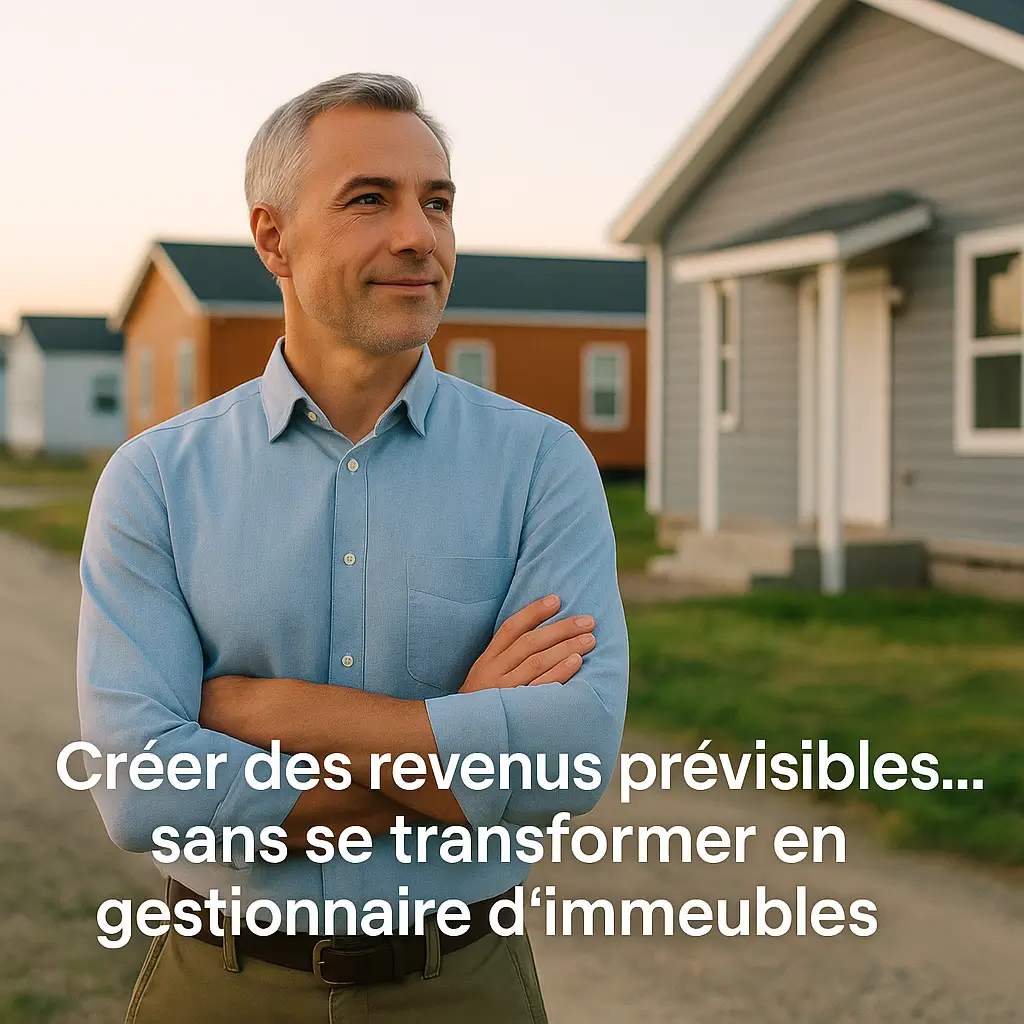
The Tenant Owned Home (TOH) represents a radically different alternative. In this model, residents purchase their own mobile home. They become the owners of their own home, with all the responsibilities that entails.
The investor retains sole ownership of the land, also known as the "pad". It is on this land base that all profitability rests.
Each owner family pays a monthly rent for occupying the land. Depending on location, this rent generally varies between $300 and $600 per month. In certain high-demand areas, it can even exceed this threshold, reinforcing income stability.
Discover our real estate opportunities in the USA → Contact LandQuire
This configuration changes everything. The investor no longer has to manage the apartments, their upkeep or repairs. Each resident, now the owner of his or her own home, takes care of the property as if it were his or her own personal assets. Work, maintenance and renovations no longer concern the landlord.
What's more, the stability of tenants is significantly higher. Owners stay in their mobile homes for an average of 12 to 15 years. Turnover is low, rents are regular, and vacancy rates are very low.
👉 TOH refocuses the investor's activity on the essentials: pure property rental, without the burden of traditional property management.
Advantages for the investor
- Lower costs: no maintenance on the homes.
- Income stability: on average, owner-occupiers stay in their homes for 14 years.
- Alignment of interests: occupants maintain their property themselves.
- Reduced risk: no complex rental management.
- Predictability: regular ground rents with no nasty surprises.
A concrete example
Let's imagine a fleet of 100 mobile homes. This simple scenario highlights the difference between POH and TOH.
👉 In the POH model, you need to manage two elements for each unit:
- a tenant with his contract, follow-up and any reminders,
- a home with its maintenance, repair and compliance needs.
That's 100 tenants to manage and 100 properties to maintain. In all, 200 potential sources of problems. The larger the portfolio, the greater the complexity. Every month, you're juggling late payments, minor repairs, vacancies and administrative obligations.
👉 In the TOH model, the logic changes completely. All 100 residents own their mobile home. So all you have to manage is the rental of 100 lots. No repairs or renovations to plan. And no unexpected housing costs.
The difference is colossal. With POH, the investor becomes a property manager. With TOH, they remain focused on real estate, with more stable, more predictable and, above all, more scalable income.
This discrepancy is not limited to the workload. It has a direct impact on net profitability. Fewer unforeseen expenses, less time spent on management, greater peace of mind for the investor.
👉 This simple case illustrates why TOH is now attracting investors looking for passive, sustainable property income in the US.
🎯 To remember: TOH brings you back to basics: land.
Why this model is attracting more and more investors
U.S. trends
In the United States, demand for affordable housing continues to grow. Rising property prices and inflation are weighing heavily on households. In this context, mobile homes represent a pragmatic and sustainable response. They offer affordable housing, while enabling families to maintain financial stability.
There are many beneficiaries:
- the middle classes, who are often excluded from the conventional housing market,
- retirees, looking for simple, economical accommodation,
- young families looking for a fast-track to home ownership.
According to the Manufactured Housing Institute (MHI), the figures speak for themselves: Manufactured Housing Institute - Research & Data (key figures, 22M+ residents). MHI
- More than 22 million Americans now live in mobile homes,
- annual growth exceeds 3%, proof of rising demand,
- the rate of home ownership remains high, as households want to own their own home.
This dynamic reflects a strong societal trend: home ownership remains a cultural priority in the United States. And in a tight economic climate, the mobile home is often the only realistic option.
This is where the Tenant Owned Home (TOH) model comes into its own. It combines families' desire to become homeowners with investors' quest for stable property income. This model aligns the interests of both parties: the resident protects his home, and the investor secures his land.
👉 In this win-win logic, TOH becomes a solution perfectly adapted to the current realities of the American market.
Land, a safe haven
Unlike built assets, land does not depreciate over time. A house ages, requires renovation and eventually loses its value if not maintained. Land, on the other hand, is a rare and durable asset. Its availability is limited, while demand is constantly increasing.
Land remains a rare, transferable and sustainable asset. To find out more about how to turn land into a profitable project, read our guide to real estate development in the United States.
Historically, land has always served as a safe haven. In times of inflation, it protects against currency erosion. In times of economic crisis, it remains attractive because it meets a fundamental need: housing. In the United States, where demographics remain dynamic, pressure on buildable land continues to grow. Urban Institute - Role of Manufactured Housing. urban.org
By focusing on land rental, investors benefit from three major advantages:
- Long-term appreciation. Land prices naturally appreciate over time, especially in areas with strong demographic growth.
- Simple management. No major renovation or ongoing maintenance. The investor receives regular rental income without having to bear the burden of a property portfolio.
- Asset security. Land remains a tangible, transferable asset. It offers a stability that few financial investments can guarantee.
👉 It's precisely this logic that makes Tenant Owned Home (TOH) a winning strategy. The investor remains focused on the land, while naturally delegating the maintenance of the homes to the owner-occupiers.
Local example: Abilene, Texas
Abilene, Texas, is a perfect example of the dynamic mobile home market. Located in an area of rapid population growth, it combines accessibility with a strong demand for affordable housing. This type of secondary market, less saturated than metropolises like Dallas or Austin, offers attractive and sustainable potential for the Tenant Owned Home model.
Park Owned Home vs Tenant Owned Home: comparison chart
| Criteria | Park Owned Home (POH) | Tenant Owned Home (TOH) |
|---|---|---|
| Revenue | Doubles (land + housing) | Stable ground rents |
| Maintenance | Strong, costly | None on houses |
| Management | Complex (tenants, reminders, vacancy) | Light and predictable |
| Risks | High (legal, overdue, maintenance) | Reduced |
| Interest alignment | Low | Strong (owner-occupier) |
| Long-term vision | Unsustainable | Durable and scalable |
The LandQuire approach: investing in predictability
At LandQuire, our mission is clear: to focus on land. We are convinced that lasting value lies not in walls to be maintained, but in the land itself. Land doesn't wear out, doesn't depreciate, and remains the foundation of any solid estate.
We firmly believe that investors should seek simplicity and predictability. Cumbersome property management, unforeseen repairs or rental disputes only weigh down a strategy that's supposed to be passive. That's why we put Tenant Owned Home (TOH) at the heart of our approach.
Our international team brings together complementary profiles in real estate, finance and data. This diversity enables us to analyze US markets in depth and identify the best real estate opportunities. We combine the rigor of numbers with local knowledge to offer each investor a reliable strategy.
In just a few years, LandQuire has convinced over 600 French-speaking investors and raised over $40 million. These results testify to a lasting trust and a shared vision: to create a stable real estate portfolio, far removed from the hazards of traditional property management.
👉 Whether you're a beginner or an experienced investor, we'll guide you step by step towards a 100% passive land model in the United States.
👉 S ee our news and projects on LinkedIn
❓ Mini FAQ - Tenant Owned Home and property investment USA
1. What is a Tenant Owned Home (TOH)?
A Tenant Owned Home (TOH) is an investment model in which residents purchase their own mobile home. The investor retains sole ownership of the land, called the "pad". Each occupant pays a monthly rent for the use of the land, generally between $300 and $600 depending on location.
2. Why is Park Owned Home (POH) risky?
Park Owned Home (POH ) requires the investor to own both the land and the homes. He must then manage tenants, maintenance, repairs and disputes. This model combines the difficulties of traditional rental management with those of owning an entire property portfolio. The result: higher costs, greater risks and less peace of mind in the long term. HUD - Manufactured Housing Programs (federal framework, standards & installation). hud.gov
3. Is TOH more profitable?
Over the long term, TOH offers higher net profitability. Why is this? Because it greatly reduces unforeseen expenses, eliminates property maintenance costs and limits turnover. As a result, property income is stable, regular and secure. What's more, land tends to appreciate in value over time.
4. How long does a resident stay in a TOH on average?
Statistics show that a mobile home owner stays in his or her accommodation for an average of 12 to 15 years. This figure is much higher than that of a conventional tenant, who generally moves every 3 to 4 years. This factor reinforces the stability and predictability of income for the investor.
5. Is TOH accessible to French-speaking investors?
Thanks to partners like LandQuire, French-speaking investors can access land opportunities in the United States. Our support covers park selection, market analysis, legal structuring and operational follow-up. The aim is to make land investment 100% passive, simple and secure.
Conclusion: TOH, the path to land freedom
Differentiation means rejecting outmoded models. For a long time, Park Owned Home seduced investors with its promise of profitability, but it locked them into a cumbersome and time-consuming rental management logic. Tenant Owned Home (TOH), on the other hand, opens up a new perspective. It's not just a different real estate strategy: it's a genuine paradigm shift.
With TOH, you no longer become a landlord overwhelmed by repairs and reminders. You're back to being what you should be: an investor in land, investing in a rare, tangible and lasting asset. You secure your income while benefiting from the exceptional stability of resident-owners.
At LandQuire, we're already supporting hundreds of French-speaking investors in this unique model. Our role is simple: to make property investment in the United States 100% passive and secure. We put at your service an international team, specialized in real estate, finance and data, to guide you step by step.
Before investing, it's essential to know how to properly analyze a plot of land. Discover the criteria detailed in our article: Evaluating land in Texas for a successful investment.
More than $40 million raised and over 600 investors won over are testimony to the soundness of our vision. We believe that the future of real estate investment lies in land, not building management.
👉 Want to see first-hand how a Tenant Owned Home works and why it's attracting more and more investors?
Contact us today to discover our opportunities and secure your first steps in land investment in the United States : Contact LandQuire
This system eliminates the need for cumbersome rental management. For those wishing to delve deeper into the subject, several authoritative resources confirm the solidity of the Tenant Owned Home model and the growing importance of land in the United States:
🌍 Further information
- U.S. Census - Manufactured Housing Survey (MHS) (price, floor space, annual series). Anchor: MHS data (U.S. Census). Census.gov
- FHFA - Duty to Serve (Manufactured Housing) (GSE support, plans 2025-2027). Anchor: FHFA Duty to Serve. FHFA.gov
- Harvard JCHS - Barriers to Manufactured Housing (2024) (brakes, costs, zoning). Anchor: Harvard JCHS 2024 - Barriers. jchs.harvard.edu
- Freddie Mac - Manufactured Housing (financing & home ownership). Anchor: Freddie Mac - Manufactured Housing. sf.freddiemac.com
- Lincoln Institute of Land Policy - Manufactured Housing & housing crisis. Anchor: Lincoln Institute - Manufactured Housing. Lincoln Institute of Land Policy
👉 Also read LandQuire articles:
- Real estate development in the United States: From bare land to profitable project
- Evaluating Texas investment land: essential criteria to avoid making a mistake
Customer testimonials
LandQuire investor testimonials
- Franz: "With LandQuire, I don't have to deal with things directly, and the benefits are better than in France or the West Indies."
- Simon: "The cooperation has been wonderful. The return on investment was estimated at around 20% and it was achieved."
- Sébastien: "Working with experienced people. So far, they have delivered everything on time. I'm looking forward to refinancing my investment."
Discover our real estate opportunities in the USA → Contact LandQuire