Wildlife Management Plan - Fiscal Alternative for Your Acres
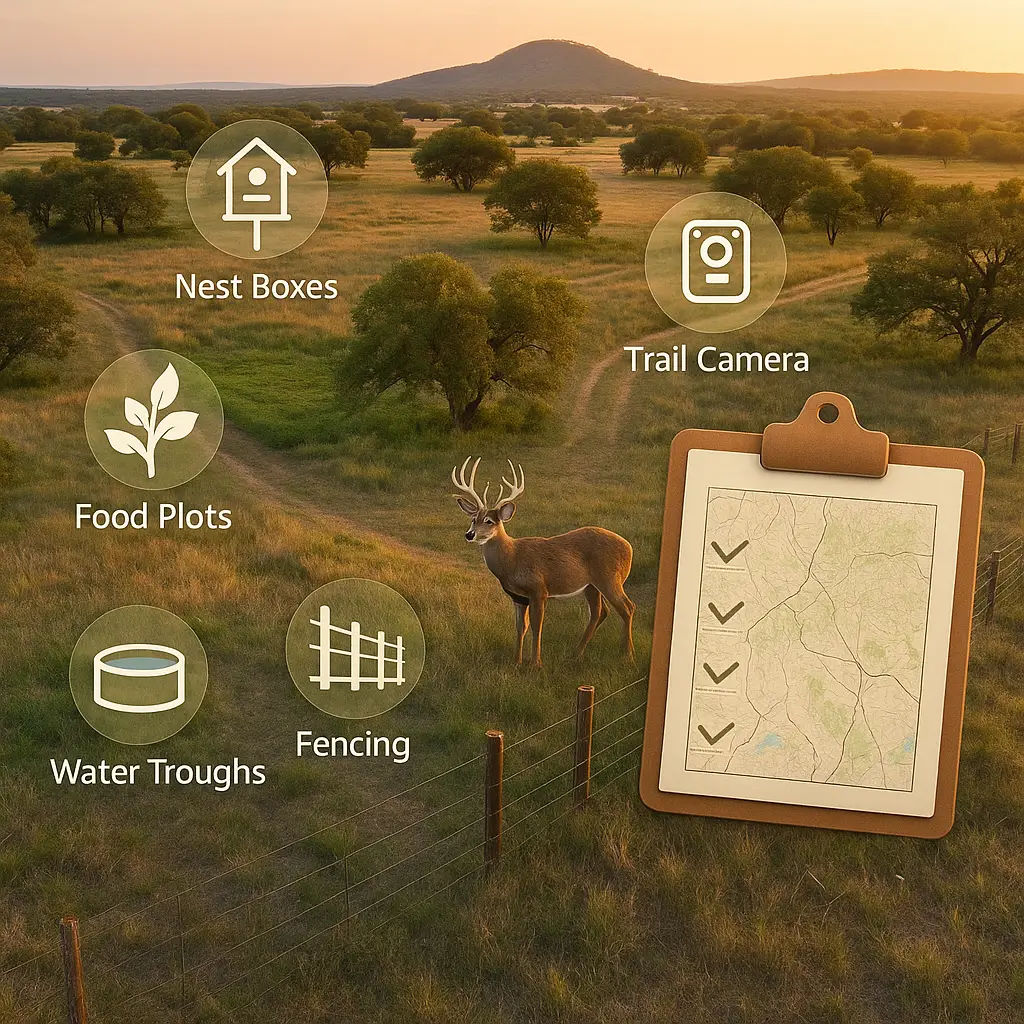
The wildlife management plan - a tax alternative for your acres - significantly reduces property taxes in the United States, especially in Texas.
This approach transforms your land into a biodiversity sanctuary.
It offers tax benefits similar to farming.
Property taxes are increasing in many counties.
This alternative becomes attractive, even essential.
It helps maintain the profitability of major land investments.
🔹 Welcome to LandQuire
At LandQuire, property investment is not just for the elite.
Our highly qualified team is with you every step of the way.
We bring together real estate, technology and data analysis to secure your project.
👉 Read our latest news on LinkedIn
Understanding the Wildlife Management Plan as a Tax Alternative
Key points to remember
- 📌 S ubstantial tax savings: 70% to 90% reduction in property assessment.
- 📌 A minimum of three of the seven categories recognized by the Texas Parks and Wildlife Department.
- 📌 C ritical deadline: initial application often before April 30. Counties may vary.
- 📌 Moderate initial investment: $5,000 to $15,000 for 50 acres, on average.
- 📌 Transferable: the new buyer can retain the qualification on resale.
What exactly is a Wildlife Management Plan?
A wildlife management plan is a strategic document.
It describes practices for conserving and enhancing wildlife habitat.
It applies to private property.
In Texas, and other states, it allows for special agricultural assessment.
This assessment greatly reduces annual property taxes.
Unlike livestock or crops, it requires little infrastructure.
No intensive day-to-day operations are required.
The plan is based on targeted management practices.
These actions sustainably support native wildlife populations.
Concrete tax advantages
Tax reductions achieved through this strategy can reach 70-90% of a property's standard appraised value. For example, a 50-acre parcel valued at $10,000 per acre (or $500,000 in total) could see its annual taxes drop from $12,000 to around $1,500, generating annual savings of $10,500.
These savings accumulate year after year, significantly transforming the overall profitability of a land investment. Over a ten-year holding period, this benefit would represent more than $100,000 in direct savings, not counting the natural appreciation of the land.
Eligibility Criteria for Your Land
Minimum area required
There is no uniform acreage threshold in Texas: the minimum and intensity of practices are defined by each fertilizer district. Depending on your county, the minimum acreage and "degree of intensity" differ considerably. Some districts may recommend 50 acres, while others accept much smaller areas. It's imperative to check the guidelines of your local appraisal district before filing your plan.
This variability reflects the ecological and geographical differences between the regions of Texas. Owners of larger parcels generally have more flexibility in designing and implementing their management strategies, but even small properties can qualify if they meet specific local criteria.
Compatible Land Types
Virtually any type of land can be suitable for a wildlife management plan, including grasslands, woodlands, mixed land and even some semi-arid areas. The key lies in the ability to demonstrate that the land supports or can support populations of targeted native wildlife species.
Land that already boasts favorable natural features - the presence of watering holes, plant diversity, travel corridors for wildlife - is a particularly suitable candidate. Before buying land, it's crucial to check certain legal aspects, such as easements in Texas, which could affect your ability to implement certain management practices.
The Seven Recognized Management Practices
Predator Control and Protection
This practice involves the reasoned management of predator populations to protect targeted wildlife species. It can include selective trapping, the use of protective fencing around nesting areas, or the creation of specific refuges for certain vulnerable species.
The aim is not to eradicate predators, but to maintain an ecological balance that allows the targeted species to thrive. This approach must be rigorously documented to satisfy tax audit requirements.
Supplementary Food Supply
This practice includes planting specific food crops for wildlife (food plots), installing regulated feeders, and managing natural vegetation to maximize available food production. Food plots can include native grasses, legumes, sunflowers, or other plants favored by local wildlife.
Diversifying food sources throughout the year is a key element of this strategy. Owners must document the types of plants grown, the planting periods, and the regular maintenance carried out.
Water supply
The installation and maintenance of watering points is often the practice most valued by tax authorities. This can include artificial troughs, ponds, retention basins, or the improvement of existing natural springs.
In Texas, where water is a precious resource, this practice has an immediate and measurable impact on wildlife populations. Watering systems must be regularly maintained and their operation documented photographically.
Shelter supply
This practice encompasses the creation and maintenance of natural or artificial structures offering shelter and protection to wildlife. It can include the conservation of dense undergrowth, the installation of bird nesting boxes, the creation of artificial burrows for certain mammals, or the preservation of dead trees offering natural cavities.
The diversity of habitats on a property directly increases the biodiversity supported, reinforcing the legitimacy of the management plan with the tax authorities.
Pest Vegetation Control
Active management of invasive or unwanted plant species improves habitat quality for native wildlife. This can include selective clearing, controlling invasive species such as mesquite or prickly pear cactus, and promoting the regeneration of beneficial native plants.
This activity must be carried out strategically and documented, demonstrating how it specifically benefits the wildlife species targeted in your plan.
Wildlife census
Regular monitoring and documentation of wildlife populations on your property is an essential obligation. This involves periodic counts, the use of trail cameras, documentation of direct observations, and sometimes participation in regional research studies.
This data provides concrete proof that your management practices are producing measurable results, a critical element during tax inspections.
Interferer management
This practice involves regulating herbivore populations (deer, wild boar, etc.) to maintain a balance with the carrying capacity of your land. It can include regulated hunting programs, the installation of management fences, or partnerships with local biologists to determine appropriate quotas.
Effective grazer management prevents overuse of vegetation and maintains the overall health of the ecosystem.
Strategic implementation of your plan
Drawing up the Initial Plan
Creating an effective wildlife management plan begins with a thorough assessment of your property. This assessment identifies existing resources, habitats present, wildlife species currently supported, and opportunities for improvement.
Many homeowners choose to work with certified biologists or specialized consultants to develop their initial plan. These professionals understand the specific requirements of each county and can optimize your strategy to maximize both ecological and tax benefits.
Documentation and Record Keeping
Documentary rigor is the most crucial element in maintaining your tax qualification. You must keep detailed records of all management activities, including dates, hours spent, methods used, materials employed, and results observed.
Essential documentary evidence checklist
To ensure compliance and facilitate tax inspections, your file must contain :
- Detailed activity log: precise dates, hours invested, tasks completed, weather conditions
- Regular dated photos: installations (watering points, feeders), wildlife observations, food plots, before/after work
- Invoices and receipts: seeds, building materials, surveillance cameras, equipment
- Annotated map of the property: identified intervention zones, GPS coordinates if possible, habitat markings
- Compliant annual report: format and content in line with the specific requirements of your appraisal district
These records must be kept for at least five years and be available for inspection by the tax authorities at any time.
🔹 Contact us
Do you have questions about tax optimization for your property investment? Contact a member of our team: https://landquire.com/contact-investissement-foncier-etats-unis/
Hours of Work and Documentation Required
Maintaining status is based on documented completion of at least three of the seven wildlife management categories, with supporting records and photos, and meeting deadlines set by your county. The initial application is generally due by April 30, while annual reports follow variable windows depending on the appraisal districts (frequently between January 1 and April 30).
This requirement of a minimum of three categories offers appreciable flexibility: you can choose the practices best suited to your terrain, your budget, and your ecological objectives. Each activity must be meticulously documented with dates, detailed descriptions, photographs and physical evidence (invoices, maps, observations).
Legal and Regulatory Considerations
Application and Approval Process
The application for a special farm assessment based on wildlife management must be submitted to your county assessment office by April 30 of the year in which you wish to obtain the tax benefit. The process involves submitting specific forms, your detailed management plan, and sometimes an on-site inspection.
Some counties require that your plan be reviewed by a licensed biologist or Texas Parks and Wildlife Department agent. This professional approval considerably strengthens your case and facilitates acceptance by the tax authorities.
Maintaining qualifications
Once approved, your special tax status must be renewed annually. You must submit activity reports demonstrating the ongoing implementation of your plan. Any substantial interruption in your management practices could result in the loss of your qualification and potentially retroactive penalties.
Consistency and continuity are therefore essential. Even if you sell your property, the new owner can usually continue under the same plan, which can increase the attractiveness of your land in a future resale.
Change-of-use implications
If you decide to convert your land to another use (residential or commercial development, etc.), you'll have to pay rollback taxes, generally covering the last three to five years, depending on your jurisdiction. These taxes represent the difference between what you actually paid and what you should have paid without the special assessment, plus interest.
This consideration is particularly important when evaluating land conversion strategies. Careful planning can optimize the timing of any transition of use.
Comparison with other tax strategies
Traditional agriculture vs. wildlife management
Traditional farming (livestock, crops) also offers similar tax advantages, but requires much greater initial investment. The purchase of livestock, farm equipment, specialized fencing and regular maintenance represent substantial costs.
Wildlife management, on the other hand, can be implemented with a relatively modest initial budget - often between $5,000 and $15,000 for a 50-acre property - and annual maintenance costs generally under $3,000. This cost-effectiveness makes this strategy particularly attractive to investors looking to optimize their net return.
Homestead Exemption and Other Exemptions
Homestead exemption offers tax reductions for principal residences, but these benefits are limited and generally only apply to a small portion of the property's value. For larger parcels, agricultural exemption via wildlife management generates far greater savings.
These strategies can sometimes be combined: part of your property could benefit from homestead exemption while the rest is under wildlife management, maximizing your overall tax benefits.
Integration into a Global Investment Strategy
Long-term value enhancement
Beyond the immediate tax savings, well-maintained land under wildlife management tends to appreciate in value more than a comparable property without a management plan. Potential buyers recognize the value of the management infrastructure in place, the established biodiversity, and the transferable tax status.
This additional appreciation, combined with annual tax savings, can increase the total return on your investment by several percentage points annually.
Complementarity with Other Income
Wildlife management does not necessarily exclude other sources of income. Many landowners combine their plans with fee-based recreational hunting, ecotourism, or even renewable energy projects on certain portions of their land.
This diversification of income, while maintaining core tax benefits, represents a sophisticated wealth optimization strategy. The Tenant Owned Home strategy illustrates how to diversify approaches to property investment, although it is crucial to check that any complementary activities remain compatible with your management plan and do not compromise your tax status.
Considerations for Mining Rights
When acquiring land in Texas, it is essential to verify the status of mineral rights in Texas, as these rights can significantly affect your ability to implement certain wildlife management practices. If extraction operations are contemplated by mineral rights holders, this could disrupt your wildlife habitats and compromise your tax qualification.
Thorough pre-purchase due diligence helps avoid future conflicts between your conservation objectives and the rights of third parties to your property.
Common mistakes to avoid
Insufficient documentation
The most common mistake is inadequate record keeping. Even with an excellent management plan effectively implemented, lack of proper documentation can result in rejection of your application or loss of qualification during an audit.
Investing in a robust documentation system from the outset - mobile app, detailed paper journal, or specialized software - is essential insurance to protect your tax benefits.
Selection of unsuitable species
Some owners make the mistake of targeting wildlife species that are non-native or unsuited to their local ecosystem. Tax authorities favor plans that focus on native wildlife, and efforts devoted to inappropriate species can be disqualified.
An initial consultation with a local biologist or Texas Parks and Wildlife Department agent can prevent this costly mistake.
Underestimation of Required Commitment
Although less demanding than traditional farming, wildlife management nevertheless requires a substantial ongoing commitment. Owners who neglect their management practices after the first year risk not only losing their tax qualification, but also facing retroactive penalties.
Honestly assessing your ability and willingness to maintain the required commitment is an essential step before committing to this strategy.
LandQuire projects and current opportunities
LandQuire actively develops land investment projects incorporating advanced tax optimization strategies, including wildlife management plans. These structured opportunities enable investors to benefit from professional expertise while capturing maximum tax benefits.
RiseQuire 1: Integrated Wildlife Management Project
Our flagship project RiseQuire 1 is a perfect example of how to integrate a wildlife management plan into a structured land investment strategy. This large-scale development combines tax optimization, ecological enhancement and substantial value-added potential.
Investors in this project automatically benefit from our team's expertise in implementing and maintaining wildlife management practices, eliminating operational complexities while fully capturing tax benefits.
LQPF17: Optimized yield by tax strategy
The LQPF17 project , with an estimated ROI of 57%, demonstrates how tax optimization through wildlife management contributes directly to exceptional returns. A significant part of this return comes from the tax savings generated by a meticulously designed and rigorously executed wildlife management plan.
This performance illustrates the transformational impact that a well-planned tax strategy can have on the overall profitability of a property investment. Investors benefit from turnkey management while retaining full tax advantages.
Future prospects and trends
Regulatory developments
State legislatures continue to refine regulations concerning special agricultural assessments. In Texas, there is a trend towards stricter documentation requirements, but also growing recognition of the ecological value of private wildlife management.
Wise investors should keep abreast of regulatory developments in their investment jurisdictions to maintain compliance and anticipate potential changes.
Growing Carbon Credit Market
A particularly interesting emerging trend concerns the intersection between wildlife management and carbon credit markets. Properties under active ecological management can potentially generate additional income through the sale of carbon credits, adding an additional lucrative dimension to this strategy.
Although this market is still developing, visionary owners are already positioning their land to capture these future opportunities.
Growing demand for ecologically managed land
Growing environmental awareness is influencing purchasing preferences. Properties demonstrating responsible ecological management often command a 10-20% premium over comparable land with no conservation history.
This trend transforms wildlife management from a simple tax optimization tool into a genuine long-term value creation strategy.
Conclusion
The wildlife management plan is a powerful and accessible tax alternative for acreage owners in the United States.
It combines tangible economic gains, a positive environmental impact and increased asset value.
All within a clear and proven legal framework.
For the savvy investor, this plan is no longer optional.
It becomes a pillar of an optimized property strategy.
Tax savings directly improve net yield.
They also create a more desirable and better-valued asset.
Success requires a rigorous method.
Plan ahead with precision.
Implement every action without delay.
Document everything carefully.
Stay committed over the long term.
With these elements, your investment prospers financially.
It also contributes to regional biodiversity.
Official sources and resources
To guarantee the conformity and accuracy of the information, please contact us directly:
- Texas Parks and Wildlife Department: Official publications including the 885-W7000 plan detailing the seven management categories
- Texas A&M AgriLife Extension: Wildlife management brochures and technical guides for agricultural valuation
- Your local Appraisal District: Specific requirements, deadlines, and forms applicable to your county
🔹 Contact us
Ready to optimize the taxation of your property investment with a wildlife management plan? Contact a member of our team
FAQ - Wildlife Management Plan
How many management practices do I really need to implement?
You must practice and document at least three of the seven categories.
These categories are recognized by the Texas Parks and Wildlife Department.
The choice depends on your terrain, your budget and your ecological objectives.
The seven possible categories
- Grazer management
- Predator control
- Supplementary food supply
- Water management
- Creating and maintaining shelters
- Controlling harmful vegetation
- Wildlife census
Grazer management
- Adjust grazing pressure according to site capacity.
- Use fences, turntables and regulated sampling.
- Note dates, zones, numbers and results observed.
Predator control
Purpose and principles
- Identify predatory species and assess the real impact.
- First, opt for non-lethal methods.
Possible actions
- Fencing, netting, protection of nests and sensitive areas.
- Selective trapping if necessary, with the support of a biologist.
Evidence to keep
- Dated log of interventions and locations.
- Before-and-after photos and field observations.
Supplementary food supply
Planning
- Diversify inputs according to season and target species.
- Select local plants that are useful to wildlife.
Implementation
- Install and maintain regulated feeders.
- Schedule seedlings and monitor volumes distributed.
Traceability
- Keep seeds, invoices and distribution schedules.
Water management
Creation and maintenance
- Create or improve permanent water points.
- Ensure controlled flow and regular cleaning.
Equipment
- Add drinking troughs adapted to the target species.
Receipts
- Store dated photos and maintenance records.
Creating and maintaining shelters
Natural and artificial habitat
- Preserve thickets, hedges and dead wood.
- Install nesting boxes, cottages or shelters where appropriate.
Mapping and monitoring
- Map coverage areas.
- Follow the occupation through the seasons.
Controlling harmful vegetation
Targeting and preparation
- First, identify invasive species and their range.
- Map the areas to be treated.
Interventions
- Mechanical or chemical methods adapted to the environment.
- Avoid non-selective products near water.
- Schedule outside nesting periods.
Proof and measurement
- Before/after photos, dates, surfaces, techniques.
- Check regrowth and adjust the plan.
Wildlife census
Field methods
- Deploy photo traps on marked transects.
- Carry out point counts (birds) and line transects (mammals/indices).
Collection and metadata
- Note sampling effort: times, distances, observers.
- Record weather, times, habitats and GPS coordinates.
Analysis and archiving
Name files by date, location, species; double save.
Avoid duplication by crossing locations and times.
Calculate densities, trends and youth/adult ratios.
Archive data and photos in a structured spreadsheet.
What is the minimum surface area required to qualify my lot?
There is no uniform acreage threshold in Texas. Each appraisal district sets its own criteria for minimum acreage and practice intensity. Some counties may require 50 acres or more, while others accept significantly smaller parcels. Contact your local appraisal district before preparing your plan for specific requirements applicable to your situation.
Can I combine wildlife management and livestock farming on my property?
Yes, many owners successfully combine these two approaches. You can maintain a small herd while implementing wildlife management practices on the rest of your land. However, this combination requires careful planning to ensure that livestock activities do not compromise your wildlife conservation objectives.
How much does the initial set-up of a wildlife management plan cost?
Initial costs vary considerably depending on the size and condition of your property, but generally range from $5,000 to $20,000 for a 50-100 acre plot. This budget includes consultation with a biologist, basic infrastructure (water points, food plots), and initial documentation. Annual recurring costs are generally less than $3,000.
What happens if I sell my property under wildlife management?
The new owner can generally continue with the same management plan.
He thus maintains the advantageous tax qualification.
This increases the attractiveness and resale value.
If he does not continue with the plan, or changes the use of the land, rollback taxes apply.
Do I have to live on my property to benefit from these tax advantages?
No, residency on the property is not required to qualify for an agricultural assessment based on wildlife management. You simply need to demonstrate that you are actively implementing your management plan and meeting the documentary requirements. Many non-resident investors are successfully benefiting from this strategy.
Which species should I target in my management plan?
Target species should be native to your area and adapted to your property's natural habitat. In Texas, commonly targeted species include white-tailed deer, wild turkey, quail, doves, and various non-game species such as songbirds and pollinators. A local biologist can help you identify the most appropriate species for your specific terrain.
Can I hunt on my property under wildlife management?
Yes, regulated hunting is often part of an effective wildlife management plan.
It helps regulate deer and wild boar populations.
Comply with all your state's hunting regulations.
Document every action in your "grazer management" practice.
Keep dated records and retain evidence.
Some landowners also monetize this activity.
They offer paid hunting days, under strict supervision.
How can I effectively document my management activities?
Keep a detailed log including dates, hours spent, specific activities performed, weather conditions, wildlife sightings, and materials used. Take regular, dated photographs of your facilities and activities. Keep all management-related purchase invoices. Many owners use specialized mobile apps or spreadsheets to facilitate this ongoing documentation.
⚠️ Warning
The information presented in this article on wildlife management plans in Texas is provided for general and educational purposes.
It does not constitute personalized legal, tax or financial advice.
Specific requirements (minimum acreage, practice intensity, filing deadlines, forms) may vary by county and tax year.
Before taking any action, consult your County Appraisal District, a Texas Parks and Wildlife Department certified biologist, or a specialized tax advisor to verify your project's compliance.