Access and Frontage – The Variable That Determines Price in Texas
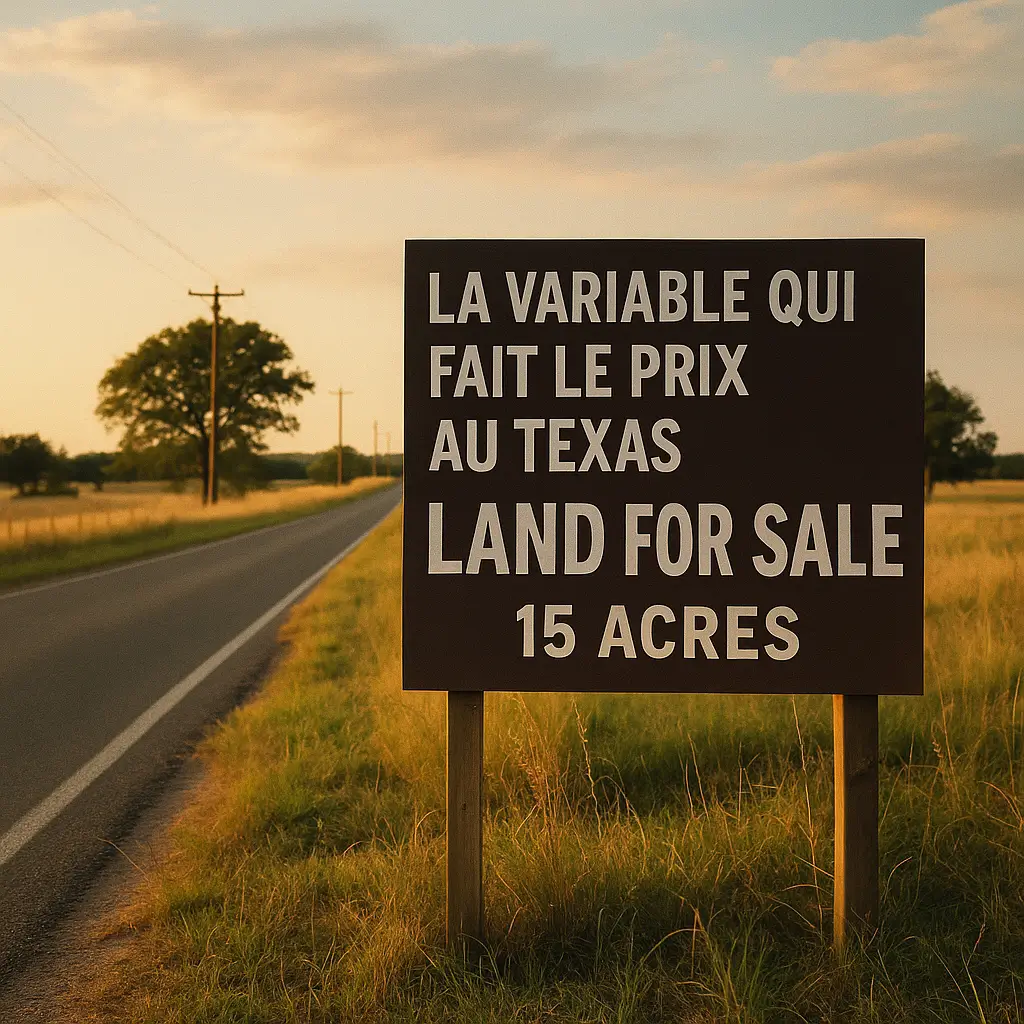
When investing in Texas real estate,access and frontage often determine 40 to 60% of the final price of a plot of land. However, many French-speaking investors underestimate this crucial variable. The result? Land purchased at too high a price or, worse still, impossible to develop. In this article, we take a detailed look at how access and frontage impact the value, permits, and profitability of your land acquisitions in Texas.
To remember
- Access and frontage determine up to 60% of the actual price of land in Texas.
- They also determine your chances of obtaining permits, bank financing, and a quick resale.
- Poor access = immediate discount + legal risks + significant future costs.
🔗 Follow LandQuire on LinkedIn
✉️ "Easements & buildability" audit — contact an expert
Why Access and Frontage Really Determine the Price
Simple definition for French-speaking investors
Access refers to your legal right to enter and exit a property via a driveway. Without guaranteed access, a plot of land loses up to 70% of its value. Frontage is the length of the facade bordering a road. The longer the facade on a strategic road, the more valuable the land is.
In practice, these two factors work together. For example, a 5-acre plot with 500 feet of frontage on a FM road will sell for 2 to 3 times more than an identical plot with only 100 feet of access via a private road. It's simple math.
What we see on the ground in Texas
At LandQuire, we systematically filter opportunities according to these criteria. In fact, we regularly turn down "cheap" land that has unresolved access issues. Why? Because our French-speaking clients deserve acquisitions without hidden legal pitfalls.
In addition, Texas has some unique characteristics. Distances are vast, rural counties apply different rules than urban areas, and Texas ETJs (effect on jurisdiction) and permits sometimes complicate the analysis. This is why local expertise remains essential.
The 3 Types of Access in Texas (and Their Impact on Price)
Type 1: Access via public road (best-case scenario)
A public road guarantees permanent access and is maintained by local authorities. In practical terms, this means zero maintenance costs for you, easy access to permits, and simplified bank financing. Banks love this type of access.
In Texas, public roads include highways, FM roads, and county roads. Each category offers different levels of traffic. Therefore, frontage on I-35 does not increase property value in the same way as access to a secondary ranch road. Nevertheless, both are preferable to private access.
Type 2: Private easement (pay attention to details)
Land that is only accessible by easement requires careful verification. Not all easements are equal. Some are perpetual and registered, while others are verbal and revocable at any time.
Before buying, always request a title report confirming the legal existence of the easement. Otherwise, you may discover after closing that your "right of way" exists only in the seller's mind. Typically, a poorly documented easement can cost $15,000 to $35,000 in legal fees to regularize.
See also: To understand how easements affect access, buildability, and land value in Texas, see Easements in Texas: Everything You Need to Know Before Buying Land .
Type 3: Landlocked terrain (enclosed = danger)
A landlocked plot has no direct access to a public road. It is completely surrounded by private property. Admittedly, these plots sell at bargain prices (sometimes 50% below market value). However, creating legal access often requires a long and costly legal battle.
In Texas, the right of access by necessity exists in theory. However, it must be proven before a judge, negotiated with neighbors, and sometimes substantial compensation must be paid. At LandQuire, we generally advise avoiding these situations unless you are prepared to invest time and money in a legal battle.
The actual costs of each configuration
To summarize simply:
- Public access: $0 additional fee, maximum value
- Private easement: 15-30% discount, shared maintenance costs ($1,000-$3,000/year)
- Landlocked: 50-70% discount, regularization costs $20,000-$50,000
How Frontage Multiplies the Value of Your Land
The dollar per linear foot rule
In Texas's high-growth corridors (Austin, Houston, Dallas-Fort Worth), storefront space is literally sold by the linear foot. In commercial areas, expect to pay between $500 and $3,000 per foot of storefront space, depending on the exact location and daily traffic volume.
For example, a plot with 300 feet of frontage on a busy thoroughfare automatically commands between $150,000 and $900,000 in value based solely on its facade. The rest of the land (depth, total area) is then added to this. This is a calculation we systematically perform during our land audits.
Corner lots: the premium configuration
Corner lots have double frontage on two different streets. This configuration generally commands a premium of 15 to 25% compared to a standard lot. Why? Because it offers double visibility, multiple entry possibilities, and maximum architectural flexibility.
In practice, a corner lot in an expanding suburban area often represents the best value for money for an investor looking to subdivide and resell by lot.
Frontage vs. depth: finding the right balance
The ideal ratio is generally around 1:4. In other words, 200 feet of frontage by 800 feet of depth provides a balanced configuration for most projects. Plots that are too narrow (ratio of 1:10 or more) drastically limit development options.
In addition, zoning regulations often impose minimum requirements. For example, a residential lot typically requires 50 to 100 feet of frontage, while a commercial project requires a minimum of 150 to 300 feet. These figures vary depending on the county and municipality.
Direct Impact on Licenses and Financing
What banks really look at
American financial institutions consider access as a major eligibility criterion. Land with direct public access obtains favorable terms: down payments of 20-30%, competitive rates, and terms of up to 20 years. Conversely, properties with private easements face stricter requirements: down payments of 35-50% and rates increased by 1-2 points.
In fact, some properties without guaranteed access are simply excluded from traditional bank financing. You will therefore have to pay cash or seek private financing at often prohibitive rates.
The requirements of Texas counties
Each county applies its own minimum standards before granting permits. However, certain rules remain universal: minimum width of 12-20 feet, ability to support emergency vehicles (30 tons), maximum slopes of 10-15%.
In addition, areas subject to MUDs and PUDs—Understanding Taxes and Services Before You Buy —sometimes impose additional standards. These special districts may require paving, street lighting, or sidewalks, significantly increasing development costs.
Emergency vehicles: a non-negotiable criterion
Fire and emergency medical services impose strict standards that directly impact your home insurance. Inadequate access can place your property in a poor classification, increasing premiums by 200 to 400%. According to the Texas Department of Insurance, this surcharge applies for the entire duration of ownership.
That is why we systematically check these aspects during our buildability audits. A "cheap" plot of land can quickly become expensive if the annual insurance premium skyrockets due to poor access.
Purchasing Strategies for Savvy Investors
Identify undervalued opportunities
Some properties with imperfect but improvable access represent exceptional opportunities. For example, a landlocked plot can be purchased at 40% of its potential value. Then, negotiate a formal easement with the neighbors for $10,000–20,000. Finally, resell at 80–90% of the normal market value.
However, this strategy requires solid legal expertise. At LandQuire, we regularly assist clients with this type of case, coordinating with real estate lawyers, surveyors, and negotiations with adjacent property owners.
Anticipating public road expansions
Long-term urban planning often reveals future infrastructure projects. Land that is currently accessible by private road may find itself adjacent to a new public road in 3-7 years. The result? A 100-300% increase in value without any investment on your part.
Texas Metropolitan Planning Organizations (MPOs) and Councils of Government (COGs) regularly publish this information. It is in the public domain, but few investors take the time to consult it. Yet this is where the real opportunities lie.
Grouped development with shared frontage
Several investors can join forces to acquire a large plot of land with substantial frontage. Then subdivide it while maintaining shared access via a collective easement. This approach pools the costs of improving the main road while creating several individually marketable lots.
Naturally, this strategy requires solid legal agreements (HOA or Property Owners Association). These documents must be drafted by a lawyer specializing in Texas real estate law to avoid future conflicts. We always recommend this precaution to our clients.
Due Diligence: Essential Checks
The winning trio: Title, Survey, Inspection
Before any purchase, three documents are absolutely essential. First, the title commitment reveals all registered easements and access restrictions. Second, the survey confirms the exact boundaries and physical location of access points. Third, a site inspection detects problems that are not visible in the documents.
Together, these three checks cost between $2,500 and $7,000, depending on complexity. This is an investment that we consider non-negotiable at LandQuire. Indeed, it regularly avoids surprises costing $50,000 or $100,000 after closing.
Check the actual accessibility of the access
Access may exist "on paper" but be impractical in reality. For example, a path crossing a creek without a bridge becomes inaccessible during Texas' torrential rains. Or, a road that is too narrow may physically block the passage of construction vehicles.
That's why we always insist on a site visit, ideally after heavy rain. This simple precaution immediately reveals drainage, erosion, or flooding issues that are not visible on Google Maps.
Consult local authorities directly
Contact the county engineer’s office and the planning department to clarify future requirements. These offices can confirm whether an existing road is public or private, what improvements will be required for permits, and whether any road projects are planned nearby.
Most of this information is free and available with just a few phone calls. However, many investors skip this step out of laziness or ignorance. Then they discover too late that they have to pave 1,000 feet of road at $50,000 to obtain their certificate of occupancy.
Specific Examples of Investments in Texas
Success: Corner lot in Pflugerville (Austin metro)
One of our clients acquires 3 acres with 400 feet of frontage on two roads. Purchase price: $450,000. After subdividing into four lots and installing infrastructure for $120,000, the lots sell individually for between $180,000 and $220,000. Net profit: $350,000 in 18 months.
This success is entirely due to the double frontage. Without this configuration, the same plot would have been worth 30 to 40% less and offered limited subdivision possibilities.
Error: Landlocked terrain in Hill County
An investor buys 10 acres for $40,000, attracted by the low price. Unfortunately, after closing, he discovers that there is no legal access to the property. Negotiations with neighbors fail. Legal proceedings cost $35,000 and take 14 months. Final actual cost: $75,000 for land worth $90,000 with access.
The moral of the story? A low price often hides a major problem. At LandQuire, we would have detected this defect immediately during the preliminary title report and rejected the opportunity.
Strategic improvement in rural areas
We identify 50 acres accessible only via an unpaved ranch road. Negotiation of an easement to a paved FM road for $15,000. Installation of a cattle guard and gate for $8,000. The land, purchased for $4,000/acre, increases in value to $7,500/acre. Capital gain: $175,000.
This strategy works particularly well in rural Texas counties where ranch owners are often open to negotiating easements in exchange for reasonable compensation.
FAQ – Key Questions About Access and Frontage
Can a plot of land without direct frontage be built on?
Yes, provided that you have a legally established and registered right of way. This right of way must be wide enough (minimum 20 feet) to allow access for emergency vehicles. Local authorities will verify its existence and validity before granting permits.
What is the difference between servitude and a verbal agreement?
An easement is a legal right formally registered with the county. It is automatically transferred to successive owners. A verbal agreement offers no legal protection and can be revoked at any time. Only a written and registered easement guarantees permanent access.
How to calculate the value of a good street frontage?
In commercial areas, frontage accounts for 30 to 50% of the total value. Compare similar properties by measuring the price per linear foot. For example, if land sells for $1,000 per foot of frontage, a plot with 300 feet is worth $300,000 based solely on its frontage.
Can I create my own access through a neighboring property?
Absolutely not without formal written permission. Creating unauthorized access constitutes a violation of property rights that is punishable under civil and sometimes criminal law. You must negotiate an easement or establish a right of access by necessity through legal proceedings.
How much does it cost to improve an unpaved access road?
For a gravel driveway with basic drainage, expect to pay $15,000 to $35,000 for 1,000 feet. An asphalt driveway costs $50,000 to $120,000 for the same distance. These figures include clearing, grading, drainage, and the final surface. Always get three local quotes before budgeting.
Conclusion: Investing Wisely in Texas Real Estate
Access and frontage are not mere technical details. They are the foundations of any successful real estate investment strategy in Texas. Land without guaranteed legal access remains problematic, regardless of its location. Conversely, generous frontage on a strategic road transforms ordinary land into a premium opportunity.
At LandQuire, we systematically integrate these variables from the preliminary analysis stage. Checking public access, measuring available frontage, assessing road quality, and understanding regulatory implications helps avoid costly mistakes. This is exactly the type of screening we apply for our French-speaking clients.
The Texas real estate market offers exceptional opportunities for investors who understand these concepts. Development corridors along major thoroughfares, ETJ areas in the process of incorporation, and areas benefiting from public infrastructure improvements are prime targets. However, these opportunities require solid local expertise.
Thorough due diligence remains essential. Hiring a specialized attorney, obtaining a professional survey, and ordering a title commitment are the three pillars of a secure acquisition. The initial investment of $3,000 to $8,000 for these services avoids complications that could cost tens of thousands later on.
Finally, think long term. Public infrastructure decisions gradually transform access dynamics. Land that is currently served by a secondary road may find itself adjacent to a new major corridor in 5-10 years, multiplying its value. Anticipating these changes by consulting regional urban plans is a major competitive advantage.
Our team assists French-speaking investors in navigating the complexities of the US real estate market. From identifying opportunities to securing closings, we build effective bridges between markets. Investing in Texas real estate requires rigor, patience, and local expertise. With the right partners, the opportunities for value creation remain exceptional.