Access and Frontage: The Factor That Determines Price in Texas
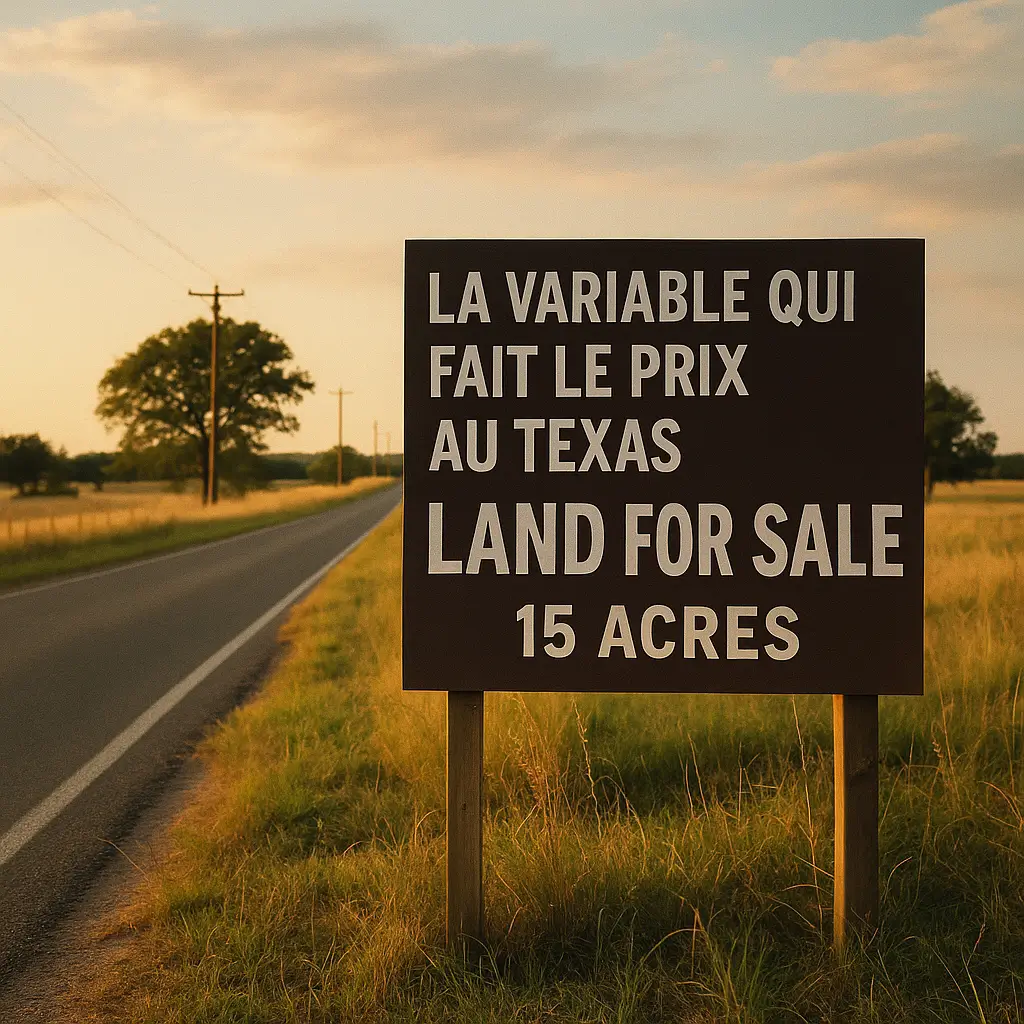
In the Texas real estate market, a parcel’s access and frontage account for 40 to 60 percent of the final price. It is one of the few factors that determines buildability, bank financing, and resale liquidity. Most French-speaking investors consider it secondarily, after area and price per square meter. You should do the opposite.
To remember
- Landlocked property can be purchased for up to 50% below market value, but it costs $20,000 to $50,000 to establish legal access.
- Retail frontage sells for $500 to $3,000 per linear foot along the Austin, Houston, and Dallas-Fort Worth corridors.
- Without direct public access, the bank’s down payment requirement rises to 35–50%, and the home insurance premium can increase by a factor of 2 to 4.
Author: Thibaut Guéant, Co-founder of LandQuire.
"Investing in land in the United States means offering yourself a 100% passive model, aligned with the safe-haven value of land. Over $40 million raised and 600+ investors already trust us to secure their assets."
Follow Thibaut Guéant on LinkedIn Follow LandQuire on LinkedIn “Easements & Buildability” Audit: Contact an Expert
Why Access and Street Frontage Really Determine the Price
Access refers to the legal right to enter and exit a property via a road suitable for vehicle traffic. Without guaranteed access, a plot of land loses up to 70% of its value, because no bank will finance it and no serious buyer will consider it. Frontage refers to the length of the property’s boundary that borders a road open to the public. The more this frontage faces a busy road, the higher the selling price.
The two factors reinforce each other. A 5-acre lot with 500 feet of frontage on an FM road sells for two to three times the price of an identical lot accessed via a 100-foot private road. Better soil or a nicer view cannot make up for this difference.
At LandQuire, this screening is the first step. We regularly rule out properties listed at attractive prices when access to them isn’t legally guaranteed. Texas is a state of vast distances: rural counties don’t follow the same rules as urban areas, and the mechanics of Texas’s extraterritorial jurisdictions (ETJs) can sometimes cloud the analysis for those without a trained eye.
The Three Major Access Cases in Texas and Their Impact on Prices
Access via public roads
This is the ideal scenario. The road is maintained by local authorities, access is always available, permits are issued without a hitch, and banks provide financing under standard terms: a 20- to 30% down payment, competitive interest rates, and terms of up to 20 years.
Texas distinguishes between several categories of public roads: highways, FM roads (Farm-to-Market), and county roads. Not all of them hold the same value. A frontage on I-35 is worth a multiple of a frontage on a secondary ranch road. But even the most modest paved county road is still far preferable to any private right-of-way.
Private easement
A property accessible only through an easement requires careful verification. Not all easements are created equal: some are perpetual, registered with the county, and enforceable against successive owners. Others are verbal, revocable, and have no legal standing.
Before signing anything, request a title report that confirms the legal existence of the easement. An inadequately documented easement costs between $15,000 and $35,000 to regularize, and sometimes even more if neighbors take the opportunity to negotiate. A thorough review of the Texas title commitment remains a mandatory prerequisite for any transaction of this type. And if the property borders a utility right-of-way, also verify how pipeline easements affect the property’s buildability.
See also: To understand how easements affect access, buildability, and the value of land in Texas, see “Easements in Texas: What You Need to Know Before Buying Land.”
Landlocked territory
A landlocked lot has no direct access to a public road: it is surrounded by private properties. These lots are often listed at 50% below market value, which attracts investors looking for bargains. However, establishing legal access requires a lengthy process: amicable negotiation, or else invoking the right of access by necessity before a Texas judge, with compensation paid to neighbors. Expect the process to take 14 to 24 months and cost $20,000 to $50,000 to reach a resolution—with no guarantee of success.
We discourage these cases, unless the investor is equipped to wage a legal battle and a cooperative neighbor has already been identified. This topic is covered in depth in our “Landlocked Parcels” guide.
The actual cost of each configuration
| Configuration | Discount vs. Market | Recurring or Accrual Costs |
|---|---|---|
| Public Access | none | 0 $ |
| Registered Private Easement | 15 to 30% | $1,000 to $3,000 per year in shared maintenance costs |
| Landlocked | 50 to 70% | $20,000 to $50,000 to establish legal access |
How Street Frontage Increases Land Value
The dollar per linear foot
In fast-growing Texas metropolitan areas (Austin, Houston, Dallas-Fort Worth), retail frontage is literally sold by the linear foot. In commercial districts, prices range from $500 to $3,000 per foot of frontage, depending on the location and average daily traffic.
A lot with 300 feet of frontage on a busy thoroughfare adds $150,000 to $900,000 in value based solely on its frontage. The lot’s area and depth are secondary factors that add to this value. This calculation is part of the systematic land audit conducted before any offer is made, in line with a rigorous analysis of U.S. land market comparables.
Corner lots: the premium configuration
Corner lots—properties that front onto two streets—command a 15 to 25 percent premium over a standard lot of the same size. With double visibility, multiple entrances, and greater architectural flexibility, they often offer the best risk-return ratio for investors looking to subdivide and resell lots in expanding suburban areas.
Frontage versus Depth: A Ratio to Keep an Eye On
The target ratio is around 1:4—for example, 200 feet of frontage for 800 feet of depth. Lots that are too narrow (1:10 or greater) limit the options for subdividing a parcel and rule out certain types of projects.
Zoning regulations also impose their own minimum requirements. A residential lot typically requires 50 to 100 feet of frontage, while a commercial project requires a minimum of 150 to 300 feet, with significant variations from one county to another.
Direct impact on licenses, financing, and insurance
What U.S. Banks Are Watching
Access criteria are central to banking analysis. With direct public access: 20–30% down payment, average interest rates, long-term financing. With private easement: 35–50% down payment, interest rates increased by 1 to 2 points. Without guaranteed access: no traditional bank financing; cash payment or recourse to private lenders with punitive terms.
County Requirements
Each Texas county enforces its own minimum standards before issuing permits: road width of 12 to 20 feet, the ability to support emergency vehicles (around 30 metric tons), and maximum gradients of 10 to 15 percent. Areas subject to MUDs and PUDs often add standards for paving, lighting, or sidewalks, which increase the cost of site development.
Insurance: The Factor Nobody Pays Attention To
Texas fire departments classify properties based on the quality of access. If access is deemed inadequate, the property is assigned a higher risk classification: the annual home insurance premium can then increase by a factor of 2 to 4. This surcharge applies until access is brought up to code—that is, for the entire duration of ownership if no action is taken. This is the most costly blind spot of “bargain” purchases.
Strategies for Savvy Investors
Buy undervalued property, then secure access. A landlocked parcel can be purchased for 40% of its potential value. If the cadastral map reveals a neighbor who is likely to sell an easement (agricultural land, absentee owner), negotiating a registered easement out of court costs $10,000 to $20,000. Resell it later at 80–90% of normal market value. This strategy requires a real estate attorney, a surveyor, and a thorough understanding of the neighborhood.
Anticipate road expansions. Texas’s Metropolitan Planning Organizations (MPOs) and Councils of Government (COGs) publish their 5- to 10-year infrastructure plans. A property currently accessed by a private road may find itself bordered by a new public road within 3 to 7 years, resulting in a 100 to 300 percent increase in value without any investment. This information is publicly available, yet few investors take the time to read it.
Pooling street frontage among multiple parties. Several investors jointly purchase a large parcel with substantial street frontage, then subdivide it into lots served by a collective easement. This spreads the cost of developing the main road while creating multiple marketable lots. Essential: a solid legal agreement (HOA or Property Owners Association) drafted by a Texas attorney; otherwise, disputes will arise within five years.
Due Diligence: What You Absolutely Must Order
Three documents are essential for any serious purchase:
- The title commitment, which identifies registered easements, access restrictions, and any title defects.
- The survey—ideally an ALTA land survey—which confirms the exact cadastral boundaries and the physical location of the access points.
- A field inspection, which identifies problems that aren't apparent on paper: drainage, erosion, and actual passability.
The total cost ranges from approximately $2,500 to $7,000, depending on the complexity of the project. This is a necessary expense that consistently prevents post-closing corrective actions costing $50,000 or $100,000. The complete methodology is detailed in our real estate due diligence guide.
Access may exist on paper but remain impractical: a path that crosses a creek without a bridge becomes impassable after Texas thunderstorms; a road that is too narrow physically blocks the passage of construction vehicles. A site visit after heavy rain reveals in a matter of hours what weeks of document analysis fail to pick up on.
Finally, never skip calling the county engineer’s office and the planning department. These offices will confirm—free of charge—whether a road is public or private, what improvements will be required for the permit, and whether any road projects are planned nearby. A few phone calls can save you from having to pay $50,000 for mandatory paving just to obtain an occupancy permit.
Real-life cases observed in Texas
A client purchases 3 acres with 400 feet of frontage on two roads in Pflugerville (Austin metro area) for $450,000. The property is subdivided into four lots, developed for $120,000, and resold individually for between $180,000 and $220,000 per lot. Net profit: $350,000 in 18 months. Without the double frontage, the same property would have been worth 30 to 40% less.
In Hill County, an investor purchased 10 acres for $40,000, attracted by the price. No legal access. Negotiations with neighbors prove unsuccessful; legal proceedings to establish a right of way based on necessity result in $35,000 in fees over 14 months. Final cost: $75,000 for a property worth $90,000 with legal access. The profit margin is slim, and the risk of a prolonged stalemate remains real.
In a more recent rural property transaction, 50 acres were accessible only via an unpaved ranch road. We negotiated a registered easement to a paved FM road for $15,000 and installed a cattle guard and a gate for $8,000. The land, acquired at $4,000 per acre, was revalued at $7,500 per acre once access was secured. Value creation: $175,000 on a parcel initially overlooked by local buyers.
This type of arbitrage is also compatible with a tax deferral through a 1031 land exchange when multiple transactions are carried out in succession.
FAQ – Key Questions About Access and Frontage
Can a plot of land without direct frontage be built on?
Yes, provided there is a legally registered right of way that is wide enough (at least 20 feet) for emergency vehicles. Local authorities verify its existence and validity before issuing the permit.
What is the difference between servitude and a verbal agreement?
An easement is a real property right that is formally registered with the county. It is automatically transferred to successive owners. A verbal agreement has no legally enforceable value and can be revoked at any time. Only a written and registered easement guarantees permanent access.
How to calculate the value of a good street frontage?
In commercial areas, frontage accounts for 30 to 50 percent of the total land value. The standard method involves comparing the price per linear foot based on recent transactions involving similar parcels. At $1,000 per foot of frontage, a 300-foot parcel is worth $300,000 based solely on its frontage.
Can I create my own access through a neighboring property?
No. Creating unauthorized access constitutes a trespass, which is punishable under civil law and, in some cases, under criminal law. The only legal recourse is to negotiate an easement or to establish a right of access based on necessity through legal proceedings.
How much does it cost to improve an unpaved access road?
For a gravel access road with basic drainage, $15,000 to $35,000 per 1,000 feet. For an asphalt access road, $50,000 to $120,000 for the same distance. These ranges include clearing, grading, drainage, and the final surface. It’s standard practice to obtain three local quotes before making a decision.
Access and Street Frontage: The Decision-Making Framework for Buying Property in Texas
Access and frontage are the first factors to consider when reviewing a Texas property listing—before price per square meter, before square footage, and before the zoning classification. Direct public access secures the entire process: permits, financing, insurance, and resale. A properly recorded easement can be managed, provided the documentation is legally sound. A landlocked property should only be considered if the investor has the time and capital to establish access, and if the neighborhood permits it.
LandQuire applies this framework early in the process for each property offered to French-speaking investors, in coordination with Texas real estate attorneys and surveyors. This is the key to turning a well-located parcel of land into a truly liquid asset.