Pipeline Easements – Read, Negotiate, and Get Value Despite Everything
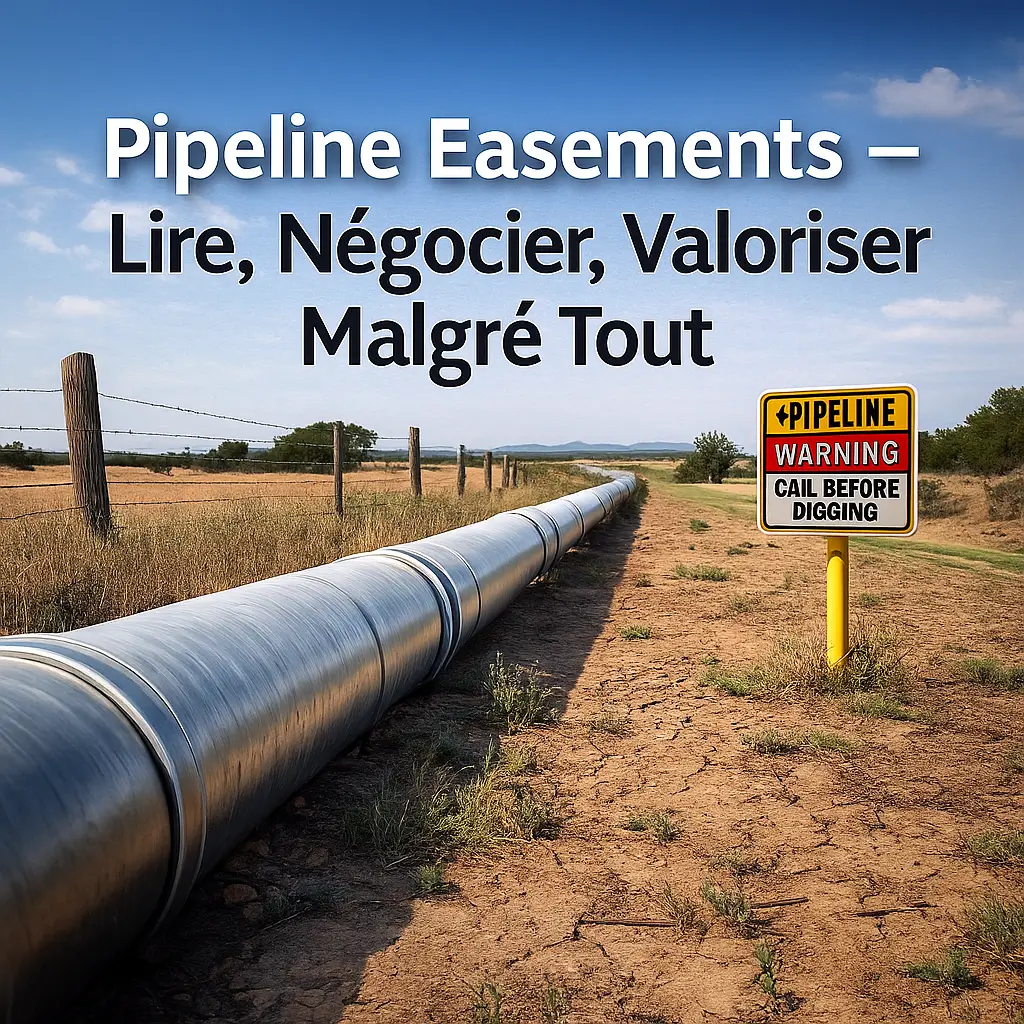
Pipeline easements are one of the most common realities of Texas land ownership. These rights of way, granted to oil and gas operators, cross millions of acres and always raise the same questions: Should I run away? Can I negotiate? How can I maximize the value of my land with this constraint? The answer may surprise you. Understanding how to read, negotiate, and even profit from a pipeline easement gives you a distinct advantage. While other investors avoid these properties out of fear or ignorance, you can spot undervalued opportunities and maximize assets that many consider compromised.
Author: This article was written by the LandQuire team, which specializes in real estate investment in the United States. Our experts assist French-speaking investors in their purchases of American land. 🔗 Follow LandQuire on LinkedIn | Specialized contact in Texas
Pipeline Easement: What You Need to Know Before You Begin
A pipeline easement grants an energy company the right to install, maintain, and operate underground pipelines on your property. Unlike a temporary easement, these rights generally last "as long as the pipeline is in use." In other words, it is virtually perpetual.
Texas produces 43% of U.S. crude oil, according tothe Energy Information Administration. These easements literally crisscross the territory. There are more than 450,000 miles of pipelines in the state. As a result, almost any land transaction of a certain size is likely to encounter one or more easements.
The Three Categories to Distinguish
Not all pipelines are created equal. Knowing how to differentiate between them helps you anticipate the real impact on your investment.
Transportation easements carry oil, natural gas, or refined products over long distances. Their right-of-way is generally 50 to 100 feet wide and imposes the most severe restrictions. Initial compensation ranges from $15,000 to $50,000 per mile, depending on the diameter and product.
Distribution easements are smaller. They serve local residential and commercial areas. Their typical width is 10 to 30 feet. Payments are more modest, ranging from $3,000 to $10,000 per mile.
Gathering easements collect hydrocarbons from individual wells in production areas. They sometimes create a dense and complex network. Their proliferation on a single plot of land can seriously complicate any development project.
Understanding these distinctions changes everything. The impact on value and your development options varies from simple to triple depending on the type of easement you encounter.
Understanding Documents: The Clauses That Really Matter
Many investors skim over easement documents. Big mistake. Each clause can make the difference between a good deal and a legal nightmare lasting several years.
Real Influence and Areas of Uncertainty
The legal width (right-of-way width) defines where restrictions apply. But beware: this measurement often represents the contractual minimum. Operators regularly claim "temporary work zones" that become permanent in practice.
Also check the access rights granted. Can the operator enter 24/7 without notice? Some older contracts allow access "via any reasonably necessary portion" of your property. This vague wording creates major legal uncertainty that you want to avoid.
Who Pays in Case of a Problem?
This issue deserves your utmost attention. Recent easements (post-2000) generally include strong indemnification clauses that protect the landowner. Older documents are sometimes dangerously silent on this point. This leaves you exposed without clear protection.
What You Can Really Do About Control
Most easements prohibit any permanent construction, planting of deep-rooted trees, or excavation within the right-of-way. Some go much further. They restrict agricultural use, ponds, or even the parking of heavy vehicles nearby.
Be particularly vigilant with clauses allowing the installation of additional pipelines without additional compensation. This provision can multiply the impact without increasing your remuneration by a single dollar.
Invest in a Specialist
Savvy investors always hire an attorney specializing in oil and gas law. This investment of $1,500 to $3,000 prevents potential losses of tens of thousands of dollars. An expert can quickly spot unfair terms and identify negotiating leverage that you would not see on your own.
Impact on Value: Understanding the Real Discount
Does a pipeline easement automatically reduce the value of your land? Yes, in most cases. But the extent varies greatly depending on several factors that you can analyze and sometimes influence.
Market Figures
According to Texas A&M Real Estate Center, agricultural land with pipeline easements is trading at a discount of 5% to 15%. This average hides enormous variations.
For agricultural land, the impact remains moderate (5-10%). Farming continues as normal outside the strict right-of-way. Annual crops grow directly above buried pipelines. Operators also compensate for temporary disruptions during maintenance work.
For developable land, the discount rises to 15-30% depending on the exact location of the easement. A pipeline running through the center of a prime commercial parcel severely devalues the potential. An easement running along one side may have minimal impact.
For residential land, psychological factors outweigh technical considerations. The statistical risks are minimal, but residential buyers are still hesitant. Discounts reach 20-35% within 300 feet of a major pipeline.
Turning Disability into an Asset
Smart investors don't suffer these discounts: they exploit them. Several creative approaches even make it possible to outperform the market.
Information arbitrage involves buying at a discount from sellers who are poorly informed. Their servitude may generate substantial rental income that they are unaware of. Or the operator pays generously to expand their influence. This asymmetry of information creates significant margins for those who know where to look.
Specialization by use exploits compatibilities. Solar farms love these rights-of-way because they provide perfect clear corridors. Hunting ranches value these corridors as access roads and areas of low vegetation that attract game.
Strategic assembly requires patience and capital. You purchase several adjacent parcels encumbered with parallel easements. You gradually create a large block of land where the easement represents a decreasing percentage of the total area. A 75-foot easement on 640 acres becomes almost negligible in the equation.
Also consider access to the land and road frontage. These factors can offset or exacerbate the impact of a pipeline easement on your overall strategy.
Negotiating a New Pipeline: Your Room for Maneuver
Receiving an easement proposal is both a financial opportunity and a test of negotiation skills. Unprepared owners often accept 30-50% of the fair value. Here's how to do much better.
The Power of Expropriation: Reality or Bluff?
In Texas, pipeline companies theoretically have the power of eminent domain for public utility projects. This threat seems frightening on paper. In reality, operators overwhelmingly prefer to negotiate voluntary agreements.
Why? Expropriation proceedings drag on for 18-36 months. They cost $50,000 to $200,000 in legal fees. They also generate negative publicity. Your bargaining power is real, despite the implicit intimidation tactics used by the land agents who contact you.
Key Negotiation Points
The initial compensation deserves your full attention. Never settle for the first offer. It typically represents 40-60% of the actual value. Instead, request an independent assessment by a certified appraiser. Expect to pay $2,000 to $5,000 for this expertise. It establishes the fair market value corresponding to the permanent loss of value of the land.
Surface damage requires separate payment for disturbances during construction. Standard rates range from $5,000 to $15,000 per acre depending on existing crops. Also insist on complete restoration of the site, including replacement of preserved topsoil.
Future interventions must be negotiated now, not later. Establish a clear protocol with automatic compensation. Without this clause, you will have to renegotiate each time from a weakened position. Nobody wants that.
The width of the right-of-way: every foot counts in the long run. If the operator requests 75 feet, question the technical justifications. Sometimes 50 feet is more than enough. You then recover 25 feet of land per mile of easement. Over a long crossing, that represents several acres in your pocket.
Use Time to Your Advantage
Land agents work under time and budgetary pressure. A delayed project costs the operator millions every day. Your strategic patience becomes a powerful lever. Respond slowly, consult widely, request multiple revisions.
However, avoid excessive arrogance. A reputation as an "impossible" landlord can actually trigger eminent domain, even if it is rare. The goal is to extract maximum value while maintaining a facade of reasonableness that avoids escalation.
Buying with an Existing Easement: What to Check
The acquisition of a property that is already encumbered requires thorough due diligence. Many investors neglect this step. They then discover unpleasant surprises after closing, when it is too late.
Searching the Registers
Start with the title report, which details all registered easements. But be careful: some older easements (pre-1950) may be "lost" in the records. Hire an experienced abstractor to trace the title chain back at least 50 years. It costs a few hundred dollars and can save you from disaster.
Next, obtain the original easement documents, not just the summaries. Platforms such as the Texas Railroad Commission maintain public databases. You can check the current operator, the product being transported, and the incident history for that specific segment.
Walking the Ground Physically
Walk each easement with a precise GPS (±1 meter). Verify that the physical markers correspond to the legal descriptions. Deviations of 10-50 feet are common. They create legal gray areas that can work for or against you depending on the circumstances.
Take plenty of photographs of the right-of-way. Note the condition of the vegetation, the presence of erosion, marker posts, and any visible infrastructure. Also look for signs of recent maintenance or abandonment that reveal actual activity.
Document how landlocked parcels may interact with easements. They sometimes create additional access challenges that must be anticipated now.
Contact the Operator Directly
Contact the pipeline operator directly. Ask for information that few buyers think to obtain:
- The age and current condition of the line
- The planned replacement or discontinuation schedule
- The history of incidents in this specific segment
- Expansion projects or additional lines
This data sometimes reveals hidden risks. For example, an aging pipeline that will soon require major replacement. Or, conversely, an underutilized line that will be abandoned in 5-10 years, thereby freeing up the easement.
See the Overview Table
Assess the combined impact with other local constraints. For example, MUD and PUD districts significantly affect taxes and services. They sometimes create negative or positive synergies with existing easements. A comprehensive analysis gives you a realistic view of your investment's true potential.
The Texas Legal Framework: What's Changing
Texas imposes a unique legal framework for pipeline easements. This system offers certain protections that are not available in other states. However, it also creates additional complexities that must be understood before investing.
Recent Reforms That Matter
Texas Property Code Chapter 21 governs eminent domain, including for pipelines. The 2021 reforms strengthened property owners' rights. Now, operators must disclose their status as entities authorized to exercise eminent domain. They also provide detailed information before any negotiations.
The Texas Supreme Court has limited the power of eminent domain in certain cases. Pipelines serving exclusively private interests (export only, for example) no longer automatically benefit from this right. This case law is still evolving. Easements negotiated 20 years ago could be contestable today if the use has changed.
ETJ Zones and Their Implications
In areas under extraterritorial jurisdiction (ETJ) of Texas cities, municipal regulations sometimes impose additional restrictions. A city that annexes your area could retroactively impose stricter setbacks from the pipeline. This possibility limits your flexibility for future development.
Check whether your parcel is located in an ETJ. Then review municipal ordinances relating to hazardous facilities, even if the easement predates these regulations.
Surface-Mineral Separation
Texas recognizes the absolute separation between surface rights and mineral rights. If you purchase only the surface rights, the owner of the mineral rights could install their own gathering pipelines without your consent. This reality potentially multiplies the easements on your parcel without you being able to prevent it.
Conversely, owning mineral rights gives you additional bargaining power with operators. This allows you to create an additional revenue stream if you develop underground resources.
Generating Income Despite Everything
Beyond accepting the constraints, sophisticated investors actively monetize their encumbered land. Several innovative approaches generate income that most people don't see.
The Unknown Opportunities
Secondary easements are an often overlooked avenue. If your pipeline easement is 75 feet wide but the physical installation only occupies 30 feet, you can lease the remaining space. Telecommunications companies pay $5,000 to $20,000 per mile for fiber rights along established corridors. This is negotiable.
Farming on the right-of-way remains perfectly viable in practice. Annual crops (corn, soybeans, wheat) grow directly above buried pipelines. You cannot plant trees, but farming generates continuous income year after year. Some operators even maintain the right-of-way with grass, which reduces your maintenance costs.
Hunting and recreation benefit from pipeline corridors. These areas create forest edges that are popular with game. Hunters value these ecological transitions. You therefore charge competitive hunting lease fees despite the presence of the easement.
Long-Term Land Banking
Land with pipeline easements is well suited for land banking. The reduced purchase price lowers your capital outlay. Your return on investment improves as the value gradually normalizes over time.
In rapidly expanding markets, the discount associated with easements naturally erodes. Land purchased at a 25% discount can recoup 70-80% of that difference in 10-15 years. Overall market appreciation generates higher returns despite the permanent constraint that remains in place.
This strategy combines well with ethical land flipping, where you are completely transparent. Full transparency about the easement avoids accusations of unfair practices while capturing market appreciation.
FAQ – Frequently Asked Questions
Does a pipeline easement always reduce the value of my land?
In most cases, yes. But the extent varies greatly (5% to 35%). It depends on the intended use, the exact location of the easement, and your ability to monetize the right-of-way. Agricultural land is least affected. High-value residential properties suffer more from negative perception.
Can I refuse an easement pipeline offer?
Theoretically, yes, you have the right to refuse. But in Texas, pipeline companies generally have the power of eminent domain for public utility projects. Refusing may trigger a forced condemnation procedure. That said, this process is long and costly. You still have substantial bargaining power to obtain fair compensation rather than outright refusal.
What compensation should I expect for a new easement?
Rates vary greatly depending on the situation. Reasonable benchmarks include $15,000 to $50,000 per mile for the permanent easement itself. Add $5,000 to $15,000 per acre for surface damage during construction. Never accept the first offer you receive. Request an independent appraisal and negotiate hard.
Can I build over a pipeline easement?
Generally not for permanent structures. However, specific restrictions vary depending on your specific contract. Some allow roads, light structures on stilts, or temporary installations. Always consult the operator and obtain written approval before starting any project in the area.
How can I find out about easements before buying?
The title report reveals officially registered easements. Hire an abstractor to conduct in-depth research in the archives. Then check public databases such as the Texas Railroad Commission. Finally, a physical inspection of the land completes the documentary research. Ground markers sometimes reveal lines that are not clearly visible in written records.
Conclusion: Making Pipeline Easements an Advantage
Pipeline easements represent much more than just a constraint on Texas real estate. For investors who know how to read them, these easements create real arbitrage opportunities. They allow investors to acquire discounted assets whose value will rebalance over time.
Mastering pipeline easements requires understanding on several levels. You need to develop legal expertise to decipher complex documents without being misled. Next, you need technical skills to assess real risks versus perceived risks. Finally, you need financial insight to model the impacts on ROI and identify compatible uses that generate revenue despite the restrictions.
Investors who develop this distinctive expertise gain access to a market segment that many avoid. Less competition means better terms of negotiation. Well-located easement properties often offer superior returns precisely because of their apparent complexity, which deters others.
The winning approach combines several complementary elements. First, exhaustive due diligence that identifies real risks without paranoia. Next, professional negotiation that maximizes compensation without counterproductive aggression. Finally, creativity in monetizing rights-of-way to generate additional revenue. Add to that a good understanding of regional dynamics such as MUD/PUD and ETJ zones, and you have a sustainable competitive advantage in this market.
At LandQuire, we work daily with French-speaking investors who navigate the complexities of American real estate. Our experience in the field shows that with the right preparation, pipeline easements are not an insurmountable obstacle. They become an investment factor to be methodically integrated into your allocation strategy, just like other land characteristics.
American land offers remarkable opportunities for patient and well-informed investors. Pipeline easements, when properly understood and negotiated, fit perfectly into this long-term vision of building a diversified and resilient land portfolio.