ALTA land survey - the standard for no-surprise headlines
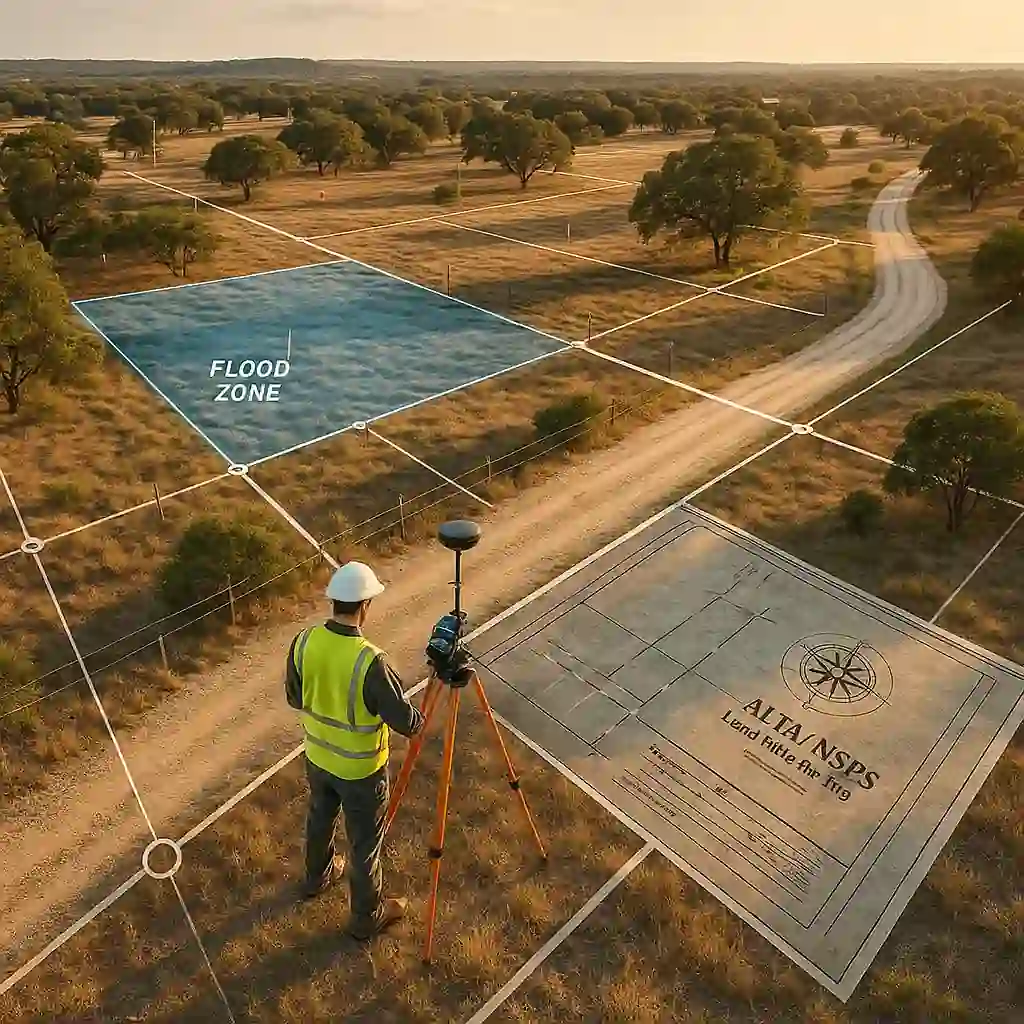
Acquiring land in Texas is a major investment that requires thorough due diligence. Among the essential tools at your disposal, the ALTA land survey is positioned as the standard of excellence for securing your land transactions. This detailed mapping, developed jointly by theAmerican Land Title Association and the National Society of Professional Surveyors, protects you from unpleasant surprises and costly litigation linked to property boundaries, easements or encroachments.
What does ALTA land survey mean?
An ALTA land survey complies with the national ALTA/NSPS standard.
- ALTA = American Land Title Association
- NSPS = National Society of Professional Surveyors
This standard establishes uniform content and precision: legal boundaries, easements, access, encroachments, FEMA zones, optional "Table A" elements. It provides lenders, title insurers and investors with a common, verifiable legal-technical basis recognized throughout the United States.
Expertise LandQuire - Land team (real estate - data - entitlement) dedicated to French-speaking investors in Texas. We coordinate ALTA/NSPS surveys, title searches and Table A for no-surprise acquisitions.
Talk to an analyst
To remember (30 s)
- TheALTA/NSPS Land Title Survey is the national standard required by lenders and insurers.
- Table A customizes completeness (zoning, utilities, FEMA, altimetry).
- Plan ahead 2-4 weeks and order as soon as the offer has been accepted, to avoid delays in closing.
What exactly is an ALTA land survey?
An ALTA land survey is much more than just a topographical map. It is a standardized document that meets strict requirements established at national level. This uniformity ensures that all parties involved in a real estate transaction - buyers, sellers, lenders and title insurers - have access to the same accurate, verifiable information.
The ALTA survey identifies legal property boundaries to centimeter accuracy. It also documents all physical features present on the property: buildings, fences, access roads, utility lines and significant vegetation. This completeness helps avoid future conflicts with adjacent owners.
Quick survey comparison
| Statement type | Main object | Typical use | Required by lenders/insurers |
|---|---|---|---|
| Boundary survey | Property limits | Single-family homes | No |
| Topographic survey | Relief & physical features | Design / engineering | No |
| ALTA land survey | Boundaries + titles + easements + access + Table A | Pro / institutional transactions | Yes (standard) |
Mandatory components of an ALTA survey
Each ALTA land survey must include basic elements defined by national standards. The professional surveyor identifies and marks all plot corners and boundaries with physical markers. He measures and maps existing buildings, determines their exact position in relation to property boundaries and verifies their compliance with zoning regulations.
The final document outlines recorded easements, whether for utility rights-of-way, road access or other rights-of-way. These easements in Texas can significantly affect the future use of your property. The survey also reveals any encroachments - structures or improvements that cross the legal boundaries of the parcel.
Setback lines imposed by municipal or county by-laws appear clearly on the plan. These buffer zones determine where you can build and directly influence the development value of your land. The surveyor also indicates existing rights-of-way and access roads that cross the property.
Why ALTA survey outperforms standard surveys
The fundamental difference between an ALTA land survey and an ordinary topographical survey lies in its thoroughness and completeness. ALTA/NSPS standards require a thorough documentary search of public archives, including property deeds, subdivision maps and urban planning documents.
This preliminary research enables the surveyor to compare physical boundaries with legal descriptions. Any discrepancies are identified and documented.
This reconciliation of land and records protects your investment against future legal uncertainties. It ensures that what you buy on paper corresponds exactly to the physical reality on the ground.
Enhanced protection for lenders and insurers
Financial institutions that grant home loans almost systematically require an ALTA land survey. This document enables them to accurately assess the mortgage collateral and identify potential risks. Without this level of detail, a lender is exposed to substantial losses if title problems arise after financing.
Title insurers use the ALTA survey to determine coverage exclusions. They may refuse to insure certain risks revealed by the survey, or adjust their premiums accordingly. This transparency allows you to negotiate with the seller to resolve any issues before closing.
Optional items in Table A
ALTA standards offer a list of optional items, called Table A, which you can request according to your specific needs. These additional items refine your understanding of the property and reveal features that could affect your development projects.
Option 1 requires the surveyor to verify any monuments found or placed at the corners of the property. Option 2 requires certification of compliance with local zoning regulations, including parking and density requirements. This verification saves you unexpected compliance costs.
Critical options for land investment
Option 3 requires the surveyor to identify encroachments, overlaps or boundary gaps between adjacent properties. These anomalies can trigger costly litigation or completely block your construction plans. Option 6A certifies the location of underground utilities - water, sewer, gas, electricity - based on available information.
For a land investment in Seguin or elsewhere in Texas, Option 8 is particularly valuable. It documents flood zones according to FEMA maps, crucial information that overlaps with FEMA flood zone analysis. This knowledge influences your construction decisions and insurance costs.
Option 11 requires vertical elevation data for existing structures and critical terrain points. These elevation data determine natural drainage and areas susceptible to water accumulation. It completes your hydrological and geotechnical risk assessment.
The ALTA survey process
The creation of an ALTA land survey begins with the collection of documents. The surveyor obtains the current deed, registered subdivision plats, legal descriptions and any easement documents. This documentation phase can take several days, depending on the complexity of the property's history.
In the field, the surveying team uses high-precision GPS equipment and total stations. They locate existing monuments, place new ones if necessary, and measure all physical elements. This field phase typically takes from one to three days for a standard residential property.
Deadlines and coordination with the transaction
It takes between two and four weeks to process the data and produce the final plan. This timeframe varies according to the size of the property, the complexity of the features and the workload of the surveying firm. For urgent transactions, some surveyors offer an accelerated service for an additional fee.
You should order the ALTA land survey as soon as your offer to purchase has been accepted. This allows you to identify problems early and negotiate solutions before the closing date. Any delay in ordering the survey may jeopardize your contractual deadlines and jeopardize your transaction.
Coordination with your real estate lawyer and title agent is essential. They review the survey to identify legal risks and exceptions to title insurance. This collective review protects your interests and facilitates a surprise-free closing.
Save time on your due diligence: LandQuire coordinates certified surveyors, title searches and Table A analysis to secure your acquisitions. Contact our experts.
Costs and variation factors
The price of an ALTA land survey in Texas varies considerably depending on several factors. For a typical residential property of less than two hectares in an urban area, expect to pay between $2000 and $4000. Larger rural lots can cost from $3,000 to $10,000 or more.
Dense vegetation increases costs, as it complicates access and visibility for measurements. Rough terrain with significant changes in elevation requires more measuring points and more working time. Geographical remoteness adds travel costs for the survey team.
Optional features and their impact on price
Each Table A item you select increases the total cost. Zoning certification can add $500 to $1,000. Locating underground utilities usually costs an additional $300 to $800.
Elevation surveys for flood zone analysis add a further $400 to $1,200. Despite these costs, the ALTA land survey represents an inexpensive insurance policy compared to the potential losses. Discovering after purchase that a building encroaches on neighboring property can cost you tens of thousands of dollars in legal fees.
Interpreting results: warning signs
A well-executed ALTA land survey sometimes reveals problems that require immediate action. Encroachments are one of the most serious warning signs. If a seller's structure crosses the property line onto adjacent land, you inherit a potential dispute.
Discrepancies between measured boundaries and the legal description of the deed raise questions of title. These inconsistencies suggest errors in previous surveys or undocumented boundary changes. Your attorney must resolve these discrepancies before closing to ensure the validity of your title.
Servitudes and hidden restrictions
Unregistered easements may appear on land in the form of power lines, pipelines or access roads used by neighbors. Even if they do not appear in the public records, these established uses can create rights by prescription.
Water rights in Texas deserve special attention if your property borders a watercourse or contains wells. The survey identifies these hydrological features but does not document the associated use rights. A separate search is required to secure your irrigation or domestic consumption rights.
Mining rights in Texas are another critical area not covered by the ALTA land survey standard. If subsurface rights have been separated from the surface, the holder of the mineral rights can access your property for exploration and extraction. This essential verification requires an in-depth title search separate from the survey.
ALTA survey and institutional due diligence
Sophisticated investors, particularly family offices in Texas, consider the ALTA land survey to be a non-negotiable part of their acquisition process. This rigor reflects their understanding of the hidden risks that can erode the value of a real estate asset.
These institutional investors often order extensive optional elements of Table A. They seek a comprehensive understanding of every physical and regulatory aspect of the property. This methodical approach minimizes post-acquisition surprises and protects their capital against unexpected depreciation.
Integration with title insurance
The ALTA land survey works in synergy with your title insurance policy. The insurer uses the survey to identify exceptions to coverage - specific risks that it refuses to insure. Without a survey, the insurer lists general exceptions that offer little real protection.
With a survey in hand, you can negotiate the removal of certain standard exceptions. If the survey confirms the absence of encroachments or zoning violations, the insurer can offer extended coverage. This negotiation enhances the value of your policy and strengthens the security of your investment.
The survey also enables the insurer to issue an access and entry endorsement. This endorsement certifies that the property has legal access to a public thoroughfare, an essential guarantee of constructability and market value.
2021 standards and recent developments
The ALTA/NSPS standards have been revised in 2021 to reflect technological advances and emerging best practices. These changes enhance the accuracy and usefulness of surveys for all stakeholders. Surveyors must now clearly identify the source and date of all data used.
Version 2021 imposes stricter requirements for utility documentation. Surveyors must contact utility companies and document their responses, even if no infrastructure is identified. This diligence reduces the risk of accidental damage to underground lines during future work.
Improved technology and precision
The widespread adoption of RTK (Real-Time Kinematic) GPS systems and 3D laser scanners has dramatically improved the accuracy of ALTA surveys. These technologies capture millions of data points in a matter of hours, creating detailed digital models of the terrain.
Unmanned aerial vehicles (UAVs) equipped with high-resolution cameras now make it possible to rapidly map vast properties. This aerial approach complements traditional ground-based measurements, revealing features that are difficult to observe at ground level. The drone images included in the final report provide a valuable visual context for the interpretation of technical data.
Common mistakes to avoid when ordering
Many buyers make the mistake of ordering an ordinary topographical survey rather than a complete ALTA land survey. This apparent saving often turns into additional costs when the lender or title insurer rejects the inadequate document.
Another common mistake is omitting the relevant optional items from Table A. If your project involves construction, you need zoning and elevation verifications. For rural land, locating services and analyzing flood zones are crucial.
Neglecting to check qualifications
Not all surveyors have the necessary expertise to carry out an ALTA land survey in compliance with national standards. Check that the professional has an active license in Texas and specific experience with ALTA surveys.
An unqualified surveyor may produce a document that looks correct but omits critical elements or contains measurement errors. These defects only become apparent when problems arise, often after closing when your recourse is limited.
Post-acquisition preservation and use
Your ALTA land survey retains its value long after the initial transaction. Keep several copies in secure locations - both physical and digital. This document will serve as a reference for all your future development projects, permit applications and transactions.
When you're planning new buildings or improvements, the ALTA survey guides the optimal placement of structures while respecting setback lines and easements. Your architect and builder will use this plan as the basis for their own site surveys.
Update for significant changes
If you make major changes to the property - new constructions, subdivisions, boundary modifications - you'll need to have your ALTA survey updated. A surveyor can revise the existing document more quickly and at a lower cost than a completely new survey.
Lenders generally require a survey less than six months old for refinancing or a new loan. If your existing ALTA survey is older but the property has not changed, the original surveyor can often issue a recertification.
Resources and official sources
To deepen your understanding of ALTA standards and best practices in land surveying, consult these authoritative resources:
- American Land Title Association (ALTA) professional organization that sets national standards for title surveys
- National Society of Professional Surveyors (NSPS) National Society of Professional Surveyors (NSPS): association working with ALTA to define technical requirements
- USGS - U.S. Geological Survey topographic and cartographic reference data
- FEMA Flood Map Service Center Official flood maps used in Table A options
Frequently asked questions about the ALTA land survey
What's the difference between ALTA land survey and boundary survey?
A boundary survey traces property boundaries only. The ALTA land survey adds full verification of title, easements, access, FEMA zones and Table A compliance. This is the standard required by lenders and insurers for professional and institutional transactions.
How long does it take to get an ALTA survey?
In general, allow 2 to 4 weeks depending on the size and complexity of the property and the Table A options selected. Anticipate the order as soon as you accept your offer to purchase to meet closing deadlines and avoid costly delays.
Do I need to order all Table A options?
No. Select the options according to your specific project: zoning and setbacks (option 2), encroachments (option 3), utilities (option 6A), flood zones and elevations (options 8 and 11). An experienced ALTA surveyor will help you target the elements relevant to your situation.
Further information
After theALTA/NSPS Land Title Survey, the next logical step is entitlement (authorizations, plats, networks, phasing) to make the lots build-ready. Land Entitlement Texas: understand, plan, succeed
ALTA survey: an essential protective investment
The ALTA land survey represents much more than a simple administrative formality in your Texas land acquisition process. This powerful tool reveals the physical and legal reality of your investment with a clarity that protects against costly surprises.
For serious investors building a sustainable property portfolio, the ALTA survey is the foundation for rigorous due diligence. It works in synergy with your other checks - title search, environmental analysis, verification of water and mineral rights - to create a complete picture of your asset.
By systematically requiring an ALTA land survey in line with the latest national standards, you adopt the best practices of sophisticated financial institutions and investors. You turn uncertainty into knowledge, risk into security, and position your land portfolio on the solid foundations of accurate, verifiable information.
LandQuire expertise
This article is brought to you by LandQuirea company specializing in land investment in Texas. Since 2021, we have assisted 400+ French-speaking investors. Thanks to a team of experts in real estate, data and land entitlement, we structure transactions totaling several million dollars in assets.
Our mission: to secure your acquisitions by eliminating the risks associated with easements, access, flood zones (FEMA), mineral rights and title discrepancies.
Important notice: past performance or internal targets are not a guarantee; results not guaranteed.
Need a reliable ALTA land survey before you sign? Our team coordinates your entire Texas land due diligence: certified surveyors, title search, regulatory analysis and entitlement verification. Contact our LandQuire analysts.
✍️ Author: LandQuire - Land team (real estate - technology - data). French-speaking investor support: due diligence, entitlement, ALTA/NSPS, title search. Follow our analysis on LinkedIn.