Alternatives to Fundrise: 5 Platforms for Higher Real Estate Returns

Why Investors Are Turning Away from Traditional Platforms
International real estate investors are turning away from traditional platforms for one simple reason: the returns no longer meet their goals. A platform like Fundrise typically offers net returns ranging from 8% to 12% annually, or even less after fees and taxes. For an investor based in Europe or the Middle East with a minimum investment of $100,000, these figures look more like a bond fund than a genuine real estate opportunity.
These investors also seek to avoid operational complexity. Traditional models expose them to interest rate volatility, tenant management risks, and unpredictable construction cycles. An international investor does not want to deal with building permits, construction delays, or margin calls on mortgage loans.
What’s the real reason for leaving these platforms? Limited access. The best real estate opportunities are never listed publicly. They circulate within private networks, among institutions and professional asset managers. Small and medium-sized investors are excluded from these institutional deals while settling for mediocre returns.
Key takeaway: Traditional platforms offer convenience, but at the cost of lower returns and exposure to operational risks you didn’t choose.
The Limitations of Fundrise and Traditional Models
Fundrise has made real estate crowdfunding more accessible, which is helpful. However, its diversified portfolio structure creates several barriers to high returns. First, spreading risk across dozens of projects also means lower margins. Second, Fundrise borrows to finance its projects, which introduces debt leverage that amplifies risks during periods of high interest rates.
Third, Fundrise’s strategy covers the entire real estate cycle, from raw land to rental properties. This involves construction management, the launch of rental properties, and exposure to vacancy rates. Each phase adds a layer of operational complexity and reduces clarity regarding the timing of exit.
Fees also play a role. Between management fees, performance fees, and U.S. taxes on rental income, investors see 20% to 30% of their gross returns disappear before they ever reach their pockets.
Finally, these platforms do not cater to international investors. They impose regulatory barriers and cumbersome KYC requirements, and offer no multilingual support. An investor based in Dubai or Geneva has to figure things out on their own.
Key takeaway: Traditional models offer convenience but sacrifice performance, transparency, and accessibility for global investors.
Our approach: off-market land acquisition and value creation through development rights
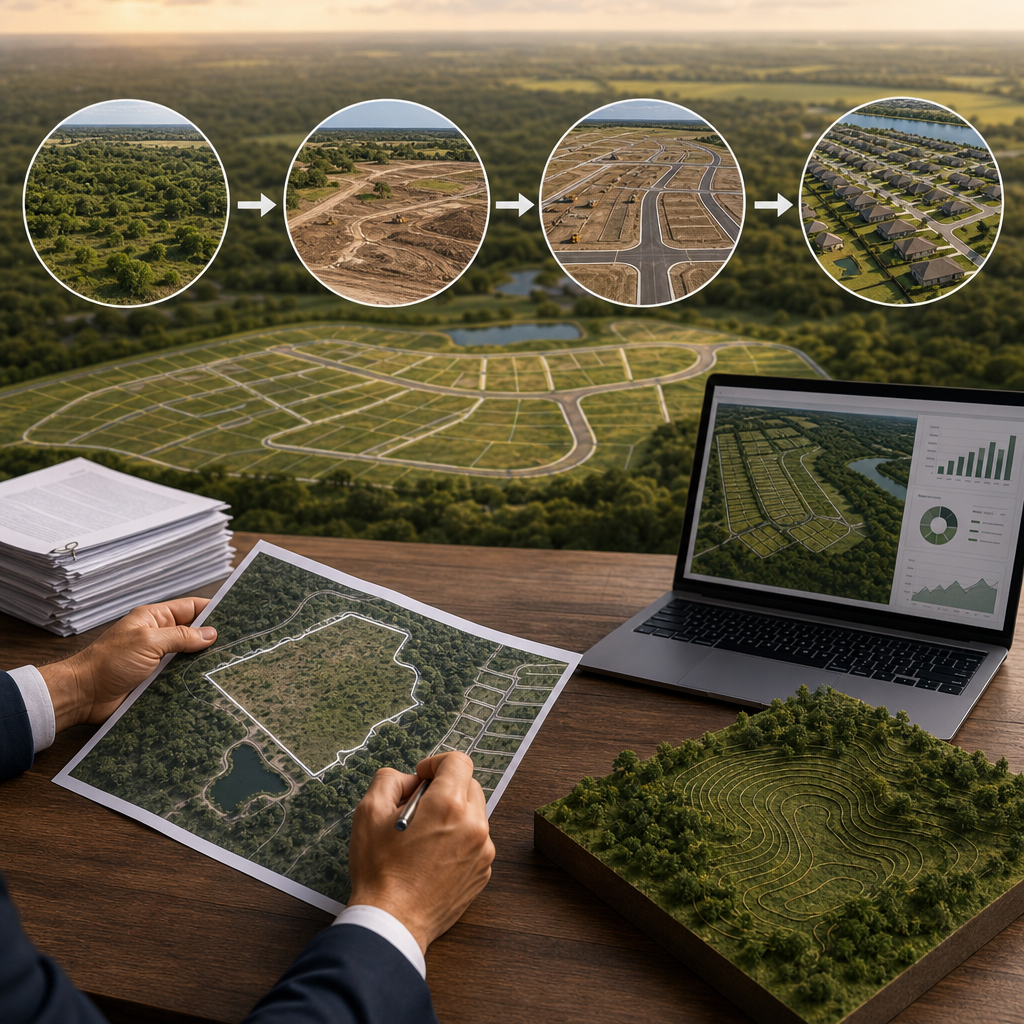
We operate on a fundamentally different principle. Instead of going through the entire construction and leasing cycle, we capture value at the most profitable stage: land acquisition and securing development rights.
Here’s how it works. We identify undervalued land in high-growth markets, primarily in Texas and Florida. We analyze the potential for residential subdivision, work with zoning experts to secure all necessary permits and approvals, and then sell the fully prepared project to developers.
This approach eliminates three major sources of risk and friction:
- No construction: We exit the project before the first brick is laid. No risk of budget overruns, no construction delays, and no exposure to volatile labor costs.
- No tenant management: No vacancies, no maintenance calls, no tenant credit issues.
- No debt exposure: All of our investments are structured as 100% equity. No leverage, no margin, and no risk of margin calls in the event of falling interest rates.
Our competitive advantage lies in our off-market access. We work directly with landowners, sellers, and institutional networks that individual investors cannot reach. The best properties are never listed on the MLS.
Key takeaway: We capture maximum value during the pre-development phase, eliminating the construction and tenant risks that other platforms impose.
Higher yields thanks to the pre-development strategy
Pre-development is the stage where margins are highest. A raw parcel of land without building rights can be worth $500,000. Once residential subdivision rights are secured, that same parcel can be worth $1.5 to $2 million. This increase in value requires no physical construction.
Our investors are targeting IRR returns of 20% to 35%+, which is two to four times higher than Fundrise. How is this possible? Three factors:
- Low-cost acquisitions: Our off-market acquisitions allow us to purchase assets at 15% to 25% below retail valuations.
- Value Creation Through Development Rights: Obtaining subdivision rights can increase property value by two to four times. We capture this increase without having to build.
- Short cycle: Within 18 to 36 months, the project is fully zoned and ready for sale to developers. There is no 5- to 7-year cycle, as with a conventional rental building.
Consider a simplified example. We identify a 50-acre parcel of land in the Central Florida growth corridor. Purchase price: $400,000. Permitting costs (survey, engineering, zoning approvals): $50,000. Total investment: $450,000. After subdivision approvals, the site can accommodate 150 residential lots. Sale price to developers: $1.2 million. Net return after expenses: $750,000, representing a 166% gain in 24 months. Annualized, this represents an IRR of 28%.
This model operates at scale. We are not constrained by the slow rental sales cycle or vacancy rates. We are limited only by access to the right acquisition opportunities and the ability to navigate zoning procedures.
Key takeaway: Pre-development offers multiple returns by capturing the value of building rights without the risks and delays associated with construction.
Access to institutional opportunities without the risk of construction
Institutional real estate investing has never been accessible to individual investors. Real estate venture capital funds, family offices, and large institutions invest in deals that you never get the chance to see. They benefit from closed networks, relationships with sellers, and complex tax structures that aren’t available to you.
We’re bridging that gap. Our 600+ global investors now have access to institutional-quality opportunities with a minimum investment of $100,000. This isn’t a hit-or-miss crowdfunding venture. It’s a rigorous selection of pre-development projects that major institutions would fund if they were interested.

The construction risk is completely eliminated from the equation. You never have to worry about:
- Construction budget overruns
- Delays caused by weather conditions or subcontractor issues
- Building permit issues that have stalled the project for months
- Poor management of construction quality
These risks are transferred to the developer who purchases the project once all the rights are in place. You exit with a profit before these risks materialize.
Key takeaway: Institutional investors build their wealth through pre-development, not through rental management or construction. We give you access to this same strategy.
Our 130+ successful projects and our 100% success rate in securing rights
Since 2021, we have completed over 130 projects. Each one has been successfully concluded with the full acquisition of building permits and a successful handover to developers. Zero failure rate. 100% success rate in zoning and permitting.
It’s not luck. It’s expertise. Our in-house team has a thorough understanding of zoning codes in Texas and Florida. We work with mayors, zoning commissions, and local urban planners. We know where approval is feasible, where it requires negotiation, and where a project cannot move forward.
Before acquiring a plot of land, we conduct a thorough zoning feasibility study. We don’t start out with mere optimism and hope. We verify technical and political feasibility before investing a single euro. That is why our success rate in securing development permits is 100%.
Our 600+ current investors have seen their investments come to a successful conclusion. IRR returns have been within the projected range. Investment cycles of 18 to 36 months have been met. There have been no negative surprises regarding the granting of rights. This track record builds the kind of trust you won’t find on general-purpose crowdfunding platforms.
Key facts: Over 130 projects, a 100% success rate in securing funding, and over 600 satisfied investors. Our track record speaks louder than any marketing promise.
Why international investors choose us
Investors based in Europe, the Middle East, and Latin America face unique challenges when using traditional U.S. platforms. Regulatory requirements, language barriers, and the lack of multilingual support effectively exclude them from many opportunities.
We are building our platform for global investors. We offer multilingual support, clear documentation on FIRPTA (Foreign Investment in Real Property Tax Act) tax requirements, and a transparent structure that meets compliance requirements for non-resident investors.
But beyond administrative support, we offer something more profound: aligned interests. International investors are seeking diversification in USD, access to high-growth U.S. markets, and returns that exceed those of European bonds or traditional REITs. We offer all of this within a single structure, without the complexity of directly owning properties, managing tenants, or navigating U.S. real estate bureaucracy.
Our investors also appreciate the tax clarity and certainty regarding timing. With a cycle of 18 to 36 months, you know exactly when your capital will be released. You can plan your overall tax strategy around this certainty. There are no 10-year cycle surprises, as is often the case with conventional real estate investments.
Key takeaway: International investors choose LandQuire for access to higher returns, multilingual support, and tax clarity—benefits that generic platforms cannot provide.
How to get started with a minimum investment of $100,000
Getting started is easy. You submit an application form with your investor information. Our team reviews your accreditation profile and prepares legal documentation tailored to your tax situation (including your FIRPTA obligations if you are a non-resident).
You then review the available project opportunities. We provide comprehensive details, including location, subdivision potential, estimated permitting timeline, IRR projections, and market profiles. You can review several projects before selecting the one that aligns with your goals.
Once you’ve selected a project and signed the investment documents, your capital is deployed. You’ll receive regular updates on the progress of zoning approvals, key milestones, and the estimated timeline for completion.
Our $100,000 minimum ensures that we work with serious investors who can see a transaction through to completion without pulling out prematurely. It’s also the entry point for accessing institutional-quality deals. Professional real estate funds require minimums of $500,000 or more. For you, it’s $100,000.
Key takeaway: With a minimum investment of $100,000, you gain access to pre-development opportunities that were previously only available to institutional investors.
Short investment terms: 18 to 36 months to maximize your returns
The typical duration of an investment cycle at LandQuire is 18 to 36 months. This is by design and represents a major advantage over conventional real estate models.
Why so short? Because we don’t wait for developers to build and sell homes. The pre-development timeline depends entirely on zoning authorities, infrastructure approvals, and the preparation of subdivision plans. These processes typically take 18 to 30 months. Once they’re complete, we finalize the sale to developers within 3 to 6 months. The cycle is complete.
Compare that to a conventional rental property where you’re locked in for 7 to 10 years or more. With pre-development, your capital is freed up and available to be reinvested in a new opportunity long before your peers have even finished building their first project.
This investment cycle also offers flexibility. If your personal goals change, if you need liquidity, or if a better opportunity arises, you aren’t locked in for a decade. Your 2- to 3-year time horizon allows you to remain agile.
For active investors, short cycles also mean faster capital growth. If you reinvest your profits into a new project every two years, your capital grows at a faster compound rate than a static investment over 10 years.
Key takeaway: Cycles ranging from 18 to 36 months free up your capital quickly, allowing you to reinvest the returns and maintain the portfolio’s flexibility.
Are you looking to outperform the returns offered by traditional platforms? Start by reviewing our current projects and see how you can invest a minimum of $100,000 in an institutional pre-development opportunity. Our teams are ready to guide you through every step of the process.
For further reading: RiseQuire Real Estate Investment.