How to Generate a 20–35% Annual Return Through Passive Real Estate Investing in the U.S.
Why Traditional Passive Real Estate Doesn't Deliver the Returns You Expect
Traditional residential real estate promises stability. In reality, rental yields average between 3% and 7% annually in the United States, before taxes and management fees. If you live in Europe or the Middle East, this outlook is already disappointing. Add to that the operational challenges: tenant management, property maintenance, unpredictable vacancies, and exposure to interest rate fluctuations.
An investment property that generated a 5% return in 2021 now yields 4% at best, because prices have risen faster than rental income. For an international investor, the real return decreases even further once costs are converted into foreign currency and remote management fees are applied.
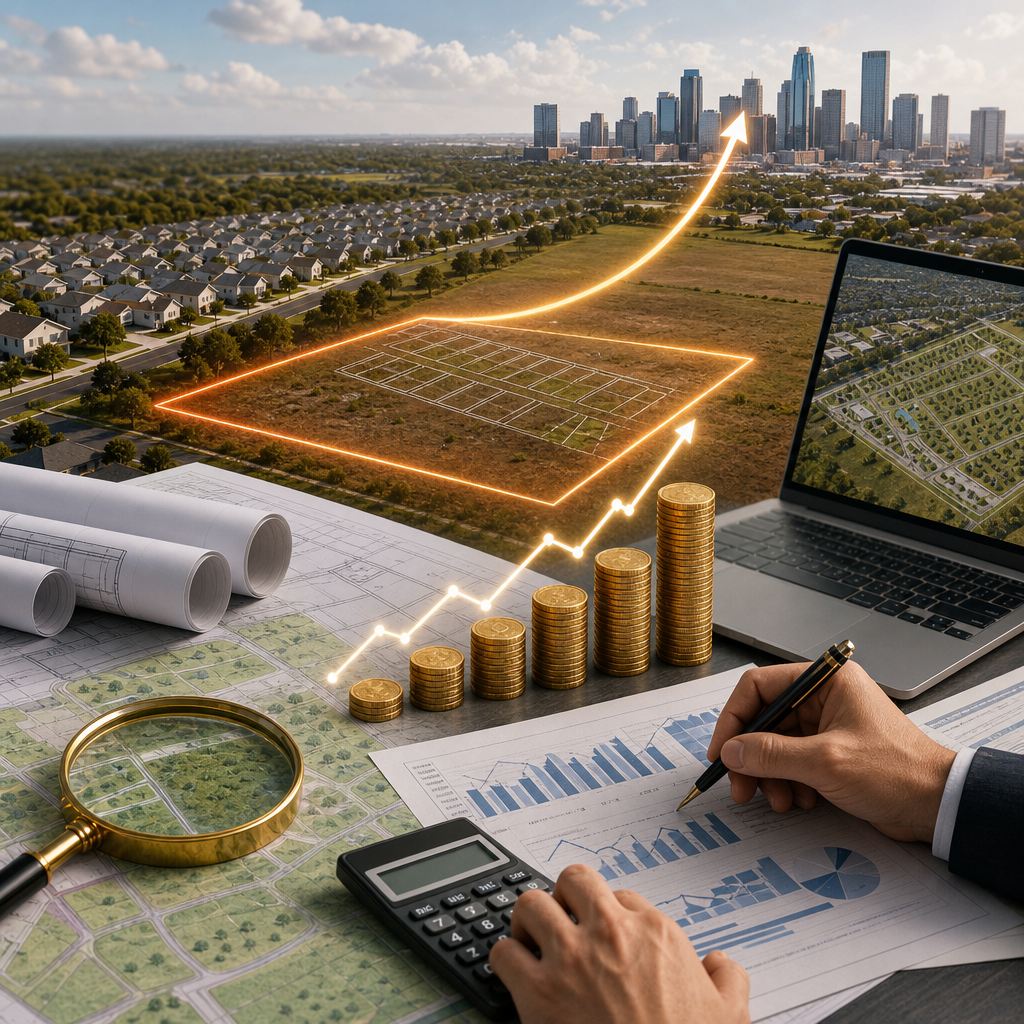
Traditional passive real estate never captures the major value creation. This value is created before construction begins, when land is acquired, zoned, and prepared for development. Once subdivision plans are approved and building rights are secured, the value of the land can increase by 150% to 300% without any additional investment. Owners of rental properties never have access to this.
Next Step: Evaluate your current real estate portfolio. Compare your annual net return (after all expenses) with your expectations at the time of your initial investment.
The Limitations of Traditional Strategies for International Investors
For an investor based abroad, the obstacles to investing in U.S. passive real estate are numerous and very real.
First, there’s regulatory complexity. Every U.S. state, county, and municipality has its own zoning codes, approval timelines, and environmental requirements. Navigating this maze on your own costs time, money, and leads to mistakes. International investors lack the local network needed to obtain permits and access critical contacts.
Second, actual returns are limited. Residential real estate available to outside investors generates moderate returns, which are eroded by management fees, high property taxes, and unexpected costs. Even a very well-managed property rarely yields more than 7–8% annually.
Third, the market remains closed. The best real estate opportunities—those offering institutional-grade returns—are transacted outside the public market. They circulate among developers and investment firms that have known about them for years. An individual investor, especially an international one, has no access to these deals.
Finally, there is a lack of control and liquidity. You are tied to a specific property, in a specific location, with specific tenants. If conditions change or if you need liquidity, you are stuck with your investment for years.
What changes the equation: a strategy focused on pre-development offers returns that are 3 to 5 times higher, with a defined investment horizon and a predictable exit.
Our Approach: Capturing Value Before Construction Begins
At LandQuire, we've built a model that captures value exactly where it's highest: before the first brick is laid.
Here’s how our strategy works. We identify undervalued land parcels in markets experiencing strong economic growth. We acquire them, then handle all the technical and regulatory work: residential subdivision plans, applications for building permits, approvals from government agencies, environmental impact studies, and infrastructure negotiations. Once all these elements are secured and approved, we resell the land to a real estate developer.
The result: a net increase in value of 150% to 300%—without construction, without tenants, and without operational responsibility. We capture this value in its entirety and share it with our investors.
This approach eliminates the three major risks associated with traditional real estate:
- No construction risk: The developer will begin construction after we have left the project.
- No rental market risk: We never own a property that is currently occupied.
- No exposure to interest rates: Our structures are 100% equity. Changes in financing costs do not affect us.
In 2026, we completed more than 130 projects using this model. Each project follows the same rigorous process: strategic acquisition, development of building rights, regulatory approval, and profitable exit. Our track record shows a 100% success rate in obtaining building rights.
Key point: We are not real estate developers. We are specialists in pre-construction value. We exit before construction risks begin.
How We Identify Undervalued Properties in Growth Markets
Identifying the right real estate opportunities relies on a combination of proprietary data and local expertise.
We use a proprietary data analytics platform that cross-references several key variables: projected population growth, net migration, job creation, government infrastructure investments, and changes in municipal zoning. This quantitative approach allows us to identify markets on the cusp of growth before prices show clear signs of a trend.
We are focusing our efforts on two key regions: Texas and Florida. These states offer sustained population growth (Texas: +1.5 million residents per decade; Florida: +500,000), a favorable tax environment, building-friendly regulations, and long-term political stability. Within these regions, we target suburban counties that lie precisely at the tipping point between rural and urban areas. That is where potential returns are highest.
Once a geographic area has been identified, we examine specific parcels of land. We look for properties that are an optimal size for subdivision (typically 10 to 100 hectares), have acceptable accessibility, nearby infrastructure (roads, water, electricity), and flexible zoning. Crucially, we review the history of each parcel to identify owners who are motivated to sell quickly and at a low price.
Our local network in each market includes brokers, zoning officials, developers, and city council members. These connections give us access to off-market properties before they are publicly listed. An off-market property often sells for 15% to 25% less than a comparable listed property.
No surprise here: the most profitable properties are never listed on the MLS. They're found through connections and data.
The Development Rights Process: Creating Value Without Construction Risk
Once a plot of land has been acquired, the real work begins: transforming theoretical building rights into approved and legally secure building rights.
Building rights in the U.S. involve obtaining official approvals from government authorities (county, municipality, state agencies) to develop a parcel of land in a specific configuration. For a typical parcel of land, this process includes:
- Subdivision Plan: We hire urban planners and civil engineers to design the optimal layout of residential lots, roads, green spaces, and infrastructure. This plan must comply with existing zoning codes, environmental standards, and municipal requirements. A poorly designed plan can derail the entire project.
- Environmental Impact Assessment: If the property borders sensitive areas (wetlands, waterways, protected habitats), a formal environmental assessment is required. We coordinate these assessments with specialized consultants to identify any issues before submitting the formal application.
- Variance Applications and Approvals: We file applications with local authorities. This process includes public hearings, technical reviews, and negotiations. Our expertise allows us to navigate these steps quickly and efficiently. Out of more than 130 projects since 2021, we have maintained a 100% success rate.
- Contractual Guarantees: Once approvals are obtained, we secure them through a contract. All rights are transferred to the purchasing developer with strong legal guarantees, preventing any withdrawal or revision after the contract is signed.
This process typically takes 12 to 24 months, depending on local complexities and administrative delays. During this period, the value of the land gradually increases as each approval brings the project closer to certainty. Once all rights have been secured, a real estate developer will pay a premium price to acquire land that is immediately ready for construction.
Real-world example: A 30-hectare plot of land purchased for $50,000 per hectare (total of $1.5 million) with an approved subdivision plan for 150 residential lots can be resold for $200,000 to $250,000 per hectare (between $6 million and $7.5 million) after full approval. This represents a 300% to 400% increase in value, with no construction required.
Action to Take: Understand that the greatest value in real estate is created through regulatory approvals, not through the construction itself.
100% Equity Investment Structures: Access to Institutional Opportunities
Our investment structures are designed to give individual investors access to transactions that were previously reserved for institutional funds.
Each LandQuire project is structured as a 100% equity co-investment entity. This means:
- No debt: Unlike traditional real estate structures that use 50% to 70% bank leverage, our projects are financed entirely with equity. You are never exposed to a margin call, a rise in mortgage interest rates, or a loan recall clause.
- Undiluted returns: With no interest costs, 100% of the capital gains go to investors.
- Limited and defined risk: Your maximum investment is known from the outset. There are no additional construction costs, no budget overruns, and no requests for additional capital.
- Contractual Transparency: Each investment agreement specifies the exit structure (the developer’s expected price), the timeline (18–36 months), and your share of the returns.
We accept a minimum investment of $100,000 per project. Most of our international investors allocate between $250,000 and $1 million per transaction, spread across several simultaneous projects to diversify geographic and temporal risk.
Your typical return: A $500,000 investment in a 36-month project with an IRR of 25% generates a net profit of $375,000 (375% average annual return). This is significantly higher than the 3–7% return on rental properties.
Direct comparison:
| Strategy | Annual Return | Duration | Operational Effort | Risk | |———–|——————|——-|———————|——–| | Traditional Rental Real Estate | 3–7% | Unlimited | High | Market, interest rates, tenants | | LandQuire Pre-Development | 20–35% | 18–36 months | Minimal | Regulatory approvals |
Fast investment cycles: 18–36 months for returns of 20–35%
The short-term investment horizon is one of the key advantages of our model.
A traditional rental property investment locks you in for 10, 20, or 30 years. You’re tied to a specific location, a specific property, and a specific rental market. With LandQuire, your typical investment horizon is 18 to 36 months.

Here's how it unfolds over time:
Months 0–2: Acquisition of the land, structuring of the deal, closing of the financing.
Months 2–12: Development of plans and submission of applications for building permits.
Months 12–24: Administrative follow-up, public meetings, approvals, and final negotiations.
Months 24–30: Finalization of all legal matters, contracts with the developer, and closing of the sale.
Months 30–36: Distribution of returns to investors.
On most of our projects, we will achieve an IRR of 20% to 35%. Some projects exceed 40%, especially if the initial acquisition was particularly favorable or if the approval process was expedited.
After 30–36 months, you’ll receive your principal and your returns. At that point, you can either reinvest with us in a new project or use the funds elsewhere. Your principal is never tied up for the long term.
Competitive Advantage: In 36 months, with an IRR of 25%, you’ll generate the same return as a rental property that yields 7% per year for five years. But you’ll recoup your principal much sooner, with significantly less risk.
LandQuire Portfolios: Turnkey Investments for International High-Net-Worth Individuals
Our approach for international investors acknowledges a simple reality: you don’t live in the United States, you may not always be fluent in English, and you don’t have the time to actively manage municipal approvals.
That is why we offer a truly passive investment structure.
Each investor has access to a multilingual online real estate investment platform that displays all available projects with complete details: location, acquisition price, subdivision plan, approvals obtained to date, projected exit price, expected IRR, and timeline. You choose the projects that match your risk profile and return objectives.
We then handle everything:
- Project Management: We coordinate all communications with government agencies, consultants, developers, and attorneys. You’ll receive quarterly updates, not daily requests.
- Regulatory Compliance: We ensure full legal compliance with federal, state, and local laws, including tax matters for foreign investors.
- Documentation: All agreements and contracts are drafted by our attorneys and reviewed by third parties if desired. You only sign what you understand.
- Distribution: Upon completion of the project, we collect the funds from the developer, deduct our fees (typically 10–15% of the profit), and distribute your principal plus any earnings in accordance with your contractual agreement.
We work with more than 600 international investors. Many are from the United Kingdom, Germany, Switzerland, the United Arab Emirates, Saudi Arabia, Israel, and Latin America. They appreciate having access to high U.S. returns without having to navigate the bureaucracy on their own.
Your responsibility: You send the money, you receive the returns. That’s it. No tenant management, no calls to plumbers, no complicated rental tax returns.
RiseQuire: Generate Returns and Recurring Revenue Simultaneously
For investors who wish to combine pre-development returns with a steady cash flow, we have developed RiseQuire, a unique hybrid structure.
RiseQuire structures a portfolio of pre-development investments to generate both long-term capital returns and interim income through land lease agreements with farmers or renewable energy operators.
Here's how it works:
- A typical investment property is acquired and the process of obtaining building rights is initiated.
- While we work on obtaining approvals (12–24 months), the land remains productive. We lease it to a farmer or a solar operator under a 1- to 3-year lease, which generates a 2–4% annual return in passive income.
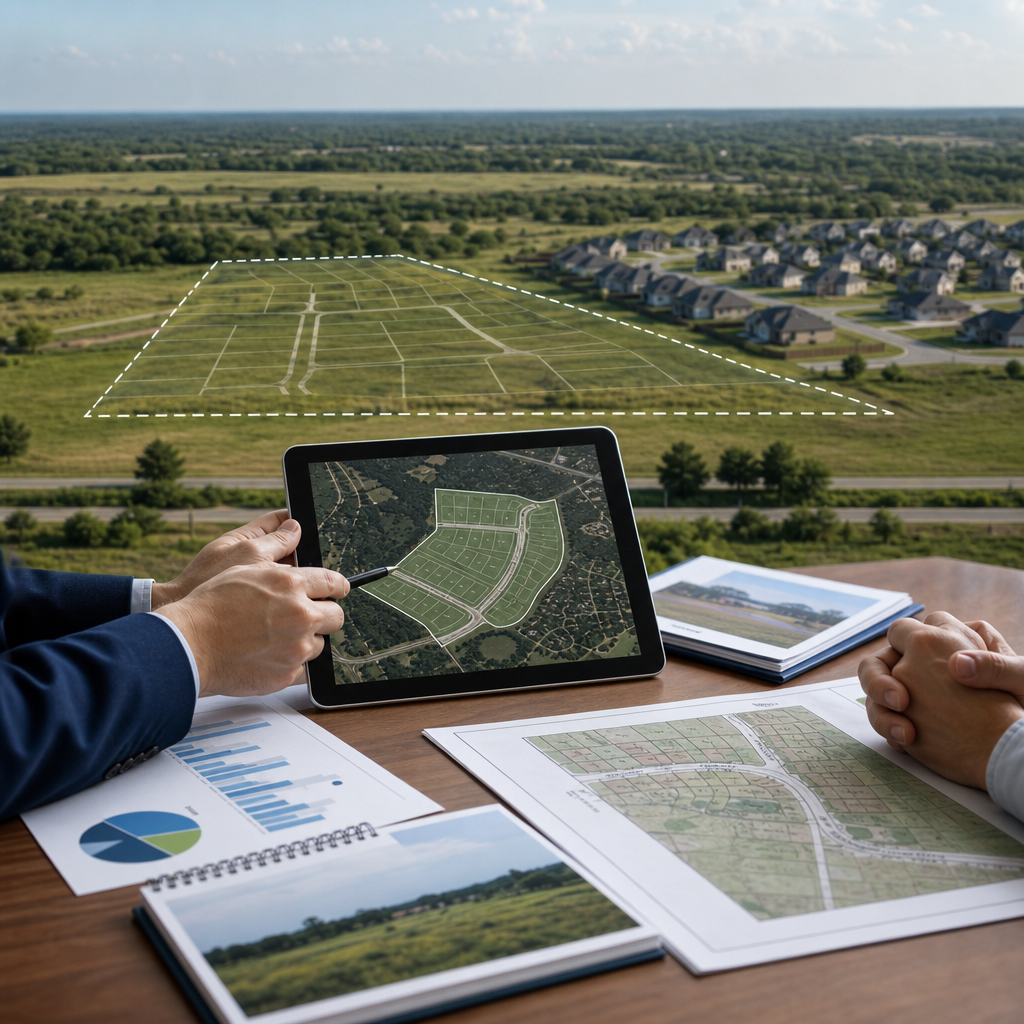
- Upon expiration of the lease (which coincides with the end of the building rights), the developer purchases the land at the predetermined price.
- The investor receives both the capital IRR (20–35% over 18–36 months) and the cumulative rental income (2–4% annually).
RiseQuire is particularly appealing to investors seeking a partial allocation to immediate income rather than deferred capital gains. It’s also a structure that works well in diversified portfolios, where you combine multiple investment vehicles.
Use Case: An investor allocates $2 million to LandQuire. $1.5 million goes to pure pre-development projects (25–30% return over 30 months), and $500,000 goes to RiseQuire (20% return on capital + 3% annual income).
Transparency and Track Record: Over 130 Successful Projects Since 2021
Trust is the watchword for international investors. You’re far from your investments, in a foreign jurisdiction, dealing with a company you may know only through a website. We owe it to you to make this possible.
Since our founding in 2021, we have completed more than 130 projects. Here’s what that means in practice:
Approval rate: 100%. Every project for which we have committed to obtaining building permits has been granted those permits. Zero failures. Zero projects canceled due to regulatory issues.
Return Performance: Our actual IRRs range from 22% to 32%, which is at the high end of our projected range of 20–35%. No project has generated an IRR below 20%.
Timeline: 91% of our projects were completed within the planned timeframe (30–36 months). The remainder were delayed by only a few months, mainly due to administrative delays beyond our control.
Capital Returned: 100% of investors’ capital was returned, plus the agreed-upon returns, with no margin calls, no requests for additional funding, and no downward adjustments to the expected structure.
We do not hide our data. We maintain a public record of our completed projects, available on our platform, with specific details on each acquisition, each approval, and each divestiture. Potential investors can request references from other investors who have participated in our projects.
We are also insured and comply with all federal and state regulatory requirements. Each transaction is documented by third-party attorneys, and our annual financial statements are audited by an independent auditing firm.
Setting the Standard: We’ve set a benchmark for trust that goes beyond a simple “track record.” We’re a company built on transparency because we know that’s what you’re looking for.
How to Get Started with Your First Passive Real Estate Investment in the U.S.
If you're convinced that pre-development offers the risk-return profile you're looking for, the process for getting started is simple.
Step 1: Initial Consultation. Contact our team with your preferences: available capital, target return, risk tolerance, preferred location (Texas or Florida), and timeline. We’ll assess your profile and recommend current projects that match your situation.
Step 2: Review the projects. Log in to our investment platform and browse the available projects. We provide all the necessary documents: plans, feasibility studies, regulatory analyses, and return projections. Feel free to ask as many questions as you need.
Step 3: Legal due diligence. If you would like an additional review, you may request one from your own legal or tax counsel. We will provide all the necessary documents. This usually takes 1–2 weeks.
Step 4: Investment Agreement. Once you’re comfortable with the terms, you sign a clear investment agreement that specifies the amount invested, the exit structure, the timeline, your share of the returns, and your right to information. No surprises, no hidden clauses.
Step 5: Closure and passive management. You transfer the capital. We deposit the funds, and you receive quarterly reports. You don’t have to do anything else until the exit, 24–36 months later.
Step 6: Distribution of Returns. At the end of the project, we collect the funds from the project sponsor, and you receive your original principal plus the agreed-upon IRR. Funds are typically distributed within 30 days of closing.
The entire process, from the initial conversation to the closing of your first investment, typically takes 4–6 weeks.
Minimum investment: $100,000 for a single project. Many investors start with $250,000 to $500,000, spread across 2–3 projects for better diversification.
Frequency: New projects become available every month. You can invest once, multiple times, or set up a recurring investment plan if you want to generate consistent returns year after year.
Contact us today for an initial consultation. Together, we’ll explore how to turn your capital into high U.S. returns, without the operational complexity of traditional real estate.