Asset Diversification: Strategy, Asset Classes, and International Allocation in 2026
Wealth management can no longer rely solely on domestic mechanisms. In 2026, the global macroeconomic environment—marked by the Federal Reserve’s interest rate adjustments, geopolitical tensions, inflation, and shifts in the commercial real estate sector—requires a rethinking of asset allocation.
Accordingto INSEE, 61.2% of French households owned real estate (primary residence, rental properties, land) as of early 2024, and real estate accounts for the lion’s share of their total assets. This structural concentration, rooted in a cultural attachment to French real estate, exposes a large portion of savers to a single economic cycle, a single currency, and a single tax system.
Building true resilience requires broadening one’s horizons. Asset diversification is not about accumulating products, but rather about allocating assets across multiple asset classes, tax brackets, time horizons, and geographic regions. It is within this framework that international real assets—including U.S. real estate—can play a role for certain savvy investors.
What is asset diversification, and why is it essential?
Asset diversification is an asset management strategy aimed at spreading capital across various financial, real estate, and alternative investment vehicles.
The principle is based on the fact that there is no perfect correlation between markets. When one asset class experiences a correction, another may hold up better or even rise. The goal is not to avoid all losses, but to limit the impact of a single shock on the overall portfolio.
According toINSEE, half of French households will have gross assets exceeding 205,000 euros in 2024. Above this median, INSEE Focus No. 354 (May 2025) specifies that 90.5% of households hold at least one financial asset, including 86.9% who hold a savings account and 41.7% who hold life insurance. However, real estate remains by far the dominant component of total net worth, with financial assets accounting for only about one-fifth of the total. This structure highlights two points: wealth accumulation involves a broad segment of the population, and diversification remains underdeveloped, given that the majority of the value is tied up in domestic real estate.
Diversification, dispersion, allocation: three distinct concepts
We need to distinguish between three concepts.
Diversification involves spreading risk across genuinely different asset classes. Holding stocks, bonds, real estate, money market instruments, and an alternative investment portfolio is part of a diversification strategy.
Scattering your investments involves holding multiple policies without an overarching strategy. Holding ten life insurance policies invested in the same euro-denominated funds and the same unit-linked funds does not constitute true diversification. It can even increase fees and make it harder to track your investments.
Asset allocation refers to the strategic allocation of capital based on risk profile, investment horizon, return objectives, tax considerations, and liquidity needs.
Why Diversification Remains Essential in 2026
In 2026, several factors are making diversification even more important: inflation still affecting certain categories of spending, interest rates higher than they were in the 2010s, stock markets that are sometimes concentrated in a few large-cap stocks, tax burdens, geopolitical instability, and diverging real estate cycles.
According to the Banque de France, approximately 58 million French people hold a Livret A savings account, for which the interest rate is set at 1.5% as of February 1, 2026. The Banque de France also notes that French households invested €128.4 billion in net inflows into financial instruments in 2025, a level close to the €129.3 billion recorded in 2024 (Banque de France, “Household Savings and Financial Assets, Q4 2025”). The base of regulated savings remains substantial, but it is not sufficient, over the long term, to offset cumulative inflation. The study “The French, Savings, and Retirement” by the Cercle des épargnants and Ipsos (February 2026) also notes that 39% of French people plan to set money aside in 2026, which is 16 percentage points more than nine years ago. The culture of saving is growing, but a culture of diversified investing has yet to take root.
Key takeaway: Diversifying your portfolio does not mean spreading your savings too thinly. It’s about building a well-balanced allocation to improve your resilience in the face of sectoral, geographic, currency, or tax-related shocks.
Areas of diversification: asset classes, sectors, geography, taxation
Effective asset diversification is based on four complementary pillars: asset classes, sectors, geography, and taxation.
These approaches must be combined. An investor can hold multiple financial products while remaining focused on the same risk. Conversely, a simpler but better-structured portfolio can offer true diversification.
Diversify by asset class
The first strategy involves diversifying one’s capital across several asset classes: cash, bonds, stocks, real estate, real estate investment trusts (SCPI), private equity, crowdfunding, gold, commodities, land, or real assets.
The three traditional asset classes—stocks, bonds, and real estate—do not always react in the same way. Stocks depend on corporate earnings and valuations. Bonds are sensitive to interest rates and credit risk. Real estate depends on rents, vacancy rates, financing, and appraised values. Land, in particular, depends on location, scarcity, zoning, permits, and exit conditions.
Diversify by sector and geographic region
Sector diversification involves avoiding excessive concentration in any single industry: technology, healthcare, luxury goods, banking, energy, office real estate, or consumer goods.
Geographic diversification goes a step further. It aims to reduce French or European domestic bias. Many investors believe they are diversified because they hold life insurance, a PEA, a PER, SCPIs, and a primary residence. But these investment vehicles often remain exposed to France, Europe, the euro, and French regulations. Yet the United States alone accounts for approximately 60% of global market capitalization.
Diversifying one’s assets internationally provides access to different economic cycles, currencies, real estate markets, and demographic trends.

Diversify by tax brackets and time horizons
Tax frameworks shape the structure of asset ownership: life insurance, PEA, PEA-PME, PER, CTO, civil law partnership, holding company, or foreign entity, as appropriate.
They do not replace the underlying assets. A life insurance policy may include euro funds, unit-linked products, ETFs, UCITS, real estate investment trusts (SCPI), or private equity. As a result, two policies can be very different or nearly identical.
The investment horizon is just as important. A safety portfolio must remain liquid. A growth portfolio can tolerate more volatility. An alternative portfolio can be illiquid only if the rest of the portfolio is already sufficiently diversified.
Key takeaway: A robust asset allocation strategy combines multiple asset classes, sectors, geographic regions, and tax regimes. True diversification relies on the differences in how assets behave.
An Overview of Asset Classes for Diversifying Your Portfolio
Each asset class has its own role, risk level, liquidity, and time horizon. There is no such thing as an ideal investment vehicle. The challenge is to combine the right building blocks in the right places within a wealth management strategy.
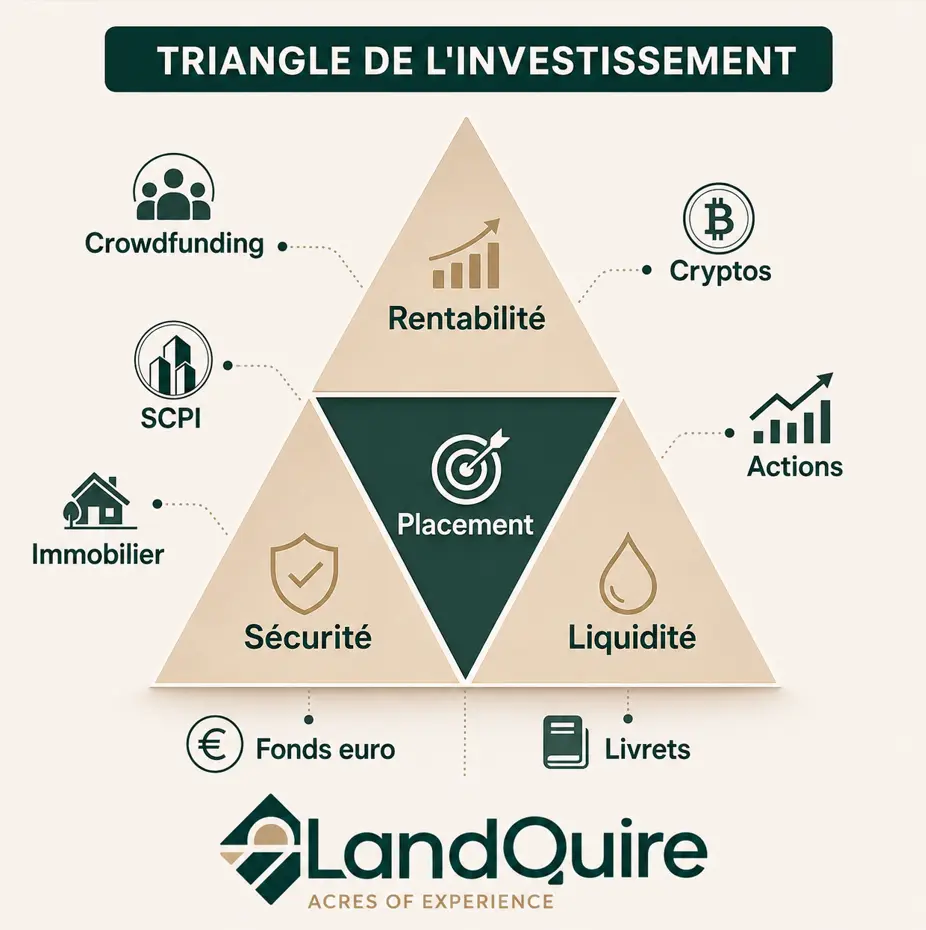
Before making any decision, a simple methodological framework is essential: the investment triangle. No investment meets all three criteria—return, safety, and liquidity—at the same time. The Livret A savings account is safe and liquid but offers a low return. Stocks can be profitable and liquid, but they are not safe. Real estate can be profitable and tangible, but it is not liquid. Any financial decision boils down to striking a balance among these three vertices.
The returns listed below are illustrative figures or observed market averages, depending on the investment vehicle. They do not constitute a guarantee of performance and may vary significantly depending on market conditions, fees, tax treatment, the investment vehicle used, and the holding period.
| Asset Class | Heritage Role | Estimated yield | Risk | Liquidity | Horizon | Taxation |
|---|---|---|---|---|---|---|
| Livret A, LDDS, LEP | Contingency Savings | 1.5% as of February 1, 2026 | Low (loss of purchasing power) | Very strong | Short term | Income Tax and Social Security Exemption |
| Monetary | Cash, pending | Varies depending on the rate | Low to moderate | Strong | Short term | Depending on the envelope |
| Obligations | Revenue, Stabilization | Coupon or bond yield | Moderate | Moderate to heavy | Ages 3 to 8 | Depending on the envelope |
| Stocks, ETFs, UCITS | Long-term growth | A historical return of approximately 7% per year, smoothed over the very long term (past performance is not a guarantee) | High | Strong | Ages 8 and up | PEA, CTO, life insurance |
| Rental Properties | Revenue, Tangible Assets | Rent and Potential Appreciation | Moderate to high | Low | 10 years and older | Real Estate Income or LMNP |
| SCPI | Real Estate Without Property Management | Average SCPI dividend yield for 2025: 4.91% (source: ASPIM) | Moderate to high | Limited | Ages 8 to 10 and up | Based on detention |
| Private equity | Unlisted Growth Companies | Potential capital gains are not guaranteed | High | Low | 7 to 10 years | Depending on the vehicle |
| Real estate crowdfunding | Project Funding | Non-Guaranteed Contractual Target | High | Low | 2 to 5 years | PFU 31.4% most often |
| International Real Estate | Real assets, geographic diversification | Potential capital gain upon exit | High | Low | 24 months or more, depending on the project | International Taxation |
Money and Bond Markets: A Foundation of Liquidity and Security
Regulated savings accounts such as the Livret A, LDDS, or LEP form the foundation of financial security. Their purpose is not to maximize returns, but to ensure that funds are immediately available. It is generally recommended to have an emergency fund equivalent to 3 to 6 months of living expenses before making any long-term investments.
Bonds and bond funds can provide a more consistent income stream, but they are not without risk. A rise in interest rates can cause a bond’s market value to fall. An issuer’s default can result in a loss. Therefore, the choice of duration, credit quality, and tax treatment remains important.
Stocks and ETFs: Drivers of Long-Term Performance
Stocks have been the driving force behind long-term historical performance. Over a very long period, U.S. stock indices have delivered a smoothed average return of approximately 7% per year, with dividends reinvested. This historical data is not a guarantee of future performance and masks volatility that can sometimes be high over short cycles.
Stocks fit well into a dollar-cost averaging (DCA) strategy, which involves investing gradually to spread out entry points.
ETFs provide access to broad indices—such as the MSCI World, S&P 500, Nasdaq, and Euro Stoxx—as well as emerging markets and specific sectors. The PEA offers exposure to European stocks within a favorable tax framework. The CTO offers greater flexibility, particularly for U.S. stocks, REITs, and certain international ETFs.
Real Estate: Physical Property, SCPI, Land
Real estate remains a cornerstone of French wealth. It can take several forms: primary residence, rental investment, SCPI, publicly traded real estate investment trusts, bare ownership, or land.
A primary residence offers security of use, but it often concentrates a significant portion of one’s assets in a single property. Rental real estate can generate income, but it involves management, repairs, tax considerations, vacancies, and regulatory requirements. Before making any rental investment, calculating the Internal Rate of Return (IRR) is essential for assessing the risk-return profile, taking into account the leverage effect of borrowing. This leverage amplifies gains during periods of low interest rates but can become a major burden if the cost of borrowing exceeds the project’s profitability.
SCPIs allow investors to invest in real estate without having to manage the property directly. However, as the AMF points out, they involve fees, limited liquidity, a non-guaranteed return, and the risk of capital loss.
Real estate constitutes a distinct asset class. It is not based on rental income, but on the potential appreciation of the land, its scarcity, its location, and the permits obtained.
Private equity, crowdfunding, and alternative real assets
Private equity and real estate crowdfunding allow investors to invest in unlisted companies or projects. They can complement a well-diversified portfolio, but they require investors to accept illiquidity, execution risk, and the risk of capital loss.
Alternative real assets include gold, certain commodities, infrastructure, real estate, and specific tangible assets. They can offer partial decorrelation from listed markets, but they are never risk-free. The consensus among wealth management advisors is generally to limit this non-traditional asset class to no more than 10% of total assets.
Key takeaway: A resilient investment portfolio combines the traditional trio of stocks, bonds, and real estate with the building blocks of liquidity, tax efficiency, and advanced diversification. Potential returns must always be weighed against liquidity, risk, and investment horizon.
Diversification through tax-advantaged accounts: life insurance, PEA, PER, CTO
In France, assets are often held within tax-advantaged accounts. While these are useful, they are not enough to achieve true diversification.
An investor can hold multiple life insurance policies and still be exposed to the same funds. Conversely, a single, well-structured policy can already offer several underlying assets: euro funds, unit-linked funds, ETFs, bonds, SCPIs, real estate funds, or private equity.
Life Insurance: A Multifunctional Foundation
A life insurance policy remains a key investment vehicle. Depending on the policy, it allows you to combine euro-denominated funds, unit-linked funds, bonds, ETFs, UCITS, SCPIs, or real estate investment vehicles.
After eight years, life insurance policies benefit from a favorable tax treatment on surrender values. Gains are exempt from income tax up to an annual exemption of 4,600 euros for a single person and 9,200 euros for a married couple filing a joint return. Social security contributions of 17.2% remain due on the gains.
Life insurance also plays a key role in estate planning. For payments made before age 70, each designated beneficiary may receive up to 152,500 euros free of inheritance tax (Article 990 I of the General Tax Code). For payments made after age 70, a total deduction of 30,500 euros applies across all beneficiaries, with capital gains exempt from tax (Article 757 B of the General Tax Code).
Its limitations stem from costs, the quality of the investment vehicles, restrictions in certain contracts, and the sometimes limited access to truly international assets.
PEA and PEA-PME: European Stock Allocations
The PEA allows you to invest in European stocks and certain eligible funds, with favorable tax treatment after holding the investment for five years. The contribution limit is set at 150,000 euros per person, supplemented by a PEA-PME limit of 75,000 euros. After five years, gains are exempt from income tax, but social security contributions of 18.6% remain due.
The PEA can also provide indirect exposure to broader indices through certain eligible ETFs. However, it remains regulated to focus on the European market. For an investor seeking to diversify their portfolio internationally, the PEA often needs to be supplemented by other investment vehicles.
PER: Retirement and Tax Leverage
The Retirement Savings Plan (PER), established by the 2019 Pacte Act, is designed to help individuals save for retirement. Voluntary contributions are generally deductible from taxable income within certain limits, making it a particularly attractive option for taxpayers in high tax brackets (marginal tax rate of 30% or higher).
In return, the principal is generally locked in until retirement, except in cases where the law allows for early withdrawal (purchase of a primary residence, unforeseen life events). Withdrawals can be made as a lump sum, as an annuity, or both. The PER is therefore well-suited for a long-term investment horizon but less so for short-term liquidity needs.
Standard Securities Account: Total Flexibility
The standard securities account (CTO) offers a wide range of investment options. It provides access to international stocks, ETFs not eligible for the PEA, bonds, U.S. REITs, publicly traded real estate companies, and markets in the United Kingdom, Switzerland, and the United States.
Its tax treatment is based on the Single Flat-Rate Levy (PFU, or flat tax) of 31.4% (12.8% income tax + 18.6% social security contributions), with the option to choose the progressive tax scale if it is more favorable. Although less tax-advantageous than a PEA or life insurance, the CTO often remains essential for an advanced international asset allocation strategy.
The Limits of French Funding for Internationalization
French investment funds remain useful, but they are subject to national and European regulations. They can provide access to foreign assets, but they do not always offer direct geographic diversification.
Holding a synthetic U.S. ETF in a PEA or an international unit-linked investment within a life insurance policy is not the same as directly acquiring real assets abroad. The two approaches can be complementary.
Key takeaway: Life insurance, PEA, PER, and CTO are investment vehicles. Diversification depends on the underlying assets, geographic exposure, tax treatment, and liquidity—not just on the number of accounts you have open.
Geographic Diversification: Why Leave the Eurozone in 2026?
Geographic diversification is one of the most important strategies for already structured investment portfolios. It involves investing outside of France—and sometimes outside the eurozone—to reduce domestic bias.
The initial observation is clear: French real estate accounts for by far the largest share of average household assets, and the majority of financial instruments held are denominated in euros and exposed to European indices. This concentration creates a strong dependence on the eurozone’s economic cycle, the French tax system, and local political decisions. For a savvy investor, this concentration can become a structural risk.
Why the U.S. Market Remains the Primary Focus for International Diversification
The U.S. market remains one of the main areas for international diversification. It combines financial depth, the strength of the U.S. dollar, a highly liquid stock market, an entrepreneurial culture, population growth in certain regions, and real estate diversity.
The Sun Belt—particularly Texas and Florida—has been attracting households, businesses, and capital for several years. While these markets are not without risks, they offer dynamics that differ from those seen in Europe.
Exposure to the United States can take several forms: U.S. stocks, ETFs, REITs, U.S. real estate investment trusts (SCPI), rental investments, real estate club deals, crowdfunding, or direct real estate investments.
Options for Gaining Exposure to U.S. Land and Real Estate
There are several options for investing in real estate abroad, specifically in the United States.
U.S. REITs are publicly traded real estate investment trusts. They are liquid but volatile. Real estate ETFs offer sector diversification but remain exposed to financial markets. U.S. SCPIs provide access to U.S. real estate through a regulated collective investment vehicle, with limited liquidity. Direct rental investment allows you to own a property but involves management, tax considerations, repairs, vacancies, and local regulations.
Direct real estate investment through an LLC follows a different approach.
Landquire assists French-speaking investors in acquiring and developing land in the United States, particularly in Texas and Florida, through a U.S. LLC legal structure. Landquire’s offering is not an SCPI, is not an FIA, and is not marketed as a collective investment product regulated by the AMF. It involves a direct acquisition through a U.S. LLC and is reserved for sophisticated investors.
The model is based on land entitlement: identifying land, acquiring it, handling administrative procedures, working on zoning, preparing the property for development, and selling it to a professional buyer. The target cycle is generally 24 to 36 months, excluding rental management.
This approach has several distinctive features:
- exposure to the U.S. dollar, which provides currency diversification relative to the euro but also exposes the investor to foreign exchange risk;
- exposure to the Texas and Florida markets;
- no rental income, since the underlying asset is land;
- a lack of liquidity during the term of the transaction;
- an execution risk related to the local market, authorizations, the timeline, and the terms of resale.
Landquire documents its track record through its completed real estate projects and its track record video.
The figures presented in this institutional overview reflect past performance based on closed transactions. They do not constitute a guarantee of principal, are not indicative of future performance, and should not be extrapolated to any specific transaction. Landquire real estate transactions are illiquid for the duration of the investment and are intended only for sophisticated investors. Any tax analysis specific to this type of transaction should be conducted by a specialized advisor, drawing in particular on the international tax guide.
Other options: Dubai, Portugal, the United Kingdom, Switzerland
Dubai attracts certain investors due to its tax system, real estate growth, and international standing. However, the market can be cyclical and sensitive to foreign capital flows.
Portugal continues to be considered for its quality of life, its proximity to Europe, and certain tax structures, even though the historical advantages have changed.
The United Kingdom continues to have deep financial and real estate markets, but is exposed to the British pound and a post-Brexit environment.
Switzerland offers stability, a strong currency, and legal certainty, but the barriers to entry are high, and access to real estate can be limited.
Key takeaway: Leaving the eurozone can improve the geographic diversification of an investment portfolio. The United States remains a key focus, but each investment vehicle must be analyzed based on its tax treatment, liquidity, currency risk, and level of regulation.
The Wealth Pyramid: Structuring Your Asset Allocation by Tier
The asset allocation pyramid helps you organize your portfolio by risk level. It helps you avoid a common mistake: seeking high returns too early, before you’ve solidified your foundation.
The higher the tier, the greater the potential for performance—but the greater the illiquidity, complexity, and risk.
Levels 1 and 2: Safety Foundation and Capitalization
Tier 1 corresponds to immediate liquidity. It includes regulated savings accounts (Livret A at 1.5% as of February 1, 2026, LDDS, LEP), money market funds, and available cash. Its purpose is to cover unforeseen expenses, not to maximize returns.
Tier 2 includes investment vehicles that offer capital growth and relative stability: life insurance, euro-denominated funds, high-quality bonds, a primary residence, or conservative long-term savings.
These two pillars must be solid before allocating a significant portion to riskier assets.
Level 3: Growth Engine
Level 3 is home to growth-oriented assets: stocks, ETFs, UCITS, rental real estate, SCPIs, and REITs.
There is a risk of capital loss, but the long-term horizon helps offset some of the market cycles. This tier aims to grow assets at a rate that outpaces inflation.
Level 4: Advanced Diversification and Real Assets
At the top of the pyramid are alternative assets: private equity, real estate crowdfunding, club deals, international real estate (including real estate investment through a U.S. LLC), gold, commodities, and specific real assets.
These investments can enhance an asset allocation, but they should not form its foundation. They are intended for sophisticated investors who are able to accept illiquidity, complexity, and the risk of capital loss. The consensus among wealth management professionals is that this non-traditional asset class should not exceed approximately 10% of total assets.
Key takeaway: The wealth pyramid serves as a reminder that you should consolidate your liquidity and core assets before adding alternative components. The top of the pyramid should remain proportional to your overall wealth.
What asset allocation is right for you based on your profile, age, and investment horizon?
The examples below are for educational purposes only. They do not constitute personalized advice. An actual allocation must be tailored to the investor’s family, tax, professional, and financial circumstances.
Typical asset allocation for a 30- to 40-year-old investor
An investor aged 30 to 40 often has a long investment horizon. He or she may be able to tolerate a higher degree of volatility if he or she already has an emergency fund.
Educational example for 100,000 euros:
- 15% cash and cash equivalents
- 45% stocks, ETFs, PEA, or CTO
- 20% diversified life insurance
- 10% real estate or SCPI
- 10% in alternative or international assets
The goal is to build a dynamic portfolio without compromising liquidity.
Typical compensation package for an executive aged 45 to 55
A senior executive, business leader, or investor in the process of structuring their estate often seeks a balance between growth, protection, and international diversification.
Educational example for 100,000 euros:
- 15% cash and cash equivalents
- 25% stocks and ETFs
- 25% life insurance, bonds, or euro-denominated funds
- 20% real estate, SCPI, or REIT
- 15% in alternative assets, private equity, or international real estate
This allocation may include a component of geographic diversification if the rest of the portfolio is heavily concentrated in France.
Standard benefit for an early retiree or retiree
Starting at age 60, the focus often shifts to visibility, succession planning, liquidity, and generating supplemental income.
Educational example for 100,000 euros:
- 25% cash and cash equivalents
- 25% bonds and euro-denominated funds
- 20% diversified life insurance
- 15% international stocks
- 10% real estate or SCPI
- 5% alternative assets
An alternative source of funding may exist, but it must be compatible with revenue and availability requirements.
| Profile | Monetary Policy and Security | Bonds and Euro-denominated funds | Stocks and ETFs | Real Estate and SCPI | Alternative and International |
|---|---|---|---|---|---|
| Prudent | 25% | 35% | 15% | 20% | 5% |
| Balanced | 15% | 25% | 30% | 20% | 10% |
| Dynamic | 10% | 15% | 40% | 20% | 15% |
Key takeaway: An optimal asset allocation changes over time based on age, income, tax situation, family plans, and investment horizon. Sample asset allocations are meant to serve as a framework for consideration, not as personalized advice.
Common Mistakes and Trade-offs in Asset Allocation
The first mistake is to confuse a large portfolio with a diversified portfolio. An investor may have a large net worth, but it may be concentrated in their primary residence and a few local rental properties. This is the typical situation for French households, where real estate remains by far the dominant component of net worth (a 61.2% ownership rate according to INSEE in 2024) and where financial assets account for only about one-fifth of the total.
The second mistake is domestic bias. Many French investors hold primarily French real estate, euro-denominated funds, European stocks, and French tax-advantaged investment vehicles. This tax consistency can mask an economic concentration within a single currency zone.
The third mistake is the illusion of diversification. Holding five different SCPIs does not mean you are diversified if they are all exposed to the same real estate market, the same interest rate cycles, or the same sectors. Similarly, owning a PEA, a PER, a CTO, and several life insurance policies does not constitute diversification if the underlying assets track the same indices.
The fourth mistake is to overlook liquidity. A portfolio consisting of real estate, real estate investment trusts (SCPI), private equity, and land may be well-balanced, but it becomes vulnerable if the investor needs to quickly recoup capital.
The fifth mistake is to overlook international tax issues. Investing in real estate abroad requires an understanding of tax treaties, reporting requirements, currencies, local structures, and exit taxation.
The sixth mistake is to confuse UCITS with AIFs. UCITS operate in listed and regulated markets. Alternative Investment Funds (AIFs) involve private assets that are not traded on the stock exchange. Both have their place, but at different levels of the wealth pyramid.
Checklist before adding a new asset to your portfolio:
- What role does this asset play in my portfolio?
- Is it liquid or illiquid?
- Is it really any different from my other investments?
- Is he exposed to another currency?
- What are the tax implications?
- What is the risk of capital loss?
- What is the most realistic minimum timeframe?
- Is this a basic brick or an advanced brick?
Key takeaway: Asset diversification must be thoroughly reviewed. What matters is not the number of products, but the actual diversity across risks, regions, currencies, and time horizons.
What are the four types of diversification?
The four main types are diversification by asset class, sector diversification, geographic diversification, and tax diversification. A sound asset allocation combines these four dimensions.
Why diversify your assets?
Diversification helps reduce overall risk, smooth out returns, and improve resilience in the face of crises. The goal is not to avoid all losses, but to avoid relying on a single asset, a single country, a single currency, or a single economic scenario.
How Can You Diversify Your Portfolio in 2026?
In 2026, diversifying one’s portfolio will involve combining cash, bonds, stocks, real estate, tax-advantaged accounts, and international diversification. Real and alternative assets can complement an investment portfolio for savvy investors, provided they are willing to accept their illiquidity and risk.
How can you balance risk and return when diversifying your portfolio?
Balance depends on the investment horizon. Funds needed in the short term should be held in liquid investments, which generally offer low returns and limited market risk, but may result in a loss of purchasing power if inflation exceeds the return earned. Long-term funds can be allocated to more volatile or illiquid assets.
What is a good asset allocation at age 40?
At age 40, the investment horizon is generally long-term. An asset allocation may place a significant emphasis on stocks and ETFs, while maintaining a portion in cash, life insurance, real estate, and possibly a small allocation to alternative investments. The exact breakdown depends on the investor’s risk profile and financial situation.
What should your asset allocation look like at age 50?
At age 50, investors often seek a balance between growth, protection, and retirement planning. An asset allocation can combine cash, bonds, life insurance, international stocks, real estate, real estate investment trusts (SCPI), and alternative assets in appropriate proportions.
How can I grow 50,000 euros through a diversified investment strategy?
As an illustrative example, one might allocate 50,000 euros among emergency savings, ETFs, life insurance, bonds, and a small portion in real estate or alternative investments. This asset allocation should be tailored to the investor’s time horizon, tax situation, liquidity needs, and risk tolerance.
Is investing in overseas real estate a good diversification strategy?
Foreign real estate investment can be an effective strategy for reducing domestic bias and gaining exposure to other economic cycles. Certain bilateral tax treaties may limit instances of double taxation or alter the tax treatment of foreign income. However, their impact depends on the country, the investment vehicle, the nature of the income, and the investor’s tax situation. Expert advice remains essential.
What role do private equity and alternative assets play in a diversified portfolio?
Private equity, crowdfunding, and alternative real assets can serve as a complementary asset class for savvy investors. While they may offer partial decorrelation from public markets, they remain exposed to economic risk, execution risk, liquidity risk, and the risk of capital loss. The general consensus among wealth management professionals is that this asset class should not exceed approximately 10% of total assets.
What is the minimum number of asset classes needed to be truly diversified?
There is no one-size-fits-all number. A truly diversified portfolio generally includes at least cash, bonds or euro-denominated funds, stocks, real estate, and possibly alternative assets. The quality of diversification matters more than the number of investment vehicles.
Publication Information
Author: Thibaut Guéant, co-founder of Landquire. Licensed real estate agent in Florida with over 12 years of experience in the U.S. real estate market. Has helped structure and manage approximately $73 million in real estate and land assets. Honored by Challenges magazine in 2024.
Last revised: June 23, 2026.
To learn more about the team, visit the U.S. Real Estate Investment Team page. For more information on tax considerations, see our guide to international taxation.
Are you looking to add a component of true geographic diversification to your portfolio?
Landquire is a French company that assists French-speaking investors in acquiring and developing land in the United States (Texas, Florida) over a short cycle of 24 to 36 months, without rental management.
- 100% Managed Investment
- Short-term program (24 to 36 months)
- Documented track record on completed projects
- Off-market, for experienced investors only
View current real estate opportunities
Explore Projects That Have Already Been Sold
Connect with the Landquire team