Investing $100,000 in Pre-Development: The Complete Guide to Legal Documents

The Investor's Challenge: Understanding the Documentation Requirements for Pre-Development
You have $100,000 to invest in real estate pre-development in the United States. You’ve identified an attractive parcel of land in Florida or Texas. You’ve even estimated a potential return of 25% over 24 months. But just as you’re ready to sign, your legal advisor asks, “Do you have all the documents?”
All too often, this moment of clarity comes too late. International investors discover that the documentation requirements during the pre-development phase go far beyond simply signing a purchase agreement. In the United States, the documentation process for real estate projects is complex, involves multiple states, and is subject to stringent regulations.
Pre-development rests on three key documentation pillars: the legal acquisition of the land, securing development entitlements, and operational compliance throughout the project. Each pillar generates its own set of critical documents. Ignoring this structure exposes your capital to significant delays, regulatory cost overruns, or worse yet, the inability to transfer the project to developers.
Our experience with more than 130 projects completed since 2021 has shown us that investors who understand this document architecture from the outset avoid 90% of operational problems. Those who discover these requirements along the way lose time, money, and sometimes access to their expected returns.
Why Legal Documents Are Critical to Protecting Your $100,000 in Capital
An investment in pre-development is not simply a land acquisition. It is the legal and regulatory transformation of a raw parcel of land into a subdivided and developed project, ready for a residential developer. This transformation depends entirely on sound legal documentation.
Here's why:
A defective title can invalidate your entire value chain. If the previous owner had undisclosed easements or liens on the property, your right to subdivide or transfer it is compromised. A poorly structured purchase agreement leaves you vulnerable to unexpected remediation costs.
Entitlements (permits, subdivision approvals, zoning compliance) account for 40 to 60 percent of the value created during the pre-development phase. Without appropriate and final entitlement documents, the developer who purchases your project at the end of this phase cannot build. Your project will remain unsold.
Operational compliance (meeting minutes, entity resolutions, tax filings, and USD compliance for foreign investors) protects the project from legal disruptions. In the United States, poorly structured or poorly documented entities are prone to tax audits, compliance fines, and transaction delays.
For international investors, currency risk and regulatory compliance (FATCA, U.S. income reporting) underscore the importance of accurate and consistent documentation. An error in tax records can delay the exit by 6 to 12 months.
Immediate Action: Before signing a land purchase contract, have an experienced legal advisor conduct a preliminary title search. This search will identify any defects that would be much more costly to correct after the purchase.
The Fundamental Documentary Framework: What We Require at LandQuire
We have developed a standardized documentation framework that applies to every investment, regardless of the market or the size of the property. This framework consists of five main categories:
- Acquisition and title documents: purchase agreements, title reports, right-of-way files, and closing documents.
- Legal structure documents: articles of incorporation, certificates of registration, corporate resolutions, shareholder or partner agreements.
- Entitlement documents: applications submitted to municipalities, letters of zoning compliance, approved subdivision plans, decisions by the planning commission, and permits.
- Financial and Compliance Documents: federal and state tax returns, bank account statements, investment income statements, and FATCA compliance for foreign investors.
- Operational and management documents: survey contracts, environmental reports, contracts with planning consultants, meeting minutes, regulatory correspondence.
At LandQuire, we only accept an investment if all of these documents can be gathered and kept up to date throughout the duration of the project. This discipline prevents surprises and ensures that the project remains “marketable” in the eyes of the end buyers.
Acquisition and Title Documents: Establishing Legal Ownership of the Land
The purchase process begins with three key documents: the purchase agreement, the title report, and the closing documents.
The purchase agreement must include specific provisions regarding pre-development. Unlike a standard residential real estate purchase, you need explicit subdivision rights, access to public roads, and a clear waiver of any right of first refusal by the seller or public entities. A generic contract exposes the project to the risk that the seller or a municipality might intervene during the development work.
A title report is issued by a title insurance company and lists all interests encumbering the property: prior mortgages, easements, tax liens, or covenant restrictions. For a subdivision project, certain easements may be incompatible with development. For example, a public utility easement crossing the property may prohibit the construction of residential lots in that area. You must identify these restrictions before purchasing the property and negotiate their removal or modification as part of the contract.
The closing documents (deed, lien releases, title insurance policy) legally transfer title to your legal entity. The deed must be recorded with the county recorder’s office. The title insurance must cover the right to subdivide and must be issued in the name of your investment entity.
Here’s a concrete example: In 2024, we purchased a 45-acre parcel in Central Florida. The initial title report showed an access easement belonging to an adjacent property that ran right through the center of our land. Without this clarification, we would have subdivided the property into 12 lots, 4 of which would have been inaccessible. We negotiated the removal of this easement before closing, which added two weeks to the process but preserved the project’s value of $800,000.
Key step: Request a full title report at least 30 days before the projected closing date. Identify any problematic restrictions and negotiate their removal or modification in the contract.
Entitlement Documents: The Heart of Value Creation
Entitlements transform raw land into a developable project. These documents legalize the subdivision, establish zoning compliance, and secure all necessary regulatory approvals. Without them, your land remains an undeveloped parcel with little added value.
The main entitlement documents include:
Zoning Compliance Certificate: issued by the municipality or county, confirming that the land may be used for a residential project. It also specifies the maximum density (number of permitted lots), parking requirements, and minimum setbacks (distances from property lines).
Subdivision plans: technical and legal documents that define the exact boundaries of each lot, internal roads, common areas, and easements. These plans must be prepared by a licensed land surveyor and approved by the municipality. In Florida and Texas, the approval process varies: Florida uses a “final plat” process, while Texas uses registered subdivisions.
Municipal Approval Resolutions: Formally, the municipality must vote on and document its approval of your subdivision plan. This document serves as proof that all municipal requirements have been met and that the project can no longer be challenged.
Specialized permits and certificates: Depending on the location and complexity of the project, you may need stormwater permits, environmental approvals if the property contains wetlands, or road access certificates.
Land rights are the primary source of value creation. A 45-acre undeveloped lot can be purchased for $900,000. After development and obtaining approval for 12 lots, the same property sells to a developer for $2.4 million. The difference is not due to physical improvements, but to securing the legal rights to build.
At LandQuire, our teams are well-versed in the municipal codes of Texas and Florida. We know where the permitting process is quick (certain counties in Florida: 4–6 months) and where it requires patience (more conservative counties: 12–18 months). We budget for timelines and costs realistically.
Priority Action: Before purchasing, obtain a letter of conformity from the municipality. This confirms that your target density is achievable without having to apply for variances or zoning exemptions, which would significantly delay the project.
Management and Operational Compliance Documents
Beyond acquisition and entitlement, every project requires rigorous operational compliance. This is where problems arise for inexperienced investors.
Your legal entity (typically an LLC or an S-Corp) must maintain formal records: meeting minutes, director/member resolutions, a register of members or shareholders, and loan or investment agreements. These documents demonstrate the project’s legal authority and protect limited liability in the event of a dispute.
Federal tax returns (Form 1120-S for an S-Corp, Form 1040 Schedule E for an LLC) and state tax returns must be filed annually. For international investors, U.S. tax compliance includes FATCA (Foreign Account Tax Compliance Act) and W-8BEN (Certificate of Foreign Investor Status) requirements. These documents certify your tax status to the U.S. federal government and prevent punitive withholding taxes upon withdrawal.

Consulting and surveying contracts document the services provided. When you sell the project to a developer, the buyer reviews these contracts to assess the final costs and the quality of the work. Poorly structured or incomplete contracts create confusion during the final due diligence process.
A concrete example: We managed a project where the surveying team had not signed a formal contract. At final closing, the surveyor submitted an additional invoice for “unforeseen” services. The buyer withheld this amount from the down payment, delaying the disbursement of funds to our investors by 3 weeks. A detailed contract at the start of the project would have prevented this problem.
Weekly task: Maintain a centralized file of all documents. Each month, update the compliance list and identify any missing documents. Proactive management eliminates last-minute surprises.
The LandQuire Difference: How We Simplify the Document Management Process
Our approach differs from that of traditional project managers. Instead of leaving investors to navigate the maze of paperwork on their own, we guide them through the entire process.
First, we have developed standardized templates for each type of document. Our purchase agreements include all the necessary protections for pre-development. Our LLC structures are optimized for tax efficiency and USD compliance. This reduces legal review times and minimizes back-and-forth communication with attorneys.
Second, we centrally coordinate all service providers (local attorneys, land surveyors, urban planning consultants). Each service provider receives a list of required documents defined at the start of the project. This prevents duplication, omissions, and misunderstandings regarding what is to be delivered.
Third, we maintain an internal document tracking system. Each project has a dashboard listing all required documents, along with their completion statuses and due dates. Investors have real-time access to this dashboard. There’s no mystery about the status of the documents or what still needs to be done.
Fourth, we manage end-to-end tax and USD compliance. Our teams prepare tax returns, coordinate FATCA requirements, and structure distributions to minimize withholding tax. For international investors, this means that funds are received without any regulatory surprises.
Out of 130 projects, we have never had a document compliance issue that caused a delay in release. This is no coincidence; it is the result of systematic discipline.
Complete Checklist of Documents for Your $100,000 Investment
Here is the comprehensive checklist we use at LandQuire for every investment:
Pre-acquisition phase (prior to closing)
- Title Report
- Purchase Agreement with Subdivision Provisions
- Preliminary Zoning Compliance Letter
- Preliminary Environmental Report (if required)
- Road Access Study
Closing Phase (upon signing)
- Deed (title deed)
- Title insurance policy
- Funding documents (if applicable)
- Certificate of Registration for an LLC or Other Legal Entity
- W-9 or W-8BEN for tax compliance
Entitlement Phase (6–18 months)
- Preliminary and Final Subdivision Plans
- Municipal Approval Resolutions
- Final Zoning Compliance Certificate
- Stormwater Permits and Environmental Permits
- Letters of No Objection from Utility Providers (electricity, water, gas)
Operational Phase (ongoing)
- Urban Planning Consultant Contracts
- Surveying and Geotechnical Engineering Contracts
- Minutes of Executive Meetings
- Updated Register of Members/Shareholders
- Annual Tax Returns (Form 1120-S, Form 1040 Schedule E)
- Certificate of Tax Status (W-8BEN, renewed if necessary)
Exit Phase (Preparation for Sale)
- Complete “due diligence” package for the buyer
- Final Degree Certificate
- All original entitlement documents
- Certificate of Completion (if applicable)
Helpful tip: Create a physical and digital file for each document. Store the digital copies on a secure server (a cloud storage service with restricted access). Keep a printed copy on file. This ensures accessibility even in the event of a technical issue.
Common Mistakes to Avoid: Document-Related Risks in the Pre-Planning Phase
After working on 130 projects, we've identified the documentation errors that slow down or jeopardize investments. Recognizing them will help you avoid them.
Mistake 1: Generic purchase agreements. Many investors use a contract template designed for residential real estate. These contracts do not include protections specific to pre-development. As a result, you discover after closing that you do not have the explicit right to subdivide. A developer will not purchase a project without clear subdivision rights.
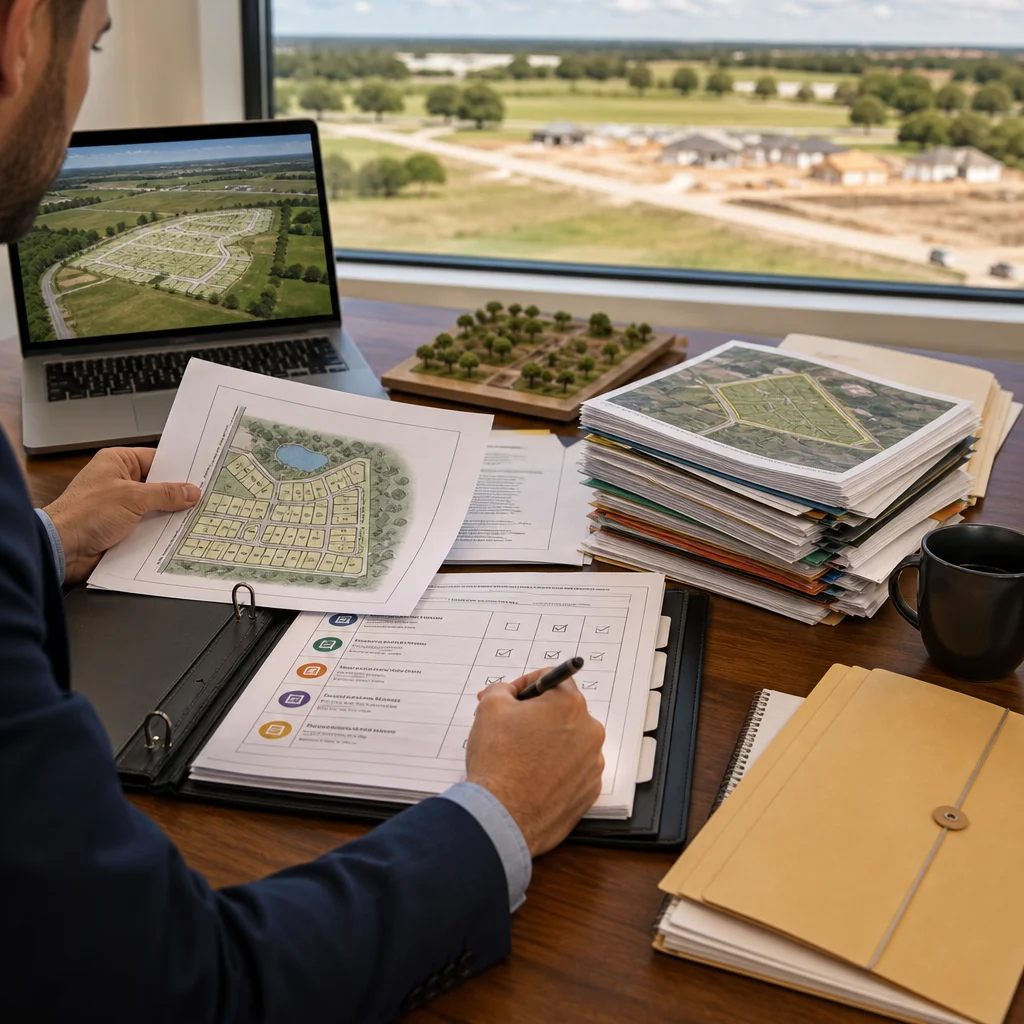
Mistake 2: Inadequate title report. Some attorneys provide a title summary rather than a full title report. Summaries often omit minor easements or restrictions that become significant during development. Always insist on a full title report issued by a licensed title insurance company.
Mistake 3: Underestimating the time required for zoning approval. Investors assume that the zoning process takes 6 months. In reality, this depends heavily on the municipality and the complexity of the project. A poorly estimated timeline means that capital remains tied up for 6–12 months longer than expected, reducing the annualized return.
Mistake 4: Lack of centralized document management. Without a tracking system, documents get lost, versions overlap, and information about their status becomes unclear. Halfway through the project, no one knows who holds which approval or whether a permit is awaiting a signature.
Mistake 5: Neglecting tax compliance. For foreign investors, failing to file a W-8BEN or register under FATCA means that 30% of your returns will be withheld by the IRS. These withholdings are not final (they can be reclaimed), but they tie up your funds for months or years while they await processing.
Mistake 6: Incomplete service contracts. A surveying contract that does not specify the deliverables (final map, report notes, surveyor’s certificate) leaves room for ambiguity about what is included. In the end, you discover that you’re being billed extra for certain additional work.
Immediate Caution: Every purchase agreement must be reviewed by a lawyer with experience in pre-construction projects at least 14 days before signing. Do not rely on generic templates.
How Our Teams Manage Documentation from Start to Finish
Our internal process demonstrates how rigorous management eliminates document-related risks.
At the time of acquisition, our legal teams review the title and the purchase agreement simultaneously. If the title reveals a restriction, we immediately request an amendment to the agreement or a formal waiver before closing. This prevents post-closing disputes.
Upon project completion, we create a project-specific documentation roadmap. This roadmap lists every action, every document to be obtained, and every key date. It is shared with all service providers (local attorneys, surveyors, consultants). There is no ambiguity regarding expectations.
During the planning phase, we make every effort to understand the exact municipal requirements before submitting a formal application. We hold pre-submission meetings with city planners. This helps avoid unexpected rejections and unnecessary back-and-forth that prolong the process.
At LandQuire, every investor is given access to a project portal. All key documents are stored and dated on this portal. Investors can see in real time when a permit is approved, when an invoice is paid, and when we’re ready for the next step. This transparency builds trust and eliminates the anxiety associated with a lack of visibility into operations.
Three months before the scheduled closing, we begin compiling the due diligence package for potential buyers. This package contains every planning document, permit, and certificate. Buyers receive it during the marketing phase. This significantly speeds up the due diligence process and reduces last-minute questions.
Here’s an example: In 2025, we completed a project in Florida in 24 months instead of the planned 28. The main reason was proactive document management. Our attorneys had identified a requirement for approval from the Department of Transportation six months before its scheduled date. We submitted the application well in advance. The project was approved before we even formally requested it. The result: a two-month time savings and a 2% improvement in returns for investors.
Start Your Investment Journey with Confidence and Clarity
Investing $100,000 in pre-development requires a solid set of documents. This isn’t just an administrative matter—it’s strategic. These documents transform raw land into an investable project and turn development rights into achievable returns.
If you're considering an investment in pre-development, here are your next steps:
Step 1: Get an independent title search. Before signing a contract, have the property reviewed by a real estate attorney. Request a specific analysis of any restrictions that might affect the subdivision.
Step 2: Check with the municipality to confirm the feasibility of the development. Contact the urban planning department and obtain a preliminary zoning compliance letter. This confirms that your target density is achievable without a variance or exemption.
Step 3: Establish an optimized legal structure. Form an LLC or an S-Corp that is appropriate for your tax status and place of residence. For foreign investors, make sure the structure complies with FATCA requirements and that your W-8BEN is up to date.
Step 4: Choose a document management partner. Whether you work independently or with a platform like LandQuire, set up a centralized document tracking system. At LandQuire, we manage this complexity from start to finish, allowing you to focus on financial performance.
Our team has successfully completed 130 projects without any documentation errors. We understand the unique aspects of Texas and Florida, the actual timelines, and the hidden pitfalls. If you’re investing $100,000 or more in pre-development, we can help you navigate the documentation process with confidence and clarity. Contact us today to discuss your project and explore how professional document management can protect your capital and maximize your return.