Investing $500,000 in Pre-Development: Liquidity, Timelines, and Optimal Strategies
Why $500,000 Is the Critical Threshold for Real Estate Investors
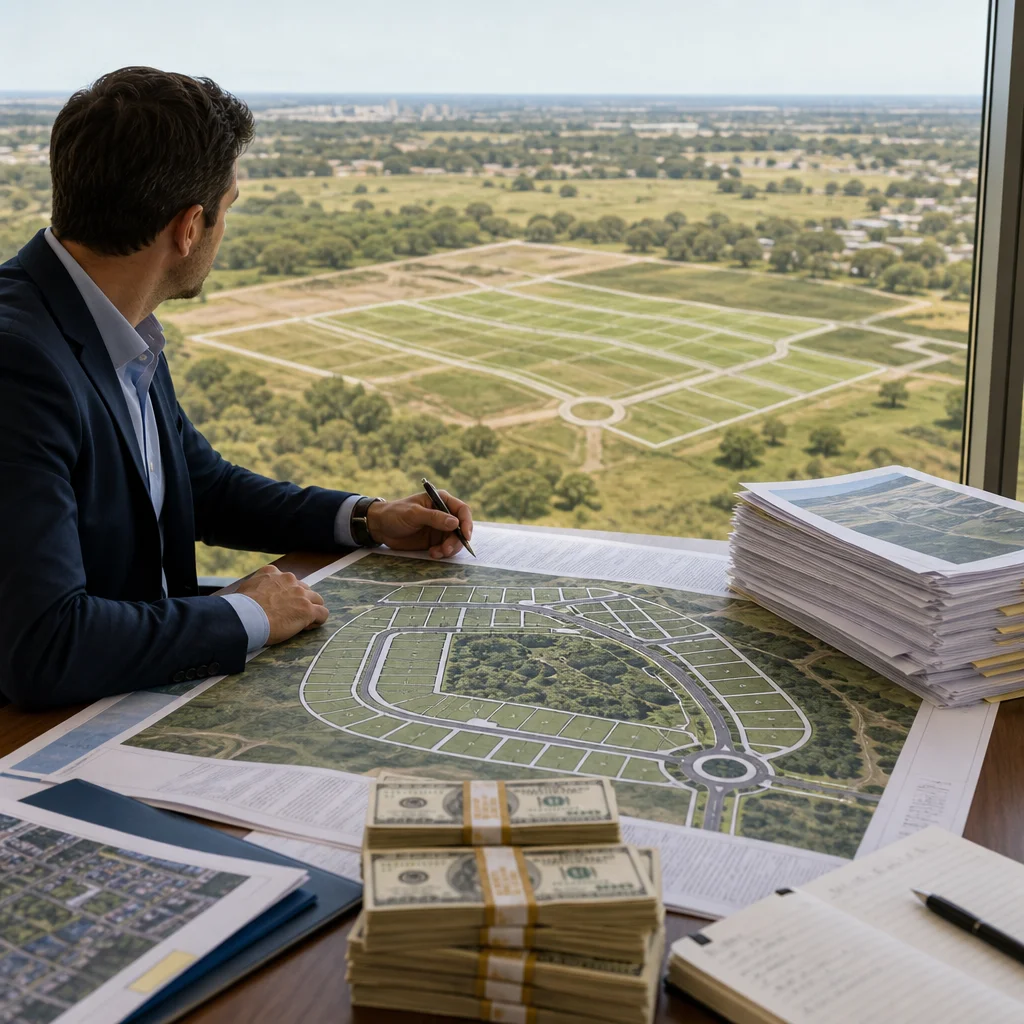
$500,000 marks a turning point in real estate investment strategy. It is the minimum capital required to gain access to strategically located properties in high-growth markets, while maintaining sufficient portfolio diversification. Below this amount, you are limited to minor acquisitions with little development potential. Above that amount, you generate exponentially higher returns thanks to economies of scale and access to institutional projects.
This $500,000 range also marks the threshold at which real estate developers seriously consider your land as an acquisition asset. Large developers are not interested in small, fragmented projects. A $500,000 portfolio allows you to assemble parcels of land with real potential for residential subdivision: 10 to 50 hectares of pre-developed land with permits in place.
For high-net-worth international investors, this amount also offers tax and structuring benefits. You can invest in U.S. dollars without significant short-term currency risk, gain diversified exposure to the Texas and Florida markets, and participate in the creation of real value prior to construction, when margins are at their highest.
Key takeaway: Having $500,000 puts you in the category of serious investors who have access to the best off-market opportunities and institutional exits.
The Challenge of Liquidity in Traditional Development Projects
Liquidity remains the major obstacle for real estate investors operating under the traditional model. You buy undeveloped land, wait for permits (2–5 years on average), and then sell it to a developer. In the meantime, your capital is tied up, immobilized, and generates no cash flow.
This waiting period leads to several complications. First, there are the costs of holding the property: property taxes, insurance, and administrative fees accumulate each year. A 20-hectare plot of land in Florida easily costs $3,000 to $5,000 a year in expenses. Multiply that by four or five years, and you lose $15,000 to $25,000 just in recurring costs.
Next, there’s regulatory risk. Municipal governments change zoning rules, permitted building densities, and environmental requirements. A piece of land that you planned to subdivide into 150 residential lots may suddenly be limited to 80 lots because of a new water protection directive. Your profit margin drops by 40 percent, and no one compensates you for the loss.
Traditional investors also have to deal with unpredictable sales timelines. A developer might sign a letter of intent and then back out six months later because the real estate market has slowed down. You end up stuck with a partially prepared asset and very few options for a quick exit.
For international investors, it’s even worse: navigating U.S. land records, managing communications with local authorities, and understanding the legal nuances of U.S. zoning from Europe or the Middle East requires years of local expertise. Most investors underestimate this friction.
Practical step: If you’re considering a traditional model, insist on written guarantees regarding construction timelines and holding costs before signing. Never rely on estimates of “two years.” Always add 18 months.
How Our Pre-Planning Approach Ensures Predictable Timelines
Our model at LandQuire is based on the opposite approach: we obtain development permits before presenting the project to investors. This means that you, as an investor, don’t have to wait for permits. You simply wait for a developer to purchase your fully permitted land.
In practical terms, here’s the process: we identify a strategically located undeveloped parcel of land. We assess its subdivision potential using our proprietary data. We partner with investors to acquire the property. Then, we manage the entire development process: feasibility studies, submissions to municipalities, administrative negotiations, and regulatory reviews. Once permits are obtained, the land transitions from “undeveloped” to “pre-developed,” ready for sale to developers.
For investors, this creates a predictable timeline. Instead of looking ahead to a 4- to 6-year horizon filled with uncertainty, you’re working within an 18- to 36-month window with clear milestones. The first year covers the acquisition and feasibility studies. The following 6 to 18 months are dedicated to obtaining permits. The final 12–24 months are dedicated to marketing the project to developers and closing the sale.
Our guarantee of securing the necessary approvals plays a key role here. We have completed more than 130 projects since 2021 without a single failure in securing approvals. This expertise reduces the regulatory risk faced by traditional investors. You won’t have to renegotiate your margin midway through the project because the rules have changed. We have already navigated these rules and designed the project to comply with them.
Take action now: Compare the official timelines provided by your current partners with ours. Ask for written proof that deadlines were met on the last 10 projects. Discrepancies often reveal which partners are reliable and which are not.
Exit Strategy: Sale to Real Estate Developers
The ultimate source of liquidity comes from sales to real estate developers. This is not an “open” market like that for single-family homes. It is an institutional acquisition market where large developers purchase pre-developed land for large-scale construction.
Developers are looking for exactly what we create: lots with all necessary permits, approved development plans, access to utilities (water, electricity, roads), and a favorable demographic profile. They don’t want to buy raw land and spend 18 months obtaining permits. They want to buy land that’s ready to go and start construction immediately.
This market dynamic changes your negotiating position. A raw plot of land sells for a price known as the “raw land price.” A pre-developed plot with 200 approved lots sells for a price known as the “development price,” which can be 3 to 5 times higher. This difference precisely reflects the value we create through development.
Take a concrete example: a 25-hectare plot of land in the suburbs of Dallas, originally purchased for $800,000 (gross). After optimal development and obtaining permits for 180 residential lots, that same plot sells for $3.2 million to a developer such as Centex or Lennar. Value creation is the difference in development. The initial investor who participated in the acquisition receives their proportional share of this value creation, plus an annualized return of 18–30%.
Developers also move quickly to make purchases. Once they approve the technical documentation and verify that the permits are enforceable, they sign the deed within 60–90 days. No complicated financing. No two-year-long negotiations. No unexercised options. For them, it’s a calculated and decisive strategic investment.
Next step: If you currently hold an interest in undeveloped land owned by third parties, determine the current stage of development. Estimate the remaining costs and time required to obtain all necessary permits. Our analysts can provide you with an assessment within two weeks.
Liquidity Scenarios with LandQuire Portfolios
To illustrate how liquidity works in practice, consider three typical investment scenarios on our platform.
Scenario 1: Average Investor ($500,000 to $1 million)
You invest $600,000 in a diversified portfolio of three properties in Central Florida and the southern suburbs of Dallas. Each is in the “acquisition + preliminary studies” stage. The total projected duration is 24 months. By month 12, all three properties have obtained their respective permits. Between months 14 and 20, we market the properties to 15–20 qualified developers. By month 22, two properties are sold. By month 26, the third follows.
Your cash flow return: $1.42 million (representing a valuation of 2.37x). Your annualized IRR: 27%. Your average payback period: 24 months. Zero construction risk. Zero tenant management.
Scenario 2: Aggressive Investor ($1 million to $3 million)
You are investing $2 million in a concentrated portfolio: a single major parcel of land (40 hectares, Texas) with the potential for 320 residential lots. This is an “anchor” project with an accelerated timeline. You are entering the advanced development phase (studies already complete, permit applications imminent). Total duration: 18 months.
By month 8, the permits are approved. By months 12–14, developers submit bids. By month 18, you receive $5.2 million. IRR: 35%. This concentrated approach offers a higher return but less temporal diversification.
Scenario 3: Patient Investor ($3 million or more)
You invest $3.5 million in a strategic portfolio of staggered acquisitions: one purchase per quarter over 18 months. Each tranche enters at a different stage of the development cycle. This approach creates a “staggered exit” effect: your exits are spread out between month 20 and month 48. You benefit from continuous visibility into capital returns, reduce concentration of market timing risk, and maximize reinvestment flexibility.
Total return: $8.9 million. Average IRR: 22%. But the stability of the cash outflow becomes your greatest asset.
These three scenarios show that, regardless of your risk profile, the predictability of timelines remains key. You know when you start, you know approximately when you’ll finish, and you know the milestones along the way.
Action for you: Assess your profile: Are you more of a moderate (diversified), aggressive (concentrated), or patient (staggered) investor? This determines your optimal liquidity strategy. We design each portfolio based on this profile.
Comparison: Actual Timelines vs. Market Expectations
The estimated timeframes for land development often differ significantly from the actual timeframes. Here are the figures that investors often misunderstand.
The typical timeline: “Land development takes 24 months, followed by the sale, which takes another 2–3 months.” Total: 26–27 months.
The reality of the traditional market: 3–5 years between acquisition and sale. Why? The initial acquisition process takes 2–3 months (search, due diligence, closing). Preliminary studies take 4–6 months (geotechnical surveys, environmental impact studies, market analyses). Permit applications take 8–12 months on average. Revisions and adjustments often require an additional 6–12 months (the government requests changes, you implement them, and then you renegotiate). Finally, marketing and sales negotiations take 6–18 months (which developers consider a long time).
Our actual project timelines (based on over 130 completed projects): 18–36 months on average, with a median of 22 months. Why such a drastic difference?
First, our data-driven sourcing process identifies pre-qualified sites. We purchase sites that already meet the criteria for density, zoning, and accessibility. We never purchase a site that comes with “regulatory surprises.” This reduces the risk of major revisions down the line.
Second, our development team works in parallel with the acquisition, not sequentially. While the closing is being finalized, the planning studies begin. This shortens the timelines by 30–40 percent.
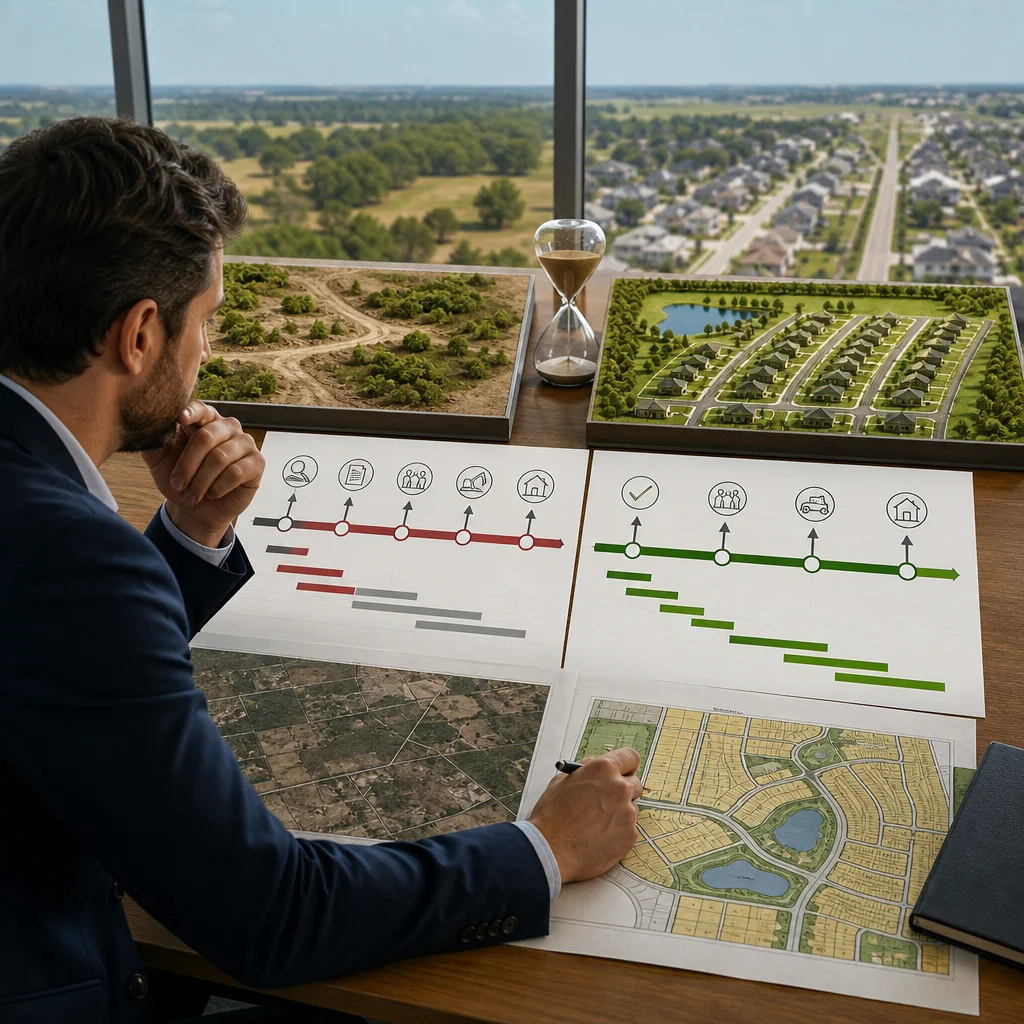
Third, our established relationships with municipalities and zoning authorities allow for faster submissions and fewer initial rejections. When an authority is familiar with your track record (100% success rate in obtaining permits), it speeds up the processing.
Fourth, we market to databases of qualified developers even before the permits are fully finalized. This means that by the time the final stamp is applied, we already have 5–10 offers in hand.
Practical benchmark: Ask your current partners what percentage of their projects have taken longer than 36 months to complete. If more than 40% answer “yes,” that’s a red flag.
Capital Management Strategies for the Next 18–36 Months
Investing $500,000 in pre-development means your capital will be tied up for 18–36 months. Here’s how to structure this period to maximize returns and minimize risk.
Strategy 1: Locked-in Capital with Lower Management Fees
Our investors agree to have their capital locked up for the duration of the project. In return, they pay very low management fees: 0.5–1.0% per year (compared to 2–2.5% for traditional funds). This reduces the total drag on returns by 2–3 percentage points. For a 24-month project, that’s a savings of $12,000 on a $600,000 investment.
Strategy 2: Intra-project Liquidity Layers
For larger portfolios ($1 million and up), we offer selective liquidity tranches. If a property in a multi-property portfolio sells after 16 months, you can recover your principal investment in that specific property plus a 20% return, while your other properties continue to appreciate. This reduces concentrated risk without sacrificing overall returns.
Strategy 3: Automatic Reinvestment
Some investors request that interim returns be automatically reinvested in the next round of projects. This creates a “rolling fund” in which your initial investment of $500,000 generates returns that are immediately reinvested. After 36 months, your initial capital has grown and continues to generate returns without any additional investment.
Strategy 4: Calendar Hedging Through Temporal Diversification
Instead of investing $500,000 all at once, spread out your purchases. Invest $250,000 today and $250,000 in 6 months. Your cash outflows will also be spread out, creating a “continuous window” of liquidity rather than a single massive outflow. This reduces your exposure to market timing and improves your resilience if market conditions slow down.
Key point: Don't think of your investment as “set and forget.” Think of it as a capital pipeline with critical decisions regarding timing and reinvestment.
Secure Entitlements: Our Guarantee of a Fixed Timeline
Permits (regulatory authorizations) are the most unpredictable factor in traditional land-use planning. Our guarantee radically changes this equation.
Our land entitlement services are based on unparalleled expertise in zoning, building codes, and U.S. administrative procedures. We don’t just work “with” local authorities. We work “within” their processes, anticipating objections, preparing documents even before they’re requested, and negotiating terms well before official decisions are made.
Here’s what our guarantee means in practice: we commit to securing all necessary development permits within the specified timeframe (typically 18–24 months). If we fail to do so, we do not charge our development fees. If the authorities reject your application due to an error in our design, we cover the costs of corrections and resubmissions. There are no additional costs to you.
This mechanism ensures that our incentives are perfectly aligned with yours: you want liquidity, we want liquidity, and we've put our money where our mouth is.
Our 130+ projects completed since 2021 without a single permitting failure are no coincidence. They are the result of rigorous processes. We assess “regulatory feasibility” even before recommending an acquisition. We identify potential obstacles (wetlands, historic landmarks, public opposition) before they become problems. We design subdivisions with real constraints in mind, not theoretical wishes.
For your consideration: Before investing with any partner, ask them for a breakdown of completion timelines and the number of projects that have exceeded their scheduled deadlines by more than 6 months. Also insist on a written guarantee of the timeline—not just a promise.
100% equity investment structure with no construction risk
Our 100% equity investment structure offers several key advantages for your liquidity and returns.

First, the absence of debt. You don’t take out any loans to finance the purchase and renovation. This means there’s zero refinancing risk if interest rates rise. In 2021–2023, many real estate funds were destabilized because their loans matured during a period of rising interest rates. Debt restructured at 7–8% eroded expected margins. With 100% equity, you are never exposed to this risk.
Second, there is no construction risk. You sell the pre-developed land to developers. They are the ones who build—not you. The risk of construction budget overruns, project delays, or contractor defaults does not apply to your investment. You exit the investment before the first foundation is poured.
Third, tax clarity. A 100% equity structure with an exit through the sale of land greatly simplifies your tax situation. You sell an asset; you recognize a capital gain. There’s no depreciation to account for, no deductible interest, and no complications related to construction in progress.
Fourth, international access. Our structure is designed for foreign investors. It complies with FIRPTA (Foreign Investment in Real Property Tax Act) requirements, facilitates the repatriation of returns to the investor’s home country, and simplifies compliance with anti-money laundering regulations.
In practical terms: you invest $500,000, you make no other payments, there is no outstanding debt against your capital, and you receive your exit proceeds in a single transaction without any additional financing. Simplicity itself is an asset in terms of liquidity.
Key benefit: 100% equity means zero debt leverage. Your 20–35% return is not diluted by interest on loans. It’s pure value creation.
How We Maximize Liquidity for International Investors
International investors face specific challenges that we have consistently overcome.
Challenge 1: Regulatory Complexity
Investing in U.S. real estate involves navigating U.S. real estate law, federal laws, municipal codes, and U.S.-specific taxes. We handle all of this for you. Our local teams in each market work directly with government agencies, developers, and tax advisors. As an international investor, you don’t need to understand any of these administrative details. You’ll receive updates in French, English, or your preferred language.
Challenge 2: Foreign Exchange Risk
Investing $500,000 USD means exposing your capital to fluctuations in the EUR-USD, GBP-USD, or AED-USD exchange rates for 18–36 months. Our approach reduces this risk because your exit is also in USD. There is no “foreign exchange loss on sale” since you sell directly to U.S. developers who pay in USD. Your only exposure is the price difference between entry and exit, not the exchange rate.
Challenge 3: Lack of Transparency
International investors are wary of “black box” projects. Our systems offer complete transparency. You have access to an online portal containing all project documents: studies, plans, permits, correspondence with government agencies, timelines, and before-and-after aerial photos. You can see exactly where your capital is and what stage the project is in.
Challenge 4: Repatriation of Funds
How can you transfer your money from the United States to your bank account in Europe or the Middle East? We structure each exit to minimize transfer fees and speed up transfers. You can also choose to leave your returns reinvested in the United States for future projects, thereby creating a “USD stronghold” of productive capital.
The foundation of our operations: we have an operational infrastructure consisting of teams across multiple locations, established relationships with major developers, international tax expertise, and a technology platform built specifically to serve non-resident investors.
Practical Step: If you’re an international investor, ask us for a 30-minute presentation on our FIRPTA compliance model and our fund repatriation processes. No obligation. No commitment. Just an explanation of how we simplify what seems complex.
—
Investing $500,000 in pre-development is not a “passive” approach in the narrow sense of the term. It is a smart and disciplined strategy that captures value at the stage where margins are highest, risk is controlled, and timelines are predictable. Unlike the traditional model, where you wait 4–6 years amid uncertainty, our model compresses timelines to 18–36 months with clarity.
Liquidity is genuine. Timelines are realistic. Returns (20–35% IRR) are well-documented and reproducible. And access is now straightforward for international investors seeking institutional opportunities denominated in USD.
Contact our teams. We can present you with a portfolio tailored to your capital and your time horizon in less than two weeks.
For further reading: Land Rights in the U.S.