Investing in the U.S. from Mexico: Exclusive Access to Off-Market Properties

Why Mexican Investors Are Seeking Real Estate Opportunities in the U.S.
Mexican investors with substantial capital face a structural challenge: maximizing returns while diversifying their assets outside their domestic market. Mexico offers opportunities, but average returns on traditional real estate hover around 6 to 10% per year, often accompanied by regulatory challenges and currency volatility.
The United States represents an attractive alternative for several reasons. First, access to U.S. markets provides direct exposure to the U.S. dollar, a global reserve currency that protects your wealth against depreciation. Second, U.S. real estate markets—particularly in Texas and Florida—are experiencing population and economic growth that exceeds the national average, with ongoing inflows of labor and capital.
For a Mexican investor, investing $100,000 to $500,000 in a well-structured U.S. investment vehicle means gaining access to returns that the Mexican market cannot reliably offer. IRR targets of 20% to 35% or higher are realistic in the U.S. real estate sector, particularly for off-market and pre-development transactions. Furthermore, the political and legal stability of the United States reduces the regulatory risks that international investors face elsewhere.
Key takeaway: The flow of Mexican capital to the United States is not a capital flight; it is a rational asset allocation strategy aimed at higher returns and diversification into hard currencies.
The Challenges of Accessing the Best Real Estate Deals in the U.S.
The U.S. real estate market appears to be open, but in reality, the best deals are never publicly listed. Approximately 85% of commercial and development land sales take place outside of well-known public channels. For an international investor, gaining access to these opportunities presents a major obstacle.
There are several barriers. First, you need to have established connections with brokers, landowners, and regional developers. These relationships are built over years and are based on mutual trust. A new investor looking to purchase land on their own will mainly find public listings that are less attractive or overpriced.
Second, navigating U.S. land use regulations is complex. Each state, county, and municipality has its own specific zoning rules, environmental approval requirements, and permitting processes. Land purchased without development rights (development permits) can be very difficult to monetize, as its actual value depends entirely on what can legally be built on it.
Third, international investors face administrative hurdles: opening a U.S. bank account, understanding tax structures, managing IRS reporting, and complying with FATCA reporting requirements. Without local expertise, these tasks become costly and time-consuming.
For a Mexican investor operating remotely, these barriers typically mean paying an unintended premium, investing in poor-quality structures, or simply passing up the best opportunities. That is precisely the problem we are solving.
Key takeaway: Access to a deal is only half the challenge. It’s access combined with local expertise in zoning and permits that makes a real difference in performance.
How Off-Market Investments Offer Higher Returns
[Off-market] transactions offer significantly better returns than public markets, and there is a rational reason for this. When a property is listed publicly on the MLS (Multiple Listing Service), the seller makes the opportunity available to all potential buyers, which creates an auction and drives the price toward the market’s “fair value.” In this competitive environment, the buyer’s profit margin shrinks.
Off-market transactions work differently. A property owner may approach a broker or investor directly, even before considering a public sale. This can happen for several reasons: the owner has an immediate need for cash, wants to avoid high brokerage fees, or prefers a quick and discreet transaction.
In this context, a savvy buyer can negotiate prices 15 to 30% below publicly listed comparables. This difference stems directly from more efficient distribution and reduced exposure. Off-market transactions are particularly effective for land without development rights (land without approved building permits). An owner may view a parcel of land as a dormant real estate liability; an entitlements expert sees it as an asset capable of generating significant value.
Let’s take a concrete example: a 50-acre parcel of land in Texas is available off-market for $400,000. At first glance, it’s zoned for industrial use. But after further research, we discover that the county has begun rezoning the area for residential use. We secure the development rights for 500 residential units. The same land, now with approved building rights, is sold to a developer for $2.5 million. Your initial $400,000 has turned into a profit of $2.1 million in 24 months—without any construction, operational management, or interest rate risk.
This return (over 500%) is possible only under three conditions: access to off-market opportunities, expertise in land use rights, and the ability to identify zoning trends before they reach the public market.
Key takeaway: The off-market is not a parallel market. It is the real market. The public market contains only the crumbs left over after the real deals have been made privately.
Our Approach: Acquisition and Development Through Zoning
We operate under a specific model that we call “acquisition and value creation through zoning” (entitlement value creation). This model captures the greatest value prior to construction, when margins are highest and risk is lowest.
Here's how we structure each project:
Phase 1: Sourcing and Analysis We use our own proprietary data and networks of regional brokers to identify off-market properties in areas experiencing strong demographic and economic growth. For each opportunity, we analyze zoning history, municipal development plans, population growth projections, and the current owner’s intentions. This screening phase eliminates 95% of leads before an offer is even made.
Phase 2: Low-Cost Acquisition Once a property passes our evaluation, we negotiate the purchase. Because we work off-market and provide quick liquidity, we typically secure prices 20 to 35% below publicly listed comparables. This initial discount is the first layer of your return.
Phase 3: Permitting and Design This is where our expertise comes into play. We work with civil engineers, urban planners, and zoning consultants to design an optimal residential subdivision plan. We then manage the entire approval process: submitting applications, meeting with local authorities, addressing public comments, obtaining environmental permits, and finalizing the plans for registration.
This process can take 12 to 24 months, but at each stage, we increase the value of the land. Land zoned for agricultural use becomes land zoned for residential use, approved for 200 units. The value increases by a huge multiple.
Phase 4: Sale to a Developer Once the necessary permits have been obtained and the project is fully approved, we sell the property to building developers. These developers pay a premium price because they eliminate regulatory risk and shorten their timeline to construction and sale.
Throughout this entire process, investors like you have no operational responsibilities. We handle the land, the permits, and our relationships with the authorities. You are an investor, not a developer.
Key takeaway: Value is not created by construction. It is created by securing the right to build before the public market recognizes the potential.
Benefits of Not Having to Manage the Construction or Tenants
A common pitfall for international real estate investors is to assume that a return of 20+% requires direct involvement in the construction or management of properties. That is not our model.
Managing a real estate construction project involves several risks:
- Budget overruns: Construction cost overruns are common and unpredictable. Labor costs fluctuate, material prices rise, and weather-related delays are becoming more frequent.
- Interest Rate Risk: If your project is financed through debt, a rise in interest rates before completion will immediately reduce your profitability.
- Rental Market Risks: Once construction is complete, the units must be rented out. Vacancy rates, rent delinquencies, and declining rental values represent ongoing operational risks.
- Time commitment: Managing a construction project requires on-site presence, supervision, and regular decision-making. For a remote investor, this is an ongoing administrative burden.
Our model eliminates all these risks. You are never a builder, developer, or property manager. You are a pre-development real estate investor. You purchase a plot of land, we secure the necessary regulatory approvals (entitlements), and then we sell it. No construction, no tenants, and no construction cash flow management.
This creates a unique risk-return profile: you capture 60 to 70 percent of the overall value creation of a residential project (the pre-development phase), while minimizing operational risk. The developer who purchases the entitled project captures the remaining 30 to 40 percent, but must bear all construction and market risks.
For a Mexican investor looking for a passive investment allocation, this is the ideal arrangement.
Key Takeaway: The best real estate returns don’t come from the development itself. They come from strategic acquisition and creating regulatory value before construction begins.
100% equity investment structure with no debt
Our investment model differs fundamentally from traditional real estate structures in that it involves no leverage (debt) and is structured entirely with equity.
Many real estate funds use debt to boost returns. For example, a fund purchases a building for $10 million, borrows $7 million, and invests its own $3 million. If the value increases to $12 million, the fund realizes a gain of $2 million on an investment of $3 million—a 67% return. Leverage multiplies the return.
But leverage also carries significant risks: lenders inevitably impose covenants (restrictive clauses), interest rates may rise upon refinancing, and in the event of a decline in value, the lender may issue a margin call or force a liquidation.
We structure our projects differently. Each project is 100% financed with investors’ equity. No debt, no lenders, no covenants. You own the land as soon as you acquire it.
What are the benefits?
- No refinancing risk: Are interest rates rising? We’re not affected. No dependence on credit availability.
- Tax Simplicity: Debt structures create tax complications (deductible interest, amortization, reporting). 100% equity structures are simpler.
- Exit flexibility: Without a lender, we can sell when the value is realized. No need to wait for a repayment schedule.
- More transparent returns: Your return is directly linked to the project’s appreciation. No financial intermediaries.
For a Mexican investor in 2026 seeking to avoid exposure to volatile U.S. interest rates and uncertain credit conditions, this structure offers a degree of control and predictability.
Key takeaway: Being debt-free means a lower return than the theoretical maximum, but a more stable and predictable risk-return profile for passive investors.
Optimized investment timelines: 18 to 36 months
Investment time frames (holding periods) are critical for calculating the annualized internal rate of return (IRR). A project that generates a return of $1 million over 5 years is not as attractive as the same return over 2 years.
Our typical projects take 18 to 36 months from acquisition to final sale. Why does it take so long?
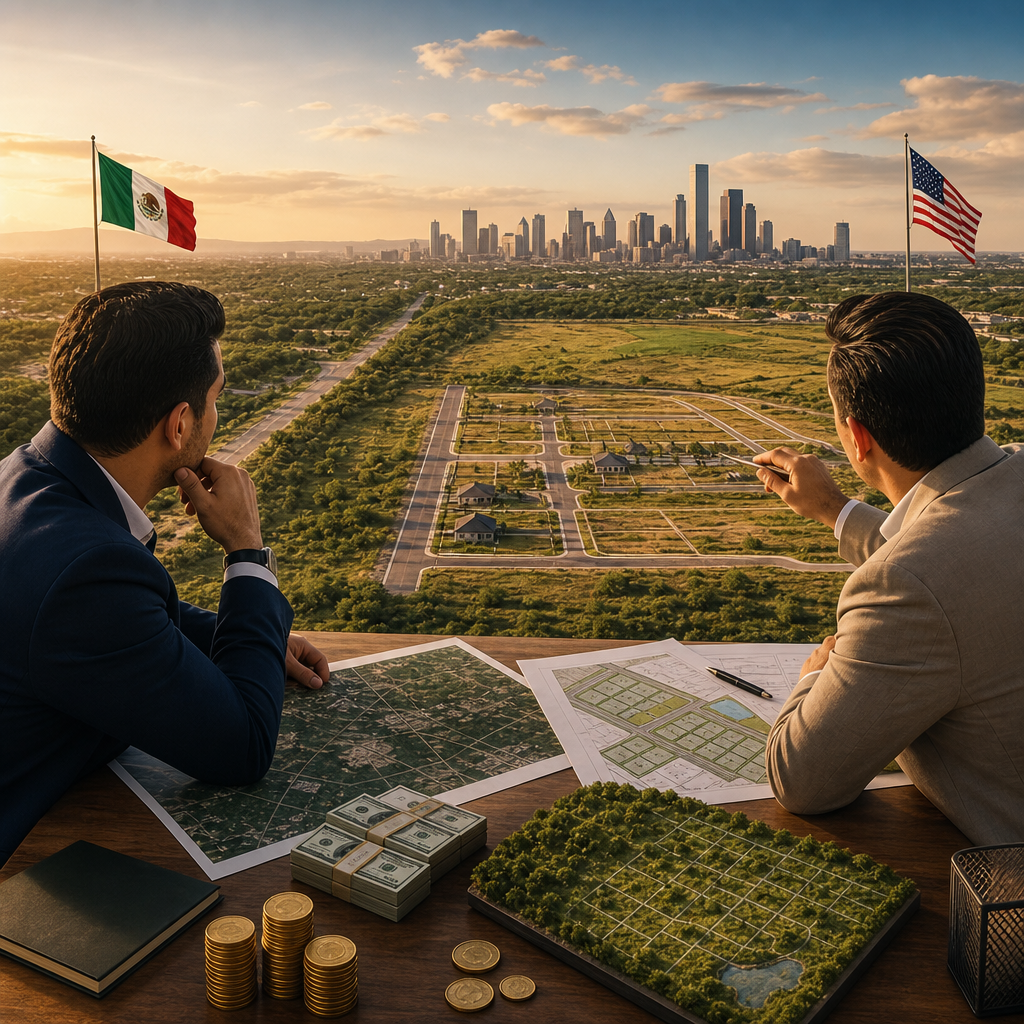
The first 6–12 months are devoted to sourcing, due diligence, and acquiring the land. This phase includes the initial zoning analysis, negotiations, and closing the transaction.
The following 12–24 months are the core of the process: obtaining the necessary permits. We work with local authorities, urban planners, and environmental agencies to secure all development permits. This phase accounts for the majority of the technical and regulatory work.
The last 3–6 months are devoted to marketing and selling the project to developers. Once the project has been approved, it becomes very attractive to developers looking to accelerate their development pipelines. This phase moves along relatively quickly.
Why is this timeline shorter than other real estate models?
- We don't build. Construction adds an additional 18–36 months.
- We do not manage rentals. It takes 12–18 months for the rental market to stabilize.
- We work in high-demand areas where approvals are granted more quickly.
- Our expertise reduces the number of back-and-forth exchanges with the authorities.
A time horizon of 18–36 months offers an attractive investment opportunity for investors who wish to reinvest their capital on a regular basis or who have medium-term liquidity needs. It is also short enough that macroeconomic risks and political changes remain limited.
Key takeaway: Shorter time horizons increased the annualized IRR and reduced exposure to time risk.
Access to proprietary data and preferred markets
LandQuire's competitive advantage is based on three pillars: proprietary data, off-market access, and expertise in land entitlements.
Property Owner Data We have built an exclusive database covering approximately a decade of real estate transactions, zoning approval plans, and demographic and economic growth trends in the United States. This database allows us to identify—before the public—which areas will soon be rezoned for residential use, where growth will be concentrated, and which property owners are likely to sell.
While other investors are looking at public lists, we have access to a forward-looking view of the market.
Off-Market Networks We maintain established relationships with more than 600 investors worldwide and with hundreds of regional brokers, property owners, and developers. These relationships generate a steady stream of opportunities before they ever reach the public market. When a property owner in Texas is considering a sale, their broker often contacts us first.
Entitlements Expertise Our in-house team includes zoning experts, civil engineers, and regulatory consultants with extensive experience in the approval processes of key states (including Texas and Florida). This expertise allows us to quickly assess a project’s feasibility, identify regulatory hurdles, and map out the path to approval.
This combination (data + access + expertise) creates a sustainable advantage. We don’t simply buy and sell land. We strategically acquire it in markets where we identify a high potential for approval, and then we monetize that potential through our expertise. For investors who place their trust in us, this means access to deals that the general market will never see.
Key takeaway: Information and relationships generate returns. Both are cumulative assets that grow more powerful over time.
Transparency and Project Monitoring for International Investors
International investors who invest remotely face a trust issue: How can you know what’s really happening with your money if you’re not there in person?
We consider this concern to be valid and legitimate. That is why full transparency and regular reporting are non-negotiable within our organization.
Each investor has access to a proprietary portal where they can view the following in real time:
- Project status: Current phase (acquisition, entitlements, marketing, sale), percentage complete.
- Regulatory Approvals: Which permits have been obtained, which are still pending, and what are the next steps with local authorities.
- Financial documentation: Breakdown of expenses, operating costs, and changes in land value.
- Communications: Correspondence with authorities, meeting minutes, updates to the urban planner.
- Timeline: Scheduled dates for key milestones, realistic timelines leading up to the sale.
In addition, we hold quarterly reporting calls where we present updates on all active projects, answer questions, and provide insights into the broader U.S. real estate markets.
For Mexican investors who prefer to communicate in French or Spanish, we offer multilingual support. Our team includes professionals who are fluent in these languages and can explain the intricacies of U.S. regulations in the context of your domestic market.
This transparency is not merely for show. It reflects our belief that investors must fully understand what is happening with their capital.
Key takeaway: An informed investor is a confident investor. Transparency reduces perceived uncertainty and builds a long-term relationship.
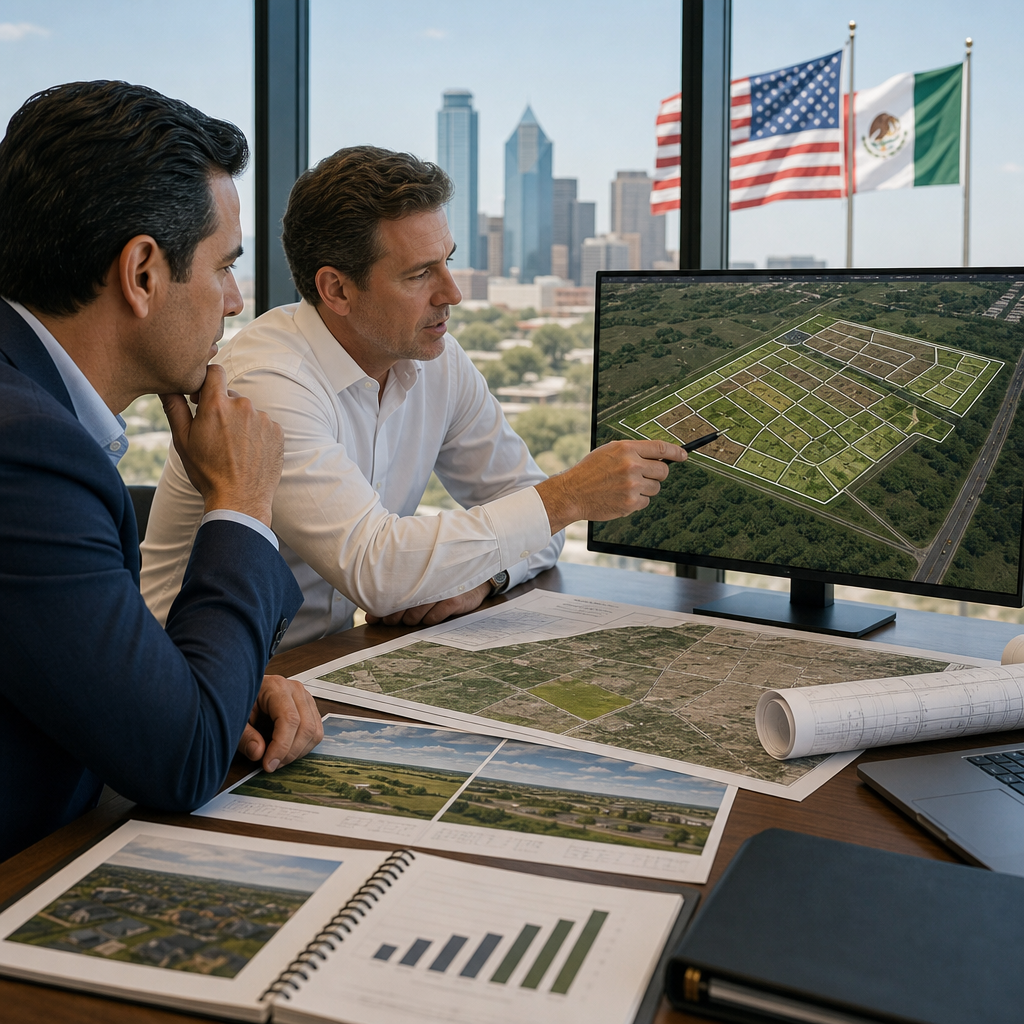
Tangible results: 130+ projects completed and a 100% success rate in securing rights
Since 2021, we have completed more than 130 real estate projects in the United States. This experience has given us unique expertise and a detailed understanding of the approval processes in key areas.
Key metrics from our track record:
- 130+ projects delivered: from acquisition to sale, since 2021.
- 100% success rate in securing development rights: No project has failed to secure the desired development rights. This is a rare statistic in the industry.
- Over 600 investors worldwide: We manage asset allocations for more than 600 investors across several continents.
- 18–36-month average hold periods: Our projects generally unfold within this timeframe without any major delays.
- Target IRR: 20–35%+: Our target annualized return remains within this range. Many projects exceed it.
These figures do not mean perfection. They mean discipline, expertise, and rigorous project selection. We say “no” to many opportunities because they do not meet our internal criteria for feasibility, eligibility, and potential return.
Why is this track record important? Because it reduces the perceived risk for a new investor. If you’re Mexican, based in Europe or the Middle East, and you’re considering investing $200,000 in a U.S. real estate fund you’re unfamiliar with, the track record makes the risk tangible. You’re not betting on promises. You’re betting on a verifiable history.
Key takeaway: A track record isn't just a marketing tool. It's proof that the model works under a variety of market conditions.
How to Get Started with Your First U.S. Real Estate Investment
If you are a Mexican investor (or an investor based elsewhere internationally) with $100,000 or more to invest, and you are interested in off-market U.S. real estate transactions without the hassles of direct management, here’s how to get started.
Step 1: Initial Qualification Contact us for an initial conversation. We’ll verify that you meet the basic criteria: minimum investment amount ($100,000), documented source of funds, and interest in an investment horizon of 18–36 months. This conversation is non-binding and helps determine whether our model aligns with your goals.
Step 2: Mutual Due Diligence We will provide you with detailed documentation regarding our track record, legal structures, approval processes, and operational partners. You’ll see examples of completed projects, profitability case studies, and regulatory compliance reports. On our end, we’ll have discussions to understand your risk profile, your return objectives, and your geographic preferences (Texas vs. Florida, for example).
Step 3: Investment Structuring Once we’re aligned, we structure your investment. This includes: establishing a U.S. legal entity (if necessary), setting up the appropriate bank accounts, and signing the investment documents. Our team handles most of the administrative details. You essentially just sign the documents, and we take care of the rest.
Step 4: Initial Allocation to a Project Your initial capital is allocated to one or more projects in our pipeline that match your profile. If you have a preference for a specific type of land (such as subdivided residential land) or a geographic area, we will accommodate it. Otherwise, we recommend a diversified portfolio across multiple projects to reduce project-specific risk.
Step 5: Reporting and Ongoing Monitoring From this point on, you’ll receive regular updates on the progress of your projects. You’ll have access to the portal, quarterly reporting calls, and our team for any questions you may have.
Practical matters to prepare:
- Document the source of your funds (proof of funds).
- Ensure you have an appropriate legal structure in your home country for tax purposes (consult your tax advisor).
- Be prepared for a processing time of approximately 30 to 60 days to complete all the administrative procedures.
- Accept the 18- to 36-month timeframe without premature liquidity pressure.
The process is designed to be as seamless as possible, but we don't sacrifice due diligence for speed. We want every investor to feel confident and fully on board before we begin.
Key takeaway: Getting started is a matter of qualifications, diligence, and structure. These are not artificial barriers. This is how we protect both your capital and our reputation.
—
Conclusion
Investing in the United States from Mexico doesn’t have to be complicated. With the right partners, access to off-market opportunities, and a strategy focused on entitlements, you can achieve returns that traditional markets simply can’t offer.
We built LandQuire specifically for investors like you: those who want substantial exposure to the U.S. real estate market but don’t want to deal with operational friction, construction risks, or regulatory complexities.
If you're ready to explore your options, we invite you to contact us for an initial, no-obligation conversation. We'll discuss your background, your goals, and how we might potentially work together.
LandQuire is here to make U.S. real estate returns accessible to global investors.
For further reading: Off-market properties in the U.S.