High-Yield Investments in 2026: Asset Classes, Returns, and Risks

What is a high-yield investment?
The concept of a high-yield investment is defined in contrast to the return on risk-free assets. In France, this benchmark is set by regulated savings accounts (Livret A, LDDS) and by the yield on 10-year Treasury-equivalent bonds (OATs), which provide a return on money without volatility. The LDDS-LEP savings account structure offers nominal protection, but its performance remains structurally limited.
In 2026, an investment is considered high-yield if its distribution rate or appreciation target significantly exceeds these benchmarks—generally more than 7 to 8 percent gross per year. Achieving such performance requires moving away from money market instruments to finance the real economy: business development, high-risk debt, or real estate and land restructuring projects.
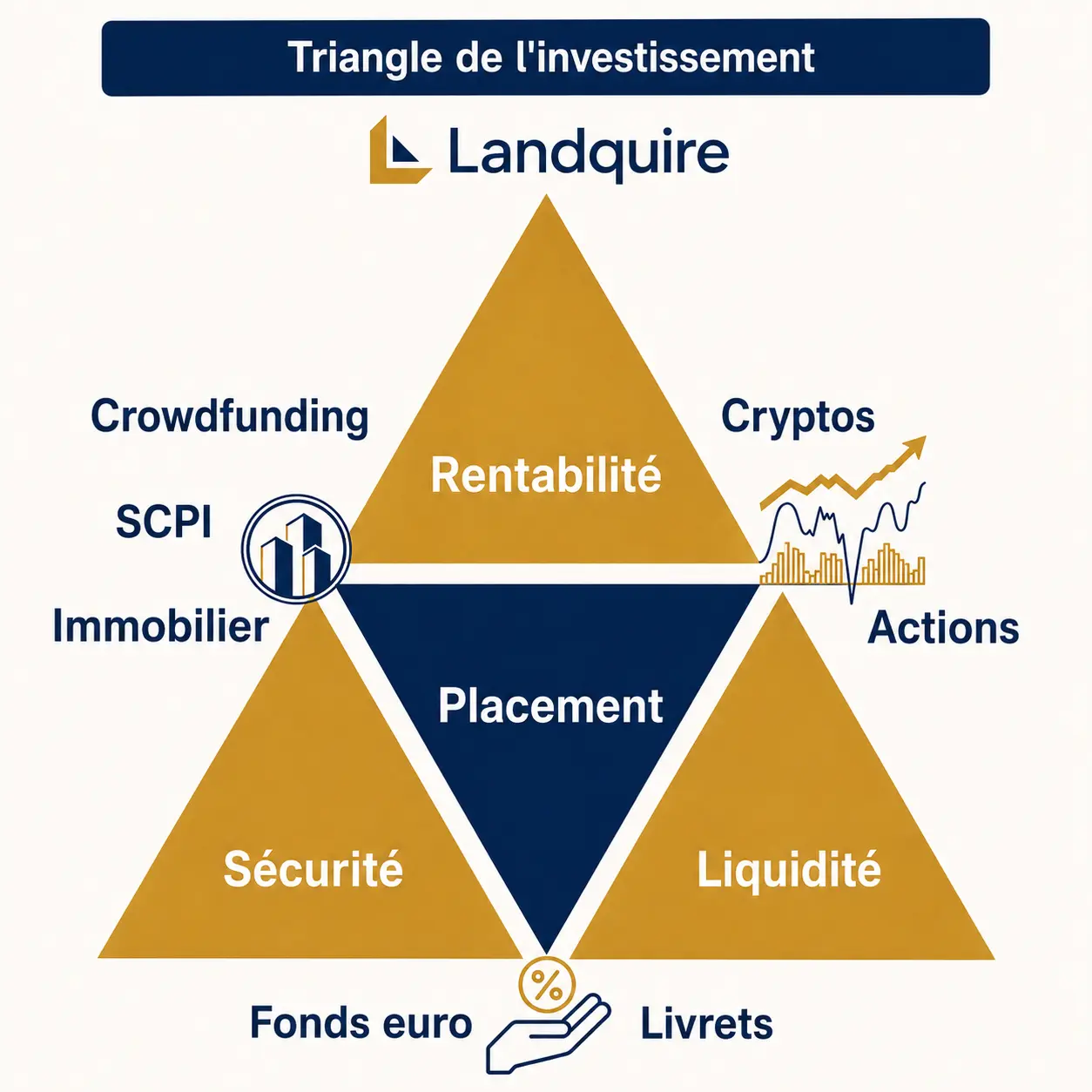
This research is based on the risk-return trade-off: a high potential return is automatically accompanied by a higher risk of capital loss. There are no exceptions to this rule. A high growth target compensates for either the risk of issuer default, high volatility, or temporary illiquidity. In accordance with the guidelines of the Autorité des marchés financiers (AMF), past performance is not indicative of future results.
The investment horizon serves as a filter. A long-term, high-yield investment allows investors to weather stock market corrections or wait out a cycle of real asset appreciation. For an investor with between 50,000 and 500,000 euros, these investment vehicles should be viewed as a complementary source of returns, never as a standalone solution.
How to Evaluate the Profitability of a High-Yield Investment
Analyzing a high-yield investment requires looking beyond the advertised gross distribution rate. Actual performance is assessed by taking into account all entry, management, and exit fees, as well as the impact of taxes and inflation.
The first step distinguishes between gross return and net return. The gross rate relates the income generated to the capital invested. The net return after fees deducts the costs charged by the intermediary or platform. The net return after taxes factors in taxes (such as the single flat-rate withholding tax) to reflect only the wealth that is actually accumulated.
For transactions involving irregular cash flows or those spread out over time (private equity, crowdfunding, real estate projects), the benchmark metric is the internal rate of return (IRR). Unlike the average annual return, which smooths out gains on a linear basis, the IRR discounts cash flows by taking into account the exact dates of payments and repayments. It measures the overall profitability of a project over a specific time period.
The lock-up period and annual fees are the two factors that have the greatest impact on the IRR of a risky project. High upfront fees require a higher initial return just to recoup the initial capital. A savvy investor demands transparency on these factors before committing capital.
High-Yield Asset Classes
Several asset classes offer the potential for consistent annual returns of 8 to 12 percent, or even more on select investments. Each follows its own set of rules.
Stocks and ETFs
Stock markets have historically been the main driver of long-term returns. Through diversified ETFs that track the MSCI World or the S&P 500, investors can capture the growth of global large-cap stocks, particularly U.S. technology stocks. The historical average annual return on stocks ranges from 7% to 9% over a period of more than 10 years, though this comes at the cost of high volatility. Investors can access these markets through a standard securities account (CTO), a PEA stock plan for European securities, or a multi-asset life insurance policy.
High-Yield Bonds
Strictly speaking, “high-yield investment” also refers to high-yield bonds. Issued by companies with weaker credit ratings (the so-called speculative grade, below BBB-), they offer a higher coupon than investment-grade bonds in exchange for an increased risk of default. Accessible through ETFs or high-yield bond funds, they often target returns of 5% to 8% depending on the interest rate cycle, and remain sensitive to economic conditions and credit risk.
Rental Real Estate and SCPI
In the primary market, high-yield rental real estate (shared apartments, investment properties) targets high gross returns, but this comes at the cost of active management and renovations. Investors who prefer to delegate are turning to turnkey passive investments. SCPIs, or real estate investment trusts, provide access to a diversified portfolio of commercial properties: according to ASPIM and IEIF, their average distribution rate stood at 4.92% in 2025, with several recent funds targeting more than 6%. Holding SCPIs within a life insurance policy reduces the tax burden on distributed income.
Private Equity and Venture Capital
Private equity provides financing for unlisted companies at various stages (early-stage capital, growth capital). Accessible through FCPR, FCPI, or FIP funds, it offers target returns of 8 to 12% per year for diversified portfolios. Drawbacks: an illiquidity period of 8 to 10 years, above-average fees, and a sometimes high minimum investment, although dedicated unit-linked life insurance products are making it more accessible.
Real Estate Crowdfunding and Crowdfunding
Real estate crowdfunding allows investors to lend to developers or real estate investors through bonds, with short-term horizons ranging from 12 to 36 months, and a target return often advertised between 8 and 10 percent. There is no liquidity during the project, and investors bear the risk of default by the operator, which could result in delayed payments or a partial loss.
U.S. Real Estate
The direct acquisition of land in the United States, particularly in Texas, is analternative investment strategy aimed at increasing value. The principle is based on land arbitrage: sourcing parcels along the development corridors of metropolitan areas experiencing strong population growth, securing their potential through land entitlement (rezoning, subdivision), and then reselling the enhanced parcel to builders or developers. This is Landquire’s approach, operating on a short cycle of 18 to 36 months, as a 100% managed service with no debt involved; the transaction is carried out through a co-investment company (LLC) in which the land constitutes the primary asset held by the entity.
By way of illustration and without constituting a commitment, transactions closed by Landquire have shown strong historical performance over their lifecycles, and ongoing projects such as RiseQuire 1 and Portfolio 15 in Marion, Texas, are targeting their announced return objectives. These figures reflect past performance or targets that are not indicative of future results. This investment involves the risk of capital loss, offers no guarantees, and is strictly reserved for sophisticated investors with the financial capacity to commit capital. For more information, see our resources on investing with Landquire in the United States and real estate investment in the United States.
Past performance is not indicative of future results; this investment is intended for experienced investors only.
Cryptoassets and Alternative Assets
For the record, the high-yield investment universe includes cryptoassets (Bitcoin, Ethereum), which are extremely volatile and subject to ongoing regulatory risk, and are therefore purely speculative. Niche markets (art, fine wines, collectible watches) target gains from scarcity, but require specialized expertise and are highly illiquid upon resale.
Historical Ranking of Investments by Performance
Over the long term, the performance gaps between asset classes are considerable. The IEIF’s annual study, “40 Years of Comparative Performance,” measures the internal rate of return for each asset class, excluding management fees.
| Asset Class | Annualized TRI over 40 years (1984–2024) |
|---|---|
| Actions | 11,8 % |
| Real Estate (Housing in Paris) | 10,1 % |
| SCPI | 7,5 % |
| Euro-denominated life insurance funds | 6,2 % |
| Gold | 4,1 % |
| Livret A | 3,3 % |
| Inflation | 1,9 % |
Over a 15-year period, the stock market remains in the lead (with returns ranging from about 7.8% to 8.9%, depending on the region), ahead of logistics and gold, followed by real estate investment trusts (SCPI) (about 5.3%). While this historical data is not indicative of future performance, it underscores a consistent pattern: over the long term, the most profitable assets are also the most volatile or the least liquid.
Sources: IEIF, “40 Years of Comparative Performance” study; ASPIM, 2025 SCPI performance indicators; AMF, Investor Portal.
Choosing a High-Yield Investment Based on Your Profile
Building a portfolio that includes high-yield investments follows a compartmentalized approach, often modeled after the “core/satellite” strategy. The core of the portfolio is allocated to liquid and secure assets; the satellite portion holds high-potential diversification assets.
Three sample asset allocations, provided for illustrative purposes only and not intended as personalized recommendations:
- Balanced portfolio: 75% core (bonds, high-performing euro-denominated funds, office or healthcare real estate investment trusts), 25% satellite (15% global equity ETFs, 10% short-term real estate crowdfunding).
- Dynamic portfolio: 50% core (euro-denominated funds, short-term corporate bonds, real estate investment trusts), 50% satellite (30% S&P 500 and Nasdaq equity ETFs, 10% private equity, 10% real estate valuation).
- For experienced investors: 30% core (secure cash, resilient income-producing real estate), 70% satellite (35% growth stocks via a securities account, 15% private equity, 20% international real estate strategies). For detailed models broken down by capital tier, our guide to investing 100,000 euros provides a breakdown of these investment structures.
Taxation of High-Yield Investments
The tax framework determines the final profitability. Data current as of 2026, subject to change: consult a tax attorney before making any decisions.
The single flat-rate withholding tax (PFU), or flat tax, applies by default to income from marketable securities (dividends, bond coupons, capital gains on securities accounts, and crowdfunding). As of January 1, 2026, the rate has been raised to 31.4%—comprising 12.8% income tax and 18.6% in social security contributions—following the increase in the CSG (General Social Contribution) enacted in the Social Security Financing Act. This increase does not apply to all types of income: life insurance, property income, and capital gains on real estate remain subject to a social security contribution rate of 17.2%.
Tax credits mitigate this tax burden:
- PEA: Income tax exemption after 5 years; only the 17.2% in social security contributions remains due.
- Life insurance: Gains are tax-free as long as the policy is not surrendered; after 8 years, an annual tax exemption of 4,600 euros (for a single person) or 9,200 euros (for a couple) applies to capital gains.
- PER: Contributions are deducted from taxable income upon contribution; taxation is deferred until withdrawal.
Direct rental real estate is classified as property income and taxed at the income tax rate plus 17.2%, unless tax optimization is achieved through the LMNP status (depreciation) or a property loss. U.S. real estate is subject to a cross-border regime governed by the Franco-American tax treaty of August 31, 1994: ownership through an LLC, taxation in the United States with a tax credit in France to avoid double taxation, and the FIRPTA provisions (IRS withholding tax upon resale).
Sources: service-public.gouv.fr, changes to the flat tax rate (PFU) effective January 1, 2026; service-public.fr, life insurance taxation; AMF, investor portal.
Specific Risks Associated with High-Yield Investments
A performance-oriented strategy requires a clear-eyed assessment of one’s counterparties. Any market investment carries the risk of partial or total capital loss.
- Illiquidity risk: inherent in private equity (funds locked up for 8 to 10 years), crowdfunding, and raw real estate; investors must wait until the transaction is completed to exit.
- Issuer default risk: specific to high-yield bonds, crowdfunding, and unlisted securities; if the project sponsor goes bankrupt, repayment becomes impossible.
- Market risk and volatility: primarily stocks and ETFs, which are sensitive to macroeconomic cycles, central banks, and geopolitical tensions.
- Foreign exchange risk and legal risk abroad: outside the eurozone (such as in the United States), the euro-dollar exchange rate affects the converted capital, and changes in local urban planning or tax laws pose a risk.
AMF Compliance: Past performance across all asset classes—including financial, real estate, and alternative assets—is not indicative of future results and does not constitute a guarantee. Each investor must ensure that the composition of their portfolio is consistent with their investment horizon and their ability to withstand capital losses.The AMF recommends reviewing the key information document for each product before investing.
Individual testimony; a specific, non-representative case; past performance is not indicative of future results.
High-Yield Investment FAQ
Which investments will yield the highest returns in 2026?
The highest target returns are found among equity ETFs, development-focused private equity, real estate crowdfunding, and U.S. real estate appreciation strategies. All of these carry a high risk of capital loss.
Is it possible to aim for a return of more than 15% per year?
This is possible in targeted private equity transactions or short-cycle raw land development projects. However, these returns reflect past performance and do not constitute any guarantee of future results; they are accompanied by the highest level of risk and illiquidity.
How do you calculate the IRR of an investment?
The internal rate of return takes into account the amount and exact date of each cash flow (a negative initial investment, positive interim cash flows, and a positive final repayment). It solves the equation that sets the net present value of these cash flows to zero, providing a measure of profitability that accounts for the time factor.
What are the safest high-yield investments?
No high-yield investment is “safe” in the sense of offering a capital guarantee: by definition, higher returns mean higher risk. The most stable approach for a moderate risk profile involves diversification, through diversified high-yield real estate investment trusts (SCPIs) or high-quality corporate bonds.
How do you invest in private equity when you're starting from scratch?
Access has become more widespread thanks to FCPR-type unit-linked funds in multi-asset life insurance policies, with investment amounts sometimes as low as a few hundred euros, all within a favorable tax framework.
Is U.S. real estate an accessible, high-yield investment?
It is available to French investors with sufficient capital for diversification, generally starting at 50,000 euros. The fund is 100% actively managed, but access is strictly limited to sophisticated investors who are aware of the funds’ temporary illiquidity.
What is the historical average return on stocks and SCPIs?
Over the long term, diversified global stocks have posted an average annual gross return of 7 to 9 percent, and up to 11.8 percent over 40 years, according to the IEIF. The distribution yield on SCPIs has remained around 4.5 to 5 percent per year in recent years, excluding appreciation in share value.
Are you looking to invest a portion of your assets in an opportunity with high potential returns outside the financial markets?
Landquire assists French-speaking investors in acquiring and developing land in the United States over a short cycle of 18 to 36 months, without rental management or construction oversight. The model is entirely managed by our teams and is reserved for experienced investors.
- End-to-end real estate investment management, from sourcing to resale, without resorting to debt.
- Short development cycle (18 to 36 months).
- More than 1,000 land acquisitions since 2021 and a documented track record of projects sold.
- Transactions primarily identified prior to their public offering (off-market), reserved for sophisticated investors.
For more information:
- View current real estate opportunities
- Explore Projects That Have Already Been Sold
- Talk with the team
*Article written and updated in June 2026 by Thibaut Guéant, co-founder of Landquire and a licensed real estate agent in Florida, with over 12 years of experience in the U.S. real estate market. Learn more about our team, our property valuation process, and our investors’ reviews.*