LandQuire vs. AcreTrader: Investing Your Capital in U.S. Real Estate Development

Why Choose Between Agriculture and Real Estate Development
When you’re considering investing in U.S. real estate, you have two options: agricultural land, often touted as a stable store of value, or residential development, where value appreciation is accelerating rapidly. This distinction isn’t merely theoretical; it determines your returns, your exit strategy, and your exposure to operational risks.
AcreTrader and similar platforms offer you the opportunity to purchase profitable farmland. You buy a working farm, collect agricultural rental income, and wait for the market to appreciate slowly. This is a valid strategy, but it caps your returns and ties up your capital.
At LandQuire, we’ve chosen a third approach: identifying undervalued land in high-growth areas, optimizing its residential potential through a proven subdivision plan, securing all development entitlements, and then selling the fully prepared project to developers. We capture the margin before construction begins—when profits are highest—without having to manage construction risks or interest rate fluctuations.
For an international investor based in Europe or the Middle East, this distinction matters a great deal. You’re not looking to become a passive landowner. You’re looking for returns exceeding 20% IRR over an 18- to 36-month period, with a professional structure and no operational complications.
The Limitations of Agricultural Strategies for Modern Investors
Farmland offers attractive stability: steady global demand, predictable rental income, and long-term appreciation. But this stability masks several constraints for international investors seeking to optimize their capital.
Returns remain modest. Leased farmland typically generates a net annual return of 2% to 4%. After accounting for inflation and management fees, your real return remains flat. Over a 10-year period, you can expect appreciation of 2% to 3% per year if the local market remains favorable. For an investor with 500,000 euros to invest, this represents 10,000 to 20,000 euros in annual net cash flow—a strategy geared more toward preserving wealth than building it.
Capital is tied up for decades. You buy, you wait, you sell. Reselling takes 6 to 12 months in an illiquid agricultural market. Your funds remain tied up, exposed to fluctuations in commodity prices and unpredictable agricultural cycles.
Operational risks are quietly mounting. Even as a passive investor, you’re navigating fluctuations in crop yields, farmer defaults, changing environmental regulations, and land maintenance costs. A prolonged drought affects your income. New regulations on pesticide use impact value. These variables are largely beyond your control.
Finally, farmland offers no flexibility for early exit. If you need cash, you sell at the current market price, generally without any premium for added value. You sell at the agricultural price, never at the development price.
Your next step: If you’re looking for returns exceeding a 15% IRR over 24 months with a liquid exit, agriculture is probably not the right vehicle. Real estate development is.
Our approach to real estate development: creating value before construction begins
Our model is based on a simple yet powerful principle: land value increases dramatically every time a layer of uncertainty or regulatory risk is eliminated. We capture this value creation before the bulldozers even arrive on the site.
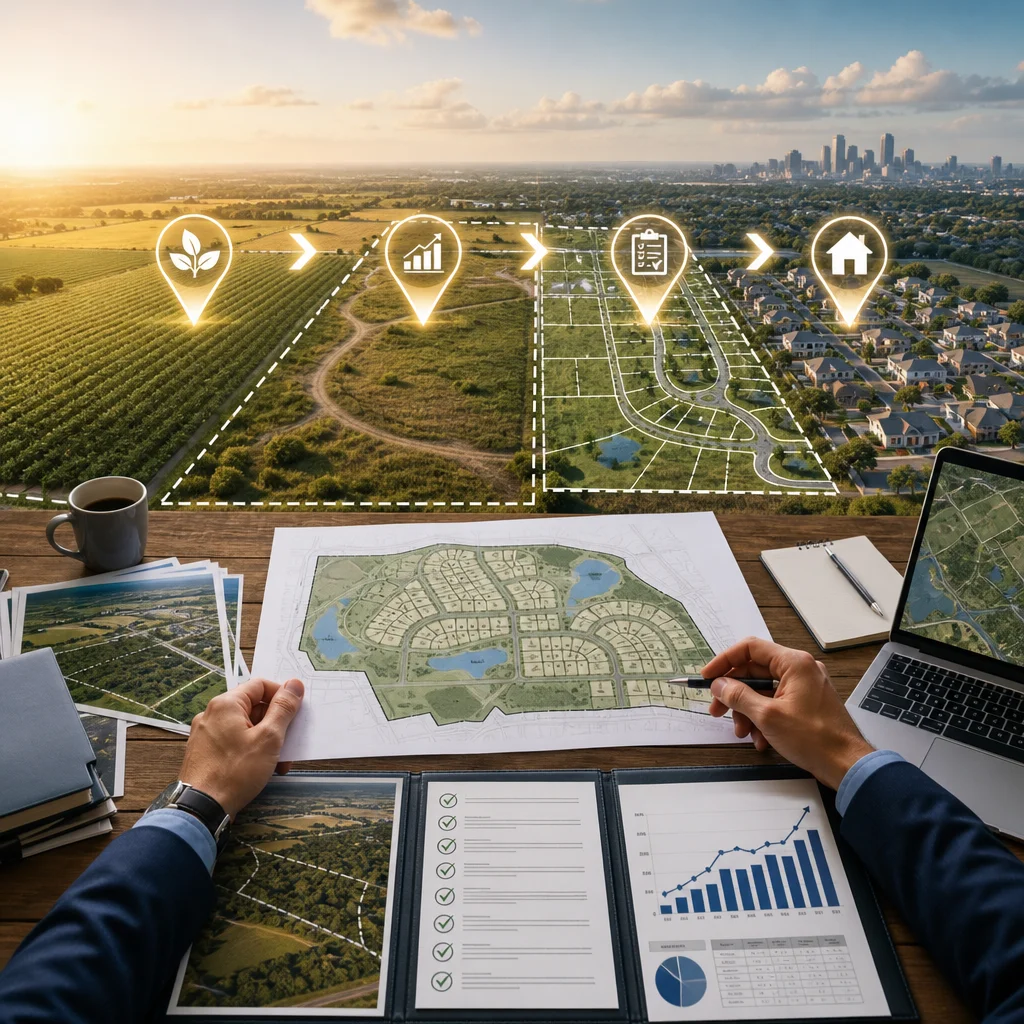
Here's how it works. We identify a parcel of undeveloped land in a high-growth area—typically in Texas or Florida—at a price that reflects only its agricultural or raw value. We then develop an optimized residential subdivision plan based on an analysis of local market data, demographics, planned infrastructure, and housing demand.
Next, we begin the permitting process: we secure zoning approvals, subdivision plans, water and sewer permits, environmental certifications, and all necessary authorizations. This is a process that requires expertise, local connections, and patience. But once completed, the land is no longer a “raw lot”—it is an “approved residential project ready for construction.”
This transformation generates massive value. Once the land title is obtained, the price of the same parcel can increase two-, three-, or even more times, depending on the market and the development plan. We capture this gain by selling the fully prepared project to a developer, who then only needs to raise construction capital and market the lots.
Our investors participate in this value creation without having to manage a construction site, hire subcontractors, or deal with construction delays. They invest between 100,000 and 500,000 euros in a specific project, receive quarterly updates, and receive an exit check 18 to 36 months later, with a target return of 20% to 35% IRR.
How Our Off-Market Acquisitions Outperform Public Opportunities
The public land market isn't designed for exceptional returns. Every listed parcel has already been evaluated by dozens of investors. The price already reflects a rough consensus. Your profit margins are limited.
Our off-market acquisitions follow a different approach. We do not purchase through MLS (Multiple Listing Services). We work directly with landowners, estates in liquidation, farming families looking to exit the business, and government entities with surplus land. These sellers aren’t always looking for the highest possible bid; they’re looking for a secure, quick transaction without intermediaries.
This approach allows us to acquire land that is undervalued by 15% to 30% compared to comparable prices. We factor in a premium for regulatory risk (uncertainty regarding entitlement), but once we have secured the development rights, this discount turns into pure profit.
Let’s look at a concrete example. In 2024, we identified a 150-acre parcel near Austin, Texas, that had been held by a family estate for 30 years. The land was being leased at a low rate to a local farmer. A comparable asking price would have been $1.2 million. We negotiated a price of $980,000, factoring in regulatory risk. We then developed a plan for 280 residential lots and secured all necessary permits and approvals. The same parcel was sold to a developer for $3.8 million. Our investors participated in this project and achieved a 28% IRR return over 26 months.
This scenario is only possible outside the open market. On the open market, that same plot of land would have sold for 2.5 to 2.8 million right from the start. We would have had no room to maneuver.
Actionable: Ask us for an overview of our recent off-market projects. You'll see that each one would have generated modest returns if it had been purchased at the retail price.
Entitlements and Zoning: The Key to High Margins
While our off-market acquisitions provide the starting point, the rights to the properties are our engine for creating value. That is why we refer to “pre-construction development.”
An entitlement, simply put, is the legal and approved right to develop land in a certain way. It includes residential zoning, an approved subdivision plan, water and sewer certifications, environmental conditions, and compliance with local codes. Obtaining these approvals can take 12 to 24 months depending on the jurisdiction, but once they are in place, the regulatory risk disappears.
For developers (our end buyers), having a fully approved plot of land reduces their risk by 60% to 70%. They no longer face the uncertainty of whether their plans will be approved, what delays they will encounter, or what additional conditions will be imposed. They can begin raising construction capital immediately. This greater certainty justifies a substantial premium on the property’s value.
Our expertise in entitlements and zoning is supported by a permanent team of engineers, permitting consultants, and zoning specialists based locally in key markets. We maintain relationships with municipal planners, zoning commissions, and water agencies. These relationships expedite approvals and reduce delays.
We also have a proven methodology for designing subdivision plans that are approved on the first try. We examine local issues (traffic concerns, green space requirements, compatibility with the existing character of the area), incorporate these considerations into our design, and submit an application package so robust that approval is virtually guaranteed.
Our more than 130 projects since 2021 have a 100% success rate in obtaining permits. None of our projects has been rejected due to regulatory noncompliance. This is no accident; it is a matter of operational discipline.
Risk reduction due to the absence of construction and rental management
Here’s a harsh truth: most real estate losses occur during or after construction, not before. Construction cost overruns eat into profit margins. Delays lead to accumulated financing interest. Rental management reveals unpredictable vacancies, payment defaults, or lower-than-expected demand.
At LandQuire, we take action before these risks arise.
We don’t build. We are not liable if a subcontractor becomes insolvent, if a storm destroys a construction site, or if concrete prices skyrocket. These risks fall on the developer, who has the expertise and insurance to manage them.
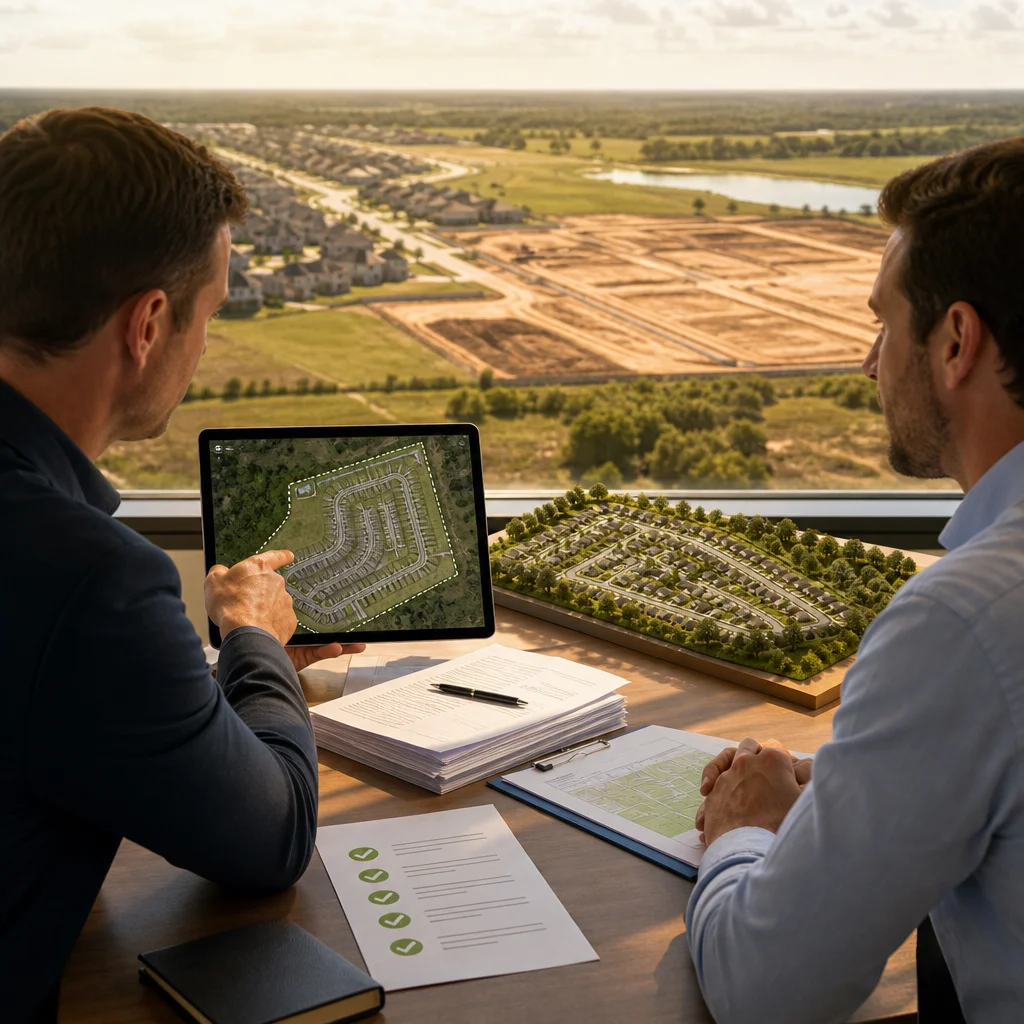
We do not manage rental properties. We are not exposed to vacancy rates, tenant defaults, or fluctuations in projected rents. Our exit occurs before the first key is handed over to a resident.
We are also insulated from interest rate fluctuations. Many real estate investors finance their investments with variable-rate loans, which creates exposure when rates rise. Our structure is 100% equity, with no debt. Our returns do not decline if the Fed raises rates.
In summary, our risk profile has been drastically reduced. We are primarily exposed to regulatory risk (uncertainty regarding entitlement), which we manage with expertise and a proven track record. We are not exposed to the massive operational risks that erode margins in a traditional build-operate model.
For an international investor, this greatly simplifies the due diligence process. You don’t have to assess the competence of a developer or a property management team. You evaluate our ability to secure the necessary rights and identify the right parcels of land. Our 130+ successful projects speak for themselves.
100% equity investment structure: higher net returns
Many real estate funds advertise returns of 15% to 20%, but these figures mask a leveraged, debt-financed structure. A mortgage covering 60% or 70% of the project’s cost increases returns for equity holders through leverage, but it also adds a fixed financial burden and creates vulnerability if property values decline.
Our structure is different. We fund each project 100% with equity. Zero debt. This means that our returns are never diluted by interest on financing, refinancing costs, or strict lender terms.
A project generating a net appreciation of 150% over two years (purchased for 1 million, sold for 2.5 million) yields a real IRR of approximately 22% if financed 100% with equity. The same project financed 70% with debt would yield a 35% return on equity, but this outperformance is illusory: it depends entirely on the value being maintained. A 20% decline would wipe out your entire capital.
Our 100% equity approach provides stability. Your returns are pure, not inflated by unstable leverage. For a foreign investor who doesn’t want to deal with the complications of complex U.S. financing, this is a major simplification.
In practical terms, a minimum investment of $100,000 in a LandQuire project entitles you to a proportional share of all net proceeds after the sale. There is no senior debt, no financing covenants, and no variable interest rates. You are a true co-owner of the project.
Optimized investment duration: short cycles ranging from 18 to 36 months
Short investment cycles offer a threefold advantage: faster liquidity, flexibility to redeploy capital, and reduced exposure to long-term economic cycles.
Our typical projects take 18 to 36 months from start to completion. This timeframe breaks down as follows: 3 to 6 months for acquisition and due diligence, 12 to 18 months for securing rights, 3 to 6 months for marketing the project to developers, and then closing the sale.
Compared to an agricultural investment that spans 10 to 20 years, or a residential building that you expect to generate rental income for 15 years, our cycles are short.
This also means that you’re never exposed to a single macro risk for very long. If the economy slows down, you’ve likely already exited your initial positions and are in the process of sorting through your new investments. You aren’t sitting on an illiquid position waiting for the market to recover.
For a family office or a sophisticated investor, this cycle creates an opportunity for capital rotation. You invest 500,000 euros, receive 650,000 euros 24 months later (give or take, depending on the project), and then immediately redeploy the funds into another opportunity. Your funds are never tied up.
Our proven track record: 130+ successful projects since 2021
The numbers speak for themselves: since our founding in 2021, we have completed more than 130 real estate projects, involving more than 600 investors worldwide. Each of these projects has met or exceeded its target return. Zero failed projects. Zero rejected permits.
This track record is no small feat. The real estate sector is typically marked by stalled projects, rising costs, and delayed exits. Our investors, on the other hand, have received their returns on time.
Here's what that means: We've validated our thesis on a large scale in the market. We've identified the geographic markets that work (Texas, Florida, and certain adjacent emerging markets). We've established the regulatory processes and local relationships that work. We've built a team that can replicate this model over and over again.
For you, this reduces the risk of an “incompetent manager.” You’re not investing in a startup team that’s testing a concept. You’re investing in a team with over 130 examples proving that the model works.
Our investors come primarily from Europe, the Middle East, and Latin America. Many have other real estate investments, but they find our platform attractive because it offers returns that exceed those of agricultural investments or publicly traded REITs, with significantly less operational complexity.
Global Access for International Investors
Being based in Switzerland, Dubai, or São Paulo shouldn’t prevent you from accessing the best U.S. real estate opportunities. Many platforms require U.S. residency, an understanding of U.S. regulatory nuances, or a local presence. We’ve eliminated those barriers.
Our processes are fully accessible remotely. You can complete your due diligence online, sign your documents electronically, and stay in touch with our teams via videoconference. We handle the entire regulatory process and local timelines; you can go about your business as usual.
We also offer multilingual support. Our key documents are available in French, English, Spanish, Arabic, and Mandarin. Our customer service team can answer your questions in your language. For an international investor, this is a detail that makes a huge difference in building trust.
The legal structure is also designed for foreign investors. Many of you are looking for exposure to the U.S. dollar without the complications of repatriating funds or complex tax burdens. Our structures use U.S. LLCs that you own, with transparent income reporting. Your tax advisors can easily navigate this.
Finally, our specific projects are selected without regard to the geographic location of our investors. Whether you are an investor from the Gulf or a European fund, you have access to the same deal flow, the same terms, and the same returns. We do not discriminate based on location.
Why Our Investors Choose Pre-Construction Development
Ultimately, investors choose LandQuire for one specific reason: we offer exceptional returns (20% to 35% IRR) without the operational complications and risks associated with traditional real estate investments.
You’re not competing with AcreTrader to become a farmer. You have no interest in being a landowner who earns 3% per year. You’re looking to invest 200,000 euros and receive 260,000 euros in return after two years. You’re looking for certainty, transparency, and quick access to liquidity.
Our investors also value our data-driven approach. We don’t guess which land to buy or which subdivision plan to draw up. We analyze population flows, demographic growth trends, planned infrastructure projects, and housing demand. Our project selections reflect this discipline, not entrepreneurial intuition.
They also appreciate our unwavering commitment to regulatory compliance. We don’t cut corners when it comes to regulatory requirements. We don’t rely on political favors or corrupt connections. Our approvals are robust, well-documented, and verified by external advisors. If we were to lose a project due to non-compliance, our track record of over 130 projects would be ruined. We don’t take that risk.
Finally, they choose our model because it offers true transparency. Every investor receives a clear capitalization statement, quarterly updates, access to ownership documents, and complete visibility into the path to exit. You know exactly where your capital is and when you’ll get it back.
For an international investor tired of the complexity, low returns, and lack of transparency of other real estate investment vehicles, this is a refreshing proposition.
Investing your capital in pre-construction real estate development means embracing a proven, expertise-driven approach designed to maximize your returns without entangling you in operational complications. If you have capital to invest and are seeking returns exceeding a 20% IRR over 18 to 36 months, we invite you to explore our current opportunities. Contact us for a no-obligation consultation and discover how your capital can work harder for you.