The Land Entitlement Process in the U.S.: A Comprehensive Guide to Steps and Timelines

Why Land Entitlement Transforms Your Real Estate ROI
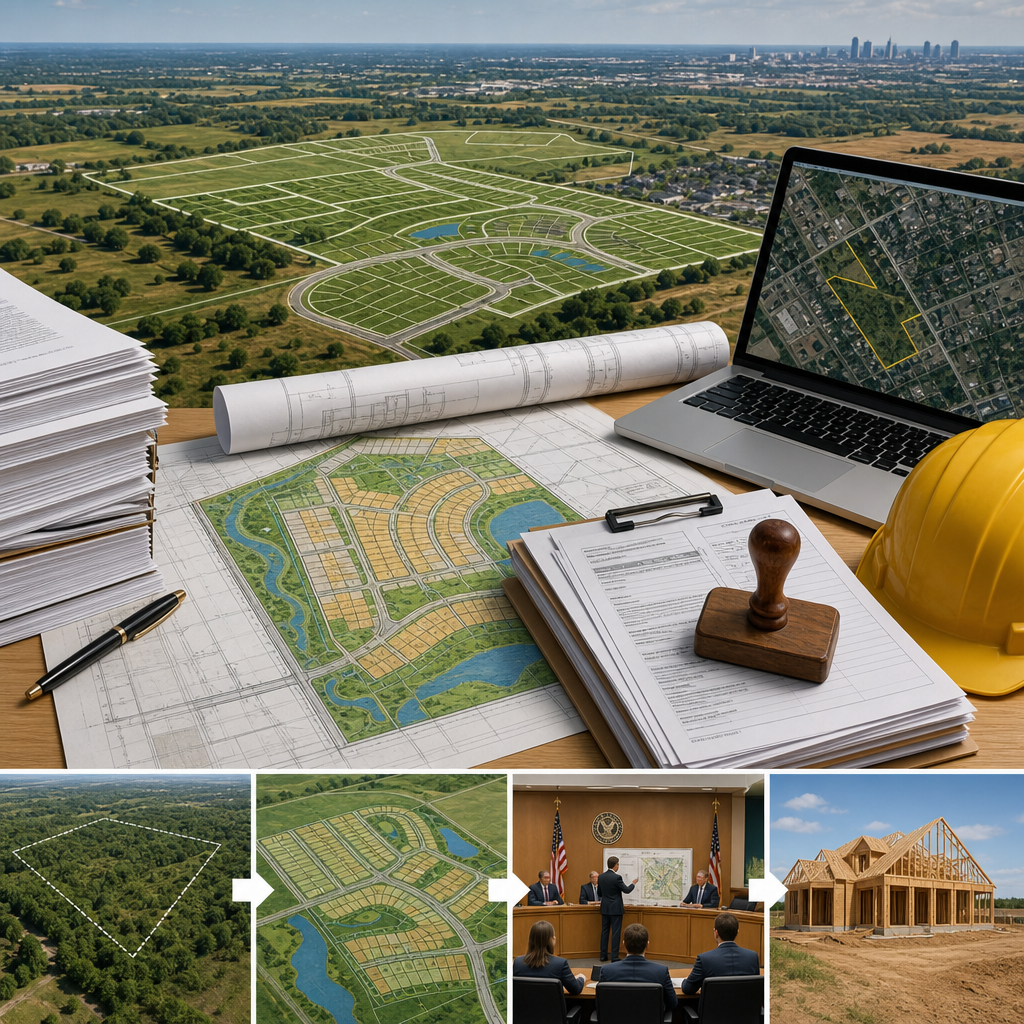
Real estate investment in the United States offers exceptional returns, but only investors who master the entitlement process succeed in capturing the lion’s share of the value. The real estate entitlement process transforms raw land into a developable asset with all necessary approvals, zoning permits, and environmental authorizations. This is precisely where the greatest opportunity for profit lies prior to construction.
Land entitlements are the invisible catalyst that multiplies a property’s value. A hectare without entitlements is worth only a fraction of what that same property is worth once zoning approvals and subdivision plans have been secured. We have found that this transformation can increase a property’s value by 30% to 100% or more, depending on the market and zoning.
Why does this gap exist? Developers pay a significant premium for “shovel-ready” lots because they eliminate regulatory risk and shorten their time to market. They don’t want to wait 18 to 36 months for municipal approvals. They want to start construction immediately.
Here’s the business model in action: buy raw land for $500,000, invest $150,000 in entitlement costs and professional fees, then sell the fully approved project for $1.2 million. That’s a 20% to 35% annual return with no construction, no tenant management, and no exposure to interest rates.
International investors are particularly attuned to this dynamic. They seek stable returns in U.S. dollars without the complexity of managing U.S. rental properties. Land entitlements offer exactly that: a bet on regulatory approval and land appreciation, with a clear exit route to developers.
Action to take: Evaluate your current investments. Are you looking for returns of more than 15% per year? If so, the entitlement strategy should be part of your portfolio.
The Hidden Challenges of Entitlement: Timelines, Costs, and Regulatory Complexity
The land entitlement process is far from a standardized procedure. Each jurisdiction has its own zoning regulations, approval processes, and environmental regulatory agencies. What you can accomplish in 12 months in Texas may take 24 months in Florida—or vice versa.
Unpredictable timelines are the first major challenge. A project you plan to complete in 18 months can stretch to 30 months if the city council requests additional traffic studies, if the environmental agency raises concerns about wetlands, or if neighbors file an objection. Every delay increases costs and reduces returns.
Entitlement costs vary just as much as the timeframes. You need to budget for:
- Surveying and feasibility study costs: $10,000 to $30,000
- Civil engineers' fees for subdivision plans: $20,000 to $60,000
- Zoning consultants and specialized attorneys: $15,000 to $50,000
- Environmental studies and ecological assessments: $5,000 to $25,000
- Municipal filing fees and review fees: $5,000 to $20,000
- Surveying and property boundary marking services: $2,000 to $8,000
The typical total cost ranges from $80,000 to $180,000 per project, depending on the size and complexity of the property. For a property of 50 to 100 acres intended for residential subdivision, expect to be at the high end of that range.
Regulatory complexity also creates pitfalls. Zoning codes vary widely. A parcel of land classified as “low-density residential” in Central Florida might allow for 5 to 8 lots per acre. In Texas, the same classifications vary from county to county. Interpreting these nuances and anticipating municipal objections requires in-depth local expertise.
Action to Take: Before purchasing a plot of land, hire a local zoning consultant to assess the likely approvals and realistic timelines. This upfront investment of $5,000 to $10,000 will help you avoid costly surprises down the road.
Step 1: Land Acquisition and Due Diligence
The entitlement process begins well before the zoning presentations. The initial selection and evaluation of the site determine 70% of your project’s success.
We begin by analyzing the data. What is the population growth rate in this region? What are the retail prices of comparable parcels of land? What are the regional and municipal land-use plans? Are schools, highways, and commercial facilities expanding toward this parcel? Public land data, property records, and municipal land-use documents paint a clear picture.
Next comes physical due diligence. You’ll organize a site visit, a title search, a land survey, and a preliminary environmental inspection. Look for federal wetlands, underground public utility easements, potential contaminated sites, and flood zones. Any environmental complications will increase permitting costs and extend timelines.
It is critical to review easements. If the property is subject to significant right-of-way or public utility easements, these may limit your ability to subdivide the land according to your ideal plan. We have seen projects delayed by several months simply because utility easements had not been properly mapped.
You should also understand the history of the previous owners. Have they previously attempted to obtain zoning variances and failed? Were there any disputes or objections from the community? Review the planning commission’s records. This history can either speed up your process or highlight potential obstacles.
Our teams conduct a comprehensive land due diligence process before making an acquisition, which means we identify 95% of the entitlement risks before closing the purchase. This allows us to negotiate the price based on the actual complexity of the deal and avoid problematic acquisitions.
Action to take: Ask the seller for all previous planning documents and correspondence with the municipality. If there have been previous attempts to obtain planning approval, this information is invaluable for understanding the obstacles.
Step 2: Subdivision Planning and Land Use Design
Once you own the land and understand its regulatory context, it’s time to develop your vision. Subdivision planning is the stage where you determine how the land will be divided into individual lots, how the infrastructure (roads, water, and sewer services) will be organized, and what type of housing or land use will be most appropriate.
The civil engineer creates a preliminary subdivision plan and a conceptual land-use plan. These plans are not finalized at this stage. Rather, they are working proposals that explore how many lots are theoretically possible, how internal roads might function, and where utility services would be located.
This phase also requires an economic analysis. If the land allows for a residential subdivision of 40 lots under the current zoning, but a zoning reclassification request could allow for 60 lots, is it worth pursuing a zoning change? A zoning change adds 6 to 12 months and $20,000 to $40,000 in costs. Are you creating enough additional value to justify the delay and the risk? The numbers must support the strategy.
You’ll also need to explore infrastructure requirements. Will the municipality require you to build internal access roads? To connect the site to municipal water and sewer systems or use private systems? To contribute to the costs of parks or schools? These obligations directly impact project costs and the final IRR.
The best subdivisions strike a balance between the maximum permitted density and practical feasibility. Too many lots on a small plot of land result in roads that are too narrow, insufficient common areas, and objections from neighbors. Too few lots mean the property won’t generate enough value to offset your entitlement costs.
Next steps: Work with a civil engineer who has local experience. Ask them to explore three density scenarios: conservative, moderate, and aggressive. Compare the cost of each scenario with the likely sales value to identify your best option.
Step 3: Navigating the Zoning Process and Municipal Approvals
This is the core of the permitting process. You present your plans to the planning commission and/or the city council. You navigate the public hearings, answer questions, address concerns, and obtain formal zoning approvals.
The process varies by jurisdiction. In some areas, a simple land-use approval is sufficient. In others, you must first obtain a preliminary subdivision resolution, followed by final approval after meeting the conditions. Some municipalities require a public hearing; others do not.
Here is a typical process in Texas or Florida:
- Formal submission of the application for approval (45 days for initial review)
- Presentation to the Planning Committee (public meeting)
- Comments from municipal staff, requests for changes
- Revision of the plans in response to comments
- Conditional approval or final approval by the city council
- Formal resolution filed with the county records office
Each step introduces potential delays. If city staff requests a traffic study or an additional environmental assessment during the initial review, your timeline will immediately be pushed back. If neighbors or interest groups publicly oppose the proposal, the city council may postpone the decision to allow for further investigation.
We have refined our pre-hearing preparation process. Before the public presentation, we contact municipal departments, meet with planning directors, and listen to the concerns that are likely to be raised. We revise our plans to anticipate objections. We also engage neighbors and local stakeholders to build support. This proactive approach reduces delays and increases approval rates.
Zoning consultants play a critical role here. They understand the language of municipal codes, planning precedents, and local policy. A good consultant anticipates difficult questions before the meeting.
Action to take: Hire a zoning consultant who has secured approvals in this jurisdiction within the past three years. Their recent experience and municipal connections are invaluable.
Step 4: Obtaining Environmental Permits and Authorizations
Once zoning approval is granted, the next step is to obtain infrastructure permits and environmental authorizations. This is often more technical than political.
Environmental permits include:
- Wetland Permits (Federal Environmental Protection Agency and State Agency)
- Rainwater Management Permit (Drainage and Erosion Control)
- Drinking Water Impact Permit
- Archaeological or cultural heritage permits (in certain states)
Infrastructure permits include:
- Approval of Plans for Sanitary Water and Drinking Water Sources
- Road Construction Permits
- Certificates of Competency for Water and Sewer Services
- Public Works Permits
The environmental agency will assess whether your project affects wetlands, streams, or the water supply. If so, you must prepare an environmental impact assessment or an ecological assessment. These studies are costly and time-consuming, but they are non-negotiable if environmental requirements mandate them.
In coastal regions or sensitive watersheds (such as South Florida), environmental requirements are stringent. We have seen coastal projects require wetland permits that take 8 to 12 months to obtain on their own. In inland Texas, environmental approval is generally faster, often taking 4 to 8 months.

Coordination among agencies is essential. The state agency is awaiting federal approval regarding wetlands. The water authority is awaiting approval for stormwater management. Delays in one area affect the entire schedule.
Action to Take: Compile a master list of all the agencies from which you need approval before formally filing. Submit preliminary applications to identify requirements early on, rather than discovering obstacles six months later.
Realistic Timeline: Average Processing Times by State and Court
The actual duration of the entitlement process varies considerably. Here are the typical timelines we see:
Texas (moderate- to fast-growing areas)
- Rural counties with low friction: 12 to 18 months
- Suburban counties (metropolitan areas): 16 to 24 months
- Large cities with rigorous review: 18 to 30 months
Florida (coastal and southern)
- Coastal counties with strict environmental requirements: 18 to 30 months
- Inland counties with growth (such as Polk County): 14 to 22 months
- Established metropolitan areas (Miami, Orlando): 20 to 36 months
Several factors speed up or slow down this timeline:
- Existing infrastructure: If the site already has water, sewer, and road services, the permitting process is faster.
- Environment: Sites with wetlands, endangered species, or sensitive water resources take longer to assess.
- Community opposition: Organized neighbors or public interest groups add 6 to 12 months.
- Zoning changes: Applications for zoning reclassification add 6 to 12 months to the process and carry a risk of rejection.
- Municipal crisis: If the planning agency is understaffed or undergoing a political transition, the timelines are extended.
For a typical residential subdivision of 40 to 60 lots that does not require a zoning change and has existing infrastructure nearby, expect the entire permitting process to take 16 to 24 months. If you are seeking a zoning change or encounter opposition, add 8 to 12 months.
Next steps: Ask your local consultant how many similar projects have been approved in this jurisdiction over the past three years and how long each one actually took. This is your best indicator of actual performance.
How Our Approach Accelerates Entitlements and Maximizes Value
At LandQuire, we’ve streamlined the entitlement process after completing more than 130 successful projects. Here’s how we speed up approvals and capture greater value.
Data-Driven Sourcing: We don’t start by falling in love with a piece of land. We start with the data. Which markets are experiencing double-digit population growth? Which counties offer zoning favorable for residential subdivision? Which specific parcels meet our entitlement criteria? This approach allows us to target parcels with the highest potential for approval from the outset, reducing risks and delays.
In-house regulatory expertise: We employ zoning consultants, civil engineers, and specialized attorneys who have an in-depth understanding of local codes. Rather than reinventing the wheel for every project, we apply the lessons learned from our 130 previous projects. If a submission strategy worked in Austin, we adapt it for San Antonio. If an obstacle arose in Polk County, we anticipate it before filing.
Early municipal engagement: We speak with municipal staff and planners before the formal presentation. This preliminary discussion identifies obstacles, clarifies requirements, and begins to build support. A project that begins with this preliminary engagement often progresses 20% faster than one launched without preparation.
Optimized Design: Our subdivision plans and land-use plans are designed from the outset to ensure approval. We do not naively maximize density. Instead, we maximize the density that the municipal market will accept, thereby reducing regulatory friction.
Environmental Risk Management: We conduct a comprehensive assessment of environmental risks prior to acquisition. If the project requires a wetland permit, we identify this in advance, budget accordingly, and hire an environmental expert from the outset. No surprises. No delays.
Tracking and Coordination: A single project manager oversees each project from initial submission to final approval. This means no miscommunication between agencies, no overlooked steps, and a tight schedule that adapts to actual delays.
Our land entitlement and ROI strategy treats the entitlement process as a managed process, not as a series of random events. This systematic approach reduces lead times by 20% to 30% on average and increases approval rates to 100% across our portfolio.
Action to Take: Assess whether your local zoning expert treats the entitlement process as proactive or reactive. Proactive experts engage with municipalities before filing an application. Reactive experts only respond after formal requests are made. Look for a proactive approach.
Real-World Feedback: Case Studies of Successful Projects
Numbers on their own are useful. Concrete examples are convincing.
Case Study 1: Residential Subdivision, Rural County in Central Texas
A 65-acre parcel of land in a rural county in Central Texas, purchased for $400,000. The area was zoned for agricultural use but was adjacent to a rapidly expanding suburban area. We identified an opportunity to rezone the land for low-density residential use (5 lots per acre), allowing for approximately 300 lots.
The zoning reclassification strategy was ambitious but justified by the municipality’s policy of promoting residential growth and the developing infrastructure in the region. Our local zoning consultant engaged the county during the planning phase. The discussions confirmed that the reclassification would be acceptable.
We hired a civil engineer, prepared the plans, and submitted the application. The planning commission approved the preliminary rezoning after two months. Final subdivision approvals followed three months later. Environmental and infrastructure permits took an additional four months.
Total timeline: 9 months of eligibility. Total cost: $120,000 in professional fees and deposits.
Result: The land's value increased from $400,000 (agricultural classification) to $1.8 million (subdivided land with all entitlements). Gross profit: $1.4 million before taxes and interest. Annualized IRR over 9 months: 48%.
The developer who purchased the fully approved project could begin construction immediately, avoiding costly regulatory delays.
Case Study 2: Coastal Subdivision, South Florida
A 28-acre parcel of land near a coastal community in South Florida, purchased for $850,000. The property included wetlands estimated to cover 40% of the site, which would complicate development.
Instead of bypassing the wetlands, we incorporated wetland conservation into our design. We worked with a specialist biologist to create a plan that would preserve critical wetlands, restore past damage, and create habitat that would enhance the project’s environmental credentials.
This approach turned a regulatory hurdle into a competitive advantage. The federal Environmental Protection Agency approved the wetlands plan in five months—a remarkably short timeframe for South Florida. Municipal approval of the overall project followed two months later.
Total timeline: 18 months of funding (longer due to the federal environmental review process). Total cost: $160,000.
Result: The land's value increased from $850,000 to $2.4 million (subdivided land with 18 high-end lots and certified environmental status). Profit: $1.55 million over 18 months. Annualized IRR: 32%.
Plots with environmental certification sold at a premium to developers seeking prestige.
These cases illustrate how expertise in land entitlement, strategic planning, and municipal engagement transform undeveloped land into highly profitable assets. The timelines varied (9 months versus 18 months), but returns remained above 20% annually.
Action to Take: Analyze properties in your current region using these cases as models. Identify two to three properties that involve zoning conflicts or have the potential for zoning changes. Hire a zoning consultant for a one-week rapid assessment. The cost is low; the insight it provides into feasibility is invaluable.
Get Started on Your Entitlement Strategy with Us
If you’re investing in U.S. real estate and looking to exceed standard returns, a land entitlement strategy should be central to your approach. Land with full entitlements sells at higher multiples than raw land. This appreciation is your return.
At LandQuire, we handle the entire entitlement process for you. You don’t need to learn the zoning codes of Texas or Florida counties. You don’t need to navigate municipal hearings or federal environmental requirements. You simply invest the capital and receive a fully approved parcel of land ready for sale to a developer.
Our approach offers:
- Data-Driven Acquisition Analysis: We identify properties with the highest potential for regulatory approval.
- Comprehensive entitlement management: From preliminary design to final approval, we manage every step of the process.
- Partnerships with municipalities: Our local expertise and relationships help speed up approvals.
- Transparency regarding timelines and costs: We provide realistic timelines and budgets before the acquisition.
- 100% approval rate: Out of our 130+ projects since 2021, we have achieved a 100% success rate in obtaining permits.
Our investors earn annual IRRs of 20% to 35%+, with no construction, no tenant management, and no exposure to interest rates. The land is sold to developers, who assume the construction risk. You simply capture the pre-development value and exit.
Typical minimum investment requirements start at $100,000, with investment horizons ranging from 18 to 36 months. The structure is generally 100% equity, which means no debt leverage, no interest rate volatility, and clear exposure to real estate returns.
If you operate beyond the U.S. market or are looking to diversify into high-yield U.S. dollar-denominated real estate assets, now is the time to act. The U.S. real estate market in growth regions remains inefficient. Properties that are expected to receive development permits within 12 months often remain unapproved because landowners lack regulatory expertise. This is the gap we’re capitalizing on for you.
Contact our team for an initial consultation. We can assess your investment profile, discuss current market opportunities, and show you how our land entitlement strategy aligns with your return objectives. No commitment is required.
Your next opportunity for double-digit returns is waiting for you. It’s just waiting for you to claim it.