Plat approval process – key steps in land validation
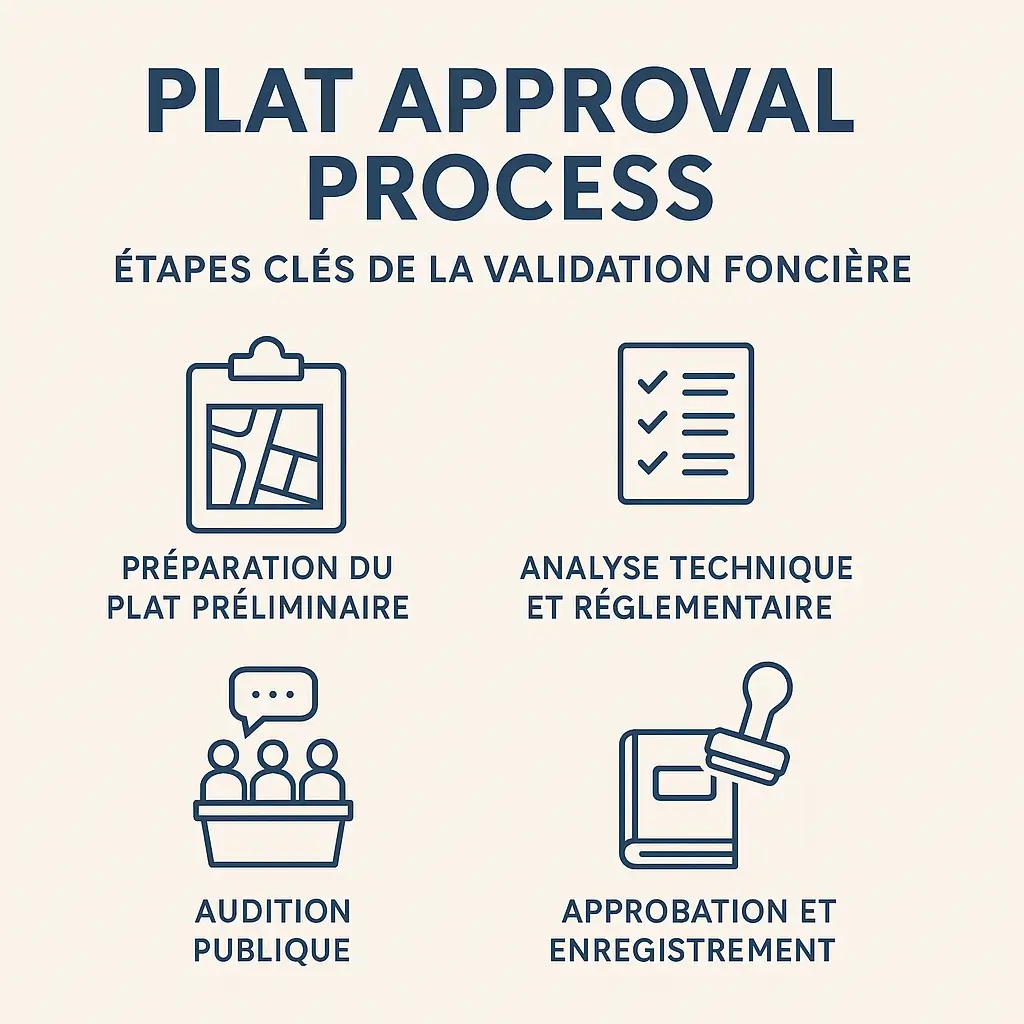
The plat approval process is an essential step in any real estate investment project in the United States. This land validation procedure determines whether a plot of land can be officially subdivided, developed, and sold in accordance with local requirements defined by the urban planning authorities (Planning and Zoning Department). Without an approved plat, no real estate transaction or construction can be legally recognized, exposing the investor to administrative and financial obstacles.
Understanding how the approval process works, its successive stages, and its technical implications is therefore essential to avoid costly delays, administrative rejections, or land depreciation. This process establishes the link between a project's development vision and the regulatory reality of the territory: it validates the conformity of the division of lots, the integration of public networks, road access, and compliance with environmental constraints (flood zones, easements, zoning).
In a dynamic state like Texas, where demand for land is skyrocketing, this approval is crucial to the success of an investment. Many foreign investors still underestimate its importance, even though a properly approved plat can multiply the value of a piece of land and guarantee the legal security of the project. Mastering the plat approval process means transforming regulatory constraints into a lever for value creation —a key step for any buyer wishing to develop or resell real estate strategically.
Author
This article was written by the LandQuire team, which specializes in real estate investment in the United States. Our experts assist French-speaking investors in their purchases of American land.
🔗 Follow LandQuire on LinkedIn
✉️ Specialized contact for land in Texas
What is the dish approval process?
The term “plat” refers to a detailed land map showing the division of a piece of land into lots. The plat approval process is therefore the process by which local authorities (city, county, or planning agency) approve this division.
Every land project, whether it involves creating a residential subdivision or re-dividing a large rural parcel, must undergo this validation process in order to be legally registered. This is one of the pillars of the American cadastral system, ensuring that land complies with urban planning standards, public utilities, and existing easements.
👉 Before getting the green light, investors often need to consult public records and check for easements in Texas: understanding everything before purchasing land, water rights, and sometimes even mineral rights.
Why is the dish approval process so important?
The plat approval process is not a mere administrative formality. It is a strategic step that secures the project and protects the value of the land. Without this validation, lots cannot be sold separately or connected to essential public utilities: water, electricity, roads, or sewers.
Each US county applies its own rules. These standards ensure that the division of plots complies with urban planning and existing infrastructure. Obtaining this approval allows the project to be placed within a clear and recognized legal framework.
For investors, this provides insurance against land disputes or administrative delays. The approved plan confirms that the land is compliant, viable, and usable according to local laws. It becomes an asset ready for construction, residential development, or resale with high added value.
In summary, mastering the plat approval process means mastering risk. It is a crucial step for any successful real estate project in the United States, especially in a competitive market like Texas, where regulatory compliance directly influences the profitability of the land.
Key issues for investors
- ✅ Legality: an approved plan is the only cadastral document recognized by local authorities.
- ✅ Transparency: it reveals the exact boundaries, easements, and non-buildable areas.
- ✅ Financial viability: a validated project is more likely to obtain financing and Title insurance in the USA – protecting your interests when buying.
- ✅ Easier resale: potential buyers have confidence in the land's compliance.
States such as Texas, where land values are rising sharply, impose strict controls on every stage of the process to prevent property disputes and environmental risks.
Step 1 – Preparing the preliminary dish
The starting point of the plat approval process is the submission of a preliminary plat. This document is prepared by a licensed surveyor and presents:
- The exact boundaries of the land;
- The dimensions of the lots offered;
- Access roads and public roads;
- Areas reserved for infrastructure;
- Physical constraints (slopes, flood zones, unstable soils).
This initial draft is then reviewed by the city planning department to verify its compliance with zoning and subdivision regulations.
💡 Good to know
ALTA land survey—the standard for titles without surprises is often requested before the land is registered. It guarantees topographical accuracy and consistency between the cadastral map and the title deed.
Step 2 – Technical and regulatory analysis
Once the preliminary plan has been submitted, local authorities receive the file for evaluation. The urban planning, public works, environment, and health departments analyze each plan. Each department verifies that the project complies with zoning standards and land use regulations. The safety or civil defense department sometimes gets involved to assess emergency access routes. These checks ensure that the future subdivision meets local requirements before any official approval is granted.
The checks include:
- Zoning Ordinance: correspondence between the intended use and the classification of the land.
- Road access: compliance of traffic lanes and connection to the public network.
- Public utilities and services: availability of connections (water, electricity, sewerage).
- Natural hazards: analysis of FEMA flood zones – mapping and reducing flood risk.
Each department issues its recommendations or objections. If the dish meets the standards, it moves on to the next stage: the public hearing.
Step 3 – Public Hearing
This phase of the planning approval process plays an essential role in the land use validation of a project. It allows the plan to be presented to local authorities and the public concerned. Local residents, associations, and technical services can express their comments. The debate often focuses on road traffic, water management, housing density, or the protection of natural areas.
This public consultation creates a framework for transparency. It helps authorities gauge the project's impact on the community. Elected officials seek to balance economic development and local quality of life. A well-explained project is often more likely to receive a favorable opinion, especially if it fits harmoniously into the county's master plan.
In Texas, some counties even require several public meetings before issuing final approval. Community opposition can delay approval or even block the process if the project does not comply with local guidelines. Investors must therefore anticipate these relational issues from the design phase onwards.
💬 Real-world example
In Travis County, near Austin, a subdivision project was suspended in 2024. The access roads did not meet Texas Department of Transportation (TxDOT) standards. This type of situation highlights the importance of early consultation, clear communication, and ongoing collaboration with local authorities. Anticipating community expectations remains a worthwhile strategy for expediting final approval.
Step 4 – Review and final approval
After the public phase, the developer or investor submits a revised version of the plan. This document incorporates the required changes (adjustment of lots, addition of easements, modification of drainage, etc.).
When the final plan (final plat) is complete, it is presented for approval by the Planning and Zoning Commission or the City Council, depending on the jurisdiction.
Once approved, it becomes a legal document registered with the county office.
🧭 Key point to remember
Step 5 – Registration with the County Clerk
Approval is not enough: the plan must then be registered with the County Clerk.
This filing formalizes the subdivision and assigns a lot number to each parcel.
At this stage, the land becomes buildable and saleable.
The title deed is then updated and can be protected by title insurance USA – protecting your interests when buying.
This registration also triggers the creation of new tax references (tax parcels), which are essential for purchase-resale transactions.
Step 6 – Coordination with other land documents
The dish approval process interacts directly with other crucial elements:
| Element | Description | Useful link |
|---|---|---|
| Title commitment | Details the conditions and exceptions of the property. | Texas Title Commitment – Understanding Exclusions and Exceptions |
| Mining rights | May be separated from the surface title. | Texas mining rights – what every buyer must check |
| Water rights | Governed by the Texas Water Code, essential for any development. | Water rights - key rules for investing in Texas |
| Easements | Influence access and buildability. | Easements in Texas: Understanding everything before buying land |
Step 7 – Post-approval inspections
Even after the plan approval process has been completed, some counties still require compliance inspections. These inspections ensure that the completed developments follow the approved plan exactly. They cover roads, utilities, drainage, and public access.
Public engineers conduct site visits. They check soil stability, drainage system capacity, and the quality of connections to water and electricity networks. They also check flood zone management, according to standards established by FEMA (Federal Emergency Management Agency). These technical points determine whether the land is actually buildable and safe.
A successful inspection boosts the project's credibility and speeds up the issuance of building permits. On the flip side, any differences between the approved plan and the actual site conditions can delay marketing. The authorities will then demand immediate corrections: changes to drainage, road repairs, or the addition of erosion control measures.
This process is a quality control step prior to marketing. For investors, it confirms that the project complies with local standards and minimizes future risks. A compliant dish thus becomes a guarantee of value and a mark of confidence for end buyers.
Step 8 – The impact of plat approval on land value
Obtaining an approved plot can increase the value of a piece of land.
Unapproved "raw land" will have a much lower price than a subdivided and registered plot.
Examples of valuation:
- Raw land: $5,000 per acre
- After preliminary flat: $7,000/acre
- After final approval: $10,000 per acre
This regulatory value creation attracts specialized investors such as LandQuire, who transform undervalued land into serviced assets.
This is the logic behind projects such as RiseQuire and Portfolio Seguin: purchase, regulatory preparation, and resale at a high capital gain.
Step 9 – Mistakes to avoid during the plate approval process
Even experienced investors can make mistakes. Here are the most common ones:
- ❌ Ignore zoning: each district has its own usage restrictions.
- ❌ Underestimating deadlines: some counties require 90 days or more for approval.
- ❌ Omitting an existing easement: an error that can block the entire project.
- ❌ Ignoring flood risks (FEMA): the new 2024 FEMA maps have changed several boundaries.
- ❌ Not consulting a local expert: regulations vary greatly from county to county.
📘 Useful external link:
Consult the Texas Local Government Code – Chapter 212 (opens in a new tab) to understand the legal framework for land subdivision in Texas.
Step 10 – Trends for 2025–2026: toward complete digitalization
The digitization of the building permit approval process is advancing rapidly in several US states. Local authorities are modernizing their systems to simplify and speed up procedures. This transformation is part of a drive for efficiency and public transparency.
By 2026, many counties will have implemented electronic submission of plans. Developers will be able to submit their plans via secure platforms, reducing delays and tracking progress online. This development reduces human error and improves coordination between departments.
Administrations are also experimenting with the use of digital twins. These 3D models enable real-time visualization of a project's impact on the terrain, networks, and sensitive areas. Engineers and urban planners can simulate water flows, road traffic, or flood constraints before approval.
In Texas, some pilot counties such as Collin and Williamson are already using these digital tools. This approach improves the accuracy of decisions and boosts investor confidence. It is part of a broader trend toward “smart land development, ” supported by organizations such as the National Association of Counties (NACo) andthe Urban Land Institute (ULI).
This modernization of the plat approval process heralds a faster, more reliable, and more sustainable era for U.S. land planning.
Benefits for investors
- Reduced approval times;
- Better coordination between public services;
- Instant access to geospatial data;
- Increased transparency and traceability of changes.
These developments are part of the "Smart Land Development"movement, supported by organizations such asthe Urban Land Institute (ULI) and the National Association of Counties (NACo).
FAQ – Plate Approval Process
1️⃣ What is a plat in legal terms?
A plat is a certified land map representing the division of a property. It defines lots, easements, and access roads. It is a legal document filed with the county.
2️⃣ How long does the plat approval process take?
On average, between 60 and 120 days, depending on the complexity of the project and the responsiveness of local authorities. Some Texas counties may take longer than six months.
3️⃣ Can I sell a lot before the subdivision is approved?
No. Until the subdivision is approved and recorded, the separate sale of lots is prohibited. Doing so would constitute a violation of the Texas Local Government Code.
4️⃣ Which experts should I consult?
A certified surveyor, a real estate lawyer, an urban planning consultant, and a specialized real estate broker are the four pillars of a successful project.
Conclusion: validate before investing, invest to add value
The approval process goes far beyond the administrative framework. It provides legal certainty and acts as a lever for land value appreciation. Each stage that is validated reinforces the credibility of the project and reassures both buyers and local authorities.
For a French-speaking investor, understanding and anticipating this procedure offers a strategic advantage. This knowledge reduces regulatory obstacles and accelerates the profitability of the real estate project. An approved, compliant, and registered deed guarantees smooth transactions and title stability.
👉 Before making any purchase, check these key points:
- The status of the dish: in progress, approved, or expired;
- Any easements and restrictions already registered;
- Mining and water rights, sometimes separate from the main title;
- FEMA risks, particularly in areas prone to flooding;
- The existence of a clear and complete title commitment.
A savvy investor doesn't settle for a good location. They analyze the legal framework, zoning, and compliance of the plot. This rigor protects their capital and increases the resale value of the land. By mastering the plot approval process, you can turn a technical obligation into a sustainable competitive advantage in the U.S. real estate market.
🏁 Contact us
Are you considering investing in US real estate?
LandQuire assists you in thoroughly checking your plots of land: buildability, risks, easements, titles, and local taxation.
📩 Contact us for a personalized audit
and discover how our experts transform regulatory complexity into investment opportunities.