Agricultural Land vs. Entitlement: Maximize Your Real Estate Returns

Why Farmland Is No Longer Enough for Savvy Investors
International investors seeking to diversify their U.S. real estate portfolios are quickly discovering an uncomfortable reality: traditional farmland rarely generates the returns that modern markets demand. A farm in Florida or Texas might offer you a 2 to 4 percent annual return if you’re lucky. When compared to the opportunity cost and inflation, that figure pales in comparison.
The problem is structural. Owning farmland locks you into a business model that depends entirely on commodity prices, weather conditions, and global demand. Every year, you wait for a harvest, hoping that your profit margins will cover your maintenance costs, property taxes, and operating expenses. For an investor seeking double-digit returns over an 18- to 36-month horizon, this approach simply doesn’t make sense.
We regularly see investors from Europe, the Middle East, and Latin America coming to the United States with the intention of purchasing productive land. They quickly realize that this strategy offers neither the liquidity, the returns, nor the potential for rapid appreciation that they are seeking. There is a better way.
The Myth of Passive Yield in Agriculture: The Hidden Realities
Farmland sells a dream: “Buy it, lease it to a farmer, and cash the checks.” The reality is much more complex and costly.
First, management. Even if you lease your land to a farmer, you remain the owner and are responsible for environmental damage, water regulations, local legal obligations, and infrastructure maintenance. A poor harvest may leave the farmer unable to pay the rent. A prolonged drought can drastically reduce the value of your land.
Second, hidden costs add up: annual property taxes (which are rising), insurance, maintenance of access roads, drainage, and pest control. In high-growth areas such as Central Texas or South Florida, property taxes rise rapidly as development pressure increases. So you’re paying more and more for the theoretical possibility that your land might one day become buildable.
Third, illiquidity. Selling farmland takes 6 to 18 months. The pool of potential buyers is limited. If you need to reinvest your capital elsewhere or if a better opportunity arises, you’re stuck.
Fourth, currency exposure. For international investors purchasing in U.S. dollars, the land value of a 25-year agricultural property may be eroded by unpredictable market cycles. Meanwhile, your USD capital remains idle.
Agriculture does not create value; it does a poor job of preserving it. Savvy investors are looking for an alternative that offers real returns, short time horizons, and a clear exit strategy.
How Entitlement Turns an Ordinary Plot of Land into Real Estate Gold
Entitlement is a game-changer. Entitlement is the process of obtaining all the necessary approvals, permits, and zoning designations to transform raw land into land ready for residential development. It is the key that unlocks exponentially higher value.
Let’s imagine a real-world scenario. You purchase a 50-acre agricultural parcel in Osceola County, Florida, for $2 million. The land itself—without any zoning changes or approvals—is worth exactly that amount. Now, we bring in our teams of experts in entitlement and zoning. We work with local authorities, prepare the required environmental and technical studies, and submit a detailed residential subdivision plan for 150 homes. Eighteen months later, all permits have been obtained and the zoning has been changed.
That same piece of land is now worth $6 to 8 million to a real estate developer. Why? Because the next buyer no longer faces any regulatory or administrative risks. They can begin construction immediately. They don’t need lawyers, urban planners, or engineers; that work has already been done. From the developer’s perspective, the land has become a finished product.
The value did not come from any physical improvements. No houses were built. No residents moved in. The value stems from a change in the land’s regulatory status. It is this capture of value prior to construction that generates returns of 20 to 35%+ over short cycles.
Our comprehensive approach to land rights explains how we structure this end-to-end process.
Our Approach: Capturing Value Before Construction Begins
At LandQuire, we don’t build. We don’t manage properties. We aren’t developers. We operate in the strategic niche of pre-development: identifying, acquiring, and securing regulatory approvals for land, followed by its sale to established developers.
Our process begins with a proprietary analysis of market data. We identify high-potential growth areas in Texas and Florida where land is currently undervalued but residential demand is rising. We specifically look for parcels where the current zoning does not reflect the best possible use of the land.
Once a property is identified, we acquire it through a 100% equity investment structure (no debt). This means our investors never have to worry about interest rates, margin calls, or refinancing. We finance the project entirely with equity.
Next, we engage our in-house teams of entitlement and zoning experts, civil engineers, and real estate attorneys. These teams work together to:
- Conduct a comprehensive market and feasibility study
- Design an optimal residential subdivision plan to maximize the number of units and property value
- Obtain all required environmental, water, and structural approvals
- Secure approval for zoning changes from local authorities
- Obtain all the necessary permits for a future construction project
All the while, investors do nothing. They monitor progress through detailed quarterly reports. There is no tenant management, no emergency calls, and no day-to-day operational decisions to make.
Once all the necessary approvals have been secured, we sell the land to an established developer or a real estate investment firm. The land, now fully approved and ready for construction, sells for a significantly higher price. Our investors recoup their initial capital plus their returns.
Tangible results: 130+ projects completed since 2021
We have successfully completed more than 130 projects since our founding in 2021. That means 130 properties identified, acquired, brought into compliance with regulations, and successfully sold. Each one has generated returns for our 600+ investors around the world.
These projects are not theories or financial models. They are actual transactions carried out in real markets (primarily Central Texas, South Florida, and other high-growth regions). Investors have actually withdrawn their capital plus their profits.
Our projects cover a wide range: from $500,000 acquisitions of small parcels of land to multi-million-dollar transactions involving multi-sector properties. Some projects took 18 months from start to exit. Others took 36 months due to more complex regulatory processes. But all resulted in a successful exit and a return for investors.
We also maintain an impressive track record: a 100% success rate in obtaining permits. Every project we have undertaken has received all required approvals and requested zoning changes. This is no fluke; it is the result of in-depth expertise, established relationships with local authorities, and strict discipline in project selection. We only begin projects where our teams are convinced that obtaining the necessary permits is feasible.
An investment structure with no construction or rental management risk
The investment structure we propose eliminates two of the biggest risks in the real estate sector: construction risk and rental management risk.
Construction risk is very real. Construction projects run over schedule. Costs rise. Contractors go bankrupt. Weather conditions cause delays. For passive investors, participating in real estate construction means exposure to these risks, plus the added burden of active project management and the potential for further losses.
We don't build. You don't have that risk.
The risk associated with rental property management is just as significant. Owning a rental property means managing tenants, dealing with late payments, maintaining the property, coping with seasonal vacancies, and navigating local tenant protection laws. For an international investor based in Paris, Dubai, or Mexico City, this operational burden is unmanageable.
We don't have any tenants. You don't have that responsibility.
Instead, what you have is a simple, debt-free equity investment in land that appreciates in value as a result of regulatory improvements. You share in the appreciation. When the land is sold to the developer, you recoup your principal plus your returns, typically within 18 to 36 months.
The typical investment structure works as follows: you invest a sum of capital (minimum 100,000 euros). This capital, combined with that of other investors in the same transaction, is used to purchase the land. You hold a share of ownership in the land. As we develop the property rights and the value of the land increases, your stake grows proportionally. Upon exit (sale to the developer), the proceeds are distributed according to your stake.
There are no notes, no debt, no margin calls, and no risk of bankruptcy. Your maximum risk is your initial investment. Your potential return is determined by the property’s performance and regulatory appreciation.
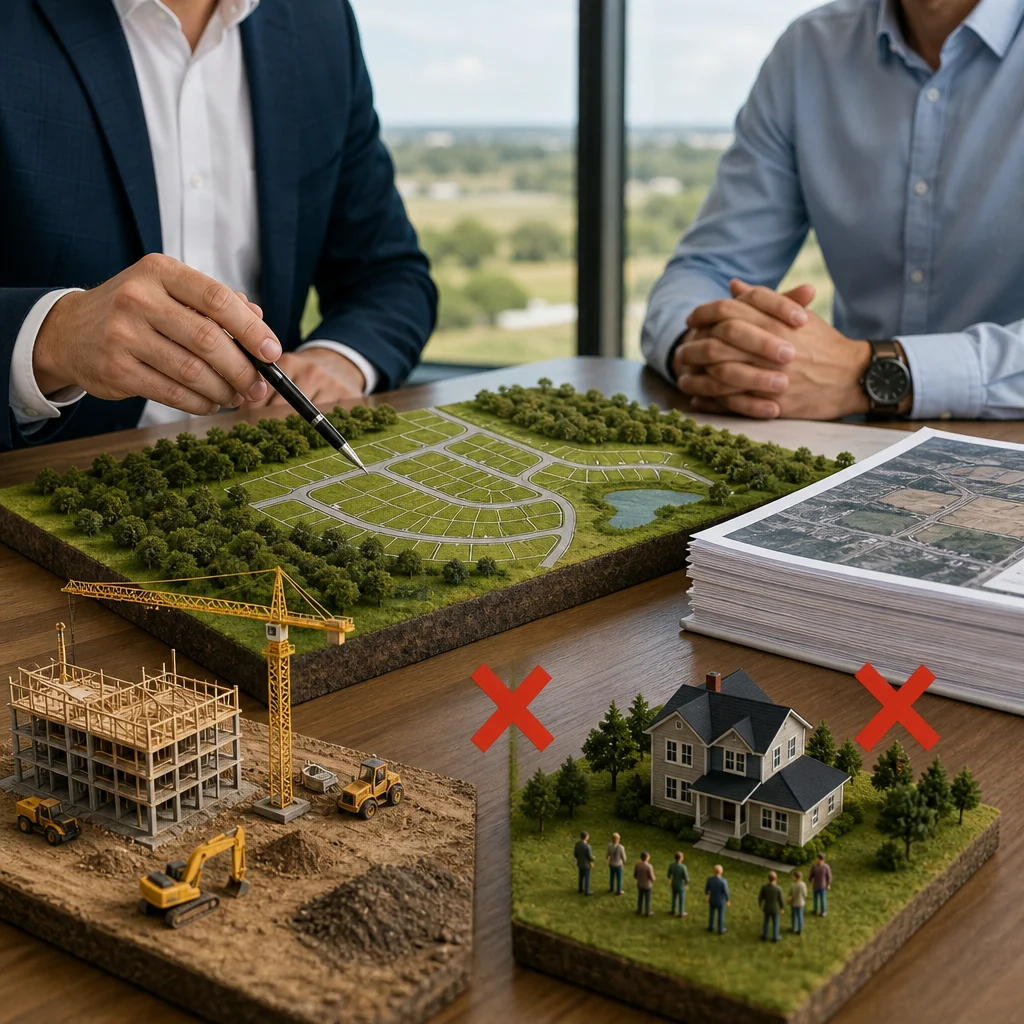
Short-term investments, high returns: 18 to 36 months to see your returns
Most real estate investors think in terms of long-term cycles: 10 years of ownership, accumulating rent, and then selling. That’s a long time to tie up capital.
Our model operates on a different timeline. We aim for cycles ranging from 18 to 36 months from start to completion. For some projects that are relatively straightforward from a regulatory standpoint, we can complete them in 18 to 24 months. For more complex projects requiring multiple approval stages, the timeline is 30 to 36 months.
This short-term perspective offers significant advantages for investors:
- Quick reinvestment: Your capital isn't tied up for a decade. Within 2 to 3 years, you can exit, recoup your profits, and redeploy the capital into the next project. This compounds your returns over multiple cycles.
- Reducing Geopolitical and Currency Exposure: For international investors, leaving USD capital tied up for 10 years creates prolonged exposure to currency risks. Shorter investment horizons reduce this exposure.
- Strategic flexibility: Your portfolio isn't set in stone. If your financial situation changes or if you find a better opportunity elsewhere, you aren't tied to a 10-year project.
- Actual vs. Theoretical Returns: Returns over the next 2 to 3 years are generally higher than the returns expected over a decade. You’re not just speculating—you’re actually achieving results.
The target IRR (internal rate of return) for our projects ranges from 20% to 35%+ per year. This means that over a 24-month cycle, you can see your investment of 100,000 euros grow by 40% to 70%+, or approximately 44,000 to 70,000 euros in net gains, before reinvestment. Compared to returns in agriculture (2% to 4%) or most public real estate funds (6% to 8%), this performance is exceptional.
Why choose the LandQuire strategy over agriculture or real estate development?
The question is simple: Why not just buy farmland directly, or invest in a real estate development company?
As we have discussed, agriculture is characterized by low returns, hidden costs, and long time horizons. It does not meet the needs of investors seeking double-digit returns.
Real estate development, on the other hand, involves direct construction and exposure to all construction risks. It also entails active operational management, frequent capital calls (in addition to the initial investment), and significant risks of cost overruns or delays. For passive international investors, this is too complex.
Our strategy—entitlement-driven pre-development—offers the best of both worlds:
- Higher returns than agriculture: 20 to 35%+ IRR vs. 2 to 4%
- No construction risks: No cost overruns, no delays, no contractors failing to deliver
- No rental management: No tenants, no maintenance, no vacancies
- Short-term horizons: 18 to 36 months vs. 10+ years
- Concentrated Expertise: You benefit directly from our team specializing in entitlement and zoning
- Off-Market Access: The best properties are never publicly listed; we acquire them directly from the source
Essentially, you’re investing in regulatory and zoning expertise—not in luck or time. Our team creates value through regulatory improvements. You receive a proportional share of that value.
Access to off-market opportunities that traditional investors cannot find
The best properties with high potential are never listed on MLS or in public real estate databases. Seasoned developers and savvy investors buy off-market, directly from existing landowners, before the market recognizes the property’s potential.
We have built a proprietary network of land sources that enables us to identify and access these off-market opportunities. Our analysts continuously analyze market data, municipal growth plans, upcoming infrastructure projects, and demographic changes to identify areas where land values will increase significantly.
Once an area is identified, our teams establish direct contact with the current landowners. Many of these landowners have held their property for decades—whether as family heirlooms or long-standing investments. They are unaware that the zoning is about to change. They don’t realize that the municipality is planning new infrastructure nearby. To them, the land is a static asset. To us, it’s a dormant opportunity.
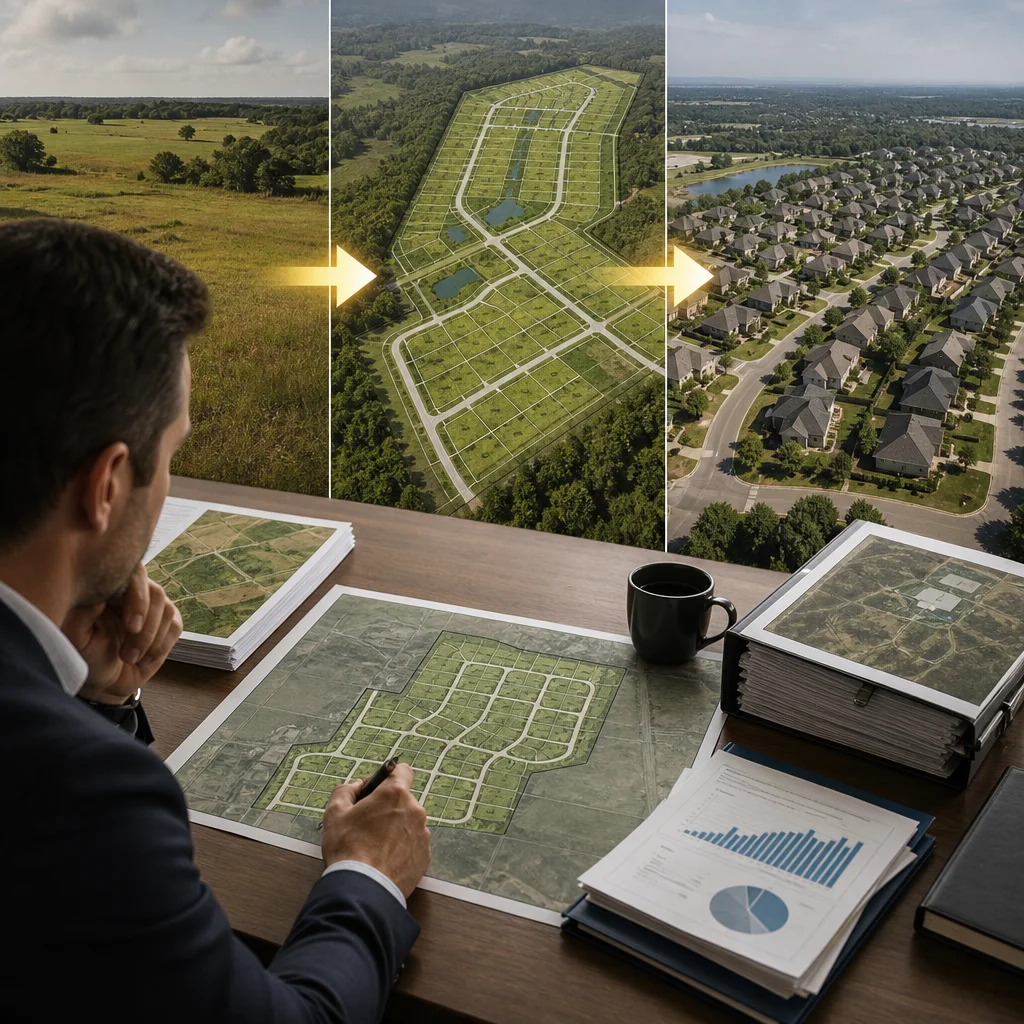
We acquire these properties directly, before traditional developers or investors take notice of them. At this point, we begin the entitlement process. Six to 18 months later, once approvals have been granted, these same properties have obviously become valuable. Now the developers show up. Prices have tripled. Our investors realize their gains.
For international investors, this off-market access is generally impossible to achieve on their own. You don’t have the local contacts. You aren’t familiar with the municipal authorities. You can’t navigate the intricacies of regional zoning. This sourcing network is a key component of the value we provide.
How Our Entitlements Guarantee a 100% Success Rate
A 100% success rate in entitlements is impressive. How do we achieve it?
First, we only undertake projects that we are confident we can complete. Our team of urban planners and attorneys evaluates each potential property in detail prior to acquisition. We analyze current zoning, municipal master plans, environmental regulations, infrastructure capacity (water, electricity, roads), and the history of zoning changes in the area. If we identify major obstacles or insurmountable hurdles, we do not purchase the property. We only take on projects where our teams are confident that rezoning and regulatory approvals are achievable.
Second, we have built lasting relationships with local authorities. Our teams work regularly with zoning commissions, urban planners, and municipal officials in the counties where we operate. These relationships are invaluable. Government officials know us. They know our standards. They know our process. When we submit a request for a zoning change or environmental approval, it’s not a cold request from an outside entity; it’s a familiar, trustworthy request from an established partner.
Third, we invest in the process. Our teams don’t cut corners. We hire the most qualified environmental consultants. We work with the best real estate attorneys. We fund comprehensive civil engineering studies, traffic analyses, and environmental impact assessments. These investments in due diligence and presentation ensure that our proposals are solid and well-researched, not slapdash.
Fourth, we are committed to the community. Zoning changes often fail due to local opposition. We work with residents, school authorities, local officials, and community groups to build consensus around our plans. We listen to legitimate concerns and modify our plans as necessary. This collaborative approach takes time, but it creates the community buy-in that allows us to secure final approvals.
The result: 130 projects, with a 100% success rate in obtaining the necessary permits. No project failed due to a denied rezoning request or a missed regulatory approval.
Getting Started: Investing 100,000 euros in real estate pre-development
If you are an international investor looking for access to high-yield U.S. real estate opportunities without the complexity of construction or property management, pre-development through entitlement is the solution for you.
Here's how to get started:
- Get in touch with our team: Visit our website at https://landquire.com to speak with an investment specialist. We’ll discuss your investor profile, your return goals, and your time horizons. If we’re a good fit, we’ll invite you to learn more about our current projects.
- Review the project details: You’ll receive comprehensive documentation on current investment opportunities. This includes market analysis, the subdivision plan, expected entitlement timelines, financial structures, and projected returns. No details are missing—it’s complete transparency.
- Conduct your due diligence: We encourage all investors to conduct their own due diligence. Hire your own attorneys and real estate experts, if you wish. Verify our experience, past projects, and references. We are happy to cooperate fully.
- Invest and track your project: Once you are satisfied, invest your minimum capital of 100,000 euros (or more). Your funds are held in an escrow account until the transaction closes. Upon closing, the land is acquired and the title registration process begins. You will receive detailed quarterly progress reports tracking each step of the zoning and approval process.
- Wait for the project to be completed and collect your profits: Within 18 to 36 months, our team will complete the land title process and sell the property to a developer or institutional buyer. You will receive your initial investment plus your returns, typically within 30 days of the sale closing.
The minimum investment is 100,000 euros, but investors can participate in multiple projects, thereby broadening their exposure and return opportunities. For investors with more capital available, we also offer larger co-investment structures.
Our team speaks French, English, Arabic, and Spanish, making the process accessible no matter where you live. We work with investors in Europe, the Middle East, Latin America, and elsewhere, all of whom share the same goal: passive access to high-quality U.S. real estate returns without the complexity.
Start your journey toward higher real estate returns today. Visit https://landquire.com to discuss your investment goals.