High-margin real estate opportunities in the U.S.: Generate 20–35% returns without construction risk
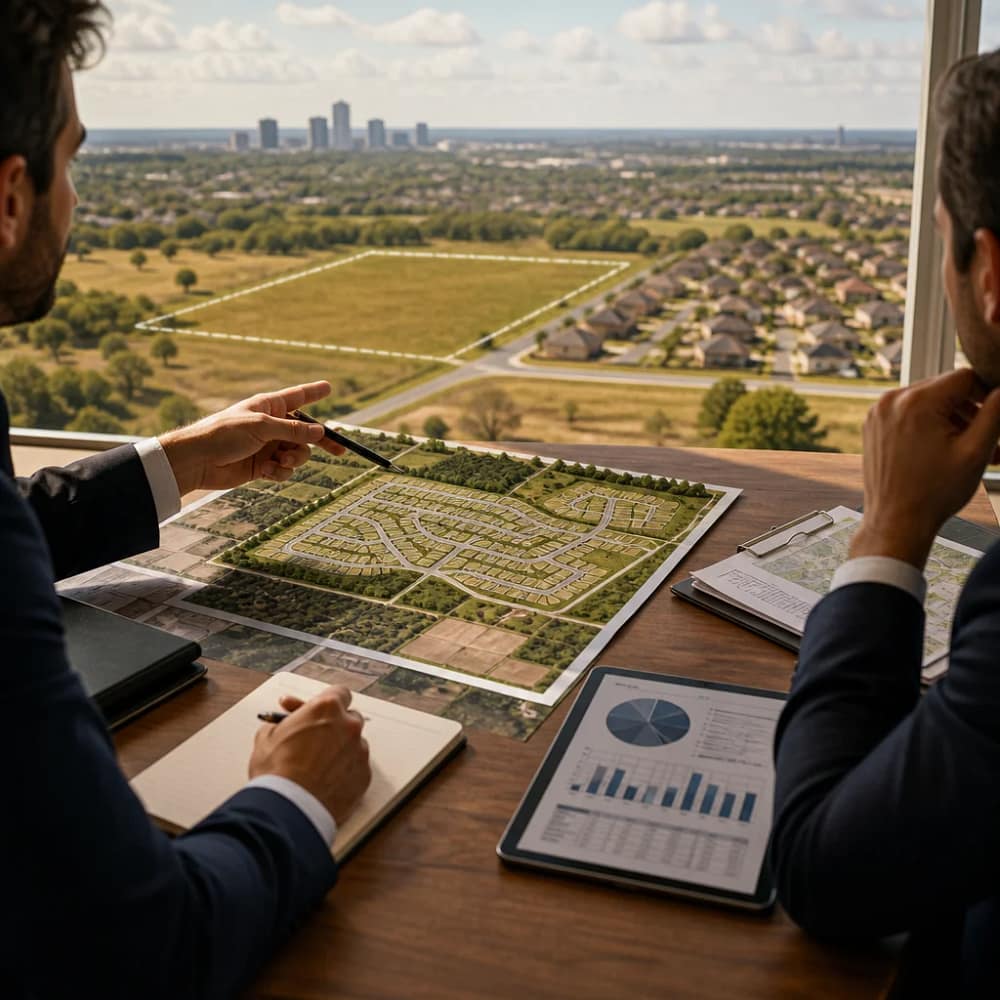
Why International Investors Are Seeking Real Estate Opportunities in the United States
International investors are turning to the U.S. real estate market for one fundamental reason: real returns. While traditional real estate markets in Europe and the Middle East offer rental yields of 3 to 5 percent annually, the United States—particularly Texas and Florida—presents a different dynamic. The populations of these states are growing rapidly, creating a pressing demand for residential housing.
This population growth presents an opportunity that most investors overlook: undervalued land prior to the construction phase. An international investor with $100,000 to invest can gain access to fully permitted residential projects that are ready for development, with short timelines (18 to 36 months), and without having to manage either construction risks or national regulatory complications.
The United States also offers institutional stability, a clear legal framework, and market liquidity that surpasses that of many other countries. For an investor based in Europe or the Middle East, this means diversification into U.S. dollars, an asset class less correlated with local markets, and returns far higher than those from conventional bonds or real estate investments.
In addition, the private equity structure (100% equity, no debt) eliminates interest rate risk, a major advantage in a volatile economic environment.
Key takeaway: Invest in land in the United States before construction begins, capture the highest margin, and then exit without operational complications.
The Challenge: Finding Real Returns in Traditional Residential Real Estate
Traditional residential real estate attracts global investors, but real returns are often disappointing. A rental property in Europe offering a gross yield of 4% must cover property management fees (8–12%), maintenance costs (3–5%), and vacancy costs (5–10%). The net yield quickly drops to 1% or less after taxes.
In the United States, even with higher nominal yields (6–8%), foreign investors face obstacles: rental regulations, remote property management, U.S. tax complications, the risk of prolonged vacancies, and direct exposure to interest rates if the property is financed with debt.
A building purchased for $1 million that generates $70,000 in annual rent represents a gross return of 7%. But after taxes, management fees, unexpected repairs, and periods of vacancy, the net return drops to 3–4%. Over 10 years, this results in slow accumulation of wealth with capital tied up, no clear exit strategy, and no significant increase in value upon resale.
Traditional rental real estate also requires constant hands-on involvement. Even with a professional property manager, investors must monitor expenses, handle tenant disputes, and navigate changing regulations. For an international investor, this complexity compounds the challenges of time zones and language barriers.
It is this frustration that is driving investors toward alternative models: land acquisition, entitlements, and a quick exit without real estate transactions.
Practical step: Evaluate your current real estate portfolio. Calculate the actual net return (rent minus all operating costs and taxes). If it’s below 5%, explore structures that don’t require property management.
How We Structure Our Land Acquisitions to Maximize Returns
We begin every acquisition by analyzing geography and demographics: where the population is growing, where there is a shortage of residential housing, and where land remains undervalued due to a lack of clear planning. Texas and Florida are our primary markets because they combine rapid growth, favorable regulations, and access to off-market land.
Once we’ve identified a piece of land, we immediately envision its best residential use. Rather than buying it and hoping for appreciation, we design an optimized subdivision plan: how many lots, what sizes, what density, and what utilities (roads, sewer, electricity). This design isn’t theoretical; it’s exactly what a developer needs to develop the land.
We then “unlock” the property’s value by obtaining all the necessary permits and approvals. This is the critical phase. A parcel of land without approvals remains speculative. A parcel of land with full approvals (approved zoning, approved subdivision plans, and validated drainage and infrastructure) is a ready-to-build property that can be sold directly to an established builder.
Our financial structure is simple: 100% equity, zero debt. This means you’re never exposed to interest rate risk or forced refinancing. Your capital works for 18 to 36 months, and then you receive your returns.
We exit the project once all entitlements are in place and market conditions are favorable. We sell the project to a professional builder, completely eliminating construction risk. You never own a house under construction, a house that hasn’t sold, or a project that’s behind schedule.
Action item: If you are considering a land acquisition, insist that the seller or partner already have a clear vision of the best residential use and a roadmap for obtaining the necessary permits. This is the foundation of profitability.
Our selection process: identifying undervalued properties in growing markets
Our team uses proprietary data to identify undervalued properties before the market takes notice. We analyze building permits, county demographics, infrastructure approvals, and comparable transactions to identify pricing anomalies. A piece of land priced at $50,000 per acre in a fast-growing county, close to major roads and amenities, is often undervalued if the owner doesn’t know how to optimize it for residential development.
We specifically target off-market properties in the U.S.—that is, properties that are not publicly listed. These opportunities arise from estates, liquidations, or owners who are unaware of the property’s potential value. By bypassing the standard MLS market, we find prices that are 20–30% lower than those of a standard transaction.
Geographic timing is extremely important. Property in an area that has just been granted a permit for a new commercial zone or a new transit line sees its value rise rapidly. We aim to buy six to twelve months before these catalysts occur, not after. This amplifies the appreciation and creates additional returns for our investors.
Our process also includes a rigorous risk analysis: confirmed road access, no major environmental issues, current zoning that allows for conversion to residential use, and municipal services that support new developments. We reject ambiguous properties. This approach reduces risks and ensures predictable timelines for permitting.

We also negotiate acquisition terms to our advantage. A “contingency entitlements” clause allows us to walk away from a purchase if regulatory approvals encounter unforeseen obstacles. This protection is essential for keeping risk under control.
Next step: Identify the fast-growing counties in your area of interest. Review building permits from the past three years. Areas with rising permit numbers are strong candidates for undervalued properties.
From Acquisition to Entitlements: Capturing Value Before Construction Begins
The period between the acquisition and the realization of the property’s value is when we create the majority of the value. A piece of land purchased for $2 million, without a clear vision for residential use, is worth exactly $2 million. But the same piece of land, with an approved subdivision plan for 50 residential lots, is worth $4 to $5 million or more, depending on the region and market prices.
This increase is not speculation. It is an objective revaluation based on authorized use. A developer will pay a higher price for land that has already been approved and is ready for construction because this reduces their regulatory risk and shortens their time to market.
The permitting process involves several steps: initial zoning (to confirm that residential development is permitted), design of the subdivision plan (to optimize the number of lots and density), infrastructure approvals (water, sewer, electricity), and an environmental review. Each step takes 3 to 6 months on average, but our experience and relationships with local authorities often speed up the process.
We have maintained a 100% success rate in securing entitlements for over 130 projects since 2021. This is no coincidence. We select only those sites where regulatory hurdles are clear and surmountable. We work with top-tier local permitting consultants to navigate each jurisdiction. And we structure projects to align the interests of the local community (more housing, more taxes, more jobs) with our development goals.
Once the rights have been obtained, the land can only be sold for a specific residential use. This protects you as an investor: no other use dilutes the value.
Practical detail: U.S. land entitlements account for 40 to 60 percent of total value creation in our model. Understanding this mechanism will help you evaluate any future land development project.
A Debt-Free Structure with No Construction Risk: Why It’s Crucial for You
Our investment structure is entirely equity-based: you invest capital, we acquire and develop the property, we sell it at a profit, and you receive your returns plus a proportional share of the profits. No debt, no loans, no refinancing.
This approach eliminates a cascade of risks. With debt, you’re exposed to interest rates. If rates rise by 2%, your borrowing costs increase, squeezing margins. With debt, you also fall behind if part of the land faces permit delays, because interest continues to accrue. With debt, forced refinancing can completely undermine the project’s financial viability if property values temporarily drop.
Our debt-free structure eliminates all of that. Your capital covers the purchase price, the cost of permits, and minor site improvements. Period. If the project takes six more months to obtain permits, it’s not a financial problem.
Furthermore, we never expose you to construction risk. A lot with full development rights is sold to a professional builder. The builder pays the construction costs, assumes the risk of cost overruns, manages the construction schedule, and sells the homes. Your return is locked in when we sign the sales contract. Construction cost overruns, delays, or a weak post-construction sales market do not affect you.
This is a critical distinction. Investors who own fully constructed rental properties bear the de facto construction risk: if a property loses value after construction due to market conditions, you’re stuck with a less valuable asset. We get out before that happens.
Key implication: This means that our 20–35% returns do not depend on luck. They are based on the selection of the land, the revaluation of the land rights, and selling at the right time. They do not depend on a successful construction project or post-construction appreciation.
Why Returns of 20–35% Are Achievable in Our Model
Our target returns of 20 to 35 percent annualized over 18 to 36 months may seem optimistic compared to traditional real estate markets. They are not. Here’s how it works.
Let’s take a real-life example: a 200-acre parcel of land in a fast-growing county in Texas, purchased for $8,000 per acre ($1.6 million total). The land has no development rights; it is zoned for agricultural use only.
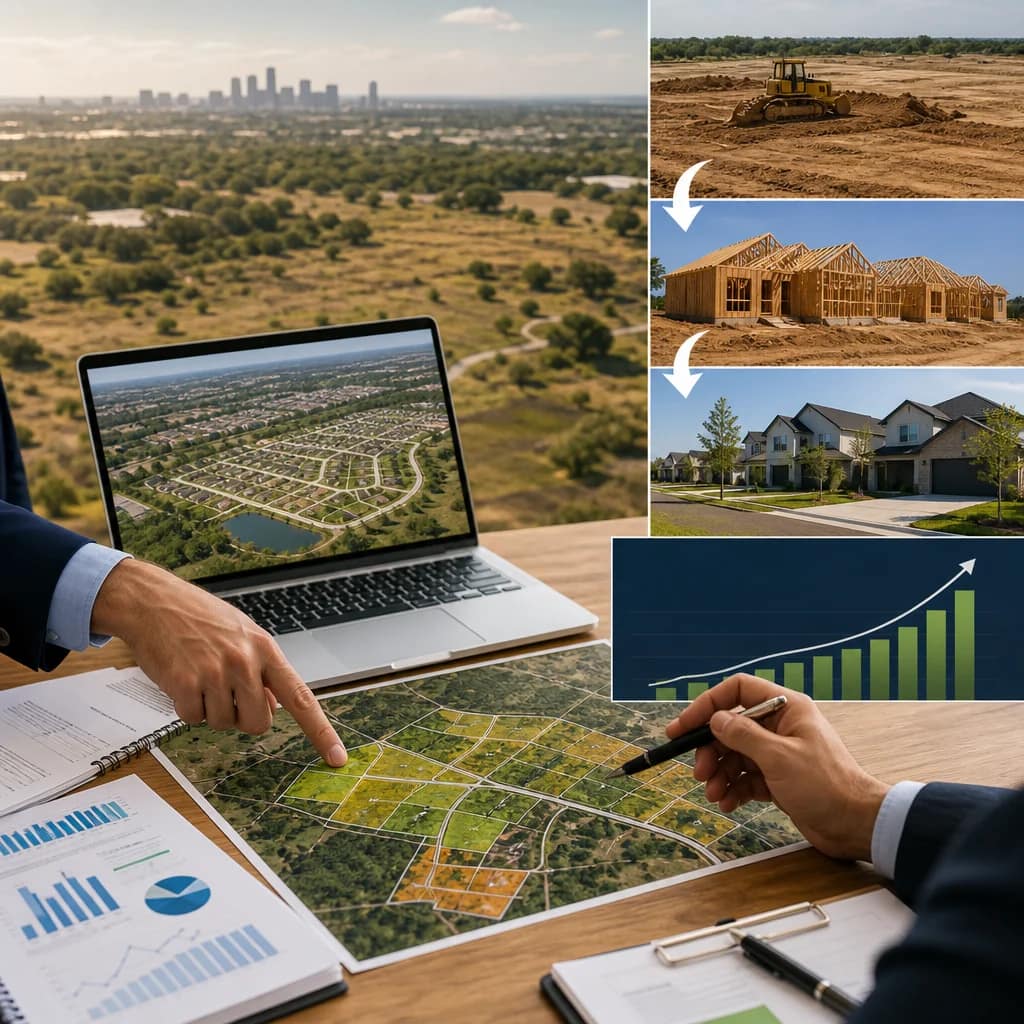
We purchase it, spend $200,000 on design and subdivision permits over 18 months, and obtain approval for 400 residential lots. With a comparable market price of $40,000 per lot in land value, this approved property is now worth $16 million ($400 lots × $40,000).
Total costs: 1.6 million (acquisition) + 200,000 (entitlements) = 1.8 million dollars.
Exit value: $16 million (based on market comparables for approved land parcels).
Profit: $14.2 million on an investment of $1.8 million = 789% return over an 18- to 24-month period.
Of course, this is an ideal scenario. But even with less drastic improvements (such as rezoning a plot from agricultural to residential use, or the addition of key infrastructure nearby), increases of 100 to 300 percent are common. Over 24 months, this translates to annualized returns of 50 to 150 percent.
An average project in our portfolio adds 150 to 200% in value through entitlements and market appreciation. After deducting costs, management fees, and the profit share with LandQuire, our investors typically earn an annualized return of 20 to 35%.
This return comes from a single source: land appreciation based on the approved best residential use. It is highly measurable and highly predictable, provided you select the right properties.
For context: these returns assume normal market conditions. During real estate booms, returns are higher. During slowdowns, they are lower. But the debt-free structure offers flexibility: we can wait for market conditions to stabilize before selling.
Comparison with Traditional Real Estate Strategies: Construction vs. Pre-Development
Let's compare three strategies side by side to determine where your advantage lies.
Strategy 1: Traditional Rental Real Estate (Residential Buildings)
- Initial investment: $1 million
- Annual gross return: 7% ($70,000)
- Operating costs: 40% of the rent ($28,000)
- Annual net return: $42,000 (4.2%)
- Typical exit strategy: resale after 10–15 years, slow appreciation, exposure to interest rates
- Passive responsibilities: minimal (property management, tenants, repairs)
Strategy 2: Full-scale real estate development (purchase, design, construction, sale)
- Initial investment: $1 million (land + design)
- Holding period: 24 to 36 months
- Risks: construction cost overruns, schedule delays, post-construction market risk
- Potential return: 30–50% if everything goes well
- Passive duties: very limited (construction supervision, sales management, emergency calls)
Strategy 3: Pre-development with entitlements (our approach)
- Initial investment: $1 million (land)
- Additional costs: $150,000 to $250,000 (entitlements)
- Holding period: 18 to 36 months
- Risks: regulatory risk (which we have managed with a 100% success rate historically), permit timeline risk (acceptable given our experience)
- Return: 20–35% annualized
- Passivity: very high (you are involved only in key decisions)
Pre-development falls within the spectrum of active and passive investment. You capture 60 to 80% of the value of the full development (since you don’t build or sell the homes individually), but you avoid almost all construction risks and operational obligations. And while your level of passivity is close to that of purely passive rental real estate, your returns are ten times higher.
Comparative breakdown: Over 10 years, $1 million invested in rental real estate = $1 million + (approximately $420,000 in gross interest) = $1.42 million. If this process is repeated every 24 months with an average annualized return of 25%, $1 million grows to approximately $9.3 million over the same period.
Entitlements as the Primary Source of Value Creation
To reinforce your understanding, let's take a closer look at exactly how entitlements create value.
An entitlement is an official approval from the local government to use land in a specific way. “Approved for 400 residential lots” is an entitlement. “Approved for a 150-unit retirement community” is an entitlement. These approvals change the perception of a parcel of land’s risk.
Land without development rights is a basic asset. An investor must ask: Can this land be developed for residential use? How many lots? Will the city approve it? These questions create uncertainty. A cautious owner lowers the price to reflect this risk.
A lot with full development rights eliminates almost all regulatory risk. The developer knows exactly what they can build. Construction lenders know the value of the collateral. Builders know they can start right away.
This certainty creates a price premium. A plot of land approved for 400 lots is worth 200 to 300 percent more than an undeveloped plot of the same size in the same area.
We capture this premium in its entirety. We buy at the price of raw land (fueled by uncertainty), we bear the regulatory risk (where our expertise significantly reduces the actual risk), and we sell at the price of approved land (fueled by certainty).
It's purely real estate speculation. We don't build—we don't build houses, and we don't manage tenants. We simply carry out the zoning plan competently and then resell the property.
Direct application: Each property you are considering should have a clear path to securing entitlements. If no one can explain how the entitlements would be obtained, or if the regulatory hurdles are unclear, that property is not suitable for our strategy.
Our track record: Over 130 successful projects and 100% of permits obtained
Since 2021, we have completed more than 130 projects in our investor portfolio. Each one involved approved raw land. And we have secured development rights for 100% of these projects, without a single regulatory setback.
This is an exceptional case. To provide some context, the development industry as a whole has a success rate for obtaining permits of about 70–80 percent, which means that 20–30 percent of projects are either abandoned or significantly revised because approvals are not granted.
Our 100% rate is the result of three key factors.
First, we have a rigorous selection process. We rule out ambiguous properties. If residential zoning isn’t even a real possibility for a property, we don’t buy it. If a property is located in a jurisdiction that has historically been hostile to development, we don’t invest in it. We target areas where the regulatory environment supports residential growth.
Second, we work with world-class zoning consultants and local attorneys in each jurisdiction. These experts are familiar with approval histories, planning commissions’ preferences, and likely obstacles. They shape our proposals to align interests: more housing = more tax revenue for the city, more jobs, and better public infrastructure funded by development fees.
Third, we build our schedules with buffers and contingency plans. If one zoning approach encounters resistance, we have a second one ready to go. This adaptability, combined with tenacity, allows us to navigate the normal complications of the regulatory process.
Our investors benefit directly from this approach. The more of your money is invested in projects with a controlled risk of claims, the more predictable and attainable your target return will be.
Tangible result: You can rely on our projected returns without worrying that regulatory approvals will fall through. Our track record shows that this won't happen.
How Our Investors Benefit from Institutional Access Without the Operational Complexity
One benefit that many investors underestimate is access. The off-market properties we select are not listed on Zillow or CoStar. They come from private owners, estate trusts, corporate auctions, and our broker contacts.
An individual investor with $100,000 has virtually no access to these opportunities. He must rely on a public listing provided by a broker, where competition drives prices toward market equilibrium and margins are squeezed.
We have institutional access. We have sourcing relationships that feed the pipeline of transactions before they become public. And because we consistently incentivize sellers (fair price, quick closing, no operational contingencies), we get the best deals first.
This direct transaction channel allows us to purchase properties at a price approximately 20–30% below the comparable price of a public transaction. This direct purchasing advantage directly improves your returns.
In addition, our institutional structure offers protection. You do not own the land individually, which would expose you to civil liability, individual property taxes, and regulatory complications. Instead, you invest in a stable, professionally managed entity with limited liability and a simplified tax structure.
For a foreign investor, this structure is crucial. You avoid being classified as a “FIRPTA foreign real estate investor,” which would result in a 15% withholding tax upon sale. You avoid having to navigate state real estate laws on your own. You receive clear tax documentation and professional FATCA compliance handled on your behalf.
It’s completely hands-off. You invest, you receive quarterly reports, you’re notified of the sale, and you receive your returns. That’s it. No permit approvals to request, no emergency calls, and no construction decisions to make.
Practical impact: You gain access to the same quality of investments as private equity funds or family offices, but with an affordable minimum investment of $100,000.
Getting Started with Your First Investment with Us: Structure and Next Steps
If this approach resonates with you, here’s how we structure an investment relationship.
Step 1: Discovery and Alignment We discuss your goals (target return, time horizon, risk tolerance) and share our project selection criteria. If a particular project aligns with your preferences and timeline, we move forward.
Step 2: Project Approval We present a detailed overview of the project: location, raw land, proposed subdivision plan, permitting roadmap, purchase price, estimated permitting costs, target resale proceeds, and projected returns. You review all the documents, and we clarify any questions.
Step 3: Investment Documentation Once approved, we prepare the documents: investment agreement, legal structure (typically an LLC), FCPA requirements, document submissions, and financing timeline. Your capital is placed in an escrow account. We do not access the funds until the real estate transaction closes.
Step 4: Acquisition and Development We acquire the land, hire land use consultants, and carry out the regulatory roadmap. You receive monthly progress reports. You are a legal co-owner; your title is registered.
Step 5: Approval and Exit Once the entitlements are complete, the land is sold to an established developer. Your returns are calculated, management fees are deducted (typically 20% of the gross profit), and the funds are distributed. The entire cycle usually takes 24 to 36 months.
Minimum investment: $100,000 per project. Many investors make several investments at the same time to diversify.
Management fees: 20% of gross returns after repayment of the initial principal. No annual management fees, no hidden acquisition fees.
Target return: 20–35% annualized, although actual results vary depending on the project and market conditions.
Next steps
First step: Send us an expression of interest. Include your available capital, your preferred time horizon (18 months vs. 36 months), and your preferred geographic location (Texas vs. Florida vs. flexibility).
Step 2: Review our existing project materials. We’ll send you a summary of a few projects currently in progress so you can see the actual selection and structuring criteria.
Step 3: Schedule an in-depth call. We’ll discuss your specific concerns, the risks you consider important, and how our approach aligns with your portfolio goals.
The U.S. real estate market offers a rare opportunity: consistently high returns, without the operational complexity of traditional real estate, and accessible to international investors. We’ve built a platform to capitalize on this at scale. Your role is simply to participate.
Contact us to discuss your first project.