How to Turn Off-Market Land into a Sold Development: A Comprehensive Case Study

The challenge for real estate investors: limited access to good opportunities
High-net-worth real estate investors face a persistent problem: the best opportunities are never publicly listed. Projects that generate institutional-grade returns circulate among established developers, private equity funds, and closed networks. For international investors seeking to diversify into U.S. real estate assets, this access remains blocked by information barriers and the need for connections.
Most real estate platforms offer residential rental properties or commercial assets that are overpriced and oversaturated in the public market. These assets offer annual returns of 5% to 8%, require active management, and expose capital to interest rate volatility and tenant-related liabilities. For an investor based in Europe or the Middle East, adding U.S. regulatory complexity to this equation does not justify the low expected return.
The result: capital tied up in poor-performing investments, or no access to the high-yield U.S. real estate market.
Key takeaway: The best commercial and residential real estate deals are made off the public market, through professionals with the right networks and sourcing expertise.
Why off-market properties outperform traditional acquisitions
Off-market properties owned by family homeowners, farmers, or small-scale developers operate under different dynamics. These sellers are not looking for a public auction. They are looking for a quick, discreet transaction without any red tape. This is precisely where value is created for a savvy investor.
When a property is acquired properly through off-market transactions, three avenues for value creation become available:
Discounted purchase: Without public bidding, prices often reflect a discount of 20 to 35 percent compared to a market transaction.
Permits and zoning: Most of the value in a residential project is created during the administrative process of rezoning the land. Converting agricultural land into a developed residential subdivision increases the value per square meter by a factor of 3 to 5. This is an increase that only a player with expertise in permitting can capture.
Short cycle: Unlike construction, which takes 3 to 5 years, the process of securing permits and preparing a project for resale to developers takes 18 to 36 months, reducing exposure to economic cycles.
Traditional public procurement does not take any of these three factors into account. We, on the other hand, have made them our specialty.
Our proprietary approach: data-driven sourcing and institutional access
We have developed a proprietary system for sourcing off-market land that combines geospatial data analysis, identification of high-growth markets, and a direct network of landowners. Since 2021, this approach has enabled us to complete more than 130 projects and deploy capital from 600 global investors.
Our process begins with a detailed mapping of high-potential areas in our key markets (Texas and Florida). We identify land parcels with the greatest development potential based on proximity to infrastructure, municipal master plans, and the availability of water and electricity services. This analysis reduces regulatory risk and expedites the approval process.
Once potential sites have been identified, our team of zoning and permitting experts assesses the potential of each project. How many residential units can the site accommodate? What permits are required? What is a realistic timeline for approvals? This feasibility analysis is conducted before any acquisition, not after.
Next, we negotiate directly with property owners, leveraging our long-term relationships and reputation as a fast and reliable broker. Property owners know that we get things done without unnecessary markups or delays, which gives us access to deals that others never see.
Practical step: If you’re looking to access off-market land, start by identifying the 5 to 10 high-growth markets in your region, then build a direct network with landowners and local agents who specialize in raw land.
Case Study: The Complete Lifecycle of an 18-Month Texas Project
To illustrate how this approach works, let’s look at an actual project completed in the Dallas-Fort Worth metropolitan area in 2024. The project demonstrates each stage: acquisition, development, value enhancement, and exit.
This 42-acre parcel of land in a rapidly growing suburban area had been owned by the same family for 35 years. The mayor wanted to develop the area to increase tax revenue. The owner was open to a quick sale but was reluctant to commit to a lengthy rezoning process. It was the ideal fit for our model.
The initial purchase price: $1.2 million (or approximately $28,500 per acre). This price reflected the land’s agricultural status and the lack of immediate viability. No major developers had shown interest, as they were waiting for others to finance the risk associated with securing development rights.
Phase 1: Strategic Acquisition and Analysis of Entitlement Potential
Upon signing the agreement, we immediately engaged our zoning consultants to conduct a detailed analysis of the site’s potential uses. The property was located near a municipal master plan that designated the area for residential and light commercial development. This was a positive factor.
We determined that the 42 acres could accommodate approximately 185 residential units in a standard subdivision layout. In addition, there were 3 acres of light commercial space and 8 acres of required green space. The calculation was simple: 185 units at $200,000 per developed unit (market value for a build-ready lot), for a total expected final value of $37 million.
Our investment in the acquisition was $1.2 million. Estimated costs for land acquisition, design, and infrastructure development: approximately $2.8 million. Total investment: $4 million. Pre-sale profit: $33 million in value created, representing an 8.25x multiple on the capital invested.
Of course, the risk was real. No permits were guaranteed. Costs could exceed estimates. But that was precisely the kind of risk we had built up the expertise to manage.
Phase 2: Entitlement Process and Permit Securing
The entitlement process begins with a comprehensive review of the local regulatory framework. In Texas, the process depends heavily on the specific jurisdiction. Some areas enforce strict zoning regulations, while others follow mixed-use plans. For this project, we worked within the ETJ Texas framework, which defines the extraterritorial jurisdiction of cities over adjacent lands.
Our team engaged local planning consultants and municipal authorities to determine exactly what would be required. The main requirements included:
- A subdivision plan that complies with setback and maximum density regulations
- A transportation impact study and an agreement to fund road improvements
- A Stormwater and Drainage Management Plan
- Connections to municipal utilities (water, electricity, sewer)
Each of these requirements involved timelines, engineering costs, and points of negotiation with the municipality. We budgeted 12 to 16 months for the entitlement phase, assuming normal cooperation from the municipality.
In reality, the city proved to be very supportive of growth, which accelerated the process. We obtained the approvals in about 10 months, compared to our conservative estimate of 16 months. This is a victory, but we never count on such positive surprises.
During this phase, we also secured commitments for connections to municipal utilities and acquired the necessary easements for roads and infrastructure services.
Phase 3: Pre-construction Value Enhancement and Developer Exit
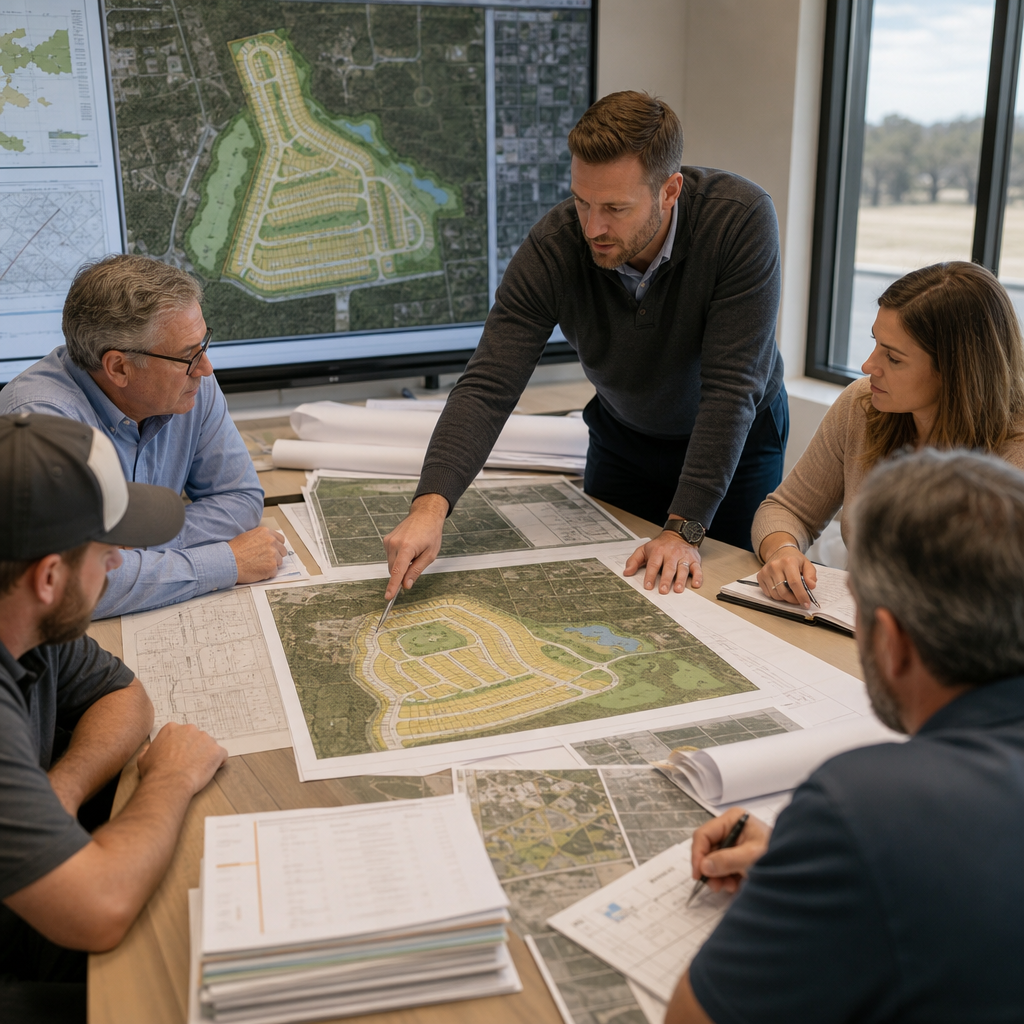
Once all the necessary permits had been obtained, the land was formally rezoned. A complete subdivision plan was filed with the county, listing each future lot, its boundaries, and its access points. Building permits were issued, confirming that each lot complied with residential building codes.
At that point, the site had not yet been developed, but it was fully prepared for construction. This is precisely what a major commercial developer is looking to purchase: a “shovel-ready” project where they can begin construction immediately without any regulatory risks.
We launched a targeted marketing campaign aimed at regional developers and funds specializing in residential housing developments. Three competitive bids were received. The winning bid came from an established developer that has been operating in the region for 20 years, which estimated that the construction and eventual sale of the 185 units would generate a reasonable profit.
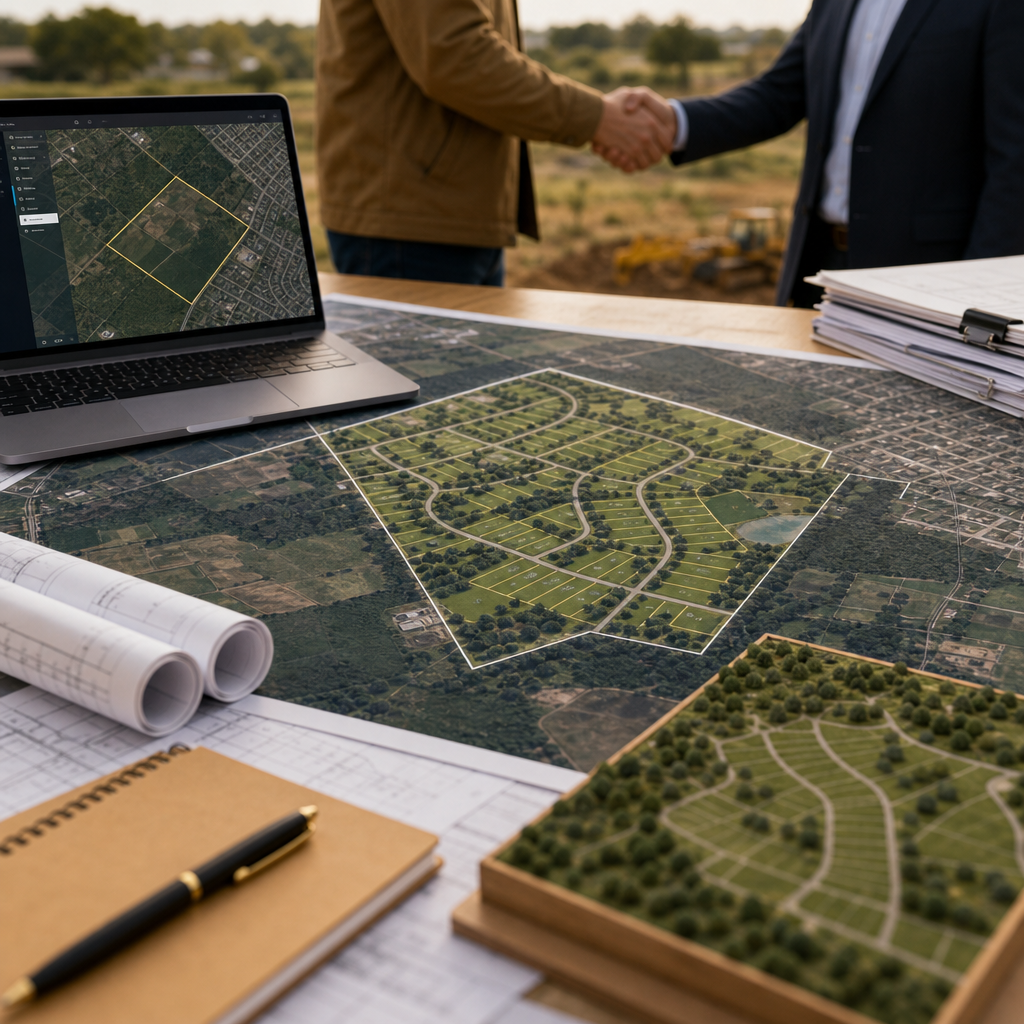
Negotiated exit price: $34.8 million. Payment was received 14 months after the initial acquisition. At the time of the exit, all entitlements had been secured and recorded.
Key figures: returns and realized equity multiples
Let's take another look at the numbers:
Initial acquisition: $1.2 million Permitting, design, and feasibility costs: $2.6 million (slightly below the estimated $2.8 million) Total capital invested: $3.8 million Sale price: $34.8 million Net profit: $31 million Capital investment multiple: 9.16x Annualized return (IRR) over 14 months: 38%
This particular project generated returns that exceeded our target of 20% to 35% annually due to accelerated entitlement and strong demand from developers. Other projects achieved returns of 22% or 28%, depending on market conditions and regulatory challenges.
The key point is that this return was achieved without any construction work, site management, exposure to construction risks, or retail operations. The main risk was regulatory, an area where we have the expertise to manage it.
Why construction and rental management are not our business model
Some might ask: Why not build and sell the 185 units yourselves and keep the entire profit margin?
The answer is simple: that’s not where our competitive advantage lies, and that’s where the risks for our investors increase.
If we were to build, we would be exposing ourselves to several risks that we would prefer to avoid:
Market risk: Economic conditions or interest rates may change during the 2- to 3-year construction period. Buyers may pull out. Construction costs could skyrocket due to inflation in labor and materials.
Operational responsibility: Managing a 185-unit construction project requires expertise in construction management, code compliance, insurance, and potential litigation. It is a profession in its own right.
Tied-up capital: We would have to finance the entire construction project, tying up capital for 36 months or more.
Liquidity risk: Selling 185 units to individual buyers is a chaotic process involving marketing, retail finance, and customer dependencies. Selling a completed project to an established developer is a straightforward B2B transaction.
Our model, on the other hand, captures maximum value with the lowest risk. We buy low, create regulatory value, and sell to those who can bear the construction risks. That is why our investors remain committed to this model.
How our investors gain access to these institutional opportunities
Our 600 global investors gain access to these projects through a simple equity structure. Each project is structured as a separate legal entity (typically an LLC or a corporation). Investors purchase an equity stake in this entity, which is debt-free, unleveraged, and independent of external financing or banks.
Since each project is separate, investors retain control over their allocations. They can choose projects that align with their risk profile, investment horizon, and capital size.
Our role is to source the land, secure the necessary permits, manage the project from start to finish, and negotiate the exit with the developers. In exchange, we receive a management fee and a performance-based fee when the project is sold.
We handle all the complexity. Investors receive regular updates, have access to comprehensive legal documents and external audits, and get their capital back plus returns upon exit. No surprises, no hidden structures.
For an international investor based in Europe or the Middle East, this is transformative. They gain access to institutional-quality deals normally reserved for private equity funds with portfolios worth billions, but with the transparency and flexibility of a direct equity investment.
Next steps: Add off-market projects to your portfolio
If you are a high-net-worth investor looking to diversify into high-yield U.S. real estate assets, here’s how to proceed:
- Define your investor profile. Do you have between $100,000 and $1 million in available capital? Are you comfortable with an investment horizon of 18 to 36 months? Are you looking for an annualized return of 20% or more? If so, the pre-construction off-market model is right for you.
- Understand the structure and risk framework. Learn how entitlement projects work, the regulatory risks specific to the markets you are considering, and how deals with developers are structured. Review our framework on zoning and entitlements in Texas to better understand local regulations.
- Please contact us for an exploratory discussion. We will review your investment goals, assess how they align with our current and planned projects, and present you with opportunities that match your profile.
- Review the project documents. For each opportunity, we provide a detailed analysis, feasibility studies, pro forma financial statements, and a local team of contacts for due diligence.
- Invest and stay informed. Once you’ve signed up, you’ll receive quarterly updates, have access to all regulatory documents, and be kept informed at every stage of the entitlement process.
Since 2021, we have maintained a 100% success rate in securing rights for all projects we have undertaken. This does not mean that every project outperforms with a 38% IRR. It means that we manage regulatory risk effectively, and that our investors receive their capital back plus a return in line with market expectations.
We invite you to explore how off-market properties and value creation through development rights can strengthen your real estate portfolio. Visit our website to view current available projects and schedule an introductory call with our team.