Real estate due diligence – comprehensive 14-point checklist
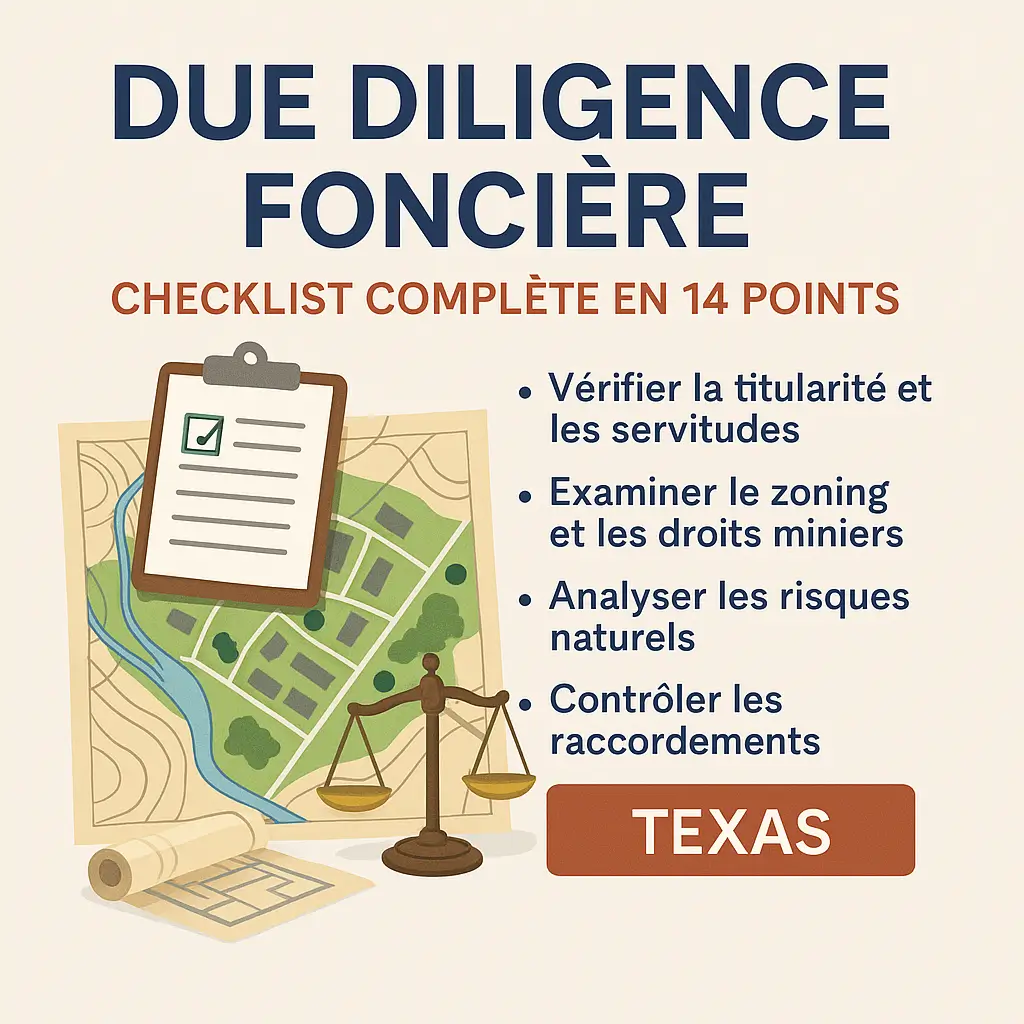
Why Land Due Diligence is Essential in Texas
Land due diligence is the most strategic step in purchasing land in Texas. It reduces uncertainty and provides a framework for the investment decision. Before buying, you check every critical point without exception.
- You examine the titles, easements, and any mining rights.
- You control zoning, buildability, and permit deadlines.
- You assess natural hazards, including floods and erosion.
- You confirm access, topography, and soil type.
- You secure essential connections and their actual costs.
- You compare local taxation, special districts, and their impacts.
- You have an ALTA survey done to lock in the boundaries.
- You have the title agreement reviewed by an attorney.
This structured approach protects your capital.
- It avoids legal disputes and hidden extra costs.
- It preserves the resale value and the project schedule.
- It transforms a simple purchase into a controlled and defensible operation.
Author
This article was written by the LandQuire team, which specializes in real estate investment in the United States.
Our experts assist French-speaking investors in their acquisitions of American land.
🔗 Follow LandQuire on LinkedIn
✉️ "Easements & buildability" audit: Specialized Texas land contact
1️⃣ Verify ownership and chain of title
It all starts with verifying the title deed. This step builds trust in any real estate transaction. It confirms that the seller actually owns the land and that there are no claims against it. Without this check, the buyer is exposed to costly disputes or the loss of the property.
A title search traces the complete history of the property. It reviews every transfer, every mortgage, and every recorded judgment. This process highlights errors in deeds, incomplete estates, or forgotten foreclosures. It also identifies any undeclared co-owners or heirs.
A specialized attorney or title company usually performs this check. They consult the County Clerk Office archives to establish a clear chain of title. If any anomalies are found, they must be resolved before signing. For example, an old mortgage that has not been discharged may block the registration of the new title.
Land due diligence requires absolute rigor here. Any doubts about ownership must be documented and resolved. This is the time to request title insurance, which protects against defects discovered after purchase.
💡 Read: Title insurance USA – protecting your interests when buying
👉 In addition,Texas title commitment – understanding exclusions and exceptions helps you anticipate restrictions before signing.
2️⃣ Identify existing easements
Easements define the legal limitations on the use of land. They determine what you can and cannot do on the plot. An easement may relate to a right of way, an underground pipe, an electrical network, or even a protected view. These constraints are often invisible during a visit, but they have a real impact on value and buildability.
Some easements prevent the construction of a building or restrict its location. Others reserve public space for road access or future connections. A savvy investor never signs without reviewing them. They consult county records and cadastral maps to determine their exact scope.
In real estate due diligence, this verification is essential. An incorrectly identified easement can block a project, delay a permit, or reduce the usable area. Sometimes, it even prevents the installation of a fence or the planting of trees.
The legal analysis of the title deed must therefore mention each active easement. In case of doubt, an attorney or ALTA survey can confirm their precise location on the land.
📎 Easements in Texas: everything you need to know before buying land
It is essential to carefully read the notarial deeds and the cadastral map before making any commitment.
3️⃣ Review zoning and project compatibility
Zoning determines the permitted uses for each plot of land. It determines whether the plot can be used for a house, a business, or agricultural operations. This local classification directly influences the profitability and feasibility of a project. Inappropriate zoning can render a plot unusable or delay its development.
Every city or county in Texas has a Planning and Zoning Department responsible for enforcing these rules. Before buying, consult their official maps. An area classified as Residential 1 prohibits industrial or tourist activities. Similarly, a Commercial zone does not always allow for the construction of a home.
Investors must also verify that zoning regulations are compatible with the project vision. If your goal is to develop multiple lots, you must confirm that subdivision is permitted. If you want to develop a residential park, you must ensure that maximum densities allow for it.
When zoning regulations block your project, there are two options: request a variance (exemption) or rezoning (change of zoning). These procedures require time and additional costs. Some municipalities also require environmental studies before granting a change.
Effective land due diligence therefore includes this verification from the outset. It prevents you from purchasing land that you will never be able to use as intended.
📄 Learn more: Plat approval process – key steps in land validation
If the project does not comply with zoning regulations, a request for rezoning or variance may be considered, but this can take several months.
4️⃣ Verify mineral rights
In Texas, mineral rights and surface rights are often separated. The owner of a piece of land sometimes owns only the surface, without the subsoil. This legal separation—known as the distinction between surface rights and mineral rights —can turn a great purchase into a source of conflict.
An investor can therefore purchase land without owning the rights to extract the oil, gas, or minerals it contains. These resources sometimes belong to a third party, often an energy company or a former owner. The latter then retains the right to drill or install equipment on the plot.
During a real estate due diligence process, it is therefore essential to verify these rights. A detailed title search or a specialized attorney can identify the current owners of mineral rights. In case of doubt, an extract from the County Clerk Office or the Texas Railroad Commission can clarify the situation.
A savvy buyer always negotiates an exclusion clause in the purchase agreement. This clause prohibits any drilling or mining activity on the surface of the land. This precaution prevents nuisances, vibrations, and damage to the immediate environment.
Some companies also offer title insurance covering disputes related to mining rights. This is useful protection, especially for foreign investors.
📚 TEXAS MINING RIGHTS: WHAT EVERY BUYER MUST CHECK
This verification prevents you from discovering that an oil company has drilling rights on your property.
5️⃣ Analyze water rights
Water rights vary greatly from one Texas county to another. Each local authority sets its own rules based on available resources and intended use. Before buying, investors need to know whether they can draw, store, or redirect water on their land.
A landowner may hold rights of access to groundwater, a private well, or a public network. These rights determine the ability to irrigate, supply a dwelling, or carry out agricultural activities. Their absence can drastically limit the profitability of a land project.
In Texas, regulations are strict. The Texas Commission on Environmental Quality (TCEQ) oversees water withdrawals, drilling, and water quality. Certain areas require a water withdrawal permit, especially if the aquifer is located in a Groundwater Conservation District. Ignoring these rules can result in fines or a ban on operations.
During a land due diligence process, you must therefore identify the available water source and its conditions of use. Public maps and Texas Water Development Board records are key resources. A local attorney or hydrogeologist can also confirm the legality of drilling.
A residential project without approved water rights quickly becomes unsellable. Similarly, agricultural land without access to water loses all its commercial value.
🔗 Water rights – key rules for investing in Texas
External link: Texas Water Development Board
Verifying water rights ensures the long-term viability of the investment and avoids any administrative obstacles.
6️⃣ Assess the risk of flooding
FEMA flood zones identify land areas at risk of flooding. This classification is based on studies conducted by the Federal Emergency Management Agency (FEMA). It determines levels of hydrological risk and directly influences purchasing, insurance, and construction decisions.
Before investing in real estate in Texas, it is important to consult FEMA maps. These documents indicate whether a plot of land is located in a high-risk area, such as a Special Flood Hazard Area (SFHA). In these areas, the probability of flooding exceeds 1% each year. Such land often requires mandatory insurance and elevated construction.
Rigorous land due diligence always includes this step. Investing without this verification exposes the buyer to high insurance costs and administrative delays. Some municipalities refuse building permits in high-risk areas. Others impose specific foundations or safety drains.
FEMA information is available free of charge online. The Flood Map Service Center provides interactive maps by address or county. An ALTA Survey or a complete topographical survey can then specify the height of the land in relation to the flood level.
A savvy investor combines this data with local records from the Texas Water Development Board. This approach enhances the security of the project and reassures insurers.
🌊 FEMA flood zones – mapping and reducing flood risk
External link: FEMA Flood Map Service Center
Analyzing FEMA flood zones means protecting your capital, avoiding unpleasant surprises, and ensuring that your real estate project complies with regulations.
7️⃣ Obtain an ALTA Land Survey
The ALTA/NSPS survey is the US national standard for accurately delineating a property. This document, often required by banks and insurers, provides a comprehensive overview of the physical and legal status of a piece of land.
An ALTA Survey indicates the exact area of the parcel, the location of existing easements, fences, buildings, and public or private access points. It verifies the consistency between the cadastral map and the actual boundaries of the land. This verification prevents disputes between neighbors and registration errors.
This survey is based on standards established jointly bythe American Land Title Association (ALTA) and the National Society of Professional Surveyors (NSPS). In Texas, it is an essential tool for land due diligence. Investors and developers use it to confirm that the land matches the information on the title deed.
A certified survey is carried out by a licensed surveyor. It often includes GPS data, elevation benchmarks, and measurements accurate to the centimeter. These elements serve as the basis for the design, division, or construction of the property.
Requesting an ALTA Survey before signing protects against legal surprises and boundary encroachments. It is an essential step in any land purchase or real estate development.
🧭 ALTA land survey – the standard for titles without surprises
Without this document, an investor is unaware of the geographical and legal reality of their lot.
8️⃣ Examine road access and rights of way
Land that is isolated or difficult to access immediately loses market value. The absence of a public road or legal access route can render the property unusable. As part of land due diligence, this check is one of the first to be carried out.
Road easements refer to rights of way allowing access to land. They can be public, private, or shared between several owners. If the lot does not have direct access to a public road, you must prove that you have a registered right of way. Without this document, you may never obtain a building permit.
Private roads pose another challenge. Their maintenance often relies on an agreement between residents or a homeowners' association (POA). The absence of a clear agreement leads to conflicts and unexpected costs. Before buying, it is therefore crucial to consult the POA's bylaws and conditions of access.
To validate these elements, analyze the county's cadastral map and compare it with aerial views from Google Earth. This dual analysis makes it possible to identify actual access points, illegal fences, or abandoned roads. An ALTA Survey can then confirm the exact location of easements.
A rigorous land due diligence always includes this step. It ensures that your land is legally and physically accessible, without relying on temporary permits.
Verifying access rights means securing the liquidity of the property and avoiding any obstacles during a resale or future development.
9️⃣ Check connections to utilities
Network availability is a key factor in any land due diligence process. Land without access to water, electricity, or high-speed internet quickly becomes a headache. Before buying, you need to check the presence or proximity of the main connections: water, electricity, gas, fiber, and sewage.
An unserved lot often requires costly infrastructure work, sometimes exceeding $50,000. Costs vary depending on the distance to public utilities and the topography of the land. In rural areas of Texas, some landowners must finance their own power lines or individual wells. These expenses can wipe out the initial profitability of a project.
To plan ahead, consult the Utility District or public services department of the relevant county. They provide network maps and estimated connection costs. The Public Utility Commission of Texas (PUC) also centralizes information on operators and the necessary authorizations.
A comprehensive land due diligence includes this technical analysis. It allows you to assess the immediate feasibility of the project and avoid unpleasant surprises after the purchase. A local attorney or infrastructure engineer can also confirm the compliance of existing facilities.
External link: Public Utility Commission of Texas
Checking utilities means protecting your capital, reducing future costs, and ensuring that your land remains buildable and valuable over time.
10️⃣ Study the topography and soil
Steep slopes, clay or rocky soils, and wetlands can compromise a project.
A geotechnical study (soil test) can help avoid additional foundation costs and collapses.
A detailed topographic survey complements the ALTA Survey and helps to model future developments.
11️⃣ Check environmental constraints
The United States applies strict rules (EPA, TCEQ).
Certain protected or polluted areas require a special permit or prior cleanup.
The presence of protected species (Endangered Species Act) can also block development.
Lien externe : U.S. Environmental Protection Agency (EPA){:target=”_blank”}
12️⃣ Assess property taxation and special districts
Property tax varies depending on the tax district (MUD, PUD, ISD, etc.).
These districts finance local infrastructure: roads, sewers, schools.
Land in a MUD (Municipal Utility District) is subject to higher taxes.
🧾 À lire : Districts Texas MUD : impôts et implications{:target=”_blank”}
13️⃣ Confirm buildability (entitlements)
Before any construction can begin, administrative approvals must be obtained: subdivision, drainage, permits, connections.
These entitlements ensure that the project complies with local standards.
🔍 See also: Land entitlement: steps, deadlines, costs
A project without validated entitlements remains legally unbuildable, even if the land has been paid for.
14️⃣ Examine hidden costs and delays
A comprehensive real estate due diligence process is not limited to documents: it also anticipates ancillary costs:
- legal fees,
- technical studies,
- permit,
- connections,
- local taxes.
💰 These costs can represent 5 to 12% of the total cost of the transaction.
Anticipating these items helps to avoid fictitious profitability.
🧩 Summary: quick checklist for land due diligence
| Step | Verification | Objective |
|---|---|---|
| 1 | Title deed | Ensure the seller is legitimate |
| 2 | Easements | Identify usage restrictions |
| 3 | Zoning | Confirm project compatibility |
| 4 | Mining rights | Avoid unwanted drilling |
| 5 | Water rights | Ensuring access and compliance |
| 6 | Flood risk | Reduce claims |
| 7 | ALTA Survey | Define precisely |
| 8 | Access | Secure the entrance to the property |
| 9 | Utilities | Anticipating equipment costs |
| 10 | Soil and topography | Preventing geotechnical hazards |
| 11 | Environment | Comply with EPA/TCEQ standards |
| 12 | Taxation | Assess the annual load |
| 13 | Entitlements | Validate buildability |
| 14 | Costs and deadlines | Adjust profitability |
❓FAQ – Real Estate Due Diligence in Texas
1. How long does land due diligence take?
On average, 30 to 60 days depending on the complexity of the land and the responsiveness of local authorities.
2. Who can perform a comprehensive due diligence?
Attorneys, title companies, and land consultants specializing in Texas have the necessary tools and databases.
3. Is it mandatory before purchasing land?
Not legally, but it is essential to secure the investment: no bank or insurer will approve a loan application without this step.
Conclusion
Land due diligence is much more than a formality: it is the foundation of any successful investment.
In Texas, where legislation varies from county to county, this step protects against litigation, enhances resale value, and optimizes tax strategy.
Before buying, always check these 14 points and seek advice from local experts.
A professional audit transforms a simple purchase into a truly controlled asset management operation.
👉 Contact our LandQuire experts for a comprehensive audit
Real estate due diligence – comprehensive 14-point checklist
Introduction: Why Due Diligence is Strategic
Land due diligence is the most strategic step in purchasing land in Texas. It reduces uncertainty and provides a framework for the investment decision. Before buying, you check every critical point without exception.
Critical points to check:
- You examine the titles, easements, and any mining rights.
- You control zoning, buildability, and permit deadlines.
- You assess natural hazards, including floods and erosion.
- You confirm access, topography, and soil type.
- You secure essential connections and their actual costs.
- You compare local taxation, special districts, and their impacts.
- You have an ALTA survey done to lock in the boundaries.
- You have the title agreement reviewed by an attorney.
Advantages of this structured approach:
- It protects your capital.
- It avoids legal disputes and hidden extra costs.
- It preserves the resale value and the project schedule.
- It transforms a simple purchase into a controlled and defensible operation.
Author
This article was written by the LandQuire team, which specializes in real estate investment in the United States.
Our experts assist French-speaking investors in their acquisitions of American land.
🔗 Follow LandQuire on LinkedIn
✉️ "Easements & Buildability" Audit: Specialized Texas Field Contact
Complete 14-point checklist
1️⃣ Verify ownership and chain of title
Confirm that the seller actually owns the land and that there are no claims against it. A title search traces the complete history. An attorney or title company performs this check.
💡 Read: Title insurance USA – protecting your interests when buying
👉 Additional information: Texas title commitment – understanding exclusions and exceptions
2️⃣ Identify existing easements
Examine the legal restrictions on land use (rights of way, pipelines, electrical networks, etc.). An incorrectly identified easement can block a project or reduce the usable area.
📎 Easements in Texas: everything you need to know before buying land
3️⃣ Review zoning and project compatibility
Zoning determines permitted uses (residential, commercial, etc.). Check that the classification is compatible with the project vision. If there is a conflict, a variance or rezoning request may be submitted.
📄 Learn more: Plat approval process – key steps in land validation
4️⃣ Verify mineral rights
In Texas, mineral rights and surface rights are often separated. It is essential to identify the current owners of mineral rights to avoid drilling on your property. Negotiating an exclusion clause is recommended.
5️⃣ Analyze water rights
Water rights define the ability to draw, store, or redirect water. Essential verification with the TCEQ and the Texas Water Development Board to ensure the long-term viability of the project.
🔗 Water rights – key rules for investing in Texas
External link: Texas Water Development Board
6️⃣ Assess the risk of flooding
Consult FEMA (Federal Emergency Management Agency) maps to identify land in high-risk areas (‘SFHA’). This affects mandatory insurance and building standards.
🌊 FEMA flood zones – mapping and reducing flood risk
External link: FEMA Flood Map Service Center
7️⃣ Obtain an ALTA Land Survey
This topographic survey is the US national standard that precisely delineates the property, the exact area, and the location of easements. Essential for avoiding boundary disputes.
🧭 ALTA land survey – the standard for titles without surprises
8️⃣ Examine road access and rights of way
Verify the existence of a legal right of way (‘road easements’) to a public road. Review the POA (Homeowners Association) bylaws for private roads.
9️⃣ Check connections to utilities
Check the proximity and availability of connections (water, electricity, gas, fiber optics, sewerage). Unanticipated infrastructure work can exceed $50,000 and wipe out profitability.
External link: Public Utility Commission of Texas
10️⃣ Study the topography and soil
A geotechnical study (soil test) is necessary to prevent additional foundation costs due to steep slopes or unstable soils.
11️⃣ Check environmental constraints
Ensure compliance with EPA and TCEQ regulations. The presence of protected areas or protected species (Endangered Species Act) may block any development.
External link: U.S. Environmental Protection Agency (EPA)
12️⃣ Assess property taxation and special districts
Property tax varies depending on the tax district (MUD, PUD, ISD, etc.). Land in a MUD (Municipal Utility District) is subject to higher taxes due to infrastructure financing.
13️⃣ Confirm buildability (entitlements)
Obtain administrative approvals (subdivision, drainage, permits). A project without approved entitlements is legally unbuildable.
🔍 See also: Land entitlement: steps, deadlines, costs
14️⃣ Examine hidden costs and delays
Anticipate additional costs (fees, technical studies, permits, connections). These costs can represent 5 to 12% of the total cost of the operation.
💰 Typical costs: legal fees, technical studies, permits, connections, local taxes.
Summary: quick checklist for land due diligence
| Step | Verification | Objective |
|---|---|---|
| 1 | Title deed | Ensure the seller is legitimate |
| 2 | Easements | Identify usage restrictions |
| 3 | Zoning | Confirm project compatibility |
| 4 | Mining rights | Avoid unwanted drilling |
| 5 | Water rights | Ensuring access and compliance |
| 6 | Flood risk | Reduce claims |
| 7 | ALTA Survey | Define precisely |
| 8 | Access | Secure the entrance to the property |
| 9 | Utilities | Anticipating equipment costs |
| 10 | Soil and topography | Preventing geotechnical hazards |
| 11 | Environment | Comply with EPA/TCEQ standards |
| 12 | Taxation | Assess the annual load |
| 13 | Entitlements | Validate buildability |
| 14 | Costs and deadlines | Adjust profitability |
FAQ – Real Estate Due Diligence Texas
How long does a real estate due diligence process take?
On average, 30 to 60 days depending on the complexity of the terrain and the responsiveness of local authorities.
Who can perform a comprehensive due diligence?
Attorneys, title companies, and land consultants specializing in Texas have the necessary tools and databases at their disposal.
Is it mandatory before purchasing land?
Not legally required, but essential to secure the investment: no bank or insurer will approve an application without this step.
Conclusion
Land due diligence is much more than a formality: it is the foundation of any successful investment. In Texas, where legislation varies from county to county, this step protects against litigation, enhances resale value, and optimizes tax strategy. Before buying, systematically validate these 14 points and seek the advice of local experts. A professional audit transforms a simple acquisition into a truly controlled asset transaction.