Alternative Investments: A Comprehensive Guide, Types, and Strategies in 2026
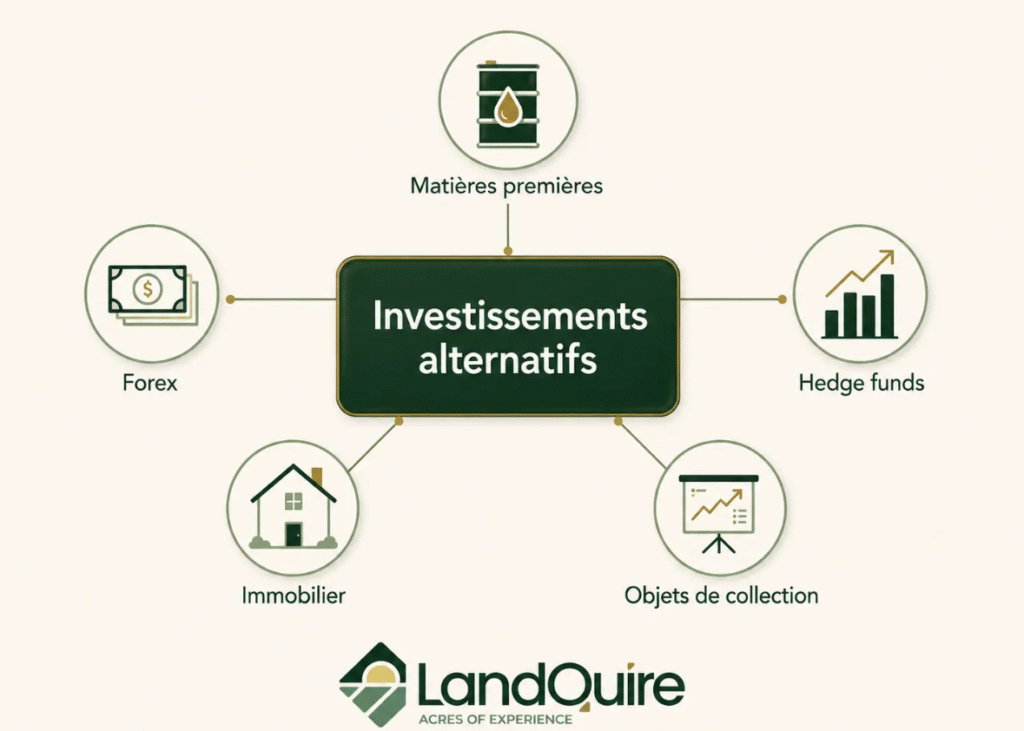
Given the increased volatility in traditional financial markets—such as stocks and bonds—conventional wealth management approaches sometimes reveal their limitations. Traditional savings solutions, such as euro-denominated life insurance, the PEA (Equity Savings Plan), or standard securities accounts (CTO), are no longer always sufficient to ensure optimal diversification and robust protection against inflation. For savvy investors, thinking outside the box is becoming a viable option.
Alternative investing, once reserved for large institutions or exceptional portfolios, is becoming more structured and gradually opening up to a wider audience. This comprehensive guide provides an overview of these non-traditional assets, from their regulatory characteristics to their return and risk dynamics in 2026.
What is an alternative investment?
Alternative investments encompass all investments that do not fall into traditional categories (listed stocks, bonds issued by major governments or leading companies, and cash held at banks). They are characterized by valuation models and operational structures that are independent of global stock market indices.
AIF (Alternative Investment Fund): The AMF’s Regulatory Definition
From a purely legal standpoint,the French Financial Markets Authority (AMF) draws a strict distinction between UCITS (Undertakings for Collective Investment in Transferable Securities) and AIFs (Alternative Investment Funds).
While UCITS are highly standardized and invest in liquid markets accessible to the general public, AIFs encompass a wide variety of funds (FPCI, FPS, SLP, SCPI). AIFs raise capital from a number of investors with the aim of investing it, in accordance with a defined investment policy, in the best interests of those investors. However, it is important to note that not all alternative assets are AIFs. Certain investments, such as the direct purchase of tangible assets or specific corporate structures, fall outside this regulatory classification of collective investment.
Alternative Investments vs. Traditional Investments
Alternative assets differ from traditional assets based on a set of fundamental technical criteria:
- Structural decorrelation: Their performance depends more on the intrinsic value of the asset or the manager’s expertise than on the day-to-day fluctuations of the CAC 40 or the S&P 500.
- Temporary or prolonged illiquidity: Unlike a listed stock, which can be sold in a matter of seconds, exiting an alternative asset may take several months or even several years.
- Higher barriers to entry: Minimum entry fees often amount to tens or hundreds of thousands of euros, although new legal structures are tending to lower these thresholds.
- Increased complexity: Analyzing these markets requires in-depth expertise in valuation, the legal framework, and an understanding of specific economic cycles.
A rapidly expanding market. According to data and analyses published by Preqin, the global alternative assets market grew from $13,700 billion in 2021 and is projected to reach $23,300 billion by 2027. This historical trajectory confirms the structural interest of major investors in these markets.
Key takeaway: Alternative investments offer alternatives to traditional investments by breaking free from the rhythms of the public markets. Whether they are AMF-regulated alternative investment funds (AIFs) or direct investments, they require investors to accept greater illiquidity and complexity in exchange for the potential for superior returns.

Why Include Alternative Assets in a Portfolio?
The inclusion of alternative assets serves specific investment objectives focused on the overall resilience of the portfolio and the search for uncorrelated sources of growth.
Decorrelation and Resilience in Turbulent Times
Since the synchronized corrections in the equity and bond markets observed in recent years, the traditional 60% equity/40% bond diversification strategy has at times failed to serve as a safety net. Alternative assets help break this interdependence. By introducing different drivers of performance (growth of private companies, infrastructure operations, real estate acquisitions), the overall portfolio reduces its sensitivity to interest rate shocks from the Federal Reserve or the European Central Bank.
In addition, many real alternative assets benefit from a mechanical or organic inflation-indexing mechanism (rents, commodity prices, land values), offering partial protection of capital’s purchasing power over the long term. Finally, they provide direct exposure to fundamental megatrends—such as the low-carbon transition, the rise of artificial intelligence infrastructure, and demographic shifts—which traditional stock market indices reflect only belatedly or indirectly.
Why do UHNW individuals allocate up to 50% when the average investor allocates 5%?
The methods for allocating capital vary considerably depending on the size of the portfolio and the investors’ time horizon.
The Knight Frank Allocation Gap. The annual surveys in the Knight Frank Wealth Report reveal that ultra-high-net-worth individuals (UHNWIs) allocate, on average, up to 50% of their total wealth to alternative assets (including private equity, investment real estate, art, and hedging strategies). In contrast, the average retail investor typically allocates less than 5% of their assets to these non-traditional asset classes.
This discrepancy can be explained by the ability of large wealth portfolios and family offices to tie up capital over the long term. Since they are not concerned about illiquidity, they capture what academics refer to as “the illiquidity premium”: the additional theoretical return offered by an asset in exchange for the inability to resell it immediately.
Key Takeaway: Beyond stocks and life insurance, alternative investments offer true diversification and exposure to uncorrelated economic cycles. The adoption of these strategies by high-net-worth individuals demonstrates the value of allocating a portion of one’s liquidity to pursue long-term performance. For the complete asset allocation methodology, see our guide to international asset diversification.
An Overview of the Major Categories of Alternative Assets
To understand this segment, it should be divided into four distinct categories, each with its own characteristics, risk-return profiles, and access constraints.
| Subfamily | Examples | Estimated Fare | Liquidity | Horizon | Main risk | Taxation |
|---|---|---|---|---|---|---|
| Private Markets | Private equity, private debt, infrastructure | Medium to high | Low | 7 to 10 years | Illiquidity, performance dispersion | Varies by vehicle |
| Alternative Real Estate | Specialized SCPIs, OPCIs, REITs, club deals | Medium | Low to moderate | 5 to 10 years | Real Estate Market, Fees, Liquidity | Real Estate Income or Real Estate Taxation |
| International Real Estate | Land in the United States Through an LLC | Medium to high | Low | 24 to 36 months, depending on the project | Execution, Local Market, Foreign Exchange | International Taxation |
| Forests | GFI, GFF, wood | Medium | Low | Ages 15 to 30 | Climate Risk, Liquidity | Potential Tax Benefits: Income Tax, Property Tax, and Estate Tax |
| Vineyards | GFV, wine shares | Medium | Low | Ages 8 to 15 | Limited yield, agricultural uncertainties | Variable |
| Hedge funds | Long-short, arbitrage, futures | High | Variable | Variable | Complexity, leverage, costs | By structure |
| Raw Materials | Gold, metals, energy, agriculture | Low to high | Variable | Short-term to long-term | Volatility, Cyclicality | By medium |
| Passion Projects | Art, wine, watches, cars | Moderate to very high | Low | Long-term | Appraisal, Preservation, Resale | Specific |
| Cryptocurrencies | Bitcoin, Ethereum | Low to high | Raised under normal market conditions | Variable | Volatility, total loss, platform | Crypto Taxation |
Key takeaway: This overview demonstrates that there is not just one type of alternative investment, but many. Each subcategory must be evaluated in light of its regulatory constraints, investment horizon, and alignment with the investor’s objectives.
Private Markets: Private Equity, Private Debt, Infrastructure
Private markets are the historic core of the institutional alternative investment universe. They involve directly financing the real economy without going through the filter of public stock exchanges.
The influence of a market leader. To gauge the institutionalization of these markets, BlackRock manages more than $631 billion in alternative assets under management, drawing on a network of more than 1,400 specialized professionals spread across more than 50 countries (source: BlackRock, 2026 Private Markets Outlook).
Private equity: venture capital, growth capital, succession capital
Private equity involves acquiring an equity stake in unlisted companies at various stages of their development:
- Venture capital: financing for technology-based or innovative startups. The risk of capital loss is high, but the potential for gain is significant.
- Growth capital: support for established companies that need funding to accelerate their growth or expand internationally.
- Leveraged buyout (LBO): the acquisition of established companies using financial leverage.
- Turnaround capital: the acquisition of struggling companies requiring extensive restructuring.
The lock-up period for private equity funds generally ranges from 7 to 10 years, giving management teams time to deploy the capital, grow the value of the portfolio companies, and then sell them.
Private Debt and Private Bonds
Faced with increasingly stringent banking regulations, companies are turning in droves to private debt funds to finance their projects. For the savvy investor, this subclass offers exposure to a company’s creditworthiness rather than its market capitalization. Returns take the form of regular coupons, often at variable rates, offering a risk profile that is sometimes more defensive than pure private equity, although the risk of default remains.
Infrastructure: Energy, Telecommunications, Transportation
Investing in infrastructure involves financing public utility facilities that are essential to the functioning of the economy: wind farms, fiber-optic networks, highways, and transportation infrastructure. These assets are characterized by predictable cash flows, often backed by long-term contracts or government concessions, offering a strong component of regular returns and natural inflation protection.
ELTIF 2.0: Making Private Markets More Accessible in Europe
Long reserved for institutional investors due to minimum investment thresholds set at several million euros, private markets are now opening up to retail investors thanks to changes in European regulations. The ELTIF 2.0 (European Long-Term Investment Fund) framework now allows private equity, private debt, and infrastructure assets to be included in high-end life insurance policies or securities accounts, with lower minimum investment thresholds and regulated conditions for periodic liquidity.
Key takeaway: Private markets offer significant depth of analysis and performance potential for investors willing to accept a prolonged lock-up of their capital. The selection of fund managers is the key factor determining ultimate performance.
Real Assets and Alternative Real Estate
Real assets are based on the ownership of tangible property. They provide reassurance due to their physical nature and their ability to weather economic cycles.
Alternative Real Estate: Specialized SCPIs, OPCIs, REITs, Club Deals
Traditional directpassive real estate investing sometimes faces limitations in terms of returns or burdensome management constraints. Alternative real estate offers the opportunity to diversify property types by focusing on specific sectors: healthcare real estate (nursing homes, clinics), e-commerce logistics, student housing, or the hotel industry. These strategies are implemented through shares in specialized real estate investment trusts (SCPIs), real estate investment companies (OPCIs), publicly traded real estate investment trusts (REITs), or private club deals reserved for a select group of sophisticated investors.
Forests, vineyards, farmland
Rural investments combine a search for meaning, a break from the markets, and specific tax treatment.
Through Forest Investment Groups (GFI) or Forest Land Groups (GFF), investors acquire a share in forest tracts. The biological return (wood growth) is steady but moderate. This investment offers specific tax benefits in France (a deduction from real estate wealth tax, income tax reductions under certain conditions, and deductions from estate taxes), but comes with sector-specific risks (storms, fires, and diseases).
Wine-Growing Land Consortia (GFV) allow investors to acquire vineyard plots leased to a grower. The pure financial return is generally low (often between 0.5% and 4%), though this is sometimes offset by long-term appreciation of the land and allocations of bottles.
International Real Estate via LLCs: The Emerging Alternative Asset Class
Within the category of real assets, the acquisition of unmanaged raw land internationally stands out as a distinct wealth optimization strategy. Unlike traditional real estate investment vehicles, this approach is neither an SCPI, nor an FIA, nor a regulated collective savings product.
Landquire offers savvy investors the opportunity to invest directly in the U.S. real estate market, particularly in the dynamic Sun Belt regions (Texas and Florida). The process involves purchasing undeveloped land with high potential, completing the administrative procedures (land entitlement process to secure zoning approvals), and then reselling the property to local real estate developers.
| Criteria | U.S. Real Estate Through an LLC with Landquire |
|---|---|
| Nature | Direct Acquisition of Land Through an LLC Legal Structure |
| Underlying | Land, land entitlement, Texas, Florida, Sun Belt |
| Cycle | 24 to 36 months (compared to 8–10 years for SCPI and 15–30 years for forests) |
| Management | Agent in Landquire, without rental management |
| Admission Decision | Active, on a project-by-project basis |
| Revenue | No rent payments; the goal is to realize potential capital gains upon exit |
| Liquidity | Low during the operation |
| Risks | Capital loss, EUR/USD exchange rate, execution, local market |
| Public | Experienced Investors |
This asset class is characterized by genuine geographic diversification (exposure to the world’s largest economy and the U.S. dollar), a short investment cycle compared to the long lock-in periods associated with real estate investment trusts (SCPIs) or forestry investments, and a complete absence of rental management.
To gain a practical understanding of how these strategies work in practice, investors can review the track record of completed real estate projects and watch the explanatory video detailing the teams’ expertise.
The figures presented in this summary reflect past performance based on completed transactions. They do not constitute a guarantee of capital, are not indicative of future performance, and should not be extrapolated to a specific project. Investing in undeveloped real estate involves risks of illiquidity and capital loss, and is intended exclusively for sophisticated investors.
To learn more about the trade-offs between U.S. real estate investment vehicles, see our comparative analysis of U.S. SCPIs versus direct real estate investments.
Key takeaway: Alternative real estate and real assets provide the tangibility needed for a diversified portfolio. Direct investment in U.S. real estate through an LLC offers a short-cycle option for savvy investors looking to move away from traditional collective investment vehicles.
Hedge Funds, Commodities, and Niche Assets
This third category includes complex financial instruments and high-value collectibles, which are prized for their hedging properties.
Hedge Funds: Non-Directional Strategies
Hedge funds (or alternative investment funds) employ advanced financial strategies designed to generate returns regardless of market trends: long-short strategies, volatility arbitrage, use of futures markets, short selling, and leverage.
Some legendary funds, such as Renaissance Technologies’ Medallion Fund, have posted extraordinary historical returns (sometimes averaging over 60% per year over several decades). However, these exceptional past returns stem from highly confidential algorithmic strategies that are closed to outside capital and cannot be extrapolated to funds available on the market. Hedge funds are intended exclusively for sophisticated investors who are aware of counterparty risks and the complexity of the instruments used.
Raw Materials and Precious Metals
Investment in commodities encompasses energy, agricultural, and metal resources. Among these, gold holds a unique status.
According to asset allocation data from the Knight Frank Wealth Report, UHNWIs allocate an average of 3% of their total assets to physical gold as a safe-haven asset, and approximately 5% to hobby assets (art, fine wines, collectible watches).
Gold acts as a portfolio stabilizer in the event of a major geopolitical or systemic crisis, exhibiting a historical decoupling from indices such as the MSCI World or the S&P 500.
Art, Wine, and Watches: Assets Driven by Passion and Investment
The market for collectibles such as art and classic cars has become increasingly professionalized. The “Blue Chip” art category (established international artists) has benchmark indices such as the Artprice100 to track price trends at global auctions. While these investments offer undeniable enjoyment as assets, they suffer from wide performance variation, high transaction, storage, and insurance costs, as well as significant illiquidity.
Key takeaway: Financial hedging strategies and passion-driven investments add a dimension of wealth preservation or technical arbitrage to an investor’s portfolio. They require a detailed understanding of the underlying markets or guidance from industry experts.
Cryptocurrencies and Digital Assets
As the newest addition to the alternative asset classes, digital finance has established itself in the contemporary wealth management landscape.
Bitcoin (BTC) and Ethereum (ETH) are now considered by many analysts to be alternative assets in their own right, characterized by programmable digital scarcity. The recent introduction of spot ETFs on major global financial markets has facilitated their technical integration into traditional securities accounts.
Knight Frank’s surveys indicate that the cryptocurrency asset class now accounts for about 2% of the average asset allocation of the ultra-wealthy worldwide, a figure lower than that of hobby assets (5%) or gold (3%), reflecting a still-cautious approach on the part of family offices.
The AMF regularly highlights the extreme risk profile of these assets: very high volatility, the risk of hacking, the potential for unregistered trading platforms to go bankrupt, and the absence of any underlying intrinsic value. In France, it is strongly recommended to use only intermediaries that hold PSAN (Digital Asset Service Provider) status or are compliant with the European PSCA framework.
Key takeaway: Cryptocurrency can serve as a potential performance driver or a tool for marginal diversification. Given its volatility, it should occupy only a very limited and highly speculative portion of an investment portfolio.
How can alternative assets be incorporated into an asset allocation strategy?
The inclusion of assets outside the traditional investment framework should not come at the expense of the overall balance of one’s portfolio. These assets serve as a complement to—not a substitute for—the fundamental building blocks of liquidity and security.
For a savvy individual investor, the rule of thumb generally observed by wealth management advisors suggests allocating between 5% and 15% of total assets to alternative assets (across all asset classes: private equity, real assets, real estate, or art). This allocation allows investors to capture the benefits of decorrelation and the illiquidity premium without jeopardizing the household’s short-term solvency.
Before making any investment decisions, it is essential to ensure that you have emergency savings readily available to cover unforeseen circumstances. The complete methodology for asset allocation by profile, age, and time horizon is detailed in our guide to asset diversification.
Common Mistakes in Alternative Investing
The pursuit of diversification can lead to mistakes in wealth management. Here are the main pitfalls to avoid.
Chasing Spectacular Returns
A reported return is never enough. It is important to understand how it is generated, the level of risk involved, the time horizon, the liquidity, and the associated fees. Past performance of certain private equity funds, hedge funds, cryptocurrencies, or real assets is not indicative of future results.
Underestimating Illiquidity
Many alternative assets cannot be sold quickly. This is the case with private equity, certain real estate funds, forests, vineyards, club deals, and real estate. Illiquidity can be acceptable if it is anticipated. It becomes problematic if the investor needs to recoup their capital quickly.
Confusing "alternative" with "high-performance"
An alternative investment may underperform. It may even lose value. The term “alternative” describes an investment category, not a guarantee of returns.
Underestimating the costs
Entry fees, management fees, performance fees, legal fees, tax expenses, custody fees, brokerage commissions: alternative assets can be costly. Net returns should always be distinguished from gross returns.
Enter without expertise
Art, hedge funds, cryptocurrencies, international real estate, and private equity all require specific expertise. Investors must understand the asset, the operator, the legal framework, and the exit risk.
Ignore performance variation
In the world of private equity, the gap between top-quartile funds (the top 25% of managers, who sometimes post returns exceeding 20%) and bottom-ranked funds (which can destroy value) is considerable. Choosing the wrong manager is much more costly in private markets than in public equity markets.
Remaining Trapped in the Home Bias
In France, alternative investing is often limited to SCPIs, forests, or GFVs. While these options may have their merits, they do not cover the full spectrum of non-traditional assets. International private markets, infrastructure, private debt, U.S. real estate, and certain foreign real assets can broaden the scope of consideration.
Confusing alternative assets with regulated investment funds (FIA)
All AIFs are alternative investment funds. However, not all alternative assets are AIFs. This distinction is important for understanding the level of regulation, disclosure requirements, liquidity, and investor responsibilities.
Key takeaway: A sound alternative investment requires a rigorous approach from the outset. While the time spent on day-to-day management is often minimal, careful initial evaluation of the fund manager, fees, liquidity, and tax implications remains essential.
FAQ: Alternative Investments
What is an alternative investment?
An alternative investment refers to any financial or real-asset investment that does not fall within the traditional markets for listed stocks, government bonds, or bank deposits.
What is an alternative investment?
It is a synonym for alternative investment. It refers to the act of investing capital in non-traditional investment channels (private markets, tangible assets, hedge funds).
What are alternative investments?
These primarily include private equity, private debt, infrastructure, specialty real estate, forests, direct real estate holdings, hedge funds, gold, commodities, works of art, and digital assets.
What are the four types of alternative investments?
They are generally divided into four main categories: private markets (private equity, private debt), real assets (real estate, land, forests), alternative investment strategies (hedge funds, commodities), and passion and digital assets (art, cryptocurrencies).
What is the best alternative investment in 2026?
There is no one-size-fits-all solution. The best investment is one that perfectly complements your current portfolio. For some, this will mean seeking short-term cycles through direct international real estate investments. For others, it will mean holding European private equity investments for the very long term.
What is the difference between an FIA and a UCITS?
UCITS are harmonized funds that invest in listed and liquid securities and are available to the general public. AIFs (Alternative Investment Funds) are structures regulated by the AMF that invest in assets that are often less liquid and more complex, and are frequently aimed at professional or sophisticated investors.
Why do UHNW individuals allocate so much to alternative assets?
With substantial wealth, the ultra-rich do not need immediate liquidity across their entire portfolio. They tie up large portions of their capital to capture the illiquidity premium and gain access to value-creation opportunities that are unavailable on public stock markets.
Are alternative investments available to individual investors?
Yes, access is becoming more widespread. Regulations such as ELTIF 2.0 and the development of specialized platforms now make it possible to enter these markets with an initial investment of just a few thousand euros, compared to millions in the past.
What are the main risks associated with alternative investments?
Major risks include the risk of total or partial loss of principal, illiquidity (the inability to sell quickly), the complexity of valuation, and heavy reliance on the expertise of the selected management teams.
What is the minimum investment amount for alternative investments?
The range is very broad. It starts at just a few hundred euros for SCPIs or fractional shares of digital assets, is around a few thousand euros for ELTIF 2.0 funds, and reaches tens or hundreds of thousands of euros for direct real estate investments or institutional private equity funds.
Key Takeaways
Alternative investing is no longer limited to large institutions. By 2026, a savvy individual investor will have access to a wider range of assets outside the traditional investment channels: private markets, real assets, alternative real estate, land, commodities, hobby assets, and digital assets.
This democratization should not cause us to lose sight of the fundamentals. Alternative investments are often less liquid, more complex, and more dependent on the manager’s expertise than traditional investments. They must therefore be incorporated methodically, in a proportion consistent with the overall portfolio.
For a savvy investor, an alternative portfolio can help reduce excessive reliance on traditional equity and bond markets. However, it must remain transparent, well-managed, and well-documented.
U.S. real estate, through a structured direct acquisition, can serve as one of these alternative investment components. It offers tangible, international exposure that is distinct from traditional real estate investment trusts. Like any alternative asset, it must be evaluated carefully, taking into account the investment horizon, risk, tax implications, currency exchange rates, and liquidity.
Any investment decision should be made with the assistance of specialized advisors, particularly regarding wealth management, tax, legal, and regulatory matters.
Publication Information
Author: Thibaut Guéant, co-founder of Landquire. Licensed real estate agent in the State of Florida, with over 12 years of operational expertise in the U.S. market. Coordinator of a portfolio of approximately $73 million in real estate and land assets. Honored by Challenges magazine in 2024.
Last revised: June 23, 2026.
For more information, visit the Landquire team page, our international taxation section, and our analysis of passive real estate investing.
Are you looking for a tangible alternative asset that is uncorrelated with the financial markets?
Landquire is a French company that assists French-speaking investors in acquiring and developing land in the United States (Texas, Florida) over a short cycle of 24 to 36 months, without rental management.
- 100% Managed Investment
- Short-term program (24 to 36 months)
- Documented track record on completed projects
- Off-market, for experienced investors only
View current real estate opportunities
Explore Projects That Have Already Been Sold
Connect with the Landquire team