MUD and PUD - Understanding taxes and services before you buy
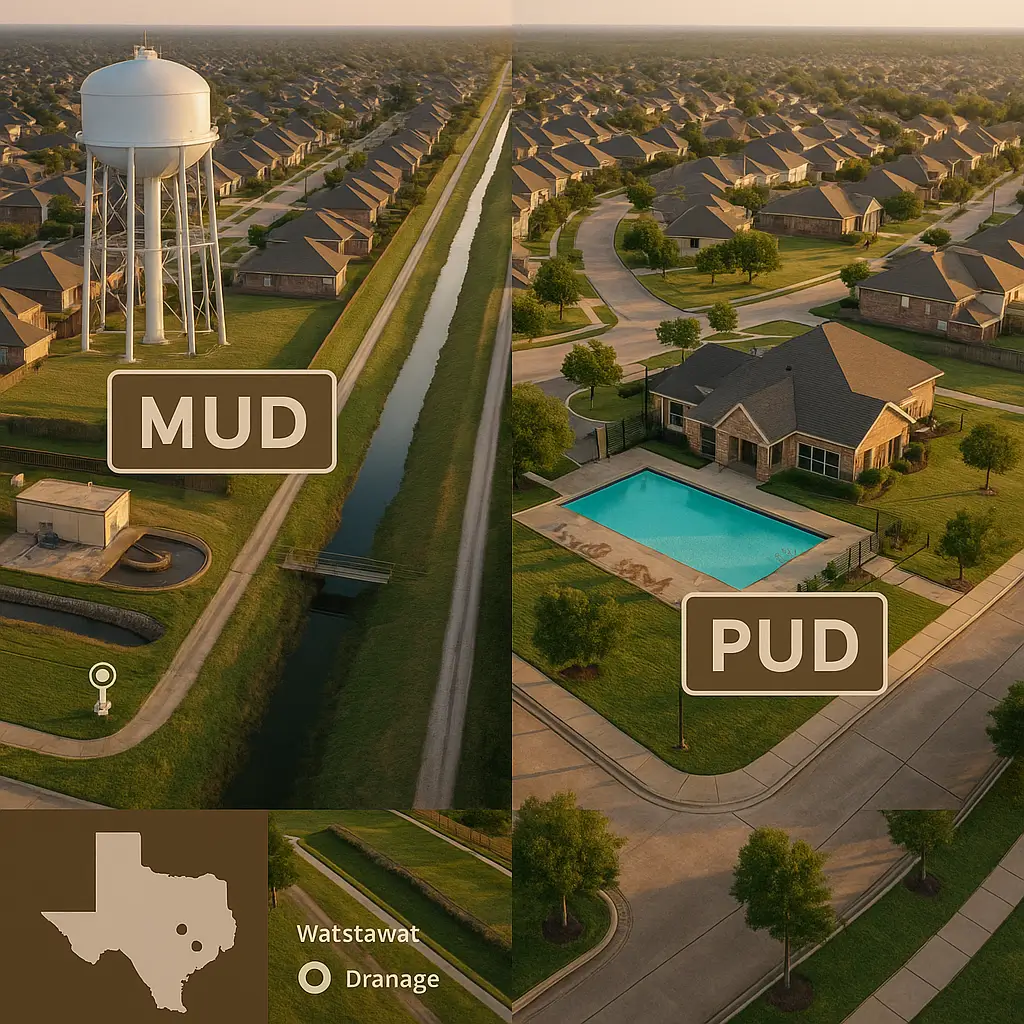
MUD and PUD - understanding taxes and services before you buy is a crucial first step for any real estate investor or future homeowner in the United States. These acronyms - Municipal Utility District and Planned Unit Development - structure financing, utility delivery and neighborhood governance. They determine your cost of ownership, quality of life and resale liquidity. Misunderstanding them can lead to budgetary deadlocks and unanticipated constraints on enjoyment. This reading aims to turn complexity into an investment advantage, by linking technology to operational decisions.
🔹 Welcome to LandQuire
At LandQuire, we believe that property investment shouldn't be reserved for an insider elite. That's why we provide a highly qualified team, combining expertise in real estate, technology and data analysis, to support you every step of the way.
👉 Check out our latest news on LinkedIn.
Understanding the MUD/PUD duality
The MUD is a local public entity that finances and operates essential networks where the city is unable to intervene immediately. It issues bonds, collects a dedicated tax and builds the "heavy" infrastructure of a neighborhood. In contrast, a PUD is an urban planning framework that creates a coherent living environment with amenities, often managed by an HOA. The former guides the tax burden, the latter frames the residential experience and the rules of living.
This duality has a direct impact on your costs and margins. It must be factored into due diligence, negotiation and financial modeling. If you ignore these parameters, you run the risk of undervaluing taxes or recurring costs that reduce net profitability.
I. The MUD: anatomy of a tax, history and governance
The MUD is born when a peripheral area needs water, sanitation and drainage to develop. Rather than wait for municipal budgets, the community creates a special district that raises funds via bonds. Perimeter property owners repay these bonds through a dedicated tax, integrated into the overall property tax. The model accelerates urbanization by spreading the real cost over decades.
Historically, these districts have accompanied major waves of urban expansion. In the metropolitan areas of Houston (Harris, Montgomery and Fort Bend counties) and Dallas-Fort Worth (Collin and Denton counties), they rapidly opened up thousands of lots to urbanization. This financial engineering comes at a price: a significant additional tax in the early years, which generally contracts as the debt is repaid.
A. The financial core: bonds, tax and debt trajectory
A MUD does not advance "on its own funds". It issues long-term bonds to finance networks and retention basins. These bonds are serviced by an additional MUD tax, expressed per $100 of assessed valuation. At launch, debt is at a maximum and the tax base is still low, so the rate starts high, then falls as construction is completed and taxable value grows.
To steer your risk, look for the Debt Retirement Schedule. This schedule indicates when the major installments run out and how the tax might normalize. A district at the end of its debt becomes more competitive at resale: the lighter tax burden expands the pool of buyers, supporting price and absorption speed. Conversely, fresh debt requires a conservative budget on PITI.
A simple example illustrates the dynamics. For a taxable value of $300,000 and a MUD share at $0.75/$100, the "MUD" line represents $2,250 per year, or about $187.50 per month. When added to county, school district and city taxes, it puts a strain on cash flow. In a rental model, this expense must be integrated into the DSCR and stress tests.
B. Governance processes: transparency and public oversight
An elected Board of Directors governs the MUD. It votes on budgets, bond issues, operating contracts and tax adjustments. Meetings are open to the public, with minutes and budget documents available for consultation. This form of governance limits abuses and gives owners a right of oversight.
Transparency also relies on the supervision of state agencies. The TCEQ monitors the environmental and operational compliance of networks. The Texas Comptroller centralizes tax information on Special Purpose Districts. The TWDB provides databases on districts, their identification and sometimes financial details. Cross-referencing these sources enables us to validate the integrity of the perimeter and the debt trajectory.
C. Essential services and network resilience
The MUD provides the backbone: water, sanitation and drainage. In counties exposed to extreme rainfall, the quality of drainage protects heritage value and reduces insurance claims. Some districts also take care of rudimentary road sections or common spaces. Their performance is measured in terms of continuity of service, recovery times and proactive management of basins during floods.
II. The PUD: quality of life, CC&R and HOA mechanics
The PUD organizes the living space. It authorizes a balanced mix of residential and local commercial uses, imposes an architectural charter and provides for shared amenities. The objective is as much urban as commercial: to offer a coherent experience that supports long-term value andattractiveness.
A. CC&R: everyday rules and concrete impacts
CC&Rs set the standards. They may regulate the color palette of facades, fencing materials, the size of sheds, the parking of trailers or utility vehicles, or even the location of antennas and solar panels. They often require regular lawn maintenance and restrict certain developments visible from the street.
The impact is twofold. On the one hand, these rules protectaesthetics and consistency, which supports resale value. On the other, they limit the owner's flexibility, with the risk offines in the event of non-compliance. Before you buy, you need to assess thesuitability of CC&Rs for your actual use: primary residence, pied-à-terre or rental investment.
B. HOA fees, reserve funds and special assessments
The HOA charges fees to finance the maintenance of parks, pools, trails, gates, clubhouses and administrative management. A solid reserve fund is essential to absorb heavy replacements (clubhouse roofing, repair of private roads). A frequently cited indicator is a reserve level of at least 10% of the annual budget, but the right level depends above all on a multi-year expenditure plan.
When reserves are insufficient, the HOA can launch aspecial assessment. This one-time contribution, sometimes several thousand dollars per lot, can come at a bad time for an owner or investor. Reviewing thehistory of special assessments, recent minutes and the schedule of planned replacements reduces uncertainty.
C. Value premium and GEO anchoring
In dynamic metropolitan markets - Travis / Williamson for Austin, Collin / Denton for DFW - well-managed PUDs command a premium. Buyers value perceived quality, security, cleanliness and access to amenities. This premium supports liquidity and resale speed, but it assumes a credible HOA, a controlled budget and CC&Rs applicable without excess.
Project in progress: CC&R / HOA analysis integrated into Investissement foncier Seguin: Portfolio 17 (24-36 months).
III. MUD + PUD: full-cost modeling (PITI) and arbitration
Many neighborhoods combine MUD for networks and PUD/HOA for amenities and governance. In this case, the investor needs to model the true cost of ownership, integrating MUD tax, HOA fees, basic property tax, insurance and debt service.
A. Case study and financial analysis
For a $300,000 property with a $250,000 mortgage, a MUD tax of $0.75/$100 represents $187.50 per month. Add $120 in HOA fees, non-MUD taxes and insurance: the $307.50 monthly difference with a non-MUD/HOA property alters an investor's borrowing capacity and ratios. Over twelve months, that's $3,690 to be absorbed by the rent or the increase in value.
This reality is not necessarily negative. It can be offset by an amenity-related rent premium, lower vacancy thanks to residential experience, or accelerated appreciation if the MUD tax falls in the medium term. The key is to align the holding profile with the district's debt curve.
B. Perimeter conflicts and municipal annexation
Responsibilities may overlap: the MUD manages "rough" drainage, the HOA landscaping. To avoid grey areas, read the statutes and agreements between entities. What's more, some cities annex MUDs at the end of the cycle.Annexation ends the dedicated tax but may substitute higher municipal water/sewer rates. Thenet impact depends on local rates and the services taken over.
IV. Advanced due diligence: step-by-step procedures and EEAT sources
Due diligence should give you a 360° view of the district and the HOA. It combines public documentary research and documents provided during the resale period.
A. MUD procedure (concrete steps)
- Identify the district: consult your county's County Appraisal District (CAD), then search for the MUD in the TWDB - District Database by district number or county name.
- Validate the perimeter: retrieve the official map and confirm that the targeted plot is included. Beware of expanding perimeters.
- Get the debt: ask for the MUD annual report and the Debt Retirement Schedule. Note the maturities and rates of the tranches issued.
- Tax history: via CAD and Texas Comptroller, find the MUD rate for the last 5 years. A downward trend reinforces the investment thesis.
- Compliance & operations: check with the TCEQ on water quality, reported incidents and any penalties.
- Supply model: does the MUD produce water or buy it wholesale? Buying districts are more sensitive to rate increases.
B. PUD / HOA procedure (concrete steps)
- CC&R: request the complete version. Look for restrictions on parking, colors, fences, collectors, short-term rentals, solar panels.
- Budget and reserves: analyze the structure of expenditure, the proportion of deferred maintenance and the level of the reserve fund. Cross-reference with a multi-year replacement plan.
- Assessment history: record the amounts, frequencies and justifications for special assessments.
- Minutes: detect recurring disputes (supplier conflicts, unpaid claims, disagreements over rules).
- Insurance: check HOA policies and deductibles, especially if the PUD includes high-value structures.
- Consistency of use: align your strategy (occupancy, long-term rental, resale) with foreseeable rules and costs.
👉 Need advice on your district or CC&Rs? Contact a team member.
C. What you'll find on official websites (EEAT)
- TCEQ - Municipal Utility Districts: district data sheets, technical references, compliance, procedures, administrative contacts.
- Texas Comptroller - Special Purpose Districts / Property Tax: tax frameworks, role of special districts, information on tax base and tax mechanisms.
- TWDB - District Database: identification of districts, perimeters, linked resources, referral to public documents.
These cross-sources reduce information asymmetry and reinforce the credibility of your investment case.
To remember
- MUD: finances networks (water/sewerage/drainage) via dedicated tax and bonds to be repaid.
- PUD: planning framework + HOA (regulations, amenities, fees).
- MUD + HOA = higher cost of ownership to be modeled in PITI.
- Check TCEQ / Texas Comptroller / TWDB, MUD rate, debt and HOA CC&Rs.
V. Impact on investment strategy: valuation, taxation, timing
A. Valuation linked to the MUD debt trajectory
Property in a young district carries a high tax burden, which can squeeze cash flow. However, if the Debt Retirement Schedule shows a significant decline over the next 5 to 10 years, the structural reduction in the tax burden creates forced appreciation. The market values a falling cost of ownership, especially if local demand remains buoyant. The investor who accepts the initial pressure can later arbitrate on a more liquid and attractive asset.
However, automatic optimism should be avoided. Construction delays, network surcharges or a tax base that grows more slowly than expected will keep the rate high for longer. Hence the importance of stress-testing conservative scenarios, including insurance and water/sewer rate volatility.
B. PUD bonus and the role of amenities
In the counties of Travis / Williamson (Austin) or Collin / Denton (DFW), PUDs with trails, green spaces, security and a clubhouse often justify a price premium and reduced rental turnover. The HOA acts as a guardian of quality, reassuring end-buyers. The downside is the rigidity of the rules and the prospect ofspecial assessments if reserves are poorly calibrated. A file that anticipates these cycles convinces better at resale.
C. Tax benefits: what's deductible (and what isn't)
For an owner-occupier, property taxes (which include the MUD line) may be deductible up to the federal SALT ceiling and underitemization conditions. HOA fees, on the other hand, are not deductible for a principal residence. For a rental investment, property taxes, insurance, interest and some management costs may be treated as operating expenses; HOA fees are then included in the pro forma. These principles depend on tax status and compliant accounting: a local CPA must validate the approach.
D. Alignment with LandQuire projects
Our models incorporate these parameters into the return projections. This is the case for the RiseQuire 1 Project - estimated IRR 20.5% and Portfolio 17 in Seguin (24-36 months), where MUD/PUD analysis is coupled with GEO data, zoning andinfrastructure trajectories. The aim: to secure robust projects in the face of fiscal and technical variables.
VI. MUD vs PUD comparison chart
| Criteria | MUD (Municipal Utility District) | PUD (Planned Unit Development) |
|---|---|---|
| Nature | Autonomous public district (government entity) | Private planned development (zoning) |
| Financing | Bonds redeemed by MUD tax (SPDs framework - Texas Comptroller) | SPDs base (district reports) | Developer + HOA fees (regulations via Property Owners' Associations) |
| Main services | Water, sewerage, drainage (sometimes roads) - see Water Districts Map Viewer (TCEQ) | Amenities (pools, clubhouse, parks) |
| Tax impact | + MUD tax (decreases when debt decreases) - resources : Property Tax Assistance (Texas Comptroller) | No dedicated fee (HOA operating costs) |
| Governance | Board elected, supervision TCEQ / WDD and data TCEQ Water Districts | HOA elected, subject to CC&R (Texas Law Library) |
| Main risk | Underestimation of tax / residual debt | Restrictive rules & special assessments (HOA) |
Conclusion: master the real cost before you buy
In the American context, MUD and PUD are not accessories: they sculpt your taxes, your fees, your UX and your exit. Reading the MUD debt trajectory, CC&Rs, HOA budgets and modeling a realistic PITI helps reduce randomness and secure performance. File discipline - public documents, official sources, conservative assumptions - is your best lever for turning regulatory complexity into competitive advantage.
👉 Talk to LandQuire to validate district, taxes and infrastructure: Contact us.
FAQ
Q1. How do I know if a lot is in a MUD or a PUD?
For a MUD: consult the County Appraisal District and the TWDB - District Database; also check the TCEQ sheets. For a PUD: ask for HOA resale documents (CC&R, budget, reserves) and check the title. The agent/seller must provide these items during the option period.
Q2. Does the MUD tax decrease over time?
Yes, as the debt is repaid and the tax base expands. At the end of the cycle, certain districts may be annexed by the city, which puts an end to the dedicated tax but substitutes municipal tariffs for public services.
Q3. Can we be in both a MUD and a PUD with HOA?
Yes. It's common: MUD fee for infrastructure and HOA fee for amenities and enforcement. In this case, you need to model the complete PITI before offering.
Q4. Are HOA fees deductible?
For a principal residence, generally not. For a rental property, they are treated as operating expenses, subject to the opinion of a CPA and the investor's tax status.
Official data & sources
- TCEQ - Municipal Utility Districts: compliance, processes, standards.
- Texas Comptroller - Special Purpose Districts / Property Tax: tax framework, records, tax bases.
- TWDB - District Database: district identification and public resources.
Disclaimer - Informative and general content. It does not constitute legal, tax or financial advice. Before making any decision, consult an attorney, CPA and/or broker duly licensed in the state concerned.