Texas vs. Florida for the Residential Division: 2026 Comparison Guide
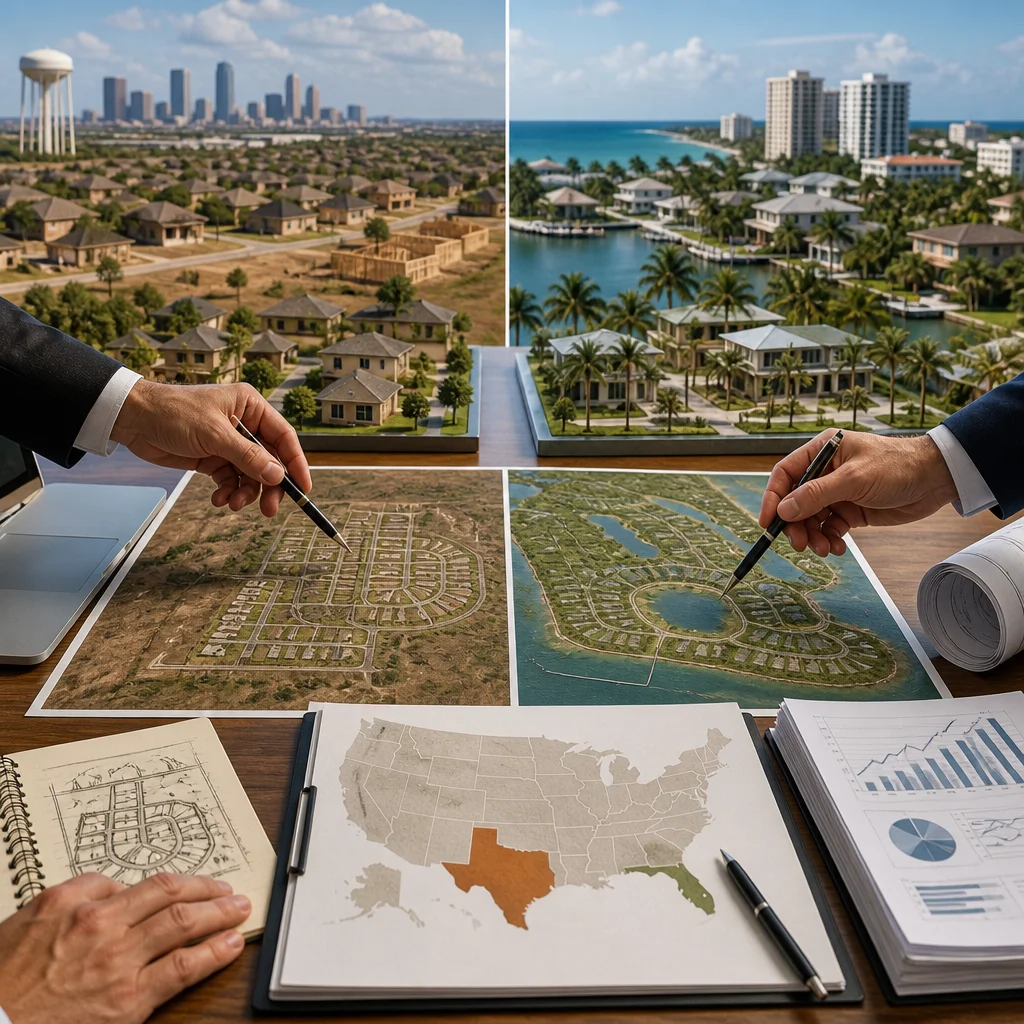
Why Choose Between Texas and Florida for a Subdivision
For real estate investors, the choice between Texas and Florida largely determines your return horizon, the duration of your investment, and your exposure to regulatory risks. These two states dominate the residential subdivision sector in the United States, but they operate according to very different principles.
Texas is experiencing exceptional population growth fueled by internal migration, the absence of state income tax, and sustained economic expansion. Florida, for its part, benefits from an influx of retirees, a robust tourism economy, and unprecedented demand for affordable housing. To maximize your returns, you need to understand not only where growth is strongest, but also where regulatory approval times are shortest and where pre-construction margins are highest.
At LandQuire, we have completed more than 130 projects since 2021 in these two jurisdictions. This experience allows us to navigate the specific nuances of each one and structure your investments to achieve target returns of between 20% and 35% annual IRR.
Texas Real Estate Market: Growth, Regulations, and Return Potential
Texas is emerging as the engine of U.S. residential growth. Between 2020 and 2025, the state welcomed more than 900,000 new residents, surpassing California and Florida combined in terms of net migration. This growth is not a temporary phenomenon; it is a structural trend fueled by the absence of state income tax, land costs that remain competitive compared to the West Coast, and a pro-development culture.
From a regulatory standpoint, Texas stands out for its predictability. Texas municipalities, particularly those around Dallas, Houston, Austin, and San Antonio, have established clear and efficient subdivision processes. A standard subdivision plan can receive initial approval in 4 to 6 months, compared to 9 to 12 months in other states. Urban planning commissions apply objective rather than discretionary criteria, which reduces the risk of unpredictable approval outcomes.
Land value margins in Texas remain attractive. Raw agricultural land can be purchased for $15,000 to $30,000 per acre in suburban growth corridors. Once entitlements are secured (regulated zoning, approved subdivision plans, planned infrastructure), that same land can be sold to developers for $80,000 to $150,000 per acre. This pre-construction value creation—even before a single home is built—is at the heart of our strategy.
The challenges in Texas are real but manageable. The state requires local expertise to navigate the differences between counties and municipalities. Austin, for example, enforces stricter environmental requirements than Houston. That’s why maintaining zoning and compliance teams in each key market allows us to anticipate obstacles and structure your projects for swift approval.
Next step: If you’re considering Texas, start by identifying the population growth corridors (north and southeast of Dallas, the Austin-San Antonio corridor, and the western suburbs of Houston). That’s where demand for entitled land is strongest.
Florida Real Estate Market: Demographics, Opportunities, and Regulatory Challenges
Florida attracts real estate investors for one simple reason: its population is growing faster than its housing supply can keep up. The state gained approximately 1.3 million residents over the past decade, with growth accelerating significantly after 2020. Retirees, young professionals fleeing expensive coastal states, and tech workers are flocking to Florida.
This inelastic demand for housing creates a unique opportunity for investors in entitled land. Florida’s land markets exhibit lower price volatility than Texas’s, but more predictable exit multiples. Florida developers know that a home will sell, so they are willing to pay for developed land.
However, Florida’s regulations are even more complex. The state requires strict environmental compliance due to its sensitive groundwater and protected coastal wetlands. In coastal counties (Miami-Dade, Broward, Palm Beach), the average approval time for a subdivision can range from 12 to 18 months. Land near the coastline requires sea-level rise assessments and climate adaptation plans—requirements that did not exist five years ago.
Inland markets (Polk County, Orange County, Lake County) offer a more streamlined regulatory process. These regions are experiencing strong population growth without the constraints found along the coast, resulting in permitting timelines comparable to those in Texas. Entry-level land is less expensive there than in Miami or Tampa, but pre-construction margins are just as strong.
Our approach in Florida is to avoid coastal areas unless the additional return justifies the longer wait. For most of our investors, inland counties offer a better return-to-time ratio.
Next step: Assess whether your risk profile allows for a longer payback period in exchange for potentially higher returns. If you prefer quick results, inland Florida offers greater predictability than a coastal approach.
Comparison of Entitlement Timeframes: Which Jurisdiction Offers the Fastest Processing?
The payback period is critical for two reasons: it directly affects your return on investment timeline, and it exposes your capital to market risk for a longer period of time. A 36-month project generates a much higher IRR than a 24-month project, all other things being equal, so speed matters.
In Texas, our projects typically complete the entitlement phase in 5 to 8 months. This requires a pre-engagement strategy with key municipalities and a standardized approach. We begin with a comprehensive feasibility analysis, then engage planners before submitting formal plans. This pre-application approach eliminates back-and-forth communication and speeds up the approval process.
In Florida, the average timeline for full entitlement ranges from 8 to 14 months. Environmental requirements call for additional assessments, and Florida planning commissions are more likely to take public comments into account, which can extend the timeline. Nevertheless, for our inland projects in Florida, we have maintained an average of 10 months for full subdivision approval.
The total turnaround time (from acquisition to sale to the developer) reflects the entitlement process plus the pre-approval acquisition and post-approval marketing phases. In Texas, we target 18 to 24 months. In Florida, we structure for 24 to 30 months. This 6-month difference changes the IRR profile by approximately 3 to 5 percentage points.
Here is how the deadlines typically break down:
Texas:
- Acquisition and due diligence: 1 to 2 months
- Permits (zoning, plan approval, permits): 5 to 8 months
- Marketing and closure: 2 to 3 months
- Total: 18 to 24 months
Florida (inland coast):
- Acquisition and due diligence: 1 to 2 months
- Permitting (including environmental assessments): 8 to 14 months
- Marketing and closure: 2 to 3 months
- Total: 24 to 30 months
At LandQuire, we streamline these timelines through our established network of zoning consultants, our understanding of specific municipal processes, and our ability to identify properties located in pre-identified growth areas where approval processes are already well-defined.
Next step: If your investment horizon is short (20 months or less), focus on Texas. If you have more flexibility in terms of time, Florida may offer comparable returns.
Value Margin Analysis: Where We Maximize Your Returns
Pre-construction value creation is at the heart of the subdivision strategy. Your return depends on three variables: the purchase price of the raw land, entitlement and light infrastructure costs, and the sale price to a developer.
In Texas, we have observed typical valuation multiples ranging from 3.5x to 5.0x the gross purchase price for key-entitlement land. Land acquired for $20,000 per acre can be sold for $70,000 to $100,000 per acre after full entitlement. Entitlement costs (feasibility studies, zoning fees, plans, permits) rarely exceed 8 to 12% of the final purchase price. Undeveloped land that does not require major infrastructure generates the highest margins.
In Florida, multiples vary more depending on location. Coastal properties or those in high-demand areas (the Tampa-Orlando corridor) can command multiples of 4.0 to 6.0x, but with higher entitlement costs (12 to 18% of the purchase price due to environmental studies). Inland land typically commands multiples of 3.0 to 4.5x, with entitlement costs capped at 8 to 11%.
The key to maximizing margins is to secure off-market access to land before multiples compress. When raw land becomes publicly listed or is put up for conventional auction, the purchase price rises and margins shrink. Our advantage lies in identifying unlisted properties and negotiating directly with landowners, which allows us to acquire land at prices that reflect agricultural or light industrial uses, rather than speculative residential values.
Here's a typical scenario in Texas:
- Acquisition: 500 acres at $25,000 per acre = $12.5 million
- Entitlement and infrastructure costs: $1.2 million (9.6% of the purchase price)
- Carrying costs (interest, insurance, taxes) over 20 months: 0.35 million USD
- Total investment cost: 14.05 million USD
- Sale price: $90,000 per acre (after residential zoning and planned subdivision) = $45 million
- Gross profit: 30.95 million USD
- Annual IRR: 28 to 32% over 20 months
This return assumes proper sizing and project execution without significant delays. That is why our selection process is rigorous: we reject 90% of opportunities because the economic case does not support a minimum target return of 20% IRR.
Next Step: Insist that any proposed project include a sensitivity analysis showing how delays in obtaining permits or reductions in sale prices affect the IRR. Sound projects maintain a minimum IRR of 18% even under pessimistic assumptions.
Off-Market Access and Competitive Advantage in Our Portfolios
Access to the off-market market is your competitive advantage—one that conventional land buyers cannot match. When a property is publicly listed, prices rise quickly and yields shrink. Sellers receive competing offers, and commercial brokers take a commission.
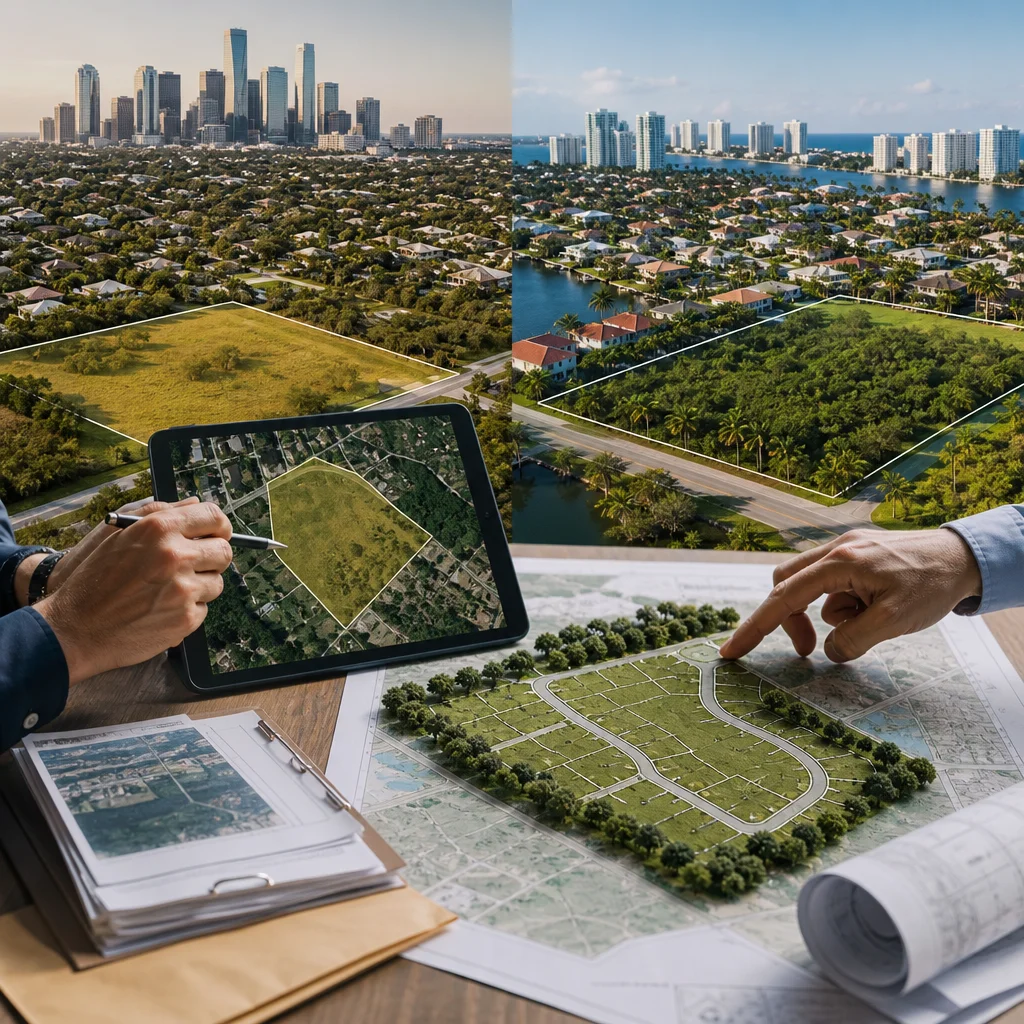
We are building off-market access through three channels: direct relationships with multi-generational landowners (farming families, long-standing development companies), commercial brokers who know us and offer us the best deals before they hit the market, and our own market intelligence system, which identifies properties likely to become available before the owner lists them.
In 2026, our pipeline includes approximately 120 to 140 opportunities at various stages of sourcing and execution in Texas and Florida. About 70% of our acquisitions come from off-market sources. This means you have access to properties that competing investors never see.
The value of this advantage is tangible. Land acquired off-market at a 5 to 10% discount compared to the comparable market price directly adds 1 to 2 percentage points to your final IRR. Multiply that by 30 to 40 projects per year, and it represents significant value creation for our investors.
We safeguard this access by maintaining a long-term commitment to sellers and brokers. We close deals quickly, we don’t renegotiate after the contract is signed, and we treat every seller with the respect due to a partner, not just a transaction. This reputation has generated a steady stream of preferred transactions.
Next Step: When evaluating a real estate portfolio manager, ask what percentage of their transactions are off-market and how long they have maintained these sourcing relationships. Figures above 60% indicate a genuine competitive advantage.
Our Proprietary Approach: How LandQuire Selects and Structures the Best Projects
Our selection process begins with a quantitative analysis of the markets. We model projected population growth, housing construction forecasts, available land supplies, and prices that offer an attractive yield spread. Only markets that meet our quantitative thresholds are included in our active analysis.
Once a project passes this screening, we conduct a site-specific feasibility assessment. Each candidate property must meet the following criteria:
- Minimum size of 40 acres (sufficient to generate zoning leverage)
- Optimized layout for a medium-density residential subdivision (6 to 12 units per acre)
- Access to existing or feasible infrastructure (roads, water, sanitation)
- Uncomplicated or correctable environmental conditions (no complex wetlands or areas subject to seismic reclassification)
- Purchase price that yields a minimum internal rate of return (IRR) of 20%
Land entitlement services are our core area of expertise. We employ licensed urban planners, zoning attorneys, and infrastructure consultants in every jurisdiction. Before submitting a formal plan, we engage in a pre-engagement phase with municipal departments, state agencies, and planning commissions. This approach allows us to identify potential obstacles and design projects around them.
The structure of the transactions always follows the same model: 100% equity, with no debt. This eliminates exposure to interest rates, reduces lenders’ restrictions on plan changes, and maintains operational flexibility. You finance the majority through private equity in proportion to your allocation, often via a dedicated investment vehicle (LLC, partnership, or fund).
The sale is structured around a pipeline of pre-identified developers. Once the development rights have been secured, we market the project for 4 to 8 weeks to a target group of builders. We typically receive several good-faith offers within 8 to 12 weeks of the subdivision’s final approval.
Next Step: Before committing your capital, request a summary of three to five completed projects, including details on actual versus budgeted costs, actual entitlement timelines, and the realized exit price. Managers with a transparent track record earn trust.
Proven Results: 130+ Completed Projects and Verified Returns
Since our founding in 2021, we have completed more than 130 projects in off-market residential subdivisions in Texas and Florida. This represents approximately 35,000 acres of agricultural or light industrial land that has been converted into residential development sites. Our investors have received distributions on each project according to schedule.
Our track record includes:
- 100% success rate in obtaining permits (no project has failed to obtain final zoning approval)
- Average annualized IRR returns of 24% to 28% across all projects
- Average duration of 22 months from initial deployment to final distribution
- More than 600 investors trading simultaneously through our network
These results reflect the discipline of our selection process, our local expertise, and our debt-free approach. We faced longer-than-expected entitlement timelines, market price declines, and changing circumstances, but we managed our projects to maintain our target returns through rigorous cost management and tactical flexibility.
Our most successful projects in Texas (the northern Dallas growth corridors and the Austin tech sector) have generated IRRs ranging from 32% to 38%. In Florida, our inland projects (Orange County, Lake County) achieved IRRs of 24% to 30%, while a few higher-risk coastal projects delivered IRRs of 28% to 35% after longer entitlement periods.
We never exaggerate potential returns or market outlooks. We present expected returns as a range (e.g., 20% to 28% IRR) and disclose the key assumptions. Investors who have worked with us understand that we are conservative in our projections and that actual returns often exceed expectations.
Next step: Ask a manager to put you in direct contact with three to five past investors who can share their own experiences. High-quality references are a sign of sound management and genuine investor satisfaction.
100% Equity Investment Structure: Risk Mitigation and Transparency in Returns
Our commitment to a 100% equity structure (zero debt) fundamentally sets our investment vehicles apart from traditional real estate development strategies. When a real estate project is financed with debt, your return depends on the interest rate, the repayment schedule, and the terms of any restructuring should complications arise. A rise in interest rates during your holding period can reduce your IRR by 3 to 5 points.
With a 100% equity structure, you’re exposed only to the property’s value cycle. As long as you complete the development and sell to a satisfied developer, you’ll earn your return. No bank, no lender, and no unexpected interest rate changes can affect you.
This also means complete transparency regarding return on capital. Every investor knows exactly what percentage of the project they own and what their share of the net profit is. A leveraged structure adds a layer of complexity that often obscures who actually gets what.
The downside of a 100% equity structure is that it requires more capital. A typical project may require a minimum investment of $100,000 per investor, with a total portfolio allocation often ranging from $500,000 to $2 million for serious investors. That is why our investors are generally high-net-worth individuals and families, family offices, or institutional investors whose private equity allocation allows for it.
The structure is typically a limited liability company (LLC) or a limited partnership, with a clear investment agreement that defines:
- Your percentage of ownership in each project
- The deployment schedule (funding tranches typically lasting 6 to 12 months)
- The distribution schedule (typically a single distribution after the sale, although we sometimes pay interim dividends if cash flow permits)
- Your Consent Rights (Limited Control, Management Delegated to the LandQuire Team)
Next Step: Insist on a clear separation between your capital (equity) and the project’s liabilities. All liabilities must be borne by the investment structure, never by you personally. This limits your exposure to no more than your invested capital.
Next Steps: Join Our Global Investor Network
If you are a high-net-worth investor based in Europe, the Middle East, or Latin America with at least $100,000 in available capital and an appetite for double-digit returns without exposure to property management or interest rate volatility, our platform is designed for you.
The process for joining our network is simple but rigorous. Start with an initial call with our investor origination team. We’ll discuss your return goals, your time horizon, and your risk profile. At the same time, we’ll explain our approach, our track record, and the opportunities currently available.
If the fit seems right, we’ll organize a detailed presentation of two to three specific projects that match your profile. You’ll receive the complete business analysis, financial projections, feasibility studies, and biographies of the local management team. There’s no pressure to commit. Our goal is for you to make an informed decision with complete clarity.
Once you decide to invest in one or more transactions, the process moves quickly. Legal documents are typically prepared within 2 to 3 weeks. International investors value our expertise in cross-border tax structures and our ability to structure investment vehicles in a way that minimizes U.S. tax exposure for nonresidents.
Funding is typically disbursed in installments during the first 6 to 12 months of the project. You’ll receive quarterly updates on project execution, permit status, and go-to-market milestones. Throughout the project, you’ll have access to our team for questions or clarifications.
Our current network includes more than 600 investors operating in 25 countries. Many return for subsequent transactions once they have experienced the process and the returns. We aim to add 80 to 100 more investors over the next 18 months as our pipeline grows.
First step: Visit our website to review our investor FAQ and case studies of recent projects. Next, request a no-obligation portfolio presentation. This will allow you to see how we structure investment opportunities and assess whether our approach aligns with your investment goals.
Investing in residential subdivisions in Texas and Florida through a structured, proven platform like LandQuire reduces both complexity and risk while offering returns that traditional strategies cannot match. Your capital gains exposure to the growth of the U.S. housing market without the burden of management, and you recoup your investment within a predictable timeframe of 18 to 30 months.
Contact us today to discuss how your capital can be put to work.