Texas Property Tax Exemption: A Complete Guide to Reducing Your Property Taxes
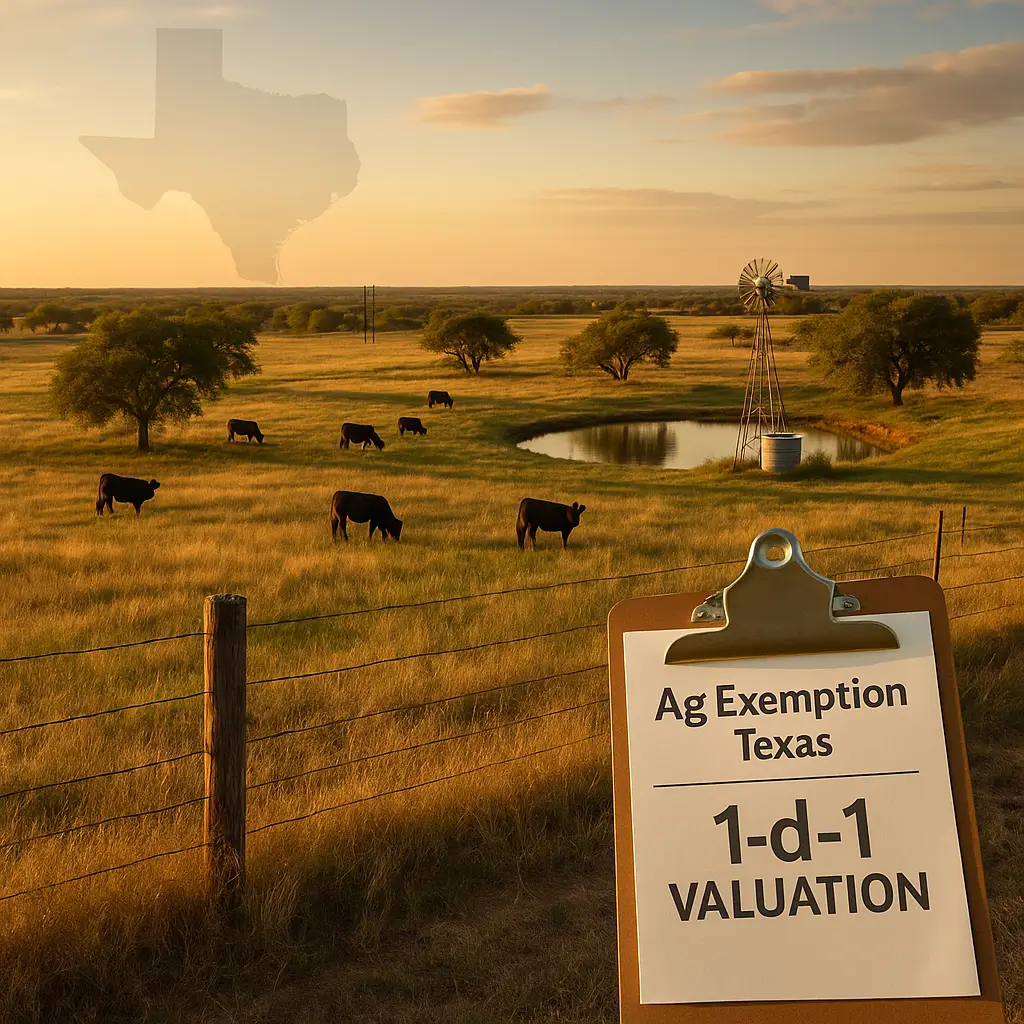
The Texas agricultural exemption allows you to significantly reduce your property taxes by assessing land based on its agricultural productivity rather than its market value. This legitimate approach transforms a recurring cost into a competitive advantage, while protecting your cash flow and the long-term value of your asset. When properly structured, it benefits both large ranches and investors with 5 to 20 acres of land used for beekeeping, light grazing, or wildlife management. In Texas, where there is no personal income tax, this tax strategy is essential for controlling the total cost of land ownership.
This article was written by Thibaut Guéant, co-founder of LandQuire, which specializes in real estate investment in the United States. Our experts assist French-speaking investors with their U.S. land acquisition projects, from sourcing to tax structuring.
Follow LandQuire on LinkedIn “Easements & Buildability” Audit: Contact Us
How Does the Texas AG Exemption Work?
The Texas agricultural exemption falls under the special agricultural appraisal (also known as the 1-d-1 valuation). The County Appraisal District (CAD) calculates an agricultural use value based on productivity (grazing, hay, crops, wildlife), which is often 10 to 20 times lower than market value. Property tax bills can be reduced by 85 to 95 percent, especially in suburban counties where prices are rising.
The basis for this stems from the Texas Constitution (Art. 8, Sec. 1-d-1) and the Texas Property Tax Code, which protect agricultural use from urbanization. The CADs apply updated productivity schedules by category (native vs. improved pasture, hay, crops, timber, wildlife). Each county publishes local guidelines (minimum size, livestock densities, number of beehives, proof of use). This special assessment method does not constitute a total exemption but rather a radical change in the tax base.
Eligible Agricultural Activities
Livestock farming is the most common qualifying activity: cattle, sheep, goats, and horses, based on animal-per-acre ratios set by each county. Cash crops include grains, hay, cotton, vegetables, vineyards, and horticulture. Beekeeping is a viable option for 5 to 20 acres, with a locally mandated number of hives per acre.Wildlife management requires an approved plan detailing habitat, shelter, water, and invasive species control.
Commercial forestry and timber production also qualify. Each type of agriculture offers specific advantages depending on your land, resources, and investment goals. Official references: Texas Parks & Wildlife, Wildlife Management, and Texas A&M AgriLife Extension. The land must be used for profit—even if modest—to meet the criterion of bona fide agricultural use.
Eligibility Criteria in Texas
The minimum size varies widely: typically 10 to 20 acres for grazing/hay, though less than 10 acres is possible for beekeeping or wildlife management on existing 1-d-1 land undergoing conversion. Rural counties sometimes accept 10 acres for cattle raising, while suburban counties require 15 to 20 acres for the same activity. This variability reflects regional grazing capacities and local climatic conditions.
The duration of use is a major criterion: generally 5 out of 7 years of qualifying agricultural use. This requirement guarantees a genuine commitment to agriculture rather than opportunistic tax optimization. The main use must be agricultural, not a hobby. Operational consistency (fences, water points, veterinary invoices, leases, hay receipts, dated photos, records) must tell the same story to the assessing authorities.
Easements in Texas can complicate your eligibility if they restrict the agricultural use of certain portions of your property. Access, utility, and drainage easements reduce the eligible area when agricultural use becomes secondary. A preliminary analysis of land restrictions helps you avoid unpleasant surprises when you apply.
Steps to Obtain "Frictionless" Status
First check the land's history with the County Appraisal District: is it already in 1-d-1 valuation? Collect Form 50-129 or 50-144, depending on the intended use. Assemble a convincing file that includes a description of the activity, dated photos, agricultural leases, receipts for livestock or seed purchases, and detailed records. This documentation strengthens your credibility with tax assessors.
Submit your application by April 30 in most counties (some accept applications until May 1). Meeting these deadlines maximizes your chances of approval and prevents you from losing an entire tax year. Latecomers can submit late applications until May 15, but may face potential penalties. Useful reference: Comptroller, Property Tax Forms.
Prepare for on-site inspections: field visits by county assessors are frequent, especially for new applications requiring field validation. Appraisal districts have a statutory period in which to review your application. In the event of refusal, you have 30 days to contest the decision before the Appraisal Review Board. This appeal procedure protects your rights and clarifies any misunderstandings.
Follow LandQuire on LinkedIn | Texas Field Specialist: Contact Us
Actual Tax Savings: Examples with Specific Figures
Real-world example: 50 acres valued at $500,000 on the open market. Agricultural assessment: $25,000. Combined local tax rate of 2.5%. Without the agricultural exemption: $12,500 per year. With the exemption: $625 per year. Savings: $11,875 per year, or $118,750 over 10 years (excluding inflation and rate adjustments). This cash flow enhances your infrastructure investments (fences, water), creates a buffer against volatility, and boosts your overall return.
An 82-acre residential lot in a growth corridor (e.g., Seguin near I-10) assessed at $800,000 could be reassessed at $40,000 as agricultural land. With a tax rate of 2.8%, annual property taxes would drop from $22,400 to $1,120. Over a 15-year holding period, this savings would amount to $319,200 in retained cash, significantly improving the profitability of the real estate investment.
Savings accumulate year after year, creating a significant financial advantage over the course of ownership. Texas’s expanding real estate markets amplify these benefits over time. This increased financial flexibility allows you to fund improvements to your property, build an emergency fund, or reinvest in the purchase of additional land, thereby optimizing your real estate portfolio.
What the Texas AG Exemption Is Not
The agricultural exemption is not a total exemption from property taxes. You still pay taxes, but they are calculated based on a significantly lower assessed value. Non-agricultural buildings and improvements continue to be taxed separately at their market value. This important distinction helps avoid misunderstandings regarding your ongoing tax obligations during the agricultural exemption period.
This is not a right acquired for life. Continued agricultural use is reviewed regularly by the County Appraisal District, usually every three to five years. These periodic reviews include on-site inspections and examination of your farm records. Substantial changes in your activities require notification to the Appraisal District and potentially a new application.
It's not a shield against existing legal constraints. Texas easements and mineral rights influence your eligibility and qualifying acreage. In-depth due diligence on these legal aspects becomes essential before the acquisition to secure your agricultural tax strategy for the long term.
Rollback Tax: Anticipating the Change in Use
A change to non-agricultural use triggers the rollback tax (recovery of taxes from the previous 3 to 5 years, depending on the county, including 7% annual interest). This tax penalty represents the difference between the taxes actually paid and those that would have been due without the agricultural exemption. The rollback tax protects the integrity of the system by discouraging abuse and maintains a balance between tax benefits and a genuine commitment to farming.
Triggering examples: residential subdivision, commercial use, abandonment of agricultural activity, significant non-agricultural infrastructure right-of-way. Transfers of ownership do not necessarily trigger a rollback if the new owner maintains compliant agricultural use. The construction of a principal residence (homestead) on a small part of the property generally does not trigger rollback tax on the remaining portion retaining agricultural use.
The winning strategy: integrate rollback into your business plan (land development), or sequence the project (maintain pasture/hay until the final regulatory milestone). Some investors consciously accept rollback tax during profitable development, turning it into a simple planned investment cost rather than an unpleasant tax surprise. This calculated approach optimizes the timing of land conversion.
Need advice before reclassifying? Contact us to avoid an unexpected penalty.
Easements and Mining Rights: Key Interactions to Be Aware Of
Easements (access, utilities, drainage) sometimes restrict areas of agricultural activity and reduce the qualifying area if agricultural use becomes secondary. Easement crossings can fragment your land, complicating consistent management of livestock or crops. Public utility easements take up space and may prevent certain agricultural activities on the portions concerned.
Easements in Texas: Understanding everything before buying land
Mining rights in Texas are an often-overlooked factor. Oil and gas production does not preclude a property from being eligible for the agricultural assessment if agricultural use remains the primary use. However, drilling pads and extraction infrastructure may exclude significant areas from your agricultural assessment. Assessment districts will adjust your exemption accordingly, excluding the areas directly affected.
Income generated from mining rights does not affect your agricultural status based on surface activities. You can legitimately benefit from both the tax savings of the exemption and oil or gas royalties. This combination creates a diversified income strategy that maximizes the overall profitability of your Texas land investment.
Maintaining Your Status Over Time
Keep meticulous farm diaries: seeding dates, veterinary charges, hay/gas invoices, seasonal photos. These documents demonstrate your ongoing commitment to productive agriculture and facilitate exemption renewals. Visible infrastructure reinforces your credibility: well-maintained fences, water access, portable shelters, feeding areas. Tax assessors verify these elements during on-site inspections.
Avoid any years with no harvest: plan your feeding during the dry season (hay harvesting, supplemental feeding). Minor changes to your activities generally do not affect your status, but substantial changes must be reported. A controlled transition (from livestock ranching to wildlife management) requires a plan approved by the Texas Parks & Wildlife Department. For property transfers: provide the buyer with the complete set of documentation to ensure continuity without any rollback.
Ongoing compliance provides peace of mind and protects your long-term tax savings. Unintentional violations resulting from a misunderstanding of the requirements can be corrected if identified quickly. Proactive communication with your assessment district prevents problems before they threaten your agricultural exemption status.
Maintenance Audit / Pivot Wildlife: Contact Us
Differences Among Texas Counties: Thinking Locally
Austin metro (Travis, Williamson): higher thresholds, stricter controls, rigorous approval process. Comal, Guadalupe, Hays: numerous mixed ranches, frequent beekeeping, appraisers familiar with small operations. Hill Country: extensive grazing combined with wildlife, relief and water availability structuring animal ratios. West Texas: lower animal/acre ratios (arid climate), requirements adapted to recurrent drought conditions.
Each Texas county applies the general principles while adapting certain requirements to local conditions. Minimum acreage thresholds vary: some rural counties accept 10 acres for cattle ranching, while suburban counties require 15 to 20 acres. The livestock-to-acre ratios also differ: a county in West Texas may require only one head of cattle per 20 acres, while a county in East Texas might allow one head of cattle per five acres.
This variability influences your strategic investment decisions. Some investors deliberately target counties with more accommodating requirements, thereby maximizing their potential tax savings. A good practice: Call the targeted CAD before the LOI or closing to fine-tune your intended use plan and ensure eligibility. This geographically informed approach maximizes the return on investment of your Texas real estate strategy.
Optimization strategies for investors
Target an existing 1-d-1 history: regaining status is much smoother than a first-time application requiring five years of establishment. Correctly size the animal load: it must be credible for the area and the local biome. Tax assessors scrutinize the consistency between the size of your operation and the intensity of your farming activities.
Establish leases with local ranchers: grazing in exchange for maintenance (win-win arrangement). These formalized agreements reinforce the argument that use constitutes a profit-making enterprise. Beekeeping for small areas: respect the county's hive density, document your apiary with photos and production records. Wildlife management: a premium option for wooded or hilly land with a long-term vision and "green" valuation on resale.
Manage the timing of your entitlement: maintain the 1-d-1 status until the final administrative milestones prior to development. Consult professionals specializing in Texas property taxes to refine your overall strategy. Agricultural appraisal experts identify opportunities specific to your situation, anticipate potential challenges, and structure your activities to maximize your tax benefits while strictly complying with regulations.
Beekeeping: A Solution for Small Areas
Beekeeping has become the most accessible option for investors who own 5 to 20 acres of land. This activity requires far less day-to-day management and infrastructure than traditional cattle ranching. The basic requirements are manageable: a minimum of 5 acres, typically six hives for the first 5 acres, with one additional hive for every 2.5 acres thereafter, depending on the county.
You must prove that the beehives are maintained and used for production (honey) or pollination for more than 50% of the year. Many investors choose to lease their land to professional beekeepers who manage the hives, ensuring that the status is maintained without daily intervention. This approach often generates a small rental income, which strengthens the argument that the operation is for-profit.
Assessment districts require documentary evidence: beekeeping lease agreements, invoices for equipment purchases, dated photos of active hives, and honey production records. This approach also offers environmental benefits (pollination) and can be integrated into a land conservation strategy while generating substantial tax savings.
Case study: the trajectory of a peri-urban ranch
Profile: 82 acres near a growth corridor (Seguin, I-10), with a market value of $850,000. Action: light grazing (15 head of cattle), annual commercial hay harvest, fences rebuilt to meet local standards, and efficient watering systems. Quarterly photo reports and formalized internal leases reinforce operational credibility.
Result: Agricultural exemption retained, assessed value set at $42,000, property taxes reduced by 92% (from $23,800 to $1,050 annually). Strategic upside: After 24 months, the wildlife plan was approved by Texas Parks & Wildlife (improved habitats, shelters built, additional water sources), creating significant “green” value at resale and stabilizing the tax base during the entitlement phase.
This case illustrates how agricultural appraisal transforms “expensive” land into a high-performing asset. The investor reinvested the tax savings in infrastructure improvements ($15,000 in fencing, $8,000 in water systems), increasing the land’s value while keeping tax liabilities to a minimum. This strategic approach simultaneously optimizes cash flow, asset valuation, and regulatory compliance.
Ag exemption Texas and estate planning
The exemption fits naturally into the inheritance process: heirs retain 1-d-1 status if they keep the qualifying agricultural use. Intra-family transfers generally involve no rollback tax if the farming activity persists. This continuity protects heirs from sudden tax burdens at the time of succession, facilitating the intergenerational transmission of land assets.
Plan ahead for heirs who do not farm the land: without agricultural use, the rollback will apply to the preceding three to five years. This is why it is important to have a land trust or a farm lease already in place to ensure continuity. Well-drafted wills and legal structures reinforce this protection and clarify the obligations to maintain agricultural use for future generations.
Include the issue of agricultural valuation in your estate planning discussions with your legal and tax advisors. This comprehensive approach ensures that your heirs understand the obligations and opportunities associated with maintaining the exemption. Experts can structure arrangements (perpetual leases, agricultural trusts) that preserve the favorable tax status across generations.
Official resources and specialized support
The Texas Comptroller’s resources are your starting point: detailed guides, downloadable forms, and up-to-date agricultural appraisal manuals. Your local County Appraisal District is an invaluable resource for specific questions. These offices employ agricultural specialists who are thoroughly familiar with local practices and requirements. Schedule a preliminary consultation before submitting your application.
Agricultural organizations such as the Texas Farm Bureau and Texas A&M AgriLife Extension offer educational programs and workshops on the agricultural tax exemption. These organizations provide unbiased information to help landowners understand the agricultural tax system.
For French-speaking investors, specialized guidance is particularly valuable. LandQuire guides international buyers through the intricacies of Texas real estate investment, including tax optimization through the agricultural exemption. Our bilingual expertise eliminates the language and cultural barriers that often complicate cross-border real estate transactions. We structure your acquisitions to maximize tax benefits from the moment of closing.
FAQ: AG Exemption in Texas
What is the minimum number of acres required for the Texas agricultural exemption?
Often 10 to 20 acres for grazing or hay. Beekeeping can qualify landowners for access with as little as 5 to 20 acres, depending on the county. Requirements vary greatly between rural and suburban counties.
Can you combine the agricultural exemption with mining income?
Yes, provided that agricultural use remains the predominant land use in the area. Areas occupied by oil platforms and oil infrastructure may be excluded from agricultural eligibility by the CAD.
Do I have to reapply every year?
No. The status is maintained through continuous use and periodic audits by the CAD. Proactively update your supporting documentation to facilitate reviews.
Does the rollback tax apply at the time of sale?
The sale itself does not automatically trigger a rollback. It is the change in land use that triggers it. If the buyer continues agricultural operations, the status remains unchanged without penalty.
Key Takeaway: A tax strategy to implement from the moment of acquisition
The Texas agricultural exemption radically changes the tax assessment base: reductions of 85 to 95% on annual property taxes. Bona fide agricultural use and documented continuity of that use make all the difference between approval and denial. The rollback tax (3 to 5 years of back taxes plus interest) must be factored into your financial models whenever a change in intended use is planned.
County regulations, biomes, and easements influence eligibility and the eligible usable area. Wildlife management and beekeeping offer strategic entry points for small parcels (5 to 20 acres). Careful documentation and ongoing compliance protect your long-term tax savings. Incorporate this strategy from the moment of acquisition to maximize your return on investment.
Agricultural valuation is not merely a “tax break”: it is a full-fledged tax structure that protects your cash flow, stabilizes your recurring expenses, and enhances resale value. Its success depends on credible agricultural use, rigorous documentation, and geographic management at the county level. The savings generated transform your real estate investment into a high-performing and sustainable asset.
Incorporate the agricultural exemption at the time of purchase, and strategically align it with easements and mining rights, and you will transform “expensive” land into an optimized wealth-generating asset. This legitimate strategy requires expertise and vigilance. The cumulative financial benefits over decades more than justify the initial investment in time and administrative compliance.
Savvy investors understand that mastering Texas ag exemption is a decisive competitive advantage in the Texas land market. By combining substantial tax savings, operational flexibility and legal protection, you position your portfolio for sustained asset growth that is resilient in the face of economic cycles.
Would you like to confirm your eligibility, develop a wildlife plan, or ensure your subdivision timeline stays on track? Contact us
Further information
- Easements in Texas: Understanding everything before buying land
- Texas mining rights: what every buyer needs to check
- Wildlife Management Plan: Getting the Most Out of Your Texas Land
- Why Texas is an ideal place to invest in real estate
- Real Estate Due Diligence: The Complete Checklist
- Texas Comptroller, Agricultural Appraisal
- TPWD, Wildlife Management
- Texas A&M AgriLife Extension
Author: Thibaut Guéant, co-founder of LandQuire. Real estate: Texas, Florida, Arizona. Follow LandQuire on LinkedIn
Disclaimer: The information presented in this article is for educational purposes only and does not constitute personalized tax, legal, or financial advice. The rules governing agricultural valuation vary by Texas county and are subject to change. Consult a tax professional or attorney specializing in Texas law before making any investment decisions or changing the use of your property.