How to Source Off-Market Land in the U.S. with Strong Development Potential

The challenge for investors: securing the best real estate opportunities before the market does
Most international real estate investors face the same obstacle: the best property opportunities in the United States are never listed publicly. They are negotiated privately among landowners, developers, and well-connected intermediaries long before an ad appears on a real estate portal.
This lack of access represents a real bottleneck. Properties entering the open market have already been evaluated by dozens of potential buyers, meaning that prices already reflect a significant portion of the value that can be created. For an investor based in Europe, the Middle East, or Latin America, finding these off-market deals requires not only available capital, but also an established network, local expertise, and a nuanced understanding of zoning regulations.
Investors who manage to overcome this challenge gain access to much higher margins. We have found that this barrier to entry is precisely the opportunity we capitalize on at LandQuire.
Why off-market properties offer IRRs of over 20–35%
Off-market properties generate institutional-grade returns for one simple reason: less competition means lower entry costs and greater control over value creation.
When a parcel of land is sold on the open market, the buyer typically pays a price that already reflects some of the identified development potential. Experienced real estate developers have scouted the site, assessed its subdivision potential, and evaluated its zoning possibilities. The negotiated price already factors in these prospects.
On the other hand, land purchased off-market—directly from an owner who is not actively seeking to sell—can be acquired at a significantly lower price. This price difference, combined with the systematic creation of value through land rights, generates the 20% to 35% IRR returns that we consistently target.
Consider this scenario: a 10-hectare plot of land purchased for $800,000 without zoning for residential development. Once the subdivision plan is approved and entitlements are secured, that same land can be resold for $1.8 million to $2.2 million to a developer ready to build. The IRR depends on the length of the entitlement process, but a 24-month cycle easily yields a 30% annual return, with no exposure to construction or interest rate risks.
The three key criteria for identifying land with strong development potential
Not all off-market land is created equal. To select a parcel of land with strong development potential, we apply three fundamental criteria.
Criterion 1: Location within a growth intersection zone
The land must be located in an area where residential demand is growing rapidly and where local governments support urban expansion. Texas and Florida dominate our portfolio precisely because these states are experiencing sustained population growth, more flexible zoning regulations, and a political culture that is favorable to development.
Within these states, we target micro-markets on the immediate outskirts of expanding urban centers, where land is still affordable but future demand is highly likely.
Criterion 2: Clear potential for rezoning
A piece of land is worthless without proper zoning. We first assess whether the current zoning allows for residential use or whether a rezoning application is necessary. Current agricultural or commercial zoning that can reasonably be rezoned to multi-family residential creates a concrete development opportunity.
This assessment is based on an analysis of municipal master plans, historical trends in rezoning approvals, and preliminary exploratory discussions with local zoning authorities. We never secure a property on the assumption that zoning approval will be granted; we first verify its feasibility.
Criterion 3: Existing infrastructure and regulatory compliance
The property must have access to public roads, water, sewer, and electricity services, either directly or through a reasonably feasible extension. A property that is isolated or requires massive infrastructure investments undermines the feasibility of the project.
In addition, we assess environmental constraints, flood zones, and conservation requirements. A site with significant obstacles (federal flood zones, protected habitats, extensive wetlands) may see its development costs skyrocket or its potential significantly reduced.
How our proprietary sourcing approach gives us access to the 60% of transactions that are never listed
We have built a proprietary sourcing system that gives us access to a pool of land that traditional investors never see. Approximately 60% of land transactions in the United States are conducted off-market, and this percentage is even higher for development land.
Our approach is based on three pillars: geospatial data, social networks, and predictive analytics.
First, we use proprietary databases that cross-reference land registry data, demographic information, municipal development plans, and transaction histories. This dataset allows us to identify land that has not yet been acquired in areas poised for growth.
Second, we maintain an active network of intermediaries, specialized brokers, and property owners in key markets. These relationships, built on years of transparent partnerships and reliable transactions, alert us when an owner is considering selling, often before the property is formally listed for sale.
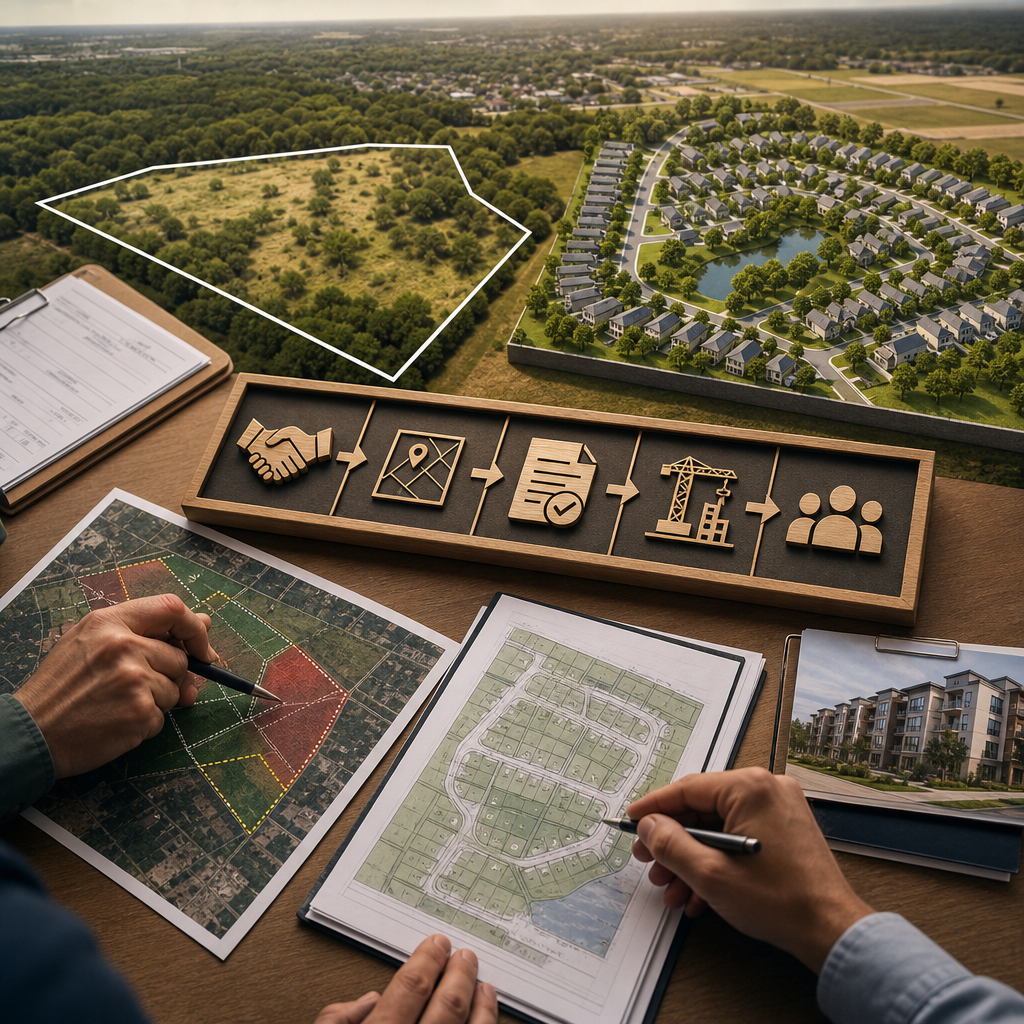
Third, we use predictive analytics to identify which properties are likely to receive zoning reclassification approval or see increased development interest in the near future. This approach allows us to position ourselves as early buyers before the value is widely recognized.
The result: we regularly acquire off-market properties at favorable purchase prices, which we then secure through title clearance to maximize their value prior to resale.
The LandQuire Strategy: From Acquisition and Zoning to Sale to Developers
Our business model is designed to maximize the value created by entitlement while minimizing risk and project duration.
As soon as an off-market property is identified and acquired, we immediately begin the land acquisition process. This involves rigorous land due diligence, including topographic surveys, geotechnical analyses, market studies, and environmental assessments. This phase typically lasts 2 to 4 months and confirms that the property indeed meets our three criteria.
Next, we develop an optimal residential subdivision plan, designed in collaboration with urban planners and development experts. This plan takes into account regulatory constraints, local market preferences, and infrastructure costs to maximize the number of buildable lots while ensuring compliance.
At the same time, we are initiating the zoning approval process. This includes administrative submissions, meetings with local authorities, plan revisions, and potential negotiations. Thanks to our expertise and established relationships, this process typically takes 12 to 20 months—significantly faster than for applications that lack proper preparation.
Once all the necessary approvals have been secured, the land is sold to developers ready to build. These developers buy precisely for this reason: the land is now “shovel-ready,” with all regulatory risks eliminated. This justifies a premium price, which we capture as our return.
Case Study: Turning an Undervalued Property into a Development Project with Over 130 Successful Projects
Our 130 completed projects since 2021 demonstrate the effectiveness of this strategy. A representative example illustrates how it works in practice.
An 8-hectare parcel of land on the outskirts of Tampa, Florida, was purchased from a farm owner for $950,000. At the time, the land was zoned for agricultural use and showed no apparent potential for residential development. However, our analysis of population growth indicated that the area would see a significant increase in housing demand over the next 24 months.
Our team developed a subdivision plan for 45 residential lots, in accordance with local municipal codes and infrastructure capabilities. The approval process took 18 months, including three rounds of revisions and a public hearing before the zoning commission.
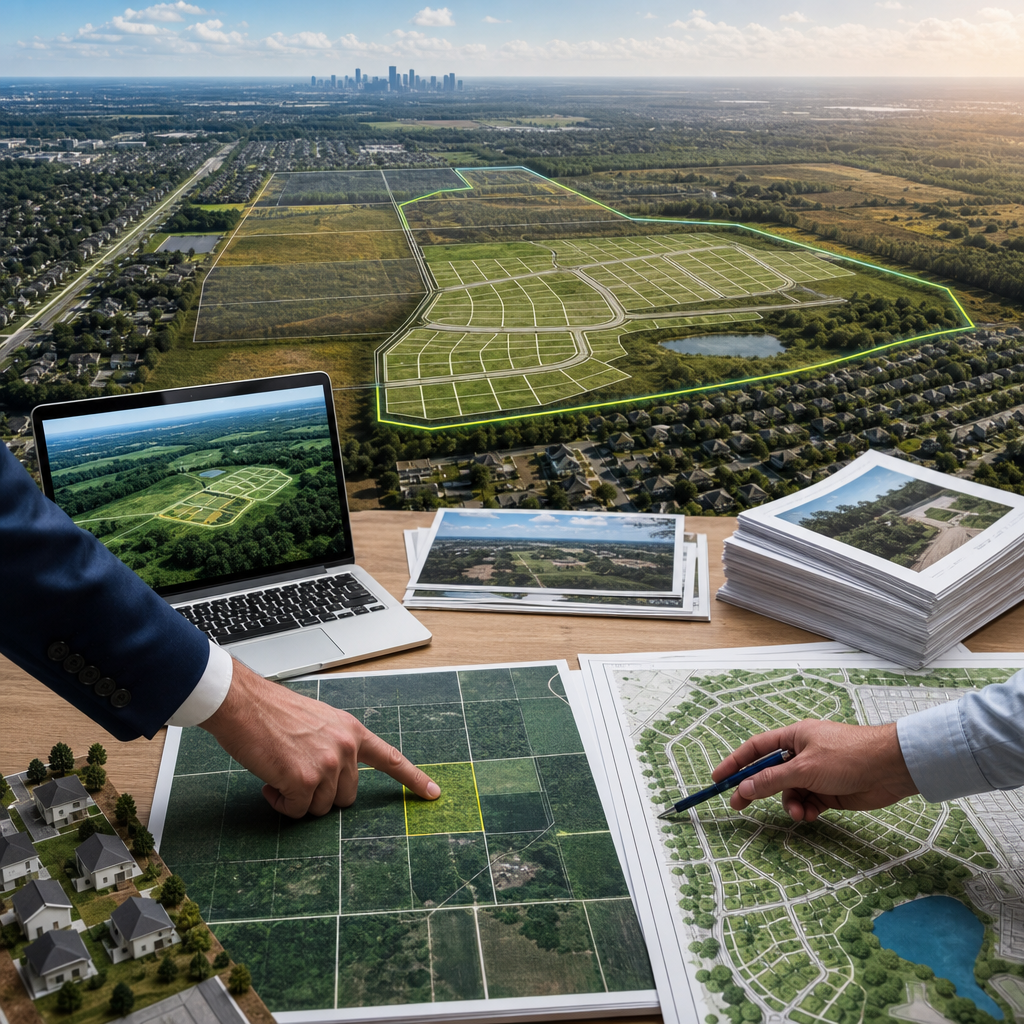
Once the necessary approvals were obtained, the land was sold to a regional developer for $2.3 million. The return on investment represented an IRR of 32% over 20 months, with no construction or financing risk.
This project embodies our value proposition: identifying undervalued land, systematically creating value through development rights, and selling to a developer. Our 130 completed projects have all followed this same model, with a 100% success rate in securing development rights.
Why international investors choose our platform for off-market land
High-net-worth investors based in Europe, the Middle East, and Latin America choose LandQuire for several structural reasons.
First, we provide access to off-market transactions that only a player with an established local network and regulatory expertise can offer. An individual international investor simply cannot build the same network or master the nuances of each local jurisdiction in a short period of time.
Second, our model eliminates the complications that investors fear: no property management, no exposure to interest rates (we do not use debt financing), and no direct interaction with regulators. We handle these complexities, and our investors earn institutional-grade returns without the operational friction.
Third, we structure our investments as pure equity, which means predictable capital and returns that are tied to the project’s success. Our 600 global investors appreciate this simplicity and transparency.
Finally, our target states (Texas and Florida) offer regulatory stability, robust population growth, and favorable tax policies, making these markets attractive for international USD diversification.
Start investing in U.S. real estate with our curated portfolios
If you are a high-net-worth investor with at least $100,000 in available capital and an investment horizon of 18 to 36 months, our curated portfolios of off-market properties offer direct access.
Our process is designed to be simple: you explore our available projects, review the entitlement documentation and market analysis, and decide whether to participate. We handle the acquisition, zoning, approvals, and resale. You receive your target return without getting involved in the operational details.
To get started, visit our platform and browse our current portfolios. We also offer a free consultation with our real estate sourcing experts to discuss your investment goals and how our approach can align with your wealth management strategy.
The best off-market land parcels with development potential will never be publicly marketed. They are accessed by investors who have built systems to find them. At LandQuire, we’ve been doing exactly that for five years. Your next investment opportunity in U.S. land is waiting.