Real Estate Investment Trust (REIT): Definition, How It Works, and Alternatives

The acronym REIT comes up in almost every discussion of publicly traded real estate, often without being clearly defined. A Real Estate Investment Trust is a company that owns, operates, or finances income-producing real estate assets, and whose shares are most often traded on a stock exchange. Originating in the United States in 1960, the model has spread worldwide, even to France’s SIICs.
This guide covers the basics: the exact definition of a REIT, how it works, the different types, its tax treatment, ways to invest in it from France, and a comparison with other real estate investment vehicles (SCPI, SIIC, OPCI) and with direct real estate investment, which is based on the opposite approach.
What is a REIT (Real Estate Investment Trust)?
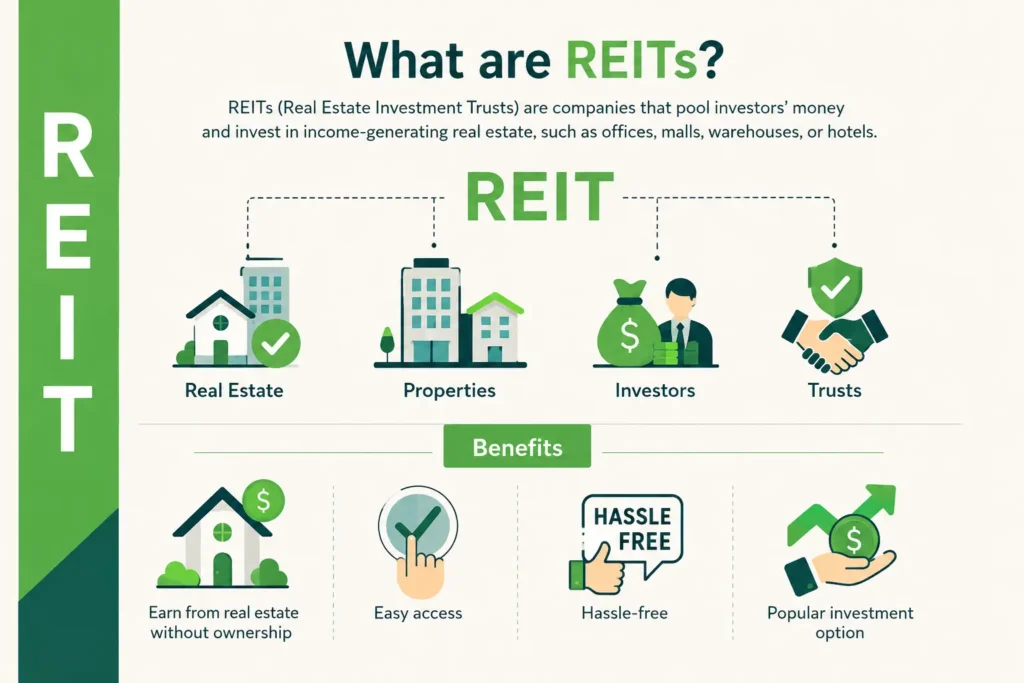
A REIT (Real Estate Investment Trust) is a company that owns, operates, or finances income-producing real estate and distributes most of that income to its shareholders in the form of dividends. In the vast majority of cases, a REIT is publicly traded: any investor can buy shares in it, just as they would buy shares in Apple or TotalEnergies.
The concept originated in the United States in 1960, when the U.S. Congress created this legal status to allow individuals to access income from commercial real estate, which had previously been reserved for the ultra-wealthy and institutional investors. The scale it has reached since then is a testament to its success: according to Nareit (National Association of Real Estate Investment Trusts), the industry’s leading organization, U.S. REITs hold more than $4.5 trillion in gross assets and some 570,000 properties across the country, with publicly traded REITs alone boasting a market capitalization exceeding $1.4 trillion. Also according to Nareit, approximately 170 million Americans live in households that invest in REITs, most often through retirement savings plans (401(k), IRA, pension funds).
In French, these are referred to as “listed real estate companies” or “listed real estate investment funds.” The closest equivalent in French law is the SIIC (listed real estate investment company), sometimes called a “French REIT.” The generic term FPI (real estate investment fund), on the other hand, refers to another category of vehicles—unlisted ones.
Key takeaway: A real estate investment trust (REIT) is a real estate company—usually publicly traded—that generates income from the rental income of its portfolio and distributes most of its profits to its shareholders. It is the most liquid way to gain exposure to real estate, but it is also the most closely correlated with the stock markets.
How does a REIT work?
A REIT is a publicly traded company that owns a portfolio of income-producing real estate assets, such as offices, retail spaces, logistics warehouses, residential properties, hotels, clinics, or data centers. Its revenue comes from rent collected on these assets, to which capital gains may be added when a property is sold.
Simplified Diagram: A REIT's Revenue Flow
- Tenants pay rent on the properties in the portfolio (offices, retail spaces, warehouses, residential units, and data centers).
- The REIT collects this rental income and uses it to pay its operating expenses and debt.
- Virtually all of the taxable income is distributed to shareholders in the form of dividends.
- In exchange for this distribution, the company is exempt from corporate income tax on the distributed profits.
Mandatory Distribution of Earnings to Shareholders
This is the fundamental rule of the statute. In the United States, a REIT must distribute at least 90% of its taxable income to its shareholders in the form of dividends each year. It must also meet asset and income tests: at least 75% of its assets must be invested in real estate, and at least 75% of its gross income must come from real estate sources (rental income, mortgage interest), with a shareholder base of at least 100 shareholders (source: Nareit, U.S. federal tax framework).
This requirement explains why REITs are among the most consistent dividend-paying stocks on the market: distributions are not a matter of corporate policy, but rather a prerequisite for maintaining their legal status.
The tax regime: corporate income tax exemption in exchange for redistribution
REITs benefit from a pass-through tax regime: the company is exempt from corporate income tax at the entity level on the profits it distributes. The tax burden is shifted to the shareholder, who pays tax on the dividends received in accordance with their personal tax rate.
This arrangement (corporate income tax exemption in exchange for distributing nearly all profits) has a downside: a REIT retains few profits to self-finance its growth. To purchase new properties, it must regularly borrow or issue new shares, which makes it vulnerable to changes in interest rates.
Key points. A REIT operates on the basis of an exchange: the company distributes at least 90% of its taxable income as dividends and, in return, is exempt from corporate income tax on those amounts. The yield is real but variable: it depends on rental income, occupancy rates, and the cost of debt. Past performance is not indicative of future results.
The Different Types of REITs
The U.S. SEC traditionally classifies REITs based on two criteria: the nature of their business (real estate ownership or mortgage financing) and their ownership structure (publicly traded or privately held). In addition, sector-specific specialization is becoming increasingly refined.
Equity REIT
The equity REIT is the dominant form: the company directly owns and manages properties, collects rent, and builds value in its portfolio over time. Most are specialized by sector: residential, retail and shopping centers, offices, logistics and warehouses, healthcare (clinics, nursing homes), hotels, self-storage, telecom towers, or data centers. This specialization allows investors to target a specific theme, such as e-commerce logistics or cloud infrastructure.
Mortgage REITs
A mortgage REIT does not own real estate: it finances real estate by granting mortgage loans or purchasing mortgage-backed securities (MBS). Its revenue comes from interest, and its performance depends primarily on the spread between its cost of funding and the yield on its loans. This profile is significantly more sensitive to interest rate fluctuations and leverage, and is therefore more volatile than an equity REIT.
Some companies combine the two approaches: these are known as hybrid REITs, which directly own real estate while also holding a portfolio of mortgage loans.
Publicly Traded REITs and Private REITs
Publicly traded REITs are traded continuously on the markets (NYSE, Nasdaq, European stock exchanges). There are also unlisted public REITs (registered with the regulator but not listed) and private REITs, which are reserved for certain qualified investors. The lack of a public listing reduces apparent volatility but eliminates daily liquidity, which is precisely the main advantage of listed REITs. For French-speaking individual investors, access in practice comes through listed REITs or funds that hold them.
Key takeaway: There are different types of REITs: equity REITs own properties and generate income from rent, while mortgage REITs finance real estate and generate income from interest. Each category is available in both publicly traded and privately held forms, with a distinct sector-specific focus.
REIT, SCPI, SIIC, OPCI: What Are the Differences?
For a French investor, the landscape of collective real estate investment vehicles can be confusing. Four acronyms dominate, each with its own rationale.
A SIIC is the French equivalent of a REIT: a publicly traded real estate investment company that, since 2003, has benefited from a comparable tax regime (corporate income tax exemption in exchange for an obligation to distribute 95% of rental income and 70% of capital gains from sales). Unibail-Rodamco-Westfield, Klépierre, Gecina, Covivio, and Icade are subject to this regime.
An SCPI (real estate investment trust) is an unlisted real estate investment vehicle: shares are bought and sold over-the-counter on a market organized by the management company. The value of the shares is based on real estate appraisals, not stock market prices, which reduces volatility but limits liquidity. For reference, the average distribution yield for SCPIs stood at 4.91% in 2025 (source: ASPIM, February 2026), an average figure that masks significant disparities and does not predict future distributions.
An OPCI (real estate collective investment vehicle) is a hybrid fund: while primarily invested in real estate, it maintains a portion of financial assets and cash to facilitate redemptions, at the cost of partial exposure to the financial markets. It is most commonly found as a unit-linked life insurance product.
| Criteria | REIT | SIIC | SCPI | OPCI |
|---|---|---|---|---|
| Stock Market Listing | Yes | Yes | No | No |
| Liquidity | Daily | Daily | Limited (unit market) | Periodic (regulated redemptions) |
| Correlation with the stock markets | Strong | Strong | Low | Average |
| Admission ticket | One share (a few dozen euros or dollars) | One share | A few hundred euros | A few hundred euros |
| Vehicle Tax Treatment | Corporate Income Tax Exemption in Exchange for a Distribution (U.S. Law) | Corporate Income Tax Exemption in Exchange for a Distribution (French Law) | Tax Transparency (Property Income) | Taxation Based on Budget Allocation |
| Cast | Mandatory (90% of the minimum taxable income) | Mandatory (95% of rent, 70% of capital gains) | Standard, not guaranteed | Variable |
| Accessible Envelopes (France) | CTO, sometimes life insurance through investment funds | CTO (excluded from the PEA since 2011) | Direct, Life Insurance | Life Insurance, Direct |
These four investment vehicles have one thing in common: the investor holds a share in a portfolio managed by a third party and receives rental income. They differ in terms of listing, liquidity, and sensitivity to financial markets.
Key takeaway: REITs and SIICs are publicly traded real estate companies that are liquid and track the stock market. SCPIs and OPCIs are unlisted funds that are less liquid but appear to be less volatile. None is “better” in absolute terms: the right choice depends on each individual’s profile, investment horizon, and risk tolerance.
How can I invest in a REIT from France?
Investing in a real estate investment trust from France is straightforward in practical terms. There are three main ways to do so.
Buying REIT shares on the stock market. A standard securities account (CTO) opened with an online broker or a bank (such as Boursorama, Trade Republic, Interactive Brokers, or any broker providing access to U.S. markets) allows you to buy REITs listed in New York as well as real estate investment trusts listed on Euronext Paris. The minimum investment is limited to the price of a single share, often a few dozen dollars. This is what makes REITs accessible to beginners or investors who want to start with 500 or 1,000 euros.
Invest through a REIT ETF. An ETF (exchange-traded fund) that tracks an index of publicly traded real estate investment trusts (REITs), such as the FTSE EPRA Nareit Developed Index, allows you to hold dozens or hundreds of REITs—diversified by sector and geographic region—in a single investment. This is the simplest way to diversify without having to analyze each individual company.
Take advantage of French tax frameworks. The CTO is the natural vehicle for REITs. Life insurance policies may provide access to unit-linked real estate funds or ETFs, depending on the policy terms. The PEA, on the other hand, is largely closed off to this asset class: SIICs have been excluded since October 2011, and non-European REITs—specifically U.S. REITs—are not eligible. Only certain synthetic ETFs with exposure to listed European real estate remain eligible for the PEA; this must be verified on a fund-by-fund basis.
From a tax perspective, dividends from a U.S. REIT received by a French tax resident are, in practice, subject to a U.S. withholding tax (15% for most individuals under the Franco-U.S. tax treaty), followed by French taxation (a flat-rate tax of 31.4% effective January 1, 2026, or a progressive tax rate upon election), with a tax credit to prevent double taxation. These rules are current as of this date and should be verified with a professional: our guide to international real estate investment taxation provides the general framework.
Before choosing a REIT or an ETF, here are a few key criteria to consider: the sector (logistics, healthcare, data centers, retail), the geographic region, the dividend yield and its consistency over time, the company’s debt level (LTV ratio), and the quality of the portfolio. Industry analysts, in fact, track FFO (funds from operations) rather than accounting net income to assess a real estate company’s actual distribution capacity.
Key takeaway: You can invest in a REIT from France starting at just a few dozen euros, either through a CTO (direct shares or REIT ETFs) or, depending on the policy, through a life insurance policy. The PEA remains virtually inaccessible for this asset class. You should consider the tax implications of foreign dividends before making a purchase.
Benefits and Risks of Investing in a REIT
Like any investment, a REIT presents a risk-return profile that must be evaluated objectively, without promises or lawsuits.
The benefits.
- Accessibility: The entry fee is limited to the price of one share; no down payment, no loan, no notary.
- Liquidity: Stocks sell on the stock market in a matter of seconds during trading hours, whereas a directly-owned property takes several months to sell.
- Regular dividends: The distribution requirement generates frequent cash flows—quarterly or even monthly for some U.S. companies.
- Diversification: A single REIT ETF provides exposure to hundreds of properties, tenants, and sectors across multiple countries.
- Transparency: publicly traded companies, audited financial statements, regulated disclosures.
Over the long term, this asset class has a well-documented track record: the CEM Benchmarking study cited by Nareit reports an average annual return of 9.7% for U.S. REITs between 1998 and 2022, compared with 7.7% for private real estate over the same period. This track record, however long it may be, remains past performance: it is in no way indicative of future results.
Risks.
- Stock Market Volatility: A REIT is still a stock. In the event of a market correction, its price falls along with the rest of the market, even if the value of the underlying properties has not changed.
- Interest rate sensitivity: Periods of rising interest rates increase the cost of debt for real estate companies and automatically weigh on their valuations, as the sector experienced during the monetary tightening of 2022–2023.
- Risk of capital loss: Neither the dividend nor the share price is guaranteed; a distribution may be reduced or suspended.
- Dependence on the real estate cycle: rental vacancies, rent renegotiations, and asset obsolescence (the post-COVID office is a prime example).
- Currency risk: For an investor holding euros, U.S. REITs add exposure to the dollar.
A REIT’s distribution rate is variable by nature: it reflects rental income and management decisions, not a contractual yield. Past performance, no matter how consistent, is not indicative of future results.
Key takeaway: REITs offer the most liquid and accessible real estate on the market, at the cost of dual exposure—to the real estate cycle and to the stock markets. It is precisely this correlation with the stock market that leads some investors to seek additional exposure to over-the-counter real estate.
International REIT Markets (U.S., U.K., Europe)
The U.S. market is the cradle and heart of the sector. With deep market liquidity, a history dating back to 1960, and highly specialized sectors, the United States accounts for the bulk of the global market capitalization of publicly traded real estate companies, under the umbrella of Nareit. The sector’s largest companies by market capitalization—such as Prologis (logistics), American Tower (telecom infrastructure), Equinix (data centers), and Simon Property Group (shopping centers)—are all U.S.-based.
The United Kingdom adopted its UK-REIT framework in 2007. Segro plc, a specialist in warehouses and logistics parks, is the best-known example: listed in London, it is also listed on Euronext Paris, a sign of the sector’s European integration.
In continental Europe, publicly traded real estate companies are tracked through the FTSE EPRA Nareit Index, which is broken down by region (notably Developed Europe) and serves as a benchmark for most real estate ETFs. France is represented in the index by its SIICs listed on Euronext Paris. The model has also been adopted in Asia, with Japanese J-REITs and Singaporean S-REITs.
For French-speaking investors, this international dimension is an asset: listed real estate allows them to look beyond the French market alone and gain exposure to international real estate markets—particularly the U.S. market—without holding assets there. Those who wish to go beyond stock market exposure may consider directreal estate investment in the U.S., which is subject to different rules.
Key takeaway: Real estate investment trusts (REITs) are a global standard: the United States (NAREIT), the United Kingdom (Segro plc), Europe (FTSE EPRA NAREIT, SIIC on Euronext), and Asia. A single ETF provides exposure to all of these international real estate markets in a single transaction.
REITs vs. Direct Real Estate Investment: Two Opposing Approaches
There is one question that few guides ask: What does a REIT shareholder actually receive, and what does he or she not receive?
A REIT purchases properties that have already been appraised at market value and compensates its shareholders through rent and long-term appreciation. Investors track the market, with all the liquidity and volatility that comes with it. Direct real estate investment follows the opposite approach: acquiring a real asset directly—if possible at a discount—creating value while holding the asset, and then realizing a capital gain upon resale. There is no stock market listing, no stock market beta, but illiquidity is accepted for the duration of the investment.
This is the model Landquire applies to U.S. real estate: acquiring undeveloped land at a discount, holding it for a short period during which the land rights can be enhanced (zoning, subdivision, access to utilities), and then reselling it at market price to individuals, developers, or builders. Each transaction is structured within a dedicated entity (an LLC formed as a joint venture between investors and Landquire), where the land serves as collateral: the capital is backed by a real asset, in a virtually debt-free model. Since 2021, the team has managed more than 130 land projects involving over 1,000 parcel acquisitions, with a typical cycle of 24 to 36 months, without rental management. This track record from past transactions is documented on our page featuring land projects already sold.
An example of a completed transaction: In Collier County, Florida, a property that was acquired and then resold within 127 days generated an observed return on investment of 37.11%. This performance, observed in a specific transaction under specific market conditions, is not representative: it is not indicative of future results and should not be extrapolated to other transactions.
The figures presented in this video (transactions executed, amounts raised, and no capital losses on closed transactions) reflect observed past performance, which is not indicative of future results. This type of investment is intended only for experienced investors.
Important note: The Landquire real estate investment is neither a REIT, nor an SIIC, nor an SCPI, nor an FIA. It is a direct acquisition backed by real assets, structured through a joint-venture LLC, and offered off-market on platforms reserved for accredited investors. The investment is illiquid for the duration of the transaction and involves a risk of capital loss.
| Criteria | REIT | Direct land ownership (Landquire model) |
|---|---|---|
| Nature | Shares of a publicly traded real estate company | Direct Acquisition of Land Through a Joint-Venture LLC |
| Quotation / Liquidity | Stock Market, Daily Liquidity | Unlisted, illiquid during the transaction |
| Correlation with the stock markets | Strong | Not correlated with the stock market |
| Performance Engine | Rental Income Distributed, Long-Term Appreciation | Discount at purchase, appreciation in land value, capital gain upon resale |
| Horizon | Unrestricted (long-term recommended) | Short cycle, 24 to 36 months per project |
| Rental Management | Covered by the company (tenants, buildings) | None (undeveloped land, no tenants) |
| Taxation | Dividends (withholding tax, PFU in France) | International Taxation of Capital Gains: A Topic to Discuss with an Advisor |
| Admission ticket | A stock or an ETF share | Raised, privately placed |
| Investor Profile | Any investor who is aware of the risks associated with stocks | For Experienced Investors Only |
The two approaches are not mutually exclusive: they address different needs. REITs provide liquidity and regular income, while direct real estate investment aims to create value upon entry and achieve decoupling from the stock market, at the cost of illiquidity. Details of the model are presented on our Landquire real estate investment page, and its geographic application is described on the pages covering real estate in Texas and Florida.
Key takeaway: A REIT provides access to the real estate market at market prices, using the stock market as a vehicle. Direct real estate investment seeks value ahead of the market: buying at a discount, adding value, and reselling. These are two opposing approaches that can potentially complement each other within a portfolio, provided you accept the constraints of each.
FAQ: Real Estate Investment Trust
What is a REIT, and how does it actually work?
A REIT (Real Estate Investment Trust) is a company—usually publicly traded—that owns or finances income-producing real estate assets. It collects rent and then distributes at least 90% of its taxable income to its shareholders in the form of dividends. In return, it is exempt from corporate income tax on distributed profits.
What is the difference between a REIT and an SCPI?
A REIT is publicly traded: its shares trade continuously, and their price tracks the stock markets. An SCPI is not publicly traded: its shares are traded on a market organized by the management company, at a value based on real estate appraisals. A REIT offers greater liquidity, while an SCPI exhibits less apparent volatility. Both remain exposed to the real estate cycle.
What are the tax benefits of a REIT?
The tax advantage applies at the corporate level: the REIT does not pay corporate income tax on the profits it distributes, which prevents double taxation before the dividend is paid. For shareholders residing in France, dividends remain subject to taxation (U.S. withholding tax followed by a flat-rate withholding tax of 31.4% since 2026, with a tax credit under the tax treaty; these rules should be verified with a professional).
How can I invest in a REIT from France?
Through a standard securities account with a brokerage firm or bank: purchase REIT shares directly (on the U.S. stock exchange or Euronext) or an ETF that tracks an index such as the FTSE EPRA Nareit. Some life insurance policies also offer real estate funds listed in unit-linked accounts. In practice, the PEA is not available for U.S. REITs or SIICs.
How can a beginner invest in a REIT?
The simplest approach is a diversified REIT ETF held in a brokerage account: a single line item, hundreds of real estate companies, and low fees. Before buying, it’s essential to understand that the value may decline, that dividends are not guaranteed, and that the recommended investment horizon is long-term.
Can you invest 1,000 euros in a REIT?
Yes. A REIT share or an ETF unit often costs a few dozen euros or dollars: 1,000 euros is enough to build a small, diversified position through an ETF. It’s one of the lowest entry barriers in real estate investing.