Article 150-0 B ter of the General Tax Code: Contribution-Sale and Reinvestment in 2026

Article 150-0 B ter of the General Tax Code (CGI) allows for the deferral of taxation on capital gains realized when a business owner contributes his or her company’s securities to a holding company that he or she controls. As of February 21, 2026, if the holding company sells these shares less than three years after the contribution, it must reinvest at least 70% of the proceeds from the sale within three years in an eligible business activity and hold that reinvestment for five years. This guide details how the contribution-and-sale scheme works, eligible reinvestments, changes in the 2026 Finance Act, and the role of real assets—such as U.S. real estate—in a post-sale wealth management strategy.
In a nutshell
- Contributing securities to a holding company that is subject to corporate income tax (IS) and controlled by the contributor allows the taxation of the capital gain on the contribution to be deferred, without any action required to obtain this deferral.
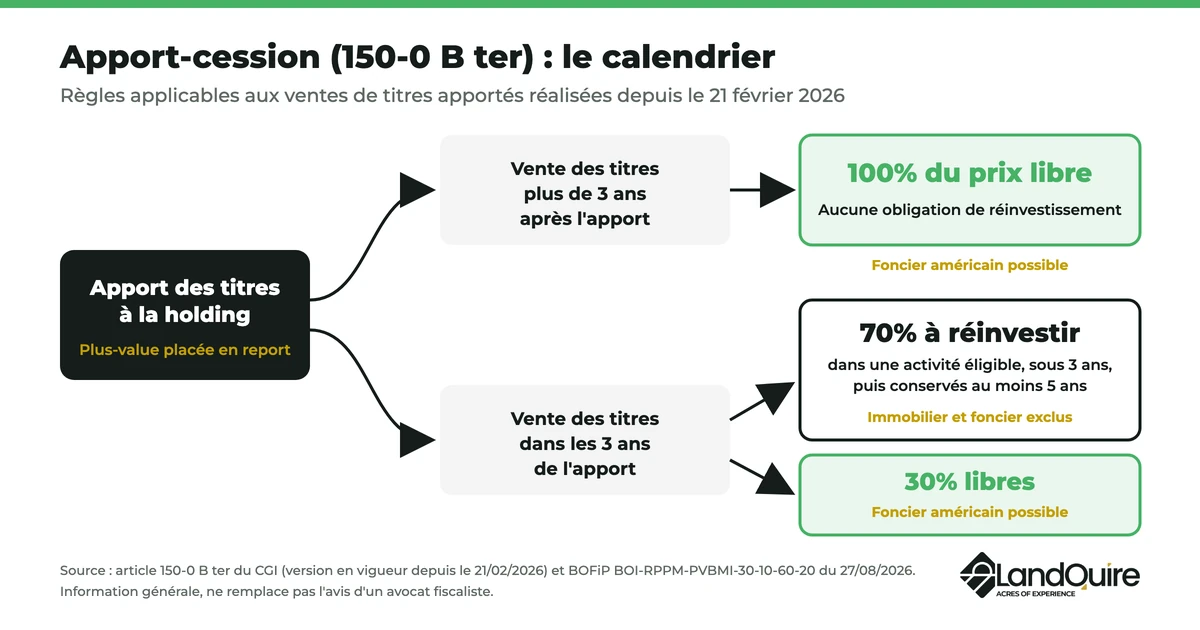
- If the holding company sells the contributed securities more than 3 years after the contribution, no reinvestment requirement applies.
- If she sells them within 3 years, she must reinvest at least 70% of the proceeds from the sale within 3 years.
- Reinvested assets or securities must be held for at least 5 years.
- Financial activities, the construction of buildings for sale or lease, and real estate activities are excluded from reinvestment.
- According to the BOFiP, these rules apply to dispositions of contributed securities made on or after February 21, 2026.
How Does the Contribution-in-Kind Work? The 3-Step Process
The contribution-and-transfer process consists of three steps, and each step has its own conditions:
- Step 1, the contribution: The executive contributes the securities (interests or shares) of his or her company to a holding company subject to corporate income tax, which he or she controls, and receives securities from that holding company in exchange. The capital gain on the contribution is calculated as of that date and then deferred for tax purposes.
- Step 2, the sale: The holding company sells the contributed securities to the buyer. Since the sale price is close to the contribution value, the capital gain realized is small.
- Step 3, reinvestment: If the sale occurs less than 3 years after the contribution, the holding company must reinvest at least 70% of the sale price in an eligible business activity. Otherwise, it may use the sale proceeds as it sees fit.
To qualify for the tax deferral, three conditions must be met; once met, the deferral applies automatically: the contribution is made in France or in a European Union member state (or a country with which France has an administrative assistance agreement), the company receiving the contribution is subject to corporate income tax, and the contributor controls that company. The relevant provision governing the tax deferral on capital gains from contributions isArticle 150-0 B ter of the General Tax Code (CGI) on Légifrance, as amended effective February 21, 2026.
When does the deferral of capital gains tax end?
The tax deferral expires—making the capital gain taxable—in the following cases:
- the sale, repurchase, redemption, or cancellation of the holding company’s securities received in exchange for the contribution;
- the sale of the securities contributed by the holding company within 3 years of the contribution, without a compliant reinvestment;
- failure to comply with the holding period for reinvested assets;
- the transfer of the contributor's tax residence outside of France.
Conversely, the deferred capital gain may be permanently eliminated:
- upon the death of the contributor;
- In the case of a gift of securities (shares or stock) of the holding company, if the donee who controls the company retains the securities for 6 years from the date of acquisition, or 11 years if the reinvestment was made through a fund.
A contribution-in-kind is therefore also a tool for business succession, provided that these holding periods are observed.
The reinvestment requirement: 70% of the proceeds from the sale within 3 years
It all depends on the time between the contribution and the resale of the securities. To continue benefiting from the deferral, the timing is just as important as the choice of reinvestments.
| Date of the sale by the holding company | Reinvestment Requirement | Use of the Sales Price |
|---|---|---|
| More than 3 years after the contribution | None | 100% free |
| Less than 3 years after the contribution | At least 70% in an eligible business within 3 years of the sale, with a 5-year holding period | 30% available |
In both cases, the tax deferral remains in effect as long as each condition is met.
Example with figures. In March 2026, an executive contributes his company’s securities, valued at €5,000,000, to his holding company. If the holding company sells them 18 months later for €5,000,000, it must reinvest at least €3,500,000 in an eligible business within 3 years of the sale and then hold that reinvestment for 5 years. The remaining €1,500,000 may be used at the holding company’s discretion. If the holding company waits more than three years to sell, the entire €5,000,000 is available for unrestricted use.
What types of reinvestments qualify under Article 150-0 B ter?
Reinvestment must finance an economic activity. Since the reform, this activity has been defined by reference to the tax reduction for investments in the capital of small and medium-sized enterprises (SMEs): it refers to an industrial, commercial, craft, agricultural, or professional activity, as defined inArticle 199 terdecies-0 A of the General Tax Code (CGI).
Proceeds from the sale can be reinvested in four ways:
- Funding for permanent operating assets allocated to the recipient company’s core business.
- The acquisition of a stake in one or more companies engaged in an eligible business activity, provided that the reinvestment gives the beneficiary company control over each of them.
- A cash subscription to the initial capital or to a capital increase of one or more companies engaged in an eligible business activity.
- The subscription of units or shares in private equity funds: FCPR, FPCI, SLP, SCR, or similar entities in another European Union or European Economic Area member state. The capital must be called within 5 years, and the fund’s assets must meet a 75% investment quota after 5 years.
With regard to points 2 and 3, the target company must be subject to corporate income tax (or an equivalent tax) and have its place of effective management in a member state of the European Union or the European Economic Area that has concluded an administrative assistance agreement with France, in accordance withArticle 150-0 D ter, Section II, Paragraph 3(c)of the General Tax Code (CGI).
| Jobs Eligible for the 70% Quota | Excluding reinvestments |
|---|---|
| Permanent operating assets of the beneficiary company | Financial Activities |
| Acquisition of control of an operating company (headquartered in the EU or the EEA) | Managing one's own investment portfolio (securities portfolio) |
| Investment in the capital of an operating company (headquartered in the EU or the EEA) | Construction of buildings for sale or rent |
| Shares in FCPRs, FPCIs, SLPs, or SCRs that meet their 75% quota | Real estate activities, including the management of its own real estate holdings |
The tax ruling explaining these conditions is published in the BOFiP, BOI-RPPM-PVBMI-30-10-60-20, in the version dated August 27, 2026.
How do I choose a fund that qualifies under Article 150-0 B ter?
Reinvestment through private equity funds is suitable for executives who do not wish to take over or manage a new company themselves. Four types of investment vehicles are permitted: venture capital mutual funds (FCPR), professional private equity funds (FPCI), limited partnerships (SLP), and venture capital companies (SCR), as well as similar entities from another member state of the European Union or the European Economic Area.
There are three requirements to check before signing up:
- The subscribed capital must be called within 5 years;
- At the end of a 5-year period beginning on the date the subscription agreement is signed, the fund’s assets must comply with a 75% investment quota, as defined by reference to Article 163 quinquies B of the CGI;
- The fund's units or shares must be held for at least 5 years, just like any reinvestment.
Compliance with the quota depends on the management company, not the investor: before signing, ask the management company how the fund complies with its quotas under the program. In the event of a donation of shares in the holding company, the required holding period for the donee is 11 years if the proceeds were reinvested through the fund, compared to 6 years otherwise.
What the 2026 Budget Act Changes
Law No. 2026-103 of February 19, 2026, on the 2026 Budget, tightened the rules governing the “contribution-sale” mechanism. According to the BOFiP (BOI-RPPM-PVBMI-30-10-60-20), these changes apply to sales of contributed securities occurring on or after February 21, 2026: it is the date of sale of the contributed securities that counts, not the date on which they were contributed.
| Before February 21, 2026 | Since February 21, 2026 | |
|---|---|---|
| Portion of the proceeds from the sale to be reinvested | 60% | 70% |
| Deadline for reinvestment | 2 years | 3 years |
| Retention of Reinvested Assets (Direct Reinvestment) | 12 months | 5 years |
| Eligible Activities | Commercial, industrial, craft, professional, agricultural, or financial | Industrial, commercial, craft, agricultural, or professional; financial and real estate activities excluded |
| Retention by the donee to eliminate the capital gain | 5 years (10 years through funds) | 6 years (11 years through funds) |
Sources: Article 150-0 B ter of the General Tax Code (CGI), versions in effect from December 31, 2023, through February 21, 2026, and subsequently as of February 21, 2026 (Légifrance); BOFiP of August 27, 2026.
The rationale behind the reform is clear: to limit tax deferral to long-term productive reinvestments and to close loopholes for purely wealth-preservation purposes. Any transaction prepared under the old rules must be reviewed before the securities are sold.
Contributing and Transferring Ownership or Directly Selling Your Business: Which Should You Choose?
For a business owner selling their company, a stock transfer isn’t always the best option. The right choice depends on what you plan to do with the sale proceeds and the tax treatment that applies to your situation.
| Direct Sale of Securities | Contribution-Transfer | |
|---|---|---|
| Taxation of Capital Gains | Immediate: The Year of the Sale | Postponed, subject to compliance with the conditions |
| Capital available for a new investment | Sales price minus tax | Full sale price, held by the holding company |
| Constraints | None | 70% must be reinvested within 3 years in the event of a quick sale |
| Transmission | Standard Gift or Inheritance Taxes | Capital gains are waived in the case of a gift followed by a 6-year holding period |
| Cost and Monitoring | Low | Holding company, valuation of the contribution, annual reporting requirements |
A stock transfer is particularly suitable for business owners who want to reinvest in another company or retain their capital as part of a long-term wealth management strategy. To finance a short-term personal project, a direct sale remains the simpler option.
Key Dates to Watch After the Contribution
- Date of contribution: The capital gain is calculated and carried forward. This is the starting point for the 3-year period.
- 3 years after the contribution: After this date, the holding company may sell the contributed securities without any obligation to reinvest the proceeds.
- Date of sale of the contributed securities: This date determines which rules apply (before or on or after February 21, 2026). If the sale occurs within 3 years of the contribution, it triggers a 3-year period during which 70% of the proceeds must be reinvested.
- 3 years after the sale: deadline for reinvestment.
- 5 years after each reinvestment: the end of the holding period for the reinvested assets, securities, or fund shares.
- Each year: Track the capital gain carried forward on your tax return for as long as the carryforward remains in effect.
- In the case of a gift: the donee must hold the securities for 6 years from the date of acquisition; 11 years if the proceeds are reinvested.
How can you ensure the security of a contribution-and-transfer transaction?
The deferral is valid as long as the terms and conditions of the program are met throughout its entire duration.
- The holding company: To defer taxation, it must be subject to corporate income tax and controlled by the contributor as of the date of the contribution, and it must issue securities in exchange for the securities contributed.
- Valuation of the contribution: The value of the contribution determines the amount of the capital gain carried forward. It must be documented, with the involvement of a contribution auditor in the cases provided for by law.
- Reporting requirements: Capital gains carried forward are reported in the year of the contribution and then tracked annually for as long as the carryforward period lasts. In the event of a sale within three years, the holding company agrees to reinvest and must provide documentation for each reinvestment.
- The timeline: Each step has a deadline; the date of sale of the contributed securities determines the applicable rules and the starting point of the 3-year period.
- Support: A tax attorney verifies the eligibility of reinvestments before any investment is made; a certified public accountant handles the bookkeeping and prepares the certificates; and a notary public handles the transfer.
If the provision is not properly implemented, the deferred tax becomes due in a single lump sum.
Contribution-Transfer and U.S. Real Estate: What's Possible
U.S. real estate cannot be used to meet the 70% reinvestment requirement. There are two reasons, each of which is sufficient on its own: real estate activities and the construction of buildings for sale are excluded, and the headquarters requirement is not met, since a target company must have its effective headquarters in the European Union or the European Economic Area.
It remains available from the unrestricted portion of the sale proceeds. Two categories are exempt from any eligibility requirements: the 30% that is unrestricted when the holding company sells within three years, and the entire sale price when it sells after that period. The company can freely invest these amounts in a wealth management strategy—for example, in real assets denominated in dollars to diversify its portfolio—alongside private equity and financial investments.
LandQuire is a U.S. company based in Miami, founded in 2021 by Romain Daniellou and Thibaut Guéant, that supports French-speaking investors. It purchases undeveloped land in the United States, primarily in Texas, obtains zoning permits, and then resells buildable lots to developers. Each parcel of land is held in full ownership by a company dedicated to the project. A transaction takes 24 to 36 months on average, with an investment of $100,000. LandQuire has completed 50 projects, 37 of which have been sold; completed transactions are listed on the page for sold land projects. This investment is illiquid until resale, is exposed to euro/dollar exchange rate fluctuations, and carries a risk of capital loss.
A French holding company that invests in the United States is subject to both U.S. and French law. The legal framework is detailed in our article on the France–U.S. tax treaty and in our guide to forming an LLC in the United States. For a post-acquisition project, you can consult with the LandQuire team regarding your real estate investment in the United States, in conjunction with your tax attorney.
Frequently Asked Questions About Section 150-0 B ter
What is Article 150-0 B ter of the CGI?
This is the section of the General Tax Code that allows for the deferral of taxation on capital gains realized upon the contribution of securities to a corporation subject to corporate income tax and controlled by the contributor. It sets forth the conditions for qualifying for the deferral, the events that terminate it, the reinvestment requirement, and the circumstances under which the capital gain is eliminated.
How does a stock contribution work?
The mechanism is simple: the business owner transfers his or her securities to a holding company, which defers taxation on the capital gain from the transfer. The holding company then sells the securities to the buyer. If this sale occurs within three years, the holding company must reinvest at least 70% of the proceeds from the sale in an eligible business.
How is the deferred capital gain calculated?
It represents the difference between the value of the securities on the date they are contributed and their acquisition cost. The amount is determined on that date and then reported annually on the tax return for as long as the tax deferral remains in effect. When the deferral ends, this amount becomes taxable; it is eliminated in the event of death or a gift followed by the required holding period.
What percentage of the sale price should be reinvested?
For sales made on or after February 21, 2026, at least 70% of the sale price must be reinvested within 3 years, and the reinvested assets must be held for at least 5 years. Prior to that date, the rule was 60% within 2 years. This is also referred to as the reinvestment requirement.
What types of reinvestments qualify under Article 150-0 B ter?
Financing the operating resources of the beneficiary company; acquiring control of or subscribing to the capital of operating companies headquartered in the European Union or the European Economic Area; and subscribing to units of FCPRs, FPCIs, SLPs, or SCRs that comply with their 75% quota.
Can you reinvest in real estate after a sale-and-purchase transaction?
Not under the 70% quota. Real estate activities, the construction of buildings for sale or rent, and the management of one’s own real estate assets are excluded. Real estate investments remain permissible within the unrestricted portion of the sale price.
What changes does the 2026 Finance Act bring to the “apport-cession” provision?
The quota increases from 60% to 70%, the reinvestment period from 2 to 3 years, the holding period for reinvested assets from 12 months to 5 years, and financial and real estate activities are excluded. The required holding period for the donee increases to 6 years (11 years through funds).
What happens if the holding company does not reinvest?
The provision no longer applies: the tax deferral ends, and the capital gain on the contribution becomes taxable in a single installment. The transaction may then cost more than a direct sale, since the structuring fees are forfeited.
Can you invest in U.S. real estate after a contribution-in-kind?
Yes, on the unrestricted portion: the 30% not subject to reinvestment if the holding company sells within 3 years, or the full purchase price if it sells after 3 years. U.S. real estate does not count toward the 70% quota.
This article is for informational purposes only and does not constitute tax advice or personalized investment advice. Have your transaction reviewed by a tax attorney. All investments involve the risk of capital loss.