Top 7 Security Mechanisms for Real Estate Investment Funds

1. Certified Third-Party Custody Accounts – The Foundation of Protection
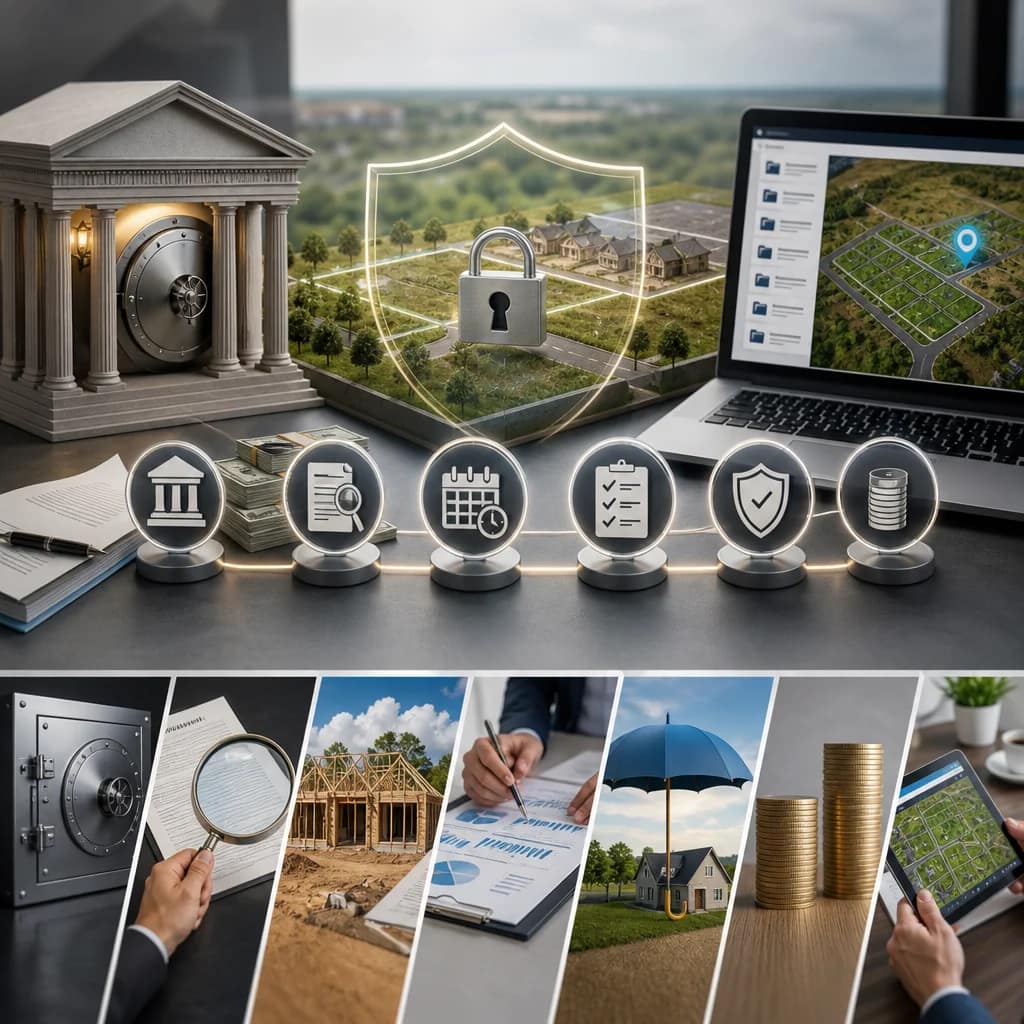
Investing in real estate abroad offers the opportunity to earn high returns, but it also raises legitimate concerns about capital protection. The international investors we serve—based in Europe, the Middle East, and Latin America—place the security of their funds at the heart of their decisions. This reality has shaped our approach at LandQuire: we have implemented seven distinct security mechanisms to ensure that your capital is protected at every stage of the investment cycle.
The deposit of funds is the first critical point of vulnerability. Your capital must never pass directly through our accounts or those of the project sponsor. Instead, we use escrow accounts managed by independent, certified third-party institutions that comply with U.S. federal standards.
Here’s how this mechanism works: as soon as you sign your investment agreement, your funds are deposited into an escrow account held by a licensed title company or a professional escrow agent. This intermediary is not affiliated with LandQuire, the developer, or any other party with a stake in the project. Its sole role is to hold your funds in accordance with written instructions and to release them only when the predefined conditions are met.
Concrete benefits:
- Your funds remain separate from the company's operating assets
- The custodial institution is insured and subject to strict compliance standards
- No party may access the funds without documented written consent
- In the event of a dispute, the funds remain frozen and protected
For example: If you invest 250,000 euros in a land subdivision project in Texas, that amount is immediately deposited into a third-party escrow account. Even if LandQuire or the land seller were to encounter financial difficulties, your principal remains intact and protected.
We select our storage partners based on their reputation, their insurance coverage, and their compliance with the licensing regulations of Texas and Florida, where the majority of our projects are located.
What to do right now: Request the direct contact information for the institution where your project is on file. Check with them to confirm that your funds have been properly registered and are awaiting release in accordance with the agreed-upon milestones.
2. Verification of title deeds before release of funds
Before your capital is released from the escrow account, a title deed must be verified and secured. This process eliminates the risk of ownership disputes, future claims, or hidden encumbrances.
We require a comprehensive verification conducted by a licensed title specialist who reviews the public land registry. This verification includes:
- The complete ownership history of the land (chain of title)
- Identification of all rights, easements, or restrictions
- Confirmation that the seller has the legal capacity to transfer title
- No court judgments, unpaid taxes, or liens
Title insurance in the U.S. also comes into play at this stage. This insurance protects your investment against title defects discovered after the purchase, providing liability coverage that compensates you in the event of a problem that went undetected during the initial review.
Real-world scenario: A parcel of land southeast of Houston appears to have a clear title, but our due diligence process uncovers an unregistered rural right-of-way dating back to 1987. This prior knowledge allows us to negotiate the termination of this right before the acquisition, eliminating a risk that could have blocked development approvals later on.

This step is non-negotiable. Your capital is released only once the title is clear, insured, and properly documented. Taking these precautions early on prevents 99% of future complications.
What to Do Now: Review the project’s initial title report in your investor portal. Note any easements or restrictions listed, and then ask us specific questions about how these conditions might affect your investment.
3. Phased release schedule and key milestones
Rather than releasing your entire investment all at once, we structure the payments according to a schedule tied to critical project milestones. This milestone-based approach reduces residual risk and creates natural checkpoints.
A typical investment cycle at LandQuire follows this structure:
- Initial Payment (10–15%): Signing of the agreement and purchase of the land
- Second payment (30–35%): Title closing and title insurance obtained
- Third payment (40–45%): Key entitlement approvals obtained
- Final payment (10–15%): Finalizing approvals, preparing for sale
Each release of funds requires compliance documentation and a progress report provided by our team and verified by the depository institution.
Key Benefit: If an unforeseen obstacle arises (for example, local opposition to a subdivision project), your capital is not entirely tied up. You retain visibility into the funds already contributed and have clear decision points before committing additional capital.
We have completed more than 130 projects since 2021, and this phased schedule has proven to be a critical safeguard. On average, 85% of scheduled payments are released according to the schedule; the remaining 15% are subject to adjusted conditions or are released after additional development milestones are met.
What to do right now: Compare the announced release schedule with the current status of the project milestones. If you’re at a critical decision point, request a call with our team before authorizing the next payment.
4. Compliance Reports and Regular External Audits
Transparency requires more than just promises. It requires documented evidence, audited by independent third parties. All of our projects undergo regular compliance audits conducted by external audit firms.
Frequency and content of audits:
- Initial audit within 30 days of acquiring the land
- Quarterly audits during the entitlement phase
- Final audit prior to the sale to developers
Each audit verifies:

- The Accuracy of Escrow Account Statements
- Compliance of Expenditures with the Approved Budget
- Project progress relative to documented milestones
- The Accuracy of Intellectual Property and Land Rights
You receive a direct copy of each audit report, without any filtering by LandQuire. This approach eliminates the conflict of interest inherent in internal reports.
Real-world example: A quarterly audit reveals that engineering costs for a project in Florida exceeded the budget by 8 percent. The audit identifies this variance and requests an explanation. We respond with detailed documentation explaining the regulatory changes that extended the review period. Specific details, rather than a vague justification, build trust.
For our more than 600 global investors, this rigorous audit process is the norm, not the exception. It reflects our commitment to the security of funds and regulatory compliance.
What to Do Now: Download the latest available audit report for your project. Read it carefully and note any discrepancies or questions. Email us with your questions about the specific issues raised.
5. Title Insurance and Liability Insurance
U.S. title insurance provides a unique and powerful layer of protection that many international investors are unaware of. This insurance is fundamental to our security model.
U.S. title insurance guarantees that you are the rightful owner of the property and that no title defects will affect you. If a valid claim arises after your purchase, the title insurer will pay for your legal defense and any judgment (up to the policy limit).
We combine this insurance with professional liability coverage that includes:
- Errors in the preparation of filing documents
- Omissions in the Disclosure of Land Conditions
- Breaches of Investment Contracts
- Financial losses resulting from our actions
These two forms of protection provide a financial safety net. If a problem arises, you have a direct recourse to a financially sound insurance company—not just a claim against us.
Typical coverage:
- Title insurance: between 500,000 and 5 million USD, depending on the value of the project
- Professional Liability Insurance: $5 million in total coverage
What to Do Right Now: Request a copy of the title insurance policy for your project and verify that the coverage exceeds the value of your investment. Also, identify the insurance company and check its financial solvency ratings online.
6. An investment structure consisting entirely of equity capital, with no leverage
One of the key ways we differ is in our financing structure. We do not finance our projects with bank debt. All of our investments are structured as pure equity (100% equity).
This means there are no senior bank creditors, no leverage to amplify risk, and no exposure to fluctuating interest rates. You hold an equity investor position—the safest one within the structure of a real estate transaction.
Direct benefits:
- There is no risk of repossession or foreclosure if a project progresses more slowly than expected
- Returns (target IRR of 20–35%) generated through value creation from development, not through leverage
- Resilience in the event of a market slowdown, as there is no rising interest expense
Most modern real estate investment structures use debt to amplify returns. This also increases risk exponentially. We have intentionally rejected this model.
For an international investor, this structure offers unparalleled clarity. You know that your return on investment comes from the creation of real value (entitlements, optimized subdivision plans, regulatory approvals), rather than from speculating on the project’s ability to service debt.
What to do right now: Request a copy of the project’s complete capital structure. Verify that there are no hidden lines of credit or bank loans, and understand how we financed the initial land acquisitions.
7. Seamless access to documents and real-time tracking
Ultimately, your peace of mind depends on your ability to verify LandQuire’s claims for yourself. We provide full access to critical project documents through our investor portal.
Documents available online:
- Land Purchase Agreements
- Title Reports and Title Insurance
- Subdivision Plans and Design Documents
- Regulatory correspondence with zoning authorities
- Monthly Progress Reports
- Statements of Expenditures and Budget Justifications
- Insurance Certificates (Escrow, Title, Liability)
You may review these documents at any time, download them, and submit them to your own legal or financial advisors for independent review. We are not withholding anything.
In addition, our real-time tracking dashboard displays the status of each project milestone, the approvals obtained, and the next steps. This radical transparency eliminates the information asymmetry that often characterizes international real estate investments.
Practical Impact: A German investor who receives a monthly update can immediately review the source documents to verify the claims. If they have any questions, they can ask our team directly, backed by the supporting documentation. This closed-loop feedback process builds trust and identifies issues quickly.
We have chosen to use French, English, and several other languages in our investor communications because we recognize that linguistic clarity is itself a form of protection.
What to do right now: Log in to your investor portal and review all the documents available for your project. Download a copy of the latest progress report and verify that the milestones listed match what you agreed upon when you made your initial investment.