
Risks of Real Estate Investment in the United States: What LandQuire Is Doing to Mitigate Them
A property in the U.S. may sell later than expected, the dollar may fall, and your money will remain tied up until it is resold. We prefer to let you know this before you invest.
Here are the six risks associated with a real estate investment through LandQuire, its advantages over rental real estate, and, for each risk, the measures we take to mitigate it.
- 50 projects launched since 2021, 37 of which have been sold
- A project-based company: difficulties in one project do not affect the others
- A quarterly report on each transaction and a K-1 form each year
- No annual management fees: fees are included in the budget for each transaction
- 60 months: If no sale occurs within this period, 100% of the net profits go to the investors
The Risks of Real Estate Investment, One by One
Any real estate investment carries a risk of capital loss, and land is no exception. What varies from one investment to another is how risk is identified, shared, and monitored. Here are our risks and the measures we have in place for each one.
Market and Resale: The property may sell later or for less
The price of a lot depends on housing demand in the city and county, and on developers willing to build there. If the local real estate market slows down, reselling may take longer, or the price per lot may be lower than expected. The profitability of the project depends directly on this: it is not known until the sale is made.
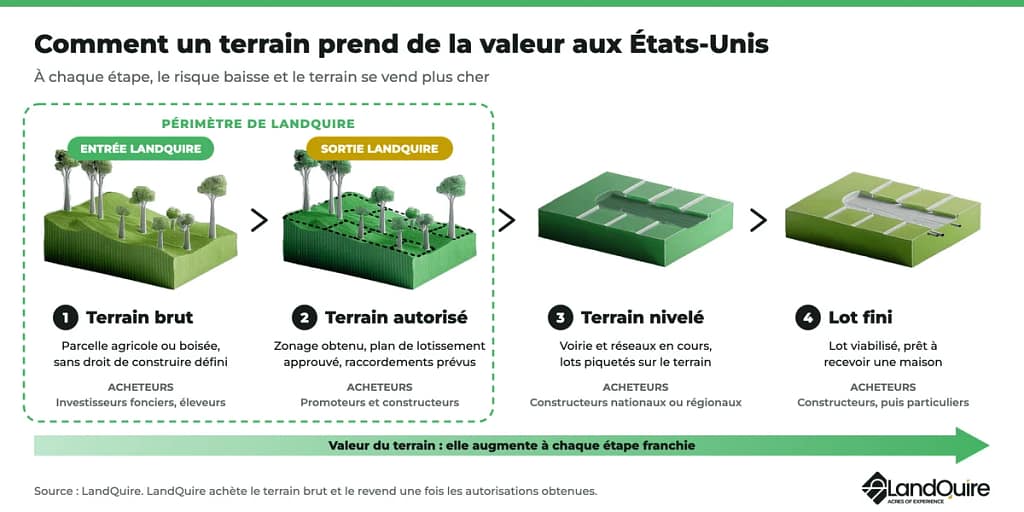
What we do: We analyze all 3,143 U.S. counties using an algorithm based on more than 120 criteria before selecting a city and a plot of land. We start with raw land and end up with zoned land, which we sell to developers and builders. We do not build: there are no construction sites or construction work involved. Each dedicated company is established for a 5-year term, with a possible 1-year extension.
Permits and Deadlines: Zoning and Permits Can't Be Imposed by Decree
Value is created once the land has been zoned and approved, and the necessary plans and permits have been obtained. A city may request additional studies, reduce the number of lots, or deny an application; water or sewer infrastructure may also be lacking.
What we do: Every plot of land undergoes a due diligence review before purchase. If the review reveals a problem, we walk away. This has happened four times: in one of those cases, the water supply was insufficient, and the capital was returned to the investors.
Currency Exchange: You're investing in dollars
Your ticket, the value of the land, and the distributions are in dollars. If the euro rises against the dollar between the time of your transfer and the sale, the amount converted back into euros will be lower, even if the transaction went well: this is the effect of the exchange rate. The opposite is also true: a stronger dollar increases the amount you receive in euros.
What we do: Opening a dollar-denominated account is one of the steps in the investment process, allowing you to choose when to convert your funds. The specialized company does not hedge against currency risk: it’s up to you to decide if and when to convert. We recommend holding U.S. real estate as a small portion of your portfolio to diversify without exposing your entire portfolio to the dollar.
Liquidity: Your money remains tied up until the land is sold
Land is neither life insurance nor a real estate investment trust (SCPI): there is no market where you can sell your shares overnight, and it does not generate income while you own it. You recoup your investment when the land is sold.
Here’s how it works: Your shares cannot be resold until the land is sold, and we make this clear to you before you sign. The time frame is specified in the documents: 5 years, with a possible 1-year extension. You may convert your investment to another LandQuire portfolio under certain conditions, on a case-by-case basis, upon signing the relevant documents.
Legal and Tax: An Investment Abroad Must Be Reported in Both Countries
For a French investor, investing in the United States involves setting up a structure, filling out U.S. forms, and filing a report with the French government. A single mistake can cost more than the investment yields.
What we do: Each offering is made to non-U.S. residents under Regulation S, with a PPM (the document detailing the transaction, its fees, and its risks) and a subscription agreement. You will receive a K-1 form each year. The U.S. tax matters for each special-purpose entity are handled by an independent CPA. For your own tax return in France, please consult your advisor.
Financial Institution and Use of Funds: Who Do You Trust With Your Money?
The risk that is most often overlooked is the one posed by the company managing the operation: how it uses the funds, how it is paid, and what it shows you.
What we do: Your funds are deposited into the account of the dedicated company, not into LandQuire’s account. You receive a quarterly report. The properties are covered by liability insurance. Some acquisitions are financed through a seller’s loan; the PPM specifies this. We are compensated based on performance, not on the outstanding balance, and our fees are included in the budget for each transaction.
Benefits and Risks of Real Estate Investment vs. Rental Property
Land is not managed the same way as a rental apartment or a real estate investment trust (SCPI). It avoids certain risks associated with rental investments, but introduces others. Here is a point-by-point comparison.
| Direct Rental Investment | SCPI | Land with LandQuire | |
|---|---|---|---|
| Income During Detention | Monthly Rent | Income Paid on a Regular Basis | No income prior to the sale of the land |
| Unpaid Rent and Vacancies | Yes | Funded by the SCPI | No tenants, so no unpaid rent |
| Tenants and Renovations | At your own expense or delegated | Covered by the SCPI | No tenants and no construction work |
| Early Resale | Possible, by selling the property | Possible, depending on redemption requests | Not until the land is sold |
| Currency | Euro | Euro most often | Dollar |
The type of investment is therefore just as important as the choice of property: land is suitable for a long-term wealth-building strategy, using a portion of your savings that you won’t need for several years. Ultimately, its return depends on the value created by the permits, not on rent: profitability and timing are assessed on a case-by-case basis by reviewing the PPM.
The Risks of Real Estate Investing Based on Your Profile
The same investment opportunity raises different questions for an individual, a business owner, or a family office. Here are the main risks for each investor profile—and our response.
Individuals with €100,000 or more to invest
Your main risk: concentrating too much of your net worth in a single piece of land. The minimum investment is $100,000 per transaction; we recommend that you invest only a small portion of your net worth in this, alongside your French real estate and financial investments, and that you choose each piece of land with full knowledge of the facts, with the PPM in hand.
Business Leaders After a Sale
Your main risk: reinvestment conditions. If you reinvest the sale proceeds through a holding company under a contribution-sale arrangement, the tax deferral is subject to specific rules regarding the nature and timing of the reinvestment. Have your tax attorney confirm eligibility before subscribing: we will provide you with the offering memorandum for the transaction.
Family offices
Your main risk: a lack of visibility into each line item. You co-invest on a deal-by-deal basis through a dedicated structure, with a quarterly report and an annual K-1 form for each company: each investment is tracked and monitored separately.
Wealth Management Professionals and Financial Advisors
Your main risk: recommending an investment that you cannot support with documentation. We provide you with the same documents we give your clients (PPM, subscription agreement, quarterly reports) so you can assess whether it is suitable for each client profile.
The Risks of Real Estate Investment Are Assessed at Every Stage
- Structure: You invest in your own name or through an LLC (often in Wyoming), using an EIN for an LLC or an ITIN for an individual.
- Dollar account: You open a dollar account, which lets you choose when to convert the currency.
- Identity verification (KYC): passport, proof of address, and proof of the source of funds.
- Review and Signing: You sign the PPM, which details the costs and risks of the transaction, and the subscription agreement.
- Bank Transfer: Your funds will be transferred to the dedicated company's account.
- Follow-up: one report each quarter, one K-1 form each year, until the land is sold.
Details on each step can be found on the " How to Invest with LandQuire" page.
A typical example: the risks of real estate investment with a $100,000 investment
Let's take an investor who invests $100,000—the minimum investment—in a piece of land in Texas. Here's what happens in both scenarios: either the land sells within the specified time frame, or it doesn't.
| Land sold within 60 months | Lot not sold after 60 months | |
|---|---|---|
| Amount Invested | 100 000 $ | 100 000 $ |
| Where is the money? | To the account of the special-purpose company | To the account of the special-purpose company |
| Follow-up | Quarterly Report, K-1 annually | Quarterly Report, K-1 annually |
| For Sale | Return of the investment, followed by a preferential return, and then a share of the capital gains with LandQuire | 100% of net profits go to investors |
| Duration of the Corporation | 5 years | 5 years + 1-year extension available |
The 60-month term aligns our interests with yours: after this period, LandQuire no longer takes its share of the capital gains.
The land auctions opening today are in Atascosa (215 acres), Cibolo (94 acres), and Waco (58.91 acres) in Texas, with a minimum bid of $100,000.
The Risks of Real Estate Investment, as Seen in Our 50 Projects
The best way to assess how we manage risk is to look at what we've done so far, including what didn't work.

37 out of 50 projects sold
Since 2021, LandQuire has launched 50 projects: 37 have been sold, and 13 are in progress (in the fundraising, development, or divestment stages). They are listed on the “Sold Real Estate Projects” page.
4 transactions abandoned during the audit
Four transactions were abandoned during the audit, prior to the purchase of the land; for the land projects in question, the funds already raised were returned to the investors. Declining a piece of land is part of the job.
Not all resales are profitable
Of our first buy-and-sell transactions, two resulted in a slight loss: we are reporting this, just as we do with the rest.
A team in the field
LandQuire was founded in 2021 by Romain Daniellou and Thibaut Guéant, co-founder and CIO. The Miami-based team manages every transaction from start to finish: sourcing, acquisition, permitting, resale, and the legal and financial management of the special-purpose company.
Frequently Asked Questions About the Risks of Real Estate Investment
What are the main risks of investing in real estate in the United States?
The six main factors are resale (timing and price), permits, currency exchange, liquidity, the legal and tax framework, and the operator managing the transaction. A property may also be located in a flood zone: this is one of the points checked during real estate due diligence. To recognize a suspicious offer, read our guide to red flags in real estate projects.
Does my money go through an escrow account?
LandQuire does not use its own escrow account. Your funds are used for the project you have chosen, through the dedicated company, and you receive a report every quarter. For certain fundraising rounds, the title company organizing the land purchase holds the subscription funds until the closing: each project’s PPM specifies where the funds go prior to the purchase.
Can I get my money back before the land is sold?
Generally speaking, no: unlike life insurance, your investment is equivalent to the sale of the land within a 5-year timeframe, with a possible 1-year extension. A conversion to another LandQuire portfolio is possible under certain conditions.
What fees will I have to pay?
Fees are included in the budget for each transaction (acquisition, fundraising), and there are no annual management fees. Details are provided in the PPM. To compare this with other real estate investments, read our article on the risks of real estate crowdfunding.
How is taxation handled?
The U.S. tax matters for each special-purpose company are handled by an independent CPA, and you receive a K-1 form each year. You’ll still need to file your tax return with the French tax authorities with your advisor, at the tax rate and according to the rules that apply to your situation. If you plan to reinvest the proceeds from the sale of a business, read our article on the “apport-cession” and the 150-0 B ter provision before subscribing.
Is the foreign exchange risk hedged?
No: You invest and receive your returns in dollars, without currency hedging by the dedicated company. The dollar account allows you to choose when to convert to euros, or to keep your dollars for another investment opportunity.
Face the risks head-on, then make a decision
Create an account to access current offers, their PPMs, and their reports. Have a question about a specific risk? Our team will answer it before you sign anything.
Past performance is not indicative of future results; all investments involve the risk of capital loss.