Real Estate Due Diligence: A Checklist Before Investing
Real estate due diligence refers to the comprehensive review of a property prior to purchasing it or investing in a real estate project that involves the property. In the United States, it covers 14 areas: title, easements, zoning, subsurface conditions, water, flood zones, access, utilities, soil, the environment, and taxes.

By Thibaut Guéant, co-founder and CIO of LandQuireUpdated on 13-minute read
Table of Contents
- What is real estate due diligence?
- What are the steps involved in real estate due diligence?
- The 14-Point Checklist: What to Check on a Property?
- What documents should you request before investing?
- How can you evaluate the exit strategy for a real estate project?
- Investing Through a Broker: What Else Should You Check?
- How does LandQuire conduct due diligence on its properties?
- Frequently Asked Questions
Land due diligence refers to the process of conducting a series of checks on a piece of land before purchasing it or investing in a real estate project that involves that land.
In the United States, it covers 14 areas: title, easements, zoning, subsoil, water, flood zones, access, utilities, soil, the environment, and taxes.
Here is the checklist, which outlines what to check and what you should ask a service provider before entrusting them with your money.
In a nutshell
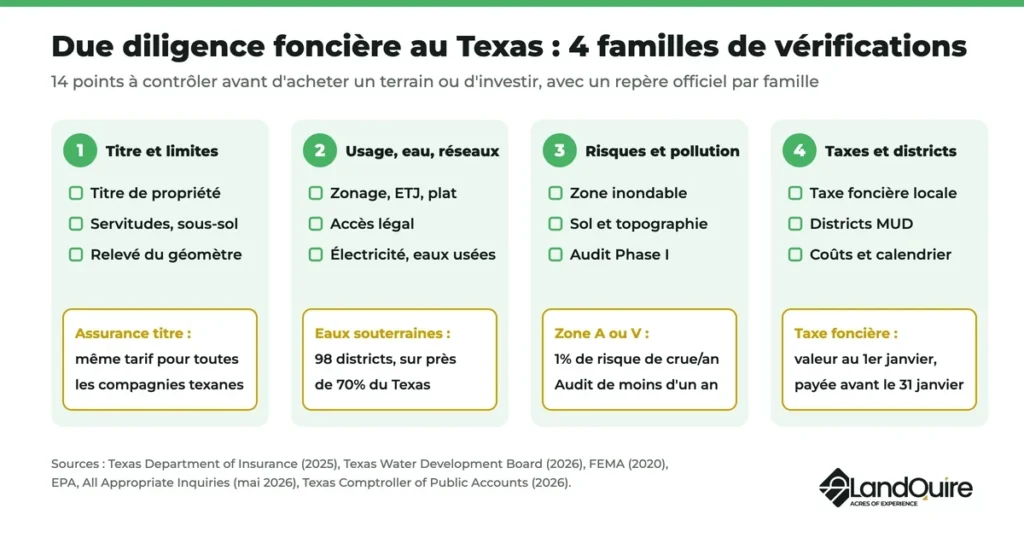
- A high-risk flood zone (zones A and V) has a 1% annual risk of flooding; flood insurance is mandatory in these areas (FEMA, 2020).
- The environmental audit (Phase I) must have been conducted within the past year as of the date of acquisition, and certain steps must have been completed within the past 180 days (EPA, May 2026).
- Texas has 98 groundwater management districts, covering nearly 70% of its territory (Texas Water Development Board, 2026).
- All Texas insurance companies charge the same title insurance premium (Texas Department of Insurance, 2025).
- More than 4,796 local governments levy property taxes in Texas; the value is assessed as of January 1 (Texas Comptroller, 2026).
- In France, the seller of a home provides the buyer with the required inspections; in the United States, the buyer of a plot of land conducts the inspections themselves (service-public.fr, 2025).
What is real estate due diligence?
Land due diligence is the analysis of a parcel of land prior to its acquisition, covering legal, technical, environmental, and financial aspects.
As with any real estate purchase, it determines whether the property is worth the price and whether it fits your plans.
It focuses on the land itself, just as a real estate due diligence focuses on a building.
Verifying the company that is offering you an investment opportunity is part of a separate process, which is described below.
The 4 Types of Due Diligence for a Parcel of Land
| Type | What he checks | Who usually leads him? |
|---|---|---|
| Legal | Title to property, easements, subsoil, lawsuits | Title company, attorney |
| Technical Studies | Boundaries, access, utility lines, soil, topography, planned construction work | Surveyor, engineer |
| Environmental | Soil pollution, flood zone, protected species | Environmental Professional |
| Finance and Urban Planning | Zoning, Permits, Taxes, Resale Value | Buyer, urban planner, real estate broker |
In the United States, this data is not centralized: each county maintains its own records, and each city handles its own zoning.
The buyer therefore coordinates several experts, or entrusts the entire process to a service provider who handles it on their behalf.
When conducted properly, it helps ensure the price and the terms of the transaction.
How this differs from buying real estate in France
In France, the seller of a home provides the prospective buyer with a set of inspection reports, which is attached to the preliminary sales agreement or the deed of sale.
According to the service-public.fr fact sheet on real estate inspections, it includes, among other things, the energy performance certificate (DPE), the asbestos report, the lead inspection report, and the risk assessment report.
| Point | Housing (French law) | Land in the United States |
|---|---|---|
| Documents Provided | Diagnostic reports provided by the seller | Audits Commissioned by the Buyer |
| Legal certainty | Notary | Title company or attorney, title insurance |
| Zoning Regulations | Local Land-Use Plan for the Municipality | City zoning, county regulations outside city limits |
| Natural Hazards | Risk Assessment | FEMA Maps and Field Surveys |
Sources: service-public.fr (2025), FEMA (2020).
What are the steps involved in real estate due diligence?
Real estate due diligence follows the transaction timeline, from the initial review of the file through to closing.
- Remote analysis: county records, zoning maps, flood zone maps, aerial photos.
- Offer and Contract: After negotiations, the purchase contract specifies a cooling-off period during which the buyer may withdraw from the transaction.
- On-site surveys: surveyor’s survey, soil analysis, environmental audit, meeting with the city or county planning department.
- Title Review: The title company issues its title commitment, which lists the encumbrances on the property.
- Decision: You can sign, resume negotiations, or withdraw before the end of the review period.
The duration of the study period and the withdrawal conditions are specified in the contract: have a lawyer review them.
The 14-Point Checklist: What to Check on a Property?
| # | Point to check | Document or source |
|---|---|---|
| 1 | Title Deed and Chain of Title | Title search, title commitment |
| 2 | Easements | Title commitment, property plan, surveyor's survey |
| 3 | Zoning and Permitted Uses | City or county |
| 4 | Subsurface minerals (oil, gas) | County Registry Records |
| 5 | Water (well, municipal supply) | Groundwater District, Water Supplier |
| 6 | Flood zone | FEMA Map (FIRM) |
| 7 | Boundaries and Area | ALTA/NSPS Survey |
| 8 | Legal Access | Public right-of-way or registered right of way |
| 9 | Utilities (electricity, wastewater) | Letters from Suppliers |
| 10 | Soil and topography | Geotechnical Study |
| 11 | Environment | Environmental Audit |
| 12 | Taxes and Special Districts | Appraisal District, MUD |
| 13 | Authorizations (entitlements) | City or county: property, permit |
| 14 | Project Costs and Schedule | Estimate, Contract |
1. Title Deed and Title Insurance
A title search traces the chain of title: sales, mortgages, judgments, probate, and hidden defects. It confirms that the seller is indeed the owner.
The title company then issues a title commitment, which lists the exceptions and encumbrances: read our guide to title commitments in Texas.
To protect your title,title insurance covers the buyer against any defects discovered after the purchase, such as fraud or an unknown heir.
According to the Texas Department of Insurance, all Texas insurance companies charge the same rate; the cost of the policy depends on the sale price.
2. Easements and Subsoil
An easement (right of way, power line, utility line) restricts the use of part of the land and may reduce the buildable area.
It is listed in the title commitment and on the surveyor's report: see our guide to easements in Texas.
In Texas, mineral rights (oil, gas) may belong to someone other than the surface owner, who retains access to the land.
County records show who owns the subsurface: our guide to verifying mineral rights in Texas explains the process.
3. Zoning, ETJ, and Permits
The zoning classification determines what you can build: residential, commercial, or agricultural. In Texas, this is decided at the city level.
In Texas, the ETJ provides a framework for the division of land into lots, even in the absence of zoning.
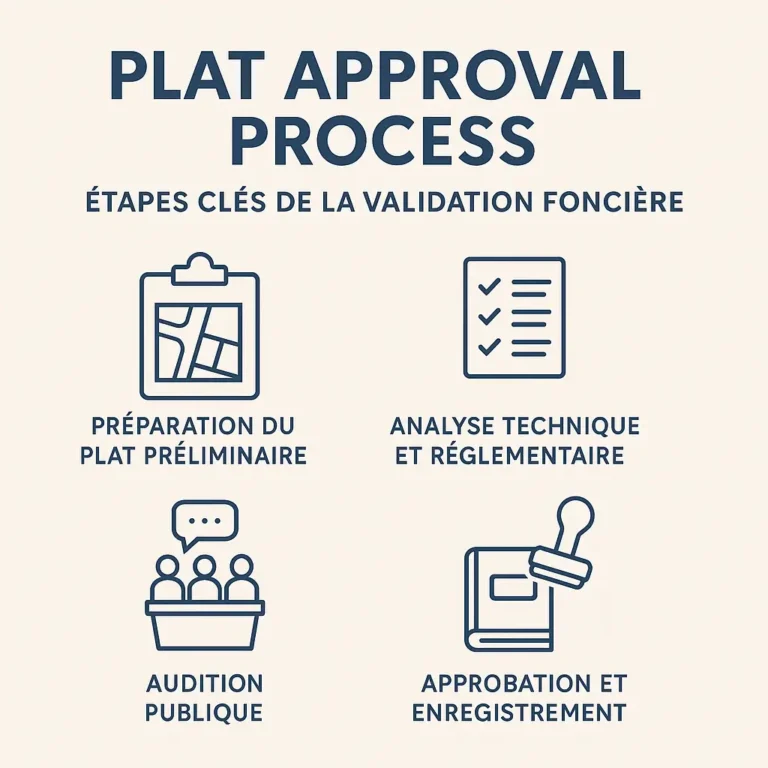
A housing development requires an approved site plan, following a process established by the city or county: see the site plan approval process.
If the zoning is not appropriate, a request for rezoning or an exemption may be filed, though there is no guarantee of success.
4. Access, Networks, and Water
A lot without legal access is difficult to sell. Make sure it borders a public road, or that a registered right of way connects it to the road.
Ask the utility providers for a letter confirming that they can provide electricity, water, and sewer service to the lot, and specifying what connection work is required.
These letters outline the network's technical constraints.
Groundwater is managed by local districts. According to the Texas Water Development Board, Texas has 98 such districts, located in 173 of its 254 counties.
These districts cover nearly 70% of the state and set the rules for wells: read our article onwater in Texas.
5. Flood Zone
FEMA, the Federal Emergency Management Agency, publishes flood insurance rate maps (FIRM).
According to its glossary of flood zones, high-risk areas—designated as A or V—have a 1% probability of flooding each year; areas B, C, and X have a moderate or low risk of flooding.
Zones A and V are also the areas where flood insurance is required, according to FEMA.
Our article on FEMA flood zones explains how to read these maps.
6. Boundaries, Soil, and Topography
The surveyor's ALTA/NSPS survey provides the exact area, boundaries, easements, and encroachments.
It serves as the basis for the title commitment: see our guide to theALTA land survey.
The technical aspect involves a geotechnical study, which measures the soil's bearing capacity.
Steep slopes, swelling clay, or rock affect the cost of construction work: foundations, roads, and utility systems.
7. Contaminated Soil and the Environment
A Phase Ienvironmental audit investigates past or present contamination through a review of former land uses, public records, site visits, and interviews.
According to the EPA's page on All Appropriate Inquiries, it follows the ASTM E1527-21 standard (or E2247-23 for rural or forested land).
This process can protect a buyer acting in good faith from liability for pollution that they did not cause.
A wetland or a protected species may also restrict development.
Example: When should the Phase I audit be conducted?
You plan to sign the purchase agreement for a piece of land on March 1, 2027.
| Phase of the study | EPA Rule | Deadline |
|---|---|---|
| Full Study | Completed or updated less than one year before signing | After March 1, 2026 |
| Interviews, public records, site visits, and research on environmental permits | Less than 180 days before signing | After September 2, 2026 |
A study conducted in January 2026 must therefore be updated before closing.
8. Taxes and Special Districts
According to the Texas Comptroller's property tax guide, more than 4,796 local governments levy property taxes: counties, cities, school districts, and special districts.
The property value is determined as of January 1, and the tax is generally due by January 31 of the following year. Ask the seller for tax statements from previous years.
A MUD district funds a neighborhood's infrastructure and imposes its own tax: read our guide to MUDs and PUDs.
What documents should you request before investing?
A complete set of documents reduces the risk of hidden defects. Before buying land, ask for:
- the title commitment and a copy of the deeds establishing the easements;
- the surveyor's survey (ALTA/NSPS or equivalent);
- the city or county zoning letter, and the site plan, if available;
- letters from water, electricity, and wastewater providers;
- the flood zone map and, if necessary, a water level study;
- the environmental audit report;
- property tax statements and the list of districts for the property.
Our guide to the legal documents needed to invest in land in the United States describes each of these documents.
How can you evaluate the exit strategy for a real estate project?
Like any real estate investment, land appreciates in value when resold. Your analysis should therefore also determine who might buy it, at what price, and under what conditions.
There are three exit strategies to consider before investing:
- The target buyers: developers and builders active in the sector, commercial buyers, or farmers. Their demand is reflected in recent sales.
- Resale price: It is compared to actual sales of nearby properties, known as market comparables.
- Permits: A plot of land that has already been approved is sold differently than undeveloped land. Ask what permits have already been obtained and what still needs to be obtained.
Also ask what happens if the property doesn't sell by the target date: who makes the decision, and who pays the taxes in the meantime.
None of these assumptions provides any guarantees regarding the final price.
Investing Through a Broker: What Else Should You Check?
In a guided real estate investment, the operator conducts due diligence on the property. Your due diligence therefore also extends to the operator.
Before sending your money, ask for a sample investor report, a list of service providers (title company, surveyor, engineer), and a history of the developer’s previously sold projects.
A track record presented on a transaction-by-transaction basis is easier to verify. Our guide to choosing a real estate investment partner in the U.S. details these criteria.
A guaranteed return or pressure to sign should raise a red flag: learn about real estate investment scams in the U.S.
How does LandQuire conduct due diligence on its properties?
LandQuire, founded in 2021 in Miami and based in Hollywood, Florida, purchases land in the United States, obtains development permits for the properties, and then resells them to developers and builders.
- The selection process: Each property is chosen from among 3,143 counties analyzed, based on more than 120 criteria.
- Audits: Four projects were abandoned during the due diligence process; two parcels of land were resold at a slight loss.
- Funds: LandQuire does not use its own escrow account. For closings scheduled before the land purchase (Cibolo, Waco), the title company holds the funds until the purchase is complete.
- The structure: a dedicated limited liability company (LLC) for each project, with a minimum investment of $100,000, representing a minority stake in the assets.
- Duration: Target duration: approximately 36 months for current funding rounds, with no guarantees. Plan for 5 years or more.
- Liquidity: The company does not repurchase shares. A sale is possible with the manager’s consent, subject to rights of first offer and preemption.
- Reporting: one report each quarter and a K-1 form each year, after the end of the fiscal year.
For each property, LandQuire works with local professionals: a title company to verify the title, an engineering and surveying firm to survey the property and assess utility lines, and the city’s planning department to confirm the zoning in writing.
Depending on the site, environmental or geotechnical studies may be conducted to supplement the analysis.
Before investing, each investor gains access to the project’s data room, which contains the due diligence report, land survey, zoning confirmation, utility studies, and tax history.
He then receives a quarterly report on the project's progress.
The offerings are open to non-U.S. residents (Regulation S) and accredited U.S. investors (Regulation D, Rule 506(c)).
The process is described on our " How to Invest" page.
The risks remain real: loss of capital, fluctuations in the dollar’s exchange rate against the euro, and delays or denials of permits. Read about our approach and the risks involved in real estate investment.
Frequently Asked Questions
How long does a real estate due diligence process take?
It lasts for the duration of the due diligence period specified in the purchase agreement, as negotiated between the buyer and the seller.
A plot of land that needs to be rezoned or connected to new utility networks requires more planning studies than a plot that is already connected to utilities.
Is due diligence mandatory?
There is no law requiring a buyer of land to conduct a survey. Without it, the buyer has no guarantee regarding what they are purchasing.
However, lenders and title insurers each have their own requirements, and an environmental audit helps the buyer protect themselves in the event of contamination.
How much does a real estate due diligence review cost?
The cost depends on the area, the location, and the required studies: title search, survey, soil tests, environmental assessment, and the type of project.
Ask for quotes in dollars before signing the offer, and include them in your budget, just like the work itself.
Can land due diligence be conducted remotely?
To some extent: county records, zoning maps, and FEMA maps are available online.
The site visit, the surveyor's survey, and the environmental assessment require professionals to be on site.
What should you do if a stitch gets stuck?
During the due diligence period, you can reopen negotiations, ask the seller to resolve the issue before closing, or withdraw from the deal.
After this period ends, the withdrawal terms set forth in the contract no longer apply in the same way.
What is the difference between real estate due diligence and land due diligence?
Real estate due diligence focuses on a building or commercial property: technical condition, leases, tenants, completed renovations, compliance, and inspections.
Land due diligence focuses on vacant land: title, compliance of the intended use with zoning regulations, access, utilities, soil conditions, and developability—without any buildings or technical conditions to analyze.
What should you check in a land purchase contract?
The duration of the due diligence period, the down payment and when it becomes final, the documents the seller must provide, and the title company selected.
Have a lawyer review the contract before you sign it: this can help ensure the transaction goes smoothly and protect your rights.
This article is for informational purposes only and does not constitute personalized legal, tax, or investment advice. The rules cited are those in effect as of the date of this update. Any real estate investment may result in a loss of principal. Past performance is not indicative of future results.
Would you like to allocate a small portion of your portfolio to U.S. real estate without having to conduct due diligence yourself?
Explore our real estate listings in the United States or contact the LandQuire team.
To learn more, check out all of our real estate investment guides.

About the Author
Thibaut Guéant, co-founder and CIO of LandQuire, founded the company in 2021 with Romain Daniellou. As a land entitlement specialist, he identifies off-market raw land, primarily in Texas, and oversees the process of obtaining zoning permits that make the land buildable before reselling it to developers.