Texas or Florida: Where Should You Invest in Real Estate?
Texas or Florida: When it comes to real estate investment, Texas offers greater growth potential and land that is one-third the price; Florida offers more expensive land and a higher risk of hurricanes. Texas gained 391,243 residents in one year, while Florida gained 196,680.

By Thibaut Guéant, co-founder and CIO of LandQuireUpdated on 13-minute read
Table of Contents
- Texas or Florida: What Are the Differences for a Real Estate Investor?
- Where is the population growing the fastest?
- How much does land cost in Texas and Florida?
- What Are the Taxes Like in Texas and Florida: Income Tax and Property Tax?
- Which entity approves a housing development: the county, the city, the ETJ, or the MUD?
- What climate-related risks: floods and hurricanes?
- Texas or Florida: Which State Should You Choose Based on Your Plans?
- Where is LandQuire investing in Texas and Florida?
- Frequently Asked Questions
Texas or Florida: When it comes to investing in real estate, Texas offers more growth potential and land that is one-third the price; Florida offers more expensive land and a higher risk of hurricanes.
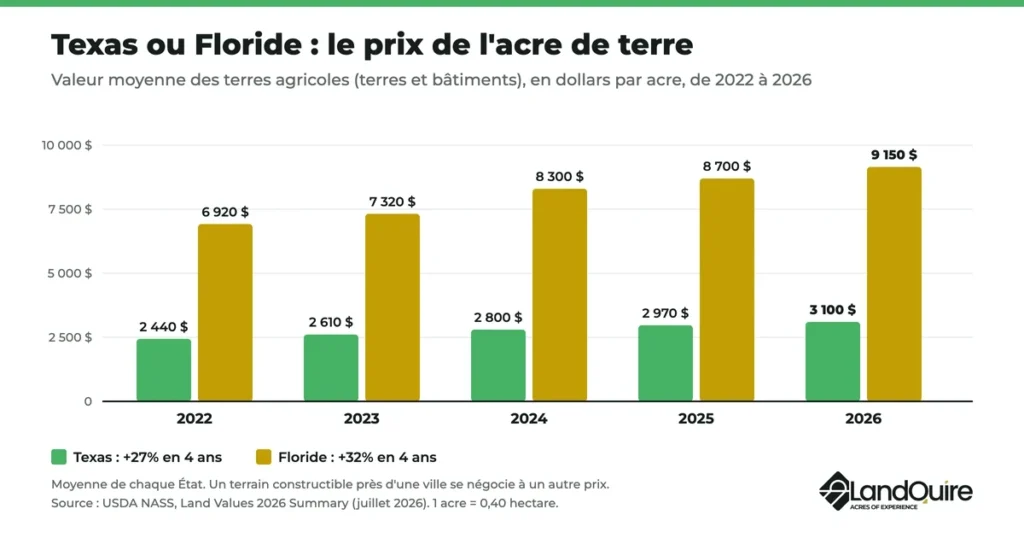
Texas gained 391,243 residents in one year, while Florida gained 196,680. An acre of farmland there is worth an average of $3,100, compared with $9,150 in Florida.
Neither state levies an income tax on individuals. The differences lie in property taxes, zoning regulations, and climate.
Here's how to compare them before investing, county by county, if you live in France.
In a nutshell
- Texas gained 391,243 residents between July 2024 and July 2025, the largest increase in the country; Florida gained 196,680, the second-largest (Census Bureau, January 2026).
- An acre of farmland is worth an average of $3,100 in Texas and $9,150 in Florida in 2026, up 4.4% and 5.2% year-over-year (USDA, July 2026).
- Neither Texas nor Florida levies an individual income tax (Tax Foundation, 2026; Florida Department of Revenue).
- The effective property tax rate is 1.40% of the value of primary residences in Texas, compared with 0.78% in Florida (Tax Foundation, 2026).
- In Florida, the assessed value of land that is not a primary residence cannot increase by more than 10% per year (Florida Department of Revenue).
- From 1851 to 2004, 110 hurricanes made direct landfall in Florida, including 35 major hurricanes, compared with 59 in Texas, including 19 major hurricanes (NOAA).
Texas or Florida: What Are the Differences for a Real Estate Investor?
Texas and Florida are the two states with the fastest-growing populations in the United States.
For a real estate investor, these factors differ in terms of land prices, local taxes, zoning regulations, and exposure to hurricanes.
The table summarizes the differences. Each row is explained in detail later in the article.
| Criteria | Texas | Florida |
|---|---|---|
| Population Growth, July 2024 to July 2025 | +391,243 residents (+1.2%), 1st among the states | +196,680 residents (about +0.8%), 2nd among the states |
| Average value of one acre of farmland in 2026 | $3,100 | $9,150 |
| Individual Income Tax (State) | None | None |
| Effective Property Tax (Primary Residences) | 1,40% | 0,78% |
| Who oversees a housing development outside city limits | The county (dishes), the neighboring city within its ETJ area | The county, according to its land-use plan |
| Hurricanes That Hit the State, 1851–2004 | 59, including 19 adults | 110, including 35 adults |
Sources: U.S. Census Bureau, USDA NASS, Tax Foundation, Florida Department of Revenue, Texas and Florida statutes, NOAA.
Where is the population growing the fastest?
Population growth is the primary driver of residential land demand and real estate investment: every new resident needs a place to live, and developers purchase land to build on.
According to the U.S. Census Bureau's press release on the 2025 population estimates, Texas had a population of 31,709,821 as of July 1, 2025, an increase of 391,243 over the past year.
Florida has 23,462,518 residents, an increase of 196,680. The two states lead in population growth, ahead of North Carolina.
The structure of this growth is different.
Texas is growing due to births and immigration; Florida, primarily due to immigration: it welcomed 178,674 residents from abroad, compared with 167,475 in Texas.
The influx of people from other states is slowing down in Florida.
The net internal migration in Florida is projected to drop to 22,517 people in 2025, down from 310,892 in 2022: Florida will rank 8th among the states.
When it comes to land use, demographic trends are significant at the county level.
The fastest-growing cities and suburbs in Texas are detailed in our article on the Texas real estate market.
How much does land cost in Texas and Florida?
Land prices in Florida are three times higher than in Texas.
According to the USDA’s “Land Values 2026” report, published on July 31, 2026, an acre of farmland is worth an average of $3,100 in Texas.
In Florida, it is worth $9,150. One acre is equal to 0.40 hectares: these averages are equivalent to approximately $7,660 and $22,610 per hectare.
Both markets have been growing over the long term. Since 2022, the average value per acre has increased by 27% in Texas and 32% in Florida.
| Average value per acre in 2026 | Texas | Florida | Difference |
|---|---|---|---|
| Farmland and farm buildings | $3,100 | $9,150 | x 3 |
| Cultivated land | $2,790 | $11,100 | x 4 |
| Pastures | $2,420 | $7,650 | x 3 |
| Year-over-year increase (land and buildings) | +4,4% | +5,2% | – |
Source: USDA NASS, Land Values 2026 Summary.
These averages apply to agricultural land.
Land on the outskirts of a growing metropolitan area sells for a higher price, especially if it has access to water and sewer systems.
Value is created largely through zoning permits: a piece of land approved for subdivision is worth more than a farm plot.
This is the strategy for increasing the value of a piece of land: buy it, obtain the necessary permits, and then resell it.
Information on home prices and the U.S. real estate market is detailed in our articles on real estate in Texas and real estate in Florida.
What Are the Taxes Like in Texas and Florida: Income Tax and Property Tax?
No state income tax in either state
Neither Texas nor Florida levies an individual income tax. The Florida Department of Revenue’s FAQ confirms this: no personal tax return is required there.
For Texas, the Tax Foundation's Texas fact sheet also notes this. Businesses remain subject to taxation in both states.
For foreign investors, however, U.S. federal tax laws apply in all cases—both to the resale of assets and to investment income.
An undeveloped lot does not generate rental income until it is sold, and does not require rental management.
A withholding tax may apply to the resale: see our article on the FIRPTA withholding tax.
On the French side, the France-U.S. tax treaty prevents double taxation on the same income.
For French residents, French tax laws also apply: consult a tax specialist.
A local property tax, which is higher in Texas
Property taxes are local taxes in both states. The Texas State Comptroller sums it up this way: “Texas has no state property tax.”
In Texas, the county, city, school district, and special districts each set their own rates.
According to the Tax Foundation, the effective property tax rate is 1.40 percent of the value of primary residences.
In Florida, the effective tax rate is 0.78%, according to the Tax Foundation's Florida fact sheet.
An investment property is not eligible for any primary residence exemption in either state.
In Florida, a piece of farmland may be appraised at a value below its market value, depending on its use.
In Texas, MUD districts can impose their own taxes: see our article on MUD and PUD districts.
Example: The 10% cap on a piece of land in Florida
According to the Florida Department of Revenue's page on property tax, the value is assessed annually as of January 1.
For a property that is not a primary residence, the taxable value cannot increase by more than 10% per year.
Let's consider a piece of land valued at $200,000 at the time of purchase, whose market value increases by 25% in one year:
| Step | Amount |
|---|---|
| Taxable value at the time of acquisition | $200,000 |
| Market value one year later (+25%) | $250,000 |
| Maximum increase in taxable value (10%) | $20,000 |
| Taxable value used | $220,000 |
| Value not taxed this time | $30,000 |
The cap only provides protection in the event of a sharp increase. The same page specifies a 4% discount for payment in November; any unpaid tax is considered past due as of April 1.
Which entity authorizes a housing development: the county, the city, the ETJ, or the MUD?
In Texas, counties with limited powers
Outside of Texas cities, the county approves subdivision plans (site plans) and sets road standards. The Texas County Subdivision Act governs this process.
That same provision generally prohibits the municipality from regulating the use of buildings or the number of housing units per acre (Section 232.101).
In municipalities, municipal zoning regulations apply.
Surrounding each city is an extraterritorial jurisdiction (ETJ) zone, where the city may enforce its zoning regulations.
According to the Texas law on the ETJ, it ranges from half a mile to five miles, depending on the municipality's population.
As of September 1, 2023, owners representing a majority of a sector’s value may request to withdraw from it (Section 42.102).
Our article on the ETJ in Texas explains these rules in detail.
In Florida, every county has a land-use plan
In Florida, each county and city adopts a comprehensive plan and zoning regulations, in accordance with Section 163.3167 of the Florida Statutes.
Agricultural land may need to be rezoned under this plan before it can be subdivided into lots.
The procedure is more strictly regulated than in rural Texas, but the rules are set in advance.
The ordinance itself is approved by a department designated by the county or city, without a new vote by elected officials, provided it complies with the law, according to Section 177.071 of the Florida Statutes.
| Stages of a Housing Development | Texas | Florida |
|---|---|---|
| Rules for Use Outside Cities | No county zoning as a general rule | County Master Plan and Zoning Regulations |
| Approval of the Division Plan | County, or city within its metropolitan area | Department designated by the county or city |
| Funding for Utility Networks in a New Neighborhood | Often a special district (MUD) | City, county, or special district |
The general steps are described in our article on the dish approval process.
What climate risks: floods and hurricanes?
Flood zones can be verified on FEMA maps in both states.
FEMA's page on flood zones defines high-risk areas as those with a 1% annual chance of flooding, known as the "100-year flood."
Land that is partially prone to flooding is not unsuitable for construction, but the affected area reduces the number of lots and increases the cost of backfilling.
Our article on FEMA flood zones in Texas explains how to interpret them.
Hurricanes hit Florida more often.
According to the National Hurricane Center's table of hurricanes by state, 110 hurricanes made direct landfall in Florida from 1851 to 2004, including 35 major hurricanes.
Texas experienced 59 such events during the same period, including 19 major ones, concentrated along the Gulf Coast.
The inland areas around Dallas, Waco, and Abilene are far from the coast.
For vacant land, the climate has the greatest impact on the end buyer:insurance for newly built homes drives up housing costs and can dampen demand in coastal areas.
Texas or Florida: Which State Should You Choose Based on Your Plans?
The choice depends less on the state than on the county, the local economy, and your investment strategy: the profitability of a real estate project cannot be assessed at the state level.
A few points of reference:
- If you're looking for more affordable land and strong population growth, consider Texas—on the outskirts of growing metropolitan areas (San Antonio, Dallas-Fort Worth, Austin, Houston) and mid-sized cities.
- You accept a higher entry price for a market driven by immigration and pre-established zoning regulations: Florida, while avoiding the most vulnerable areas.
- If you want to minimize climate-related risks, look for a lot in the interior of the state, outside a FEMA flood zone, regardless of which state you’re in.
- If you want to limit property taxes while you own the property, consider Florida, which has a lower effective tax rate and a cap on increases in assessed value.
In both states, the same checks are required before making a purchase: title, access, utilities, zoning, and flood zone status.
Our guide to investing in the U.S. outlines the steps involved in real estate or land investment.
An example of a mid-sized Texas market: Our article on real estate investment in Abilene, Texas, provides a detailed look at this market in the western part of the state.
Where is LandQuire investing in Texas and Florida?
LandQuire is an American company based in Hollywood, Florida, founded in 2021. It analyzes all 3,143 U.S. counties using an algorithm that takes more than 120 criteria into account.
It buys land in areas where the population is growing, obtains development permits (the development phase), and then resells the land to developers and builders.
It manages each project company.
In total, LandQuire has launched 50 real estate projects since 2021, 37 of which have been sold.
In Texas, its projects are located in Cibolo, Atascosa, Waco, Elmendorf, Seguin, Greenville, and Abilene, among other places.
Two Texas projects have been sold, one in Wake Village (Bowie County) and one in Abbott (Hill County).
In Florida, its projects are located in Pomona Park, Okeechobee, Bunnell, and Lady Lake.
LandQuire's first resales also took place in Florida, in Bonifay, Naples, and Palm Bay: see our sold land projects.
Past performance is not indicative of future results.
Investors invest in a dedicated limited liability company (LLC) on a project-by-project basis. The minimum investment is $100,000 per project, paid in U.S. dollars.
The offerings are open to non-U.S. residents (Regulation S) and accredited U.S. investors (Regulation D, Rule 506(c)).
Target duration: approximately 36 months for ongoing fundraising efforts, without guarantees. Plan for 5 years or more.
This is one option among many, intended for a small portion of your assets, and is a long-term strategy.
You may lose some or all of your investment: please read our real estate investment risk disclosure before committing.
To view current land sales, check out our real estate listings in the United States.
If you have any questions, please contact the LandQuire team.
Frequently Asked Questions
Is it better to invest in Texas or Florida?
Neither one is better in absolute terms.
Texas has a growing population, and land there costs one-third as much; Florida has lower property taxes but a higher risk of hurricanes.
The county and the local area matter more than the state: that’s where value is created.
Which state has the lowest property tax?
Florida, with an effective tax rate of 0.78% of the value of primary residences, compared with 1.40% in Texas (Tax Foundation, 2026).
For investment land, the actual rate depends on the county, city, and special districts.
Can a foreigner buy land in Texas or Florida?
Yes, foreign investors can purchase land without a visa, either in their own name or through a U.S. company, often an LLC. Payment is made in dollars.
Becoming a homeowner does not grant any right of residence.
Resale is subject to U.S. federal tax: our article on buying land in the U. S. details the steps involved.
What is ETJ in Texas?
The ETJ is the area surrounding a Texas city, outside its city limits, where the city may enforce its zoning regulations.
It ranges from half a mile to five miles, depending on the population of the municipality (Local Government Code, Section 42.021).
Can you build on land located in a flood zone?
Often, yes, but with certain conditions: the municipality or county generally requires a minimum floor height or backfilling in FEMA-designated high-risk areas.
This work reduces the number of lots and increases the budget.
Should we invest in both states at the same time?
Diversifying your portfolio across several counties reduces the risk of a delay in obtaining approval for a single property.
With a budget of $100,000 per project, this diversification requires a significant amount of capital.
Where is capital gain on U.S. real estate taxed?
Capital gains on land located in the United States are taxable in the United States.
The France-U.S. tax treaty prevents double taxation; consult a tax professional regarding your specific situation.
This article is for informational purposes only and does not constitute personalized tax, legal, or investment advice. The figures are those published as of the date of the last update. Past performance is not indicative of future results. All investments involve the risk of loss of principal.

About the Author
Thibaut Guéant, co-founder and CIO of LandQuire, founded the company in 2021 with Romain Daniellou. As a land entitlement specialist, he identifies off-market raw land, primarily in Texas, and oversees the process of obtaining zoning permits that make the land buildable before reselling it to developers.