Real Estate in Texas: A Growing Market

Texas is the U.S. state with the largest population growth: 391,243 more residents between July 2024 and July 2025. However, the median home price there remains stable at $339,000 in July 2026, and there is no income tax. On the other hand, property taxes are high and mortgage rates exceed 7%. Here are the real estate market figures for Texas city by city, the rules for purchasing property for French citizens, and ways to invest, from rental properties to land.
In a nutshell
- As of July 1, 2025, Texas had a population of 31.7 million, an increase of 391,243 from the previous year: no other state saw such a large increase (Census Bureau, January 2026).
- The five municipalities in the U.S. with more than 20,000 residents that experienced the highest growth between 2024 and 2025 are all in Texas, with Celina at the top (+24.6%) (Census Bureau, May 2026).
- The median home price in Texas was $339,000 in July 2026, unchanged from a year earlier (Texas Real Estate Research Center, September 2026).
- As of October 8, 2026, the average interest rate on a 30-year fixed-rate mortgage was 7.40%, compared with 6.30% a year earlier (Freddie Mac).
- There is no income tax in Texas; the effective property tax rate is 1.40% of the value of primary residences (Tax Foundation, 2026).
- The unemployment rate in Texas was 4.4% in August 2026, compared with 4.1% for the United States as a whole (Federal Reserve Bank of Dallas, September 2026).
Why is the Texas real estate market growing?
The Texas real estate market is growing primarily because the population is increasing faster there than anywhere else in the U. S. According to the U.S. Census Bureau’s 2025 population estimates, Texas gained 391,243 residents between July 2024 and July 2025, bringing its total population to 31,709,821. This is the largest increase in the country in absolute numbers and the fourth-largest in percentage terms (+1.2%). Texas also ranks second in terms of the number of new residents arriving from abroad: 167,475 over the course of a year, just behind Florida (178,674).
Employment is on the rise. According to the Federal Reserve Bank of Dallas’s September 2026 economic report, Texas businesses added jobs in August (a 1.6% increase in jobs on an annualized basis). The unemployment rate stands at 4.4%, and the regional central bank forecasts a 1.2% increase in Texas jobs in 2026.
The tax system and quality of life attract households and businesses: there is no personal income tax. Property owners, however, pay one of the highest property taxes in the country (see below).
Every new resident needs a place to live, and the housing supply is struggling to keep up. Our analysis of the housing shortage in Texas details this imbalance, which is driving demand for homes and building lots around major metropolitan areas.
Which major cities in Texas are good for investing?
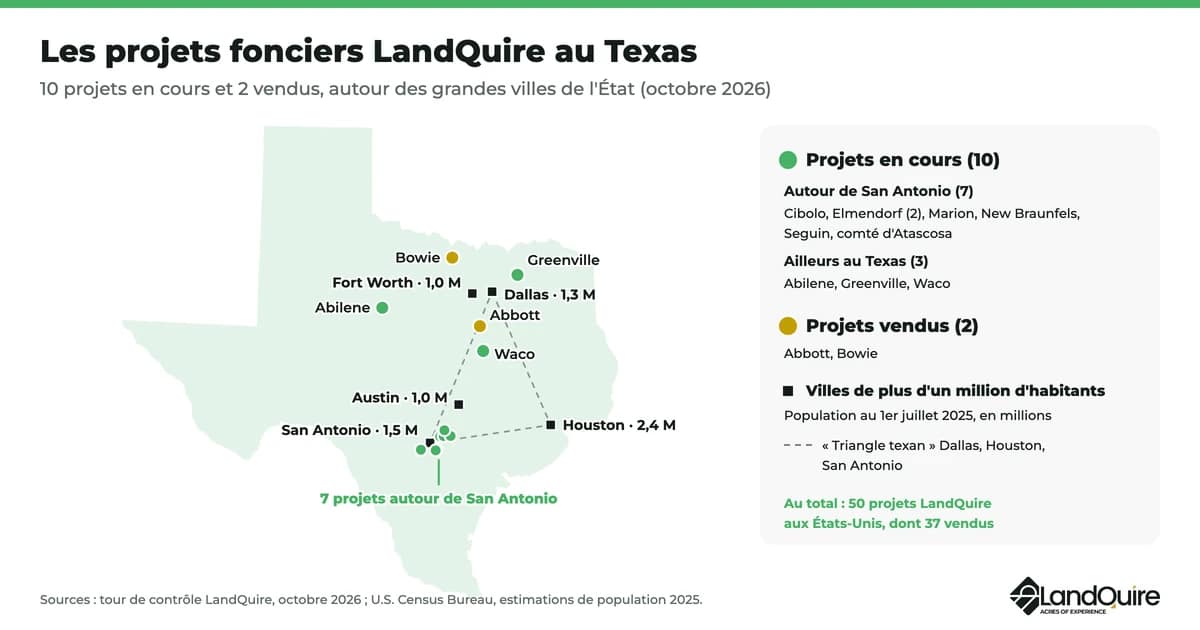
Four metropolitan areas account for the bulk of the population: Dallas-Fort Worth in the north, Houston in the southeast, and Austin and San Antonio in the center. The area between Dallas, Houston, and San Antonio is known as the “Texas Triangle.” Five Texas cities have populations exceeding one million, according to the Census Bureau’s 2025 estimates for U.S. cities.
| City | Population as of July 1, 2025 | Rank in the U.S. | Year-over-Year Housing Prices (July 2026) | What Keeps the City Going |
|---|---|---|---|---|
| Houston | 2 397 315 | 4e | Stable, after 12 months of decline | Ports, energy, health; no municipal zoning |
| San Antonio | 1 548 422 | 7e | -1,1% | Third-highest population increase in the country (+14,359 residents) |
| Dallas | 1 329 491 | 9e | -0.2% (metropolitan area) | Corporate headquarters, finance, logistics |
| Fort Worth | 1 028 117 | 10e | Up | Second-highest population increase in the country (+19,512 residents) |
| Austin | 1 002 632 | 12e | -1,4% | State Capital, Technology |
Population: U.S. Census Bureau. Real estate price trends by metropolitan area: Texas Real Estate Research Center.
Houston, the state’s most populous city, has no zoning. The city states it plainly: “The City of Houston is not zoned.” Land use there is governed by private subdivision rules (deed restrictions), which must be checked on a property-by-property basis. Along the coast, the risk of hurricanes and flooding drives up insurance costs.
Dallas-Fort Worth is home to two of the five metropolitan areas with populations exceeding one million. Fort Worth recorded the second-highest population growth in the country between 2024 and 2025.
Austin, the state capital, surpassed the one-million-resident mark in 2025. Prices there have fallen 1.4% year-over-year, the sharpest decline among major Texas metropolitan areas.
San Antonio has recorded the third-largest population increase in the country. Its growth is spreading eastward and northward, toward Seguin, New Braunfels, and Cibolo.
The fastest growth is taking place in the suburbs. The five municipalities with more than 20,000 residents that grew the most in the U.S. between 2024 and 2025 are all in Texas: Celina (+24.6%), Fulshear (+21%), Princeton (+18.1%), Melissa (+14.5%) and Anna (+10.2%). Four are suburbs of Dallas, while Fulshear is a suburb of Houston. That’s where new homes are being built, on land that was farmland just a few years ago. Mid-sized cities like Waco, between Dallas and the state capital, or Greenville, northeast of Dallas, are benefiting from the same trend.
What will real estate prices be like in Texas in 2026?
The median price of a home sold in Texas reached $339,000 in July 2026, unchanged from a year ago, according to the monthly report from the Texas Real Estate Research Center at Texas A&M University. Supply is increasing, and the housing market is shifting in favor of buyers: 32,306 sales in July (up 2.2% year-over-year), with inventory representing 5.5 months of sales and an average of 63 days to sell a property, compared to 61 days a year earlier. Price levels vary from city to city: they fell 1.4% year-over-year in Austin and 1.1% in San Antonio.
Financing costs are a bigger burden than the purchase price. The 30-year fixed rate stood at 7.40% as of October 8, 2026, compared with 6.30% a year earlier, according tothe weekly survey of mortgage rates by Freddie Mac, the U.S. mortgage refinancing agency.
Example: Monthly budget for a home at the median price in Texas, purchased with a mortgage in October 2026
| Post | Amount |
|---|---|
| Purchase Price (Median as of July 2026) | 339 000 $ |
| Contribution (20%) | 67 800 $ |
| 30-year loan at 7.40% | 271 200 $ |
| Monthly loan payment | 1 878 $ |
| Property tax (1.40% per year, average rate for primary residences) | $395 per month, or $4,746 per year |
| Total per month, before insurance and fees | 2 273 $ |
At the rate from a year ago (6.30%), the monthly payment would have been $1,679—$199 less per month. For an investor, property taxes are generally higher than in this example (see the section on property taxes). To compare with the rest of the country, check out our guide to investing in real estate in the United States.
How do I buy real estate in Texas from France?
The rules for buying property are the same throughout the U.S.; our guide to investing in the United States explains them in detail. Here’s what applies in Texas.
A French citizen can purchase a house, an apartment, or land in Texas without a visa or authorization. Effective September 1, 2025, Texas Senate Bill 17 restricts purchases by individuals and companies linked to countries considered threats by U.S. intelligence agencies; the bill specifically cites China, Iran, North Korea, and Russia. A French buyer is not affected by this law.
The steps involved in a purchase:
- Choose the legal structure: as an individual or through a U.S. company. Our guide to forming an LLC in the U.S. compares the two options.
- Obtain a tax ID: an ITIN for an individual who does not have a U.S. Social Security number, according to the IRS page on ITINs, or an EIN for a business.
- Opening a bank account in U.S. dollars: The bank requires supporting documents (passport, proof of address, proof of the source of funds).
- Make an offer—usually with the help of a real estate agent or a local real estate agency—and then have the property inspected. The real estate transaction is finalized through a title company, which verifies the title to the property.Title insurance protects the buyer against any title defects that may be discovered later.
- Financing the Purchase: U.S. banks are reluctant to lend to nonresidents. According to the National Association of Realtors’ 2025 report on foreign buyers, 47% of foreign buyers pay in cash, compared with 28% of all buyers.
- Plan for the resale: According to the IRS page on FIRPTA, the buyer generally withholds 15% of the sale price as a FIRPTA withholding. This withholding is an advance payment on the tax due, not a final tax.
Real estate taxation follows the “place of source” rule: rental income and capital gains are taxable in the country where they are earned. The France-U.S. tax treaty prevents double taxation on this income.
How much is property tax in Texas?
The Texas property tax is a local tax paid annually based on the value of the property. According to the State Comptroller, “Texas has no state property tax”: the county, city, school district, and any special districts each set their own rates. The county assessor’s office estimates the property’s value as of January 1. Property owners can challenge the assessed value of their property before a local board, which begins hearing appeals around May 15. The tax is generally due by January 31 of the following year.
The average effective tax rate is 1.40 percent of the value of primary residences, according to the Tax Foundation’s fact sheet on Texas. This is the trade-off for the absence of an income tax.
Investors generally pay more. The homestead exemption—which, among other things, reduces the value assessed by the school district by $140,000—is reserved for owners who live in the property, according to the comptroller’s page on exemptions. A rented house or apartment, like a property owned by an investor, is not eligible for this exemption.
The tax rate is always determined based on the exact address. In newer subdivisions, special districts fund roads and utilities and impose their own taxes: see our article on MUDs and PUDs. An agricultural parcel, on the other hand, may be assessed based on its agricultural use, withthe agricultural exemption.
Rental, New Construction, or Land: How to Invest in Real Estate in Texas?
There are three types of investments available to French savers.
Buying a property to rent out. A single-family home or a rental apartment, managed on-site by a property manager. Profitability is calculated after accounting for property taxes, insurance, management fees, maintenance, and periods without tenants. With a 7.40% mortgage rate, it’s difficult to break even without a substantial down payment.
Buy a new home in the suburbs. Fast-growing suburbs, such as Celina or Princeton north of Dallas, offer new homes sold by builders. Demand there is driven by an influx of new residents; check the number of housing developments under construction near the property, as this can affect the resale price.
Investing in residential land. This involves purchasing land on the outskirts of a growing city, obtaining development permits to subdivide it into building lots, and then arranging for the sale of those lots to homebuilders. The investor has neither tenants nor buildings to manage. However, the investor receives no income until the land is resold. Our guide toreal estate investing in the United States details the steps and risks involved.
| Rental Housing | Residential land to be developed | |
|---|---|---|
| Revenue | Monthly Rent | None prior to resale |
| Expenses | Property tax, insurance, property manager, maintenance | Property Tax, Studies, and Permit Applications |
| Management | Tenants, Renovations, Property Manager | No rental management |
| Duration | Available; resale subject to request | Capital tied up until the lots are sold |
| Main Risk | Vacancies, unpaid bills, and increases in taxes and insurance premiums | Delays or denials of permits, decline in local demand |
How does LandQuire invest in real estate in Texas?
Texas is home to the majority of LandQuire’s ongoing projects: 10 out of 13 as of October 2026. Seven are located around San Antonio, in Cibolo, Elmendorf (two sites), Marion, New Braunfels, Seguin, and Atascosa (Bexar County). The other three are in Waco, Greenville, and Abilene. Two Texas projects have already been sold, in Bowie and Abbott: see our previously sold land projects. In total, LandQuire has completed 50 projects in the United States, 37 of which have been sold.
The method tracks population growth. The team analyzes all 3,143 U.S. counties using an algorithm based on more than 120 criteria, purchases parcels on the outskirts of metropolitan areas that are gaining residents, obtains development permits (zoning, subdivision, utility access), and then resells the land to homebuilders. LandQuire manages the project from start to finish; tax matters are handled by an independent U.S. certified public accountant (CPA).
Example: In this region, LandQuire purchased a 205-acre (83-hectare) parcel of land in early 2025, with the goal of developing approximately 1,180 building lots.
For an investment with LandQuire, the minimum investment is $100,000 per project. Fees are included in each project’s budget, with no annual fees. Investors receive a quarterly report throughout the project’s lifespan, and the project company is established for five years, extendable by one year. As of October 2026, fundraising efforts are focused on Cibolo (94 acres, or 38 ha), Atascosa, and Waco: explore our available land investment opportunities in Texas. Each investment opportunity is reserved for experienced investors; capital is tied up for several years and may be partially lost.
What are the risks associated with real estate in Texas?
- Property tax: high, reassessed annually based on the property's value, and with no exemptions for investors.
- Weather: hurricanes along the Gulf Coast, flooding, hail. Check FEMA’s flood zones in Texas before buying; home insurance is expensive in high-risk areas.
- Differences among major cities: Prices are falling in Austin (-1.4% year-over-year) while they are rising in Fort Worth. The state average doesn’t tell the whole story for a city or neighborhood.
- The cost of credit: At 7.40%, it reduces the profitability of a purchase made on credit.
- The land itself: An inexpensive parcel may hide high utility costs or usage restrictions. Before buying, check for easements in Texas, water rights, and zoning regulations in areas surrounding cities (ETJ). Our method for evaluating land in Texas takes these points into account.
Frequently Asked Questions
Can a French citizen buy real estate in Texas?
Yes, without a visa or authorization, whether it’s a house, an apartment, or a plot of land. Texas Senate Bill 17, which took effect on September 1, 2025, applies only to individuals and companies linked to countries considered threats by U.S. intelligence agencies. The purchase of real estate does not grant any right to reside in the United States.
What is the average price of a house in Texas?
In Texas, the median home price was $339,000 in July 2026, unchanged from a year ago (Texas Real Estate Research Center). Prices fell slightly in Austin and rose in Fort Worth.
Where should you invest in real estate in Texas?
The five metropolitan areas with populations over one million are Houston, San Antonio, Dallas, Fort Worth, and Austin. The fastest growth is occurring in their suburbs: Celina, Princeton, Melissa, and Anna near Dallas, and Fulshear near Houston. The choice of city depends on your strategy: renting, buying a new home, or investing in real estate.
Is there an income tax in Texas?
No, no state-level personal income tax is levied. Income from property in Texas remains subject to U.S. federal tax, and the Franco-American tax treaty prevents double taxation.
How much is property tax in Texas?
On average, the effective tax rate is 1.40% of the value of primary residences (Tax Foundation, 2026). It varies by county, city, and school district. An investor who is not eligible for the primary residence exemption generally pays more.
Can you take out a loan to buy a home in Texas if you live in France?
It’s possible but difficult: U.S. banks require more collateral from nonresidents, and the 30-year rate is projected to reach 7.40% in October 2026. Nearly half of foreign buyers pay in cash (47%, National Association of Realtors).
Should you invest in Texas or Florida?
Texas has the largest population growth (391,243 in one year, compared with 196,680 for Florida), but its property taxes are high. Florida attracts more residents from abroad and remains vulnerable to hurricanes. Our Texas vs. Florida comparison details the differences in property taxes.
Is Texas a good place to live if you're French?
Texas offers jobs (4.4% unemployment in August 2026), five cities with more than one million residents, and no state income tax. On the other hand, property taxes are high, and the coast is prone to hurricanes. Quality of life depends largely on the city and neighborhood: life in Austin, a tech-focused capital, is nothing like life in a growing suburb of Dallas or Houston.
How Can You Invest in Real Estate in Texas with LandQuire?
LandQuire purchases parcels of land on the outskirts of growing Texas metropolitan areas, obtains the necessary permits, and then resells them to builders. The minimum investment is $100,000 per project, and is reserved for experienced investors. As of October 2026, projects are open in Cibolo, Atascosa, and Waco.
This article is for informational purposes only and does not constitute personalized tax, legal, or investment advice. The figures are those published as of the date of the last update. Past performance is not indicative of future results. All investments involve the risk of loss of principal.