Investing in Real Estate in the United States: The 2026 Guide

You can invest your money in U.S. real estate without living there: directly, through an SCPI or a REIT, or through land investments. In 2026, financing in the market is expensive: new homes have a median price of $410,700, and 30-year mortgage rates exceed 7%. On the tax front, the Franco-American tax treaty prevents double taxation of rental income. This guide compares the available investment options, costs, tax rules, and risks for an investor with €100,000 or more.
In a nutshell
- The median price of a new home in the U.S. was $410,700 in the second quarter of 2026 (U.S. Census Bureau and HUD).
- As of October 8, 2026, the average 30-year fixed-rate mortgage stands at 7.40%, compared with 6.30% a year earlier (Freddie Mac).
- Rental income from a property located in the United States is taxed there; France takes this into account and grants a tax credit (1994 tax treaty).
- Upon resale, the buyer generally withholds 15% of the sale price under FIRPTA (IRS).
- Upon death, assets located in the United States valued at more than $60,000 require the filing of an estate tax return with the IRS.
- Texas gained 391,243 residents between July 2024 and July 2025, ahead of Florida (196,680), according to the Census Bureau.
Why invest in real estate in the United States?
For investors residing in France, U.S. real estate offers three advantages: exposure to the dollar, a deep market, and regions experiencing strong population growth. Texas gained 391,243 residents in one year—more than anywhere else—according to the U.S. Census Bureau’s 2025 population estimates. This growth is driving up rents and land values in Southern cities, where opportunities are concentrated. Foreign buyers are numerous there: from April 2024 to March 2025, they purchased 78,100 homes for $56 billion, and Florida remains their top destination, according to the National Association of Realtors’ 2025 report on foreign buyers. These advantages come with a trade-off: risks specific to the U.S. real estate market, detailed below.
There’s no investment simpler than buying a property close to home. Rules vary from county to county, managing the property remotely comes at a cost, and the final outcome depends on exchange rates. For an overview of investments across the Atlantic (stocks, bonds, real estate, and property), read our guide to investing in the United States.
Renting, SCPI, REIT, real estate: What are the options?
There are five main ways to invest in U.S. real estate. They differ in terms of initial investment, expected return, time commitment, and liquidity.
| Option | Admission ticket | Management | Liquidity | Point to Note |
|---|---|---|---|---|
| Rented on an annual basis (rental investment) | Property value + fees, or down payment if financing is used | To be entrusted to a manager | Low: resale takes several months | Expenses, property tax, insurance |
| Vacation Rentals (Orlando, Miami, etc.) | Property Value + Furniture | Heavy: housekeeping, reception, platforms | Low | Local Regulations on Short-Term Rentals |
| Listed REIT | The price of a share | None | Strong: stock market sale | Fluctuations in the Financial Markets |
| SCPI with investments there | The value of one share | None | Average: Resale of shares not guaranteed | Entry fees, currency exchange risk |
| Land (property to be developed) | $100,000 at LandQuire | None | Weak: capital tied up until resale | No current income during the operation |
Year-round rentals. This is the most common option: a property rented out on a long-term basis. Returns depend on the purchase price, the rent, the county property tax, and rental management fees—which are almost essential when you live far away.
Vacation rentals. In tourist areas like Orlando or Miami, they can be more profitable than a traditional lease, but they require daily oversight, and some municipalities regulate or restrict them. Check county regulations before signing.
REITs. These are publicly traded companies that own real estate (residential properties, offices, warehouses). They are traded on the stock market and follow the performance of the financial markets. According to Nareit, the U.S. association of REITs, they must distribute at least 90% of their taxable income. Our article on REITs explains how they work, compared to other real estate investments.
SCPIs. Some SCPIs purchase properties across the Atlantic: this is a hands-off investment. They can be purchased directly or, in some cases, through a life insurance policy. See our comparison of SCPIs invested in the U. S.
Land. You purchase a plot of land, obtain the necessary development permits (zoning, subdivision), and then resell it to developers. This is the LandQuire model, described below.
How do I buy real estate in the United States from France?
A foreign investor can become a property owner without a visa or local residency; the purchase alone does not confer the right to reside in the country. The steps involved in a direct investment:
- Define the strategy: annual or seasonal lease, location, budget, resale timeline.
- Choose a business structure: as a sole proprietorship or through a company, often an LLC (limited liability company). This choice affects tax treatment on both sides of the Atlantic: our guide to forming an LLC in the United States explains the details.
- Obtaining a tax ID number: an ITIN for an individual, an EIN for a corporation. According to the IRS page on ITINs, it is a 9-digit number issued for federal tax purposes to individuals who are not eligible for a Social Security number.
- Financing: cash or credit. Foreign investors can borrow locally, but the terms are generally stricter. Our article on investing in the U.S. as a nonresident details the options.
- Make an offer, then verify the property: technical inspection, title deed, and title insurance, which protects the buyer against title defects.
- Signing the closing documents: the funds are transferred, the sale is recorded with the county, and closing costs are added.
How much will a real estate investment in the U.S. cost in 2026?
The median price of new homes reached $410,700 in the second quarter of 2026, according to data from the Census Bureau and HUD on new home sales. Price variations are significant from one city to another: always compare prices with recent sales in the neighborhood.
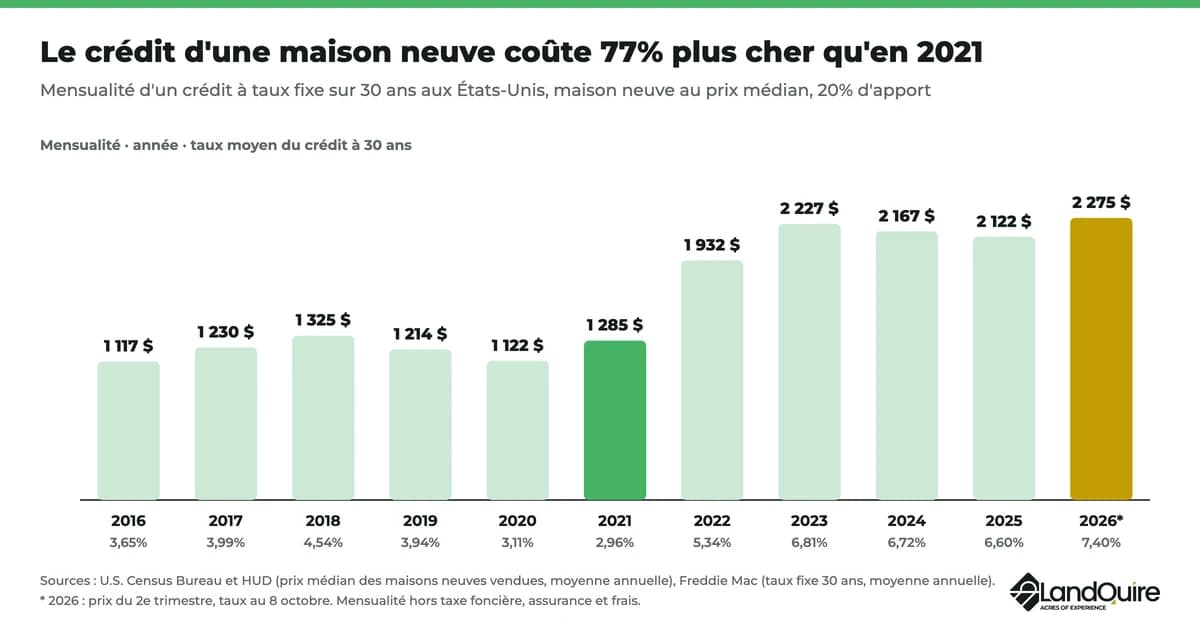
Mortgage rates have risen in the U.S. housing market. The 30-year fixed-rate mortgage stood at 7.40% as of October 8, 2026, up from 6.30% a year earlier, accordingto Freddie Mac’s weekly mortgage survey. For a median-priced new home financed with a 20% down payment, the monthly payment will rise from $1,285 in 2021 to $2,275 in 2026—a 77% increase.
In addition to this cost, there are expenses that investors often underestimate:
- closing costs: fees, title insurance, registration taxes;
- property tax, set by the county and paid annually;
- home insurance, which is more expensive in areas prone to hurricanes;
- HOA fees in residential complexes;
- property management, if you don't live on-site;
- Currency exchange: Every transfer in dollars and every remittance of rent is based on the daily exchange rate of the euro against the dollar.
What taxes do you have to pay on U.S. real estate?
Taxes are assessed at three different times: during the lease, upon resale, and upon transfer of ownership.
Rental Income. According to Article 6 of the Franco-American Tax Treaty of August 31, 1994, rental income from property located in the United States is taxable there. By default, the IRS taxes them at 30% (or at the reduced rate provided for in a treaty); however, the owner may choose to be taxed on net income, after deducting expenses, by exercising the option under Section 871(d) of the U.S. Internal Revenue Code, according to the IRS page on rental income received by nonresidents. The owner reports this income on Form 1040-NR, the IRS tax return for nonresidents. This income must also be reported on this side of the Atlantic: under Article 24 of the treaty, it is included in the tax calculation, and a tax credit equal to the corresponding tax prevents double taxation.
Resale. Capital gains are taxable in the country of sale (Article 13 of the treaty). The buyer withholds a portion of the amount under FIRPTA: according to the IRS page on the FIRPTA withholding, the withholding is generally 15% of the sale price. This withholding applies to foreign investors selling property; it is an advance payment, and the seller subsequently reports the actual capital gain. The capital gain is also reported to the tax authorities in the seller’s country of residence, with a tax credit equal to the tax paid in the United States, up to the amount of tax due. See our article on the FIRPTA withholding.
Transfer of Ownership. Property located in the United States becomes part of its owner’s U.S. estate. According to the IRS page on nonresident estates, a return is required if the value of assets located in the United States exceeds $60,000 at the time of death.
For more information: our guide to federal taxation for foreign investors and our article on the France-U.S. tax treaty. Have your investment structure reviewed by an advisor who is familiar with both tax systems.
Texas or Florida: Where Should You Invest?
There is no single "best" city: it all depends on the strategy, and there are significant differences between states.
- Texas attracts the most new residents (391,243 in one year). The major cities—Houston, Dallas-Fort Worth, Austin, and San Antonio—are where demand and opportunities are concentrated; be sure to check the county property tax rate, which affects profitability. See our article onreal estate in Texas.
- Florida gained 196,680 residents, mainly due to international immigration: its net internal migration fell to 22,517 people in 2025, down from 310,892 in 2022, according to the Census Bureau. Tourism (Orlando, Miami, Tampa) supports the vacation rental market; hurricane insurance is a cost factor to consider. See our guide to investing in Florida.
Be wary of ads for very low-cost homes sold remotely in certain areas of the Midwest, such as Detroit: a bargain-priced property may hide major repairs, unpaid taxes, or a neighborhood that’s difficult to rent out. Our article on real estate investment scams in the U.S. lists the warning signs.
What are the risks?
Every real estate investment in the U.S. carries its own risks, which must be weighed against its benefits:
- Currency risk: Rental income and principal are denominated in dollars; fluctuations in the dollar affect the result once converted.
- Credit risk: At 7.40% over 30 years, leverage is costly and weighs on the returns from a rental investment.
- Remote Property Management: Vacancies, Unpaid Rent, Repairs, and Dealing with the Property Manager.
- Climate risk: hurricanes along the southern coasts, flooding in certain areas, and high insurance premiums in exposed regions.
- Fluctuations in the local market: Property values can decline in a city even when the national market is rising.
- Liquidity: It takes several months to resell, and the FIRPTA withholding ties up a portion of the proceeds.
Real Estate: Investing Without Having to Manage a Property
Land investment allows you to invest your money in real estate without tenants, without renovations, and without taking out a loan yourself. At LandQuire, investors join a company dedicated to the project, which acquires land in a growing area, obtains development permits (zoning, subdivision plan), and then resells it to developers. The investment amount is $100,000 per project, with an average time horizon of 24 to 36 months. The LandQuire team has completed 50 projects since the company’s founding, 37 of which have been sold. Investors receive support from the LandQuire team from acquisition through resale. This type of investment complements the other real estate investments described above.
On the other hand, it is an illiquid investment: the land does not generate income during the investment period, the capital is tied up until resale, and the return is not guaranteed. Our guide toreal estate investment in the United States explains how land appreciates in value, and current projects are listed on the page featuring available real estate opportunities in the United States.
Frequently Asked Questions
Can a French citizen buy a house in the U.S.?
Yes. Any foreign national may purchase a home or land in the country without residing there and without a visa; however, the purchase does not confer the right to reside in the country. A tax identification number (ITIN or EIN) is required, however, to report rental income and the resale of the property.
What is the average price of a home in the U.S.?
New homes sold for a median price of $410,700 in the second quarter of 2026, according to the Census Bureau and HUD. There are significant variations by area: compare these figures with recent sales in your neighborhood.
How much money do you need to invest in real estate in the U.S.?
It all depends on the investment you choose and the returns you’re seeking. A REIT share or an SCPI unit represents a modest investment. A direct rental property purchase requires the property’s value plus fees, or a significant down payment if you’re taking out a loan. At LandQuire, the investment amount for a real estate project is $100,000.
Should I form an LLC?
It’s not mandatory: you can purchase property in your own name. An LLC (limited liability company) separates the property from your personal assets, but its tax treatment on this side of the Atlantic should be verified with an advisor. The right choice depends on the amount, the number of partners, and the intended transfer of ownership.
How is rent taxed?
Rental income is taxable in the country where the property is located: nonresidents must file Form 1040-NR. It must also be reported on your tax return: the 1994 tax treaty takes it into account when calculating taxes and grants a tax credit equal to the corresponding tax, which prevents you from paying twice.
What happens when you resell it?
Capital gains are taxable in the United States. The buyer generally withholds 15% of the sale price as FIRPTA, an advance payment of U.S. tax. The capital gain is also reported on your annual tax return, with a tax credit equal to the tax paid in the United States, up to the amount of tax due.
Can non-residents borrow items at the library?
Yes, some banks lend to non-residents, though the terms are generally stricter. Mortgage rates are high in 2026: an average of 7.40% for a 30-year loan as of October 8, according to Freddie Mac. Nearly one in two foreign buyers pays in cash: 47%, compared with 28% of all buyers, according to the National Association of Realtors. This avoids the cost of borrowing but ties up more capital in a single investment.
What is the best country to invest in real estate?
There is no single “best” country in absolute terms: it all depends on your goals, your time horizon, and your tax situation. In the U.S. real estate market, Texas has the highest population growth (an increase of 391,243 residents in one year). Opportunities are concentrated in the South, with varying levels of risk: hurricane exposure along the coast and property tax rates that vary by county.
This article is for informational purposes only and does not constitute personalized tax or investment advice. Past performance is not indicative of future results. All investments involve the risk of loss of principal.