Real Estate in Florida: Prices, Risks, and Ways to Invest in 2026
Florida is the top destination for foreign real estate buyers in the U.S.: 21% of them buy there. In September 2026, the median price for a single-family home there was $415,000 and for a condominium, $293,500, and the state does not levy an income tax. However, two challenges weigh on the real estate market: the cost of hurricane insurance and new safety regulations for condominiums, adopted following the collapse of a building in Surfside in 2021. This guide provides an overview of the Florida real estate market, actual costs, buying from France, and investment options, ranging from rental properties to land.
In a nutshell
- As of July 1, 2025, Florida had a population of 23.5 million, an increase of 196,680 over the past year, marking the second-largest increase in the country (Census Bureau, January 2026).
- Its growth comes mainly from abroad: 178,674 net inflows from abroad—the highest in the country—compared with only 22,517 from the rest of the country (310,892 in 2022) (Census Bureau, January 2026).
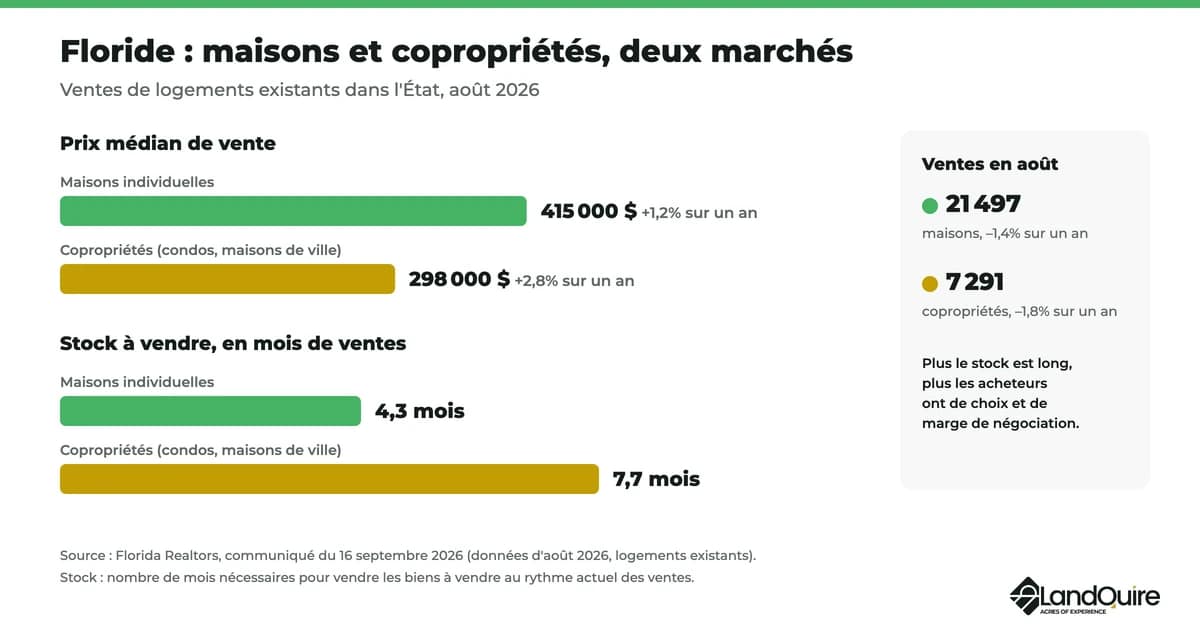
- The median price of a single-family home was $415,000 in September 2026 (+1.2% year-over-year), while the median price of a condominium was $293,500 (-1.8%) (Florida Realtors, October 2026).
- The inventory of condos for sale represents 7.7 months of sales, compared with 4.4 months for single-family homes: there is a wide selection of condos (same source).
- The effective property tax rate is 0.78% of the value of owner-occupied homes, excluding local income taxes on individuals (Tax Foundation, 2026).
- 21% of foreign homebuyers in the U.S. choose Florida, which has been the top destination for at least 15 years (National Association of Realtors, 2025).
Why does Florida attract real estate investors?
Florida’s primary strength lies in its demographics: the population continues to grow, but its composition has changed. According to the U.S. Census Bureau’s 2025 population estimates, the state had 23,462,518 residents as of July 1, 2025—an increase of 196,680 over the past year. Immigration from abroad (178,674) ranks the state first in the country. In-migration from the rest of the country, however, fell to 22,517 in 2025, down from 183,646 in 2023 and 310,892 in 2022: the wave of people moving in from New York or California has clearly subsided.
Foreign home purchases remain concentrated in Florida. According to the National Association of Realtors’ 2025 report on foreign buyers, 21% of them are buying in Florida, which has been the top destination for at least 15 years.
Tourism is driving demand for vacation homes and short-term rentals. A record 143.3 million visitors came to the state in 2025, including 9.3 million from overseas and 2.9 million from Canada, according to preliminary estimates from Visit Florida released by the governor.
Finally, taxation: no personal income tax, and assets denominated in dollars. For an investor, this benefit always comes into play after property taxes and, above all, after insurance.
What will real estate prices be like in Florida in 2026?
The median price of an existing single-family home was $415,000 in September 2026, up 1.2% year-over-year, according to the monthly report from Florida Realtors, the association of Florida real estate agents. The median price of a condominium (condo or townhome) was $293,500, down 1.8%. Home sales declined to 20,537 in September (-3.5%), while condominium sales remained stable at 7,179 (-0.1%).
The difference is most evident in inventory. Single-family homes for sale represent 4.4 months of sales, while townhouses represent 7.7 months. When it comes to condos, buyers therefore have plenty of options and room to negotiate.
Financing costs are a major burden. The 30-year fixed rate stood at 7.40% as of October 8, 2026, up from 6.30% a year earlier, accordingto Freddie Mac’s weekly survey of mortgage rates. Its chief economist cites this rise in borrowing costs as the main cause of the slowdown in sales.
Example: Monthly budget for a median-priced home in Florida, purchased with a mortgage in October 2026
| Post | Amount |
|---|---|
| Median value as of September 2026 | 415 000 $ |
| Contribution (20%) | 83 000 $ |
| 30-year loan at 7.40% | 332 000 $ |
| Monthly loan payment | 2 299 $ |
| Property tax (0.78% per year on average) | $270 per month, or $3,237 per year |
| Total per month, before insurance and fees | 2 569 $ |
At 6.30%, the rate from a year ago, the monthly payment would have been $2,055—$244 less per month. Homeowners insurance is not included: in Florida, this is often the expense that makes the biggest difference, and it varies by address. For a comparison, see our article onreal estate in Texas, and for an overview, check out our guide to investing in real estate in the United States.
Why is the condominium market under pressure?
On June 24, 2021, the Champlain Towers South apartment building, a 12-story condominium in Surfside, near Miami, partially collapsed, according toan investigation by the National Institute of Standards and Technology. Safety regulations for condominiums were subsequently tightened.
- Mandatory inspection at age 30: Florida’s Structural Inspection Law requires a milestone inspection for condominium buildings with three or more habitable stories in the year they turn 30, and every 10 years thereafter. The local government may move up the deadline to age 25, for example, in areas near saltwater.
- Reserve Fund Study: Florida’s Condominium Act requires condominium complexes to conduct a structural integrity reserve study at least once every 10 years. For budgets adopted on or after December 31, 2024, unit owners may no longer vote to set reserve funds at levels lower than those required by law.
As a result, condominium buildings that had set aside little money for renovations now have to catch up. Maintenance fees are rising, and special assessments are being imposed on owners. Some are selling to avoid these costs, which is increasing the number of units on the market.
A savvy buyer can find real room to negotiate, provided they thoroughly review the condominium association’s records before making an offer: budget and reserves, inspection report, analysis of reserves, approved or planned assessments, and building insurance. Buying a condo in Florida without reading these documents means running the risk of paying for repairs that should be someone else’s responsibility.
How much do property taxes and insurance cost in Florida?
Property tax. The average effective rate is 0.78% of the value of primary residences, according to the Tax Foundation’s fact sheet on Florida. This rate takes into account the homestead exemption: according to the Florida Department of Finance, it can reduce the assessed value by up to $50,000, but only if the owner makes the property their permanent residence. A rental property, a vacation home, or land owned by an investor therefore generally pays more in property taxes.
Home insurance. In Florida, all coastal areas are at risk of hurricanes. The cost of insurance varies significantly depending on the age and remaining lifespan of the roof, the distance from the ocean, and the specific area. A good rule of thumb: get an actual quote for your exact address before accepting any offer.
Flood insurance. This is in addition to homeowners insurance. According tothe Federal Emergency Management Agency (FEMA), “Most homeowners insurance does not cover flood damage”: most homeowners insurance policies do not cover flood damage. A policy under the federal program generally takes effect after a 30-day waiting period. Check the flood zone maps for each property you visit.
Which Florida cities are good for investing?
Each region has its own unique characteristics: a beachfront condo in Miami is not the same as properties in the center of the peninsula.
| Region | What drives the demand | Point to Watch For |
|---|---|---|
| Miami, Miami Beach, and Miami-Dade County | International metropolis, finance, ties to Latin America | Older condominiums, coastal properties that are expensive to insure, high entry prices |
| Orlando | Tourism and theme parks, central peninsula, inland | Competition in the Short-Term Rental Market, Local Regulations |
| Tampa | Bay, port, health, diversified economy | Hurricanes Helene and Milton in 2024: Flooding and Insurance |
| Naples (Collier County) | Southwest, affluent and retired clientele | High prices, coastal exposure |
| West Palm Beach and Palm Beach County | Arrival of Financial Companies | Valuations Are Already High |
| Tampa-Orlando Corridor | Growth Between the Two Major Cities | Lower liquidity in secondary markets |
From Palm Beach County to Miami Beach, via Fort Lauderdale, the southeastern coast forms a single large metropolitan area centered on Miami; Tampa and Orlando are part of a different market—that of the central region and the west coast. In any case, insurance, flood risk, and—for a condo—the financial health of the homeowners’ association must be verified on a property-by-property basis. These factors account for the difference between two neighboring addresses.
How do I buy real estate in Florida from France?
The rules for buying a home are the same throughout the U.S.; our guide to investing in the United States explains them in detail. Here’s what you need to know in Florida.
A French citizen can purchase a house, a condo, or a piece of land in Florida without a visa or authorization. Ownership does not confer any right to reside in the United States.
- Choose the legal structure: as an individual or through a U.S. company. Our guide to forming an LLC in the U.S. compares the two options.
- Obtain a tax ID: an ITIN for individuals who do not have a U.S. Social Security number, according to the IRS page on ITINs, or an EIN for a business.
- Opening a bank account in U.S. dollars: The bank requires supporting documents (passport, proof of address, proof of the source of funds).
- Make an offer through a Florida-licensed real estate agent or real estate agency after obtaining an insurance quote and, for a condo, reviewing the condominium documents. The real estate transaction is finalized through a title company, which verifies the title;title insurance protects the buyer against any defects discovered later.
- Financing the Purchase: Banks are reluctant to lend to non-residents, and 47% of foreign buyers pay in cash (National Association of Realtors). Our guide to real estate financing in the U.S. for foreign investors details the options.
- Plan for the resale: According to the IRS page on FIRPTA, the buyer generally withholds 15% of the sale price as a FIRPTA withholding. This is an advance payment on the tax due, which is adjusted after filing the tax return.
Rent and capital gains are taxable in the country where they are earned; the France-U.S. tax treaty prevents double taxation.
Pitfalls specific to Florida: buying without an insurance quote, buying a condo without auditing the homeowners’ association, ignoring flood zones, relying on the gross return advertised by the seller, and buying remotely without an agent or a reliable local contact. Our article on red flags to watch for before investing in the United States helps you spot deals that seem too good to be true.
Rental, Seasonal, or Real Estate: How to Invest in Florida?
Year-round rentals. There is demand for rentals, driven by an influx of new residents and by households that the cost of borrowing is keeping from buying a home. Profitability is calculated after accounting for insurance, property tax, homeowners’ association (HOA) fees, management costs, and periods without tenants.
Seasonal rentals. With record visitor numbers in 2025, demand for vacation homes and apartments is high around Orlando and along the coast. However, many cities and condominium associations regulate or prohibit short-term rentals, imposing licensing requirements and tourist taxes. Management is cumbersome, and the business is seasonal.
Investing in land. This involves purchasing land in a developing area, obtaining the necessary permits to subdivide it into lots (our article on the subdivision plan approval process details the steps), and then reselling it to homebuilders. In Florida, this approach avoids the two major constraints of built property: a plot of land has no roof to protect against hurricanes, no homeowners’ association, and no tenants. On the other hand, it generates no income until it is resold. Our guide toland investment in the United States details the steps and risks involved.
| Year-Round Rentals | Vacation Rental | Land to be developed | |
|---|---|---|---|
| Revenue | Monthly Rent | Rent varies by season | None prior to resale |
| Major Costs | Insurance, property tax, HOA, management | Insurance, concierge services, housekeeping, tourist taxes | Property Tax, Studies, and Permits |
| Hurricane Insurance | Yes | Yes | No (no building) |
| Local Rules | Lease, Tenant Rights | Licenses, Possible Restrictions | Zoning, subdivision into lots |
| Main Risk | Rise in Insurance Costs and Expenses | Ban or Decline in Attendance | Delays or Denials of Authorizations |
How does LandQuire invest in real estate in Florida?
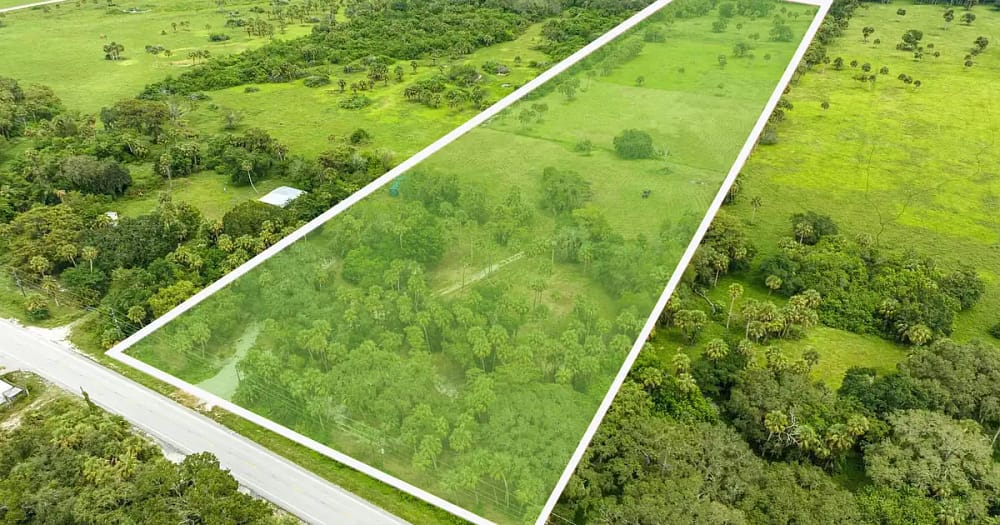
LandQuire is an American company based in Florida. It is developing real estate projects there in Pomona Park (65 acres, or 26 ha), Okeechobee, Bunnell, and Lady Lake. As of October 2026, two projects in Florida are underway: Pomona Park and Okeechobee. In Bunnell and Lady Lake, as well as in one of the two Okeechobee projects, the land is zoned for manufactured homes, a more affordable form of housing. The other Okeechobee project is a site approved for a RV park. In total, LandQuire has completed 50 projects in the United States, 37 of which have been sold: see our previously sold land projects.
The method is the same everywhere: analyze the 3,143 U.S. counties using an algorithm based on more than 120 criteria, purchase land where the population is growing, obtain the necessary permits (zoning, subdivision, utility connections), and then resell the land to homebuilders. LandQuire manages the project from start to finish; tax matters are handled by an independent U.S. certified public accountant (CPA).
To invest, the minimum investment is $100,000 per project. Fees are included in each project’s budget, with no annual fees. Each partner receives a quarterly report throughout the project’s lifespan; the project company is established for 5 years, with the option to extend for one year. Explore our available real estate opportunities. These opportunities are reserved for experienced investors; capital is tied up for the duration of the project and may be partially lost.
What are the risks of investing in real estate in Florida?
- Insurance: Hurricanes and Floods. The actual quote takes precedence over any simulation.
- Condominiums: Inspections, reserve fund studies, and special assessments since the laws passed following the Surfside incident.
- Property tax: higher for an investor, who is not eligible for the homestead exemption.
- Interest rates: At 7.40%, they reduce the profitability of a debt-financed acquisition.
- Short-term rentals: changing local regulations, bans in certain cities and condominium complexes.
- Land-related issues: delays or denials of permits, utility costs (water, sewer), wetlands, or flood-prone areas. Our method for evaluating a property before investing includes these key considerations.
Frequently Asked Questions
Can a French citizen buy real estate in Florida?
Yes, without a visa or residency requirements, whether it’s a house, a condo, or a plot of land. The sale is arranged with a real estate agent, finalized through a title company, and requires a U.S. tax identification number (ITIN or EIN). Ownership does not confer any right to reside in the United States.
What is the average price of a house in Florida?
In September 2026, the median price of an existing single-family home was $415,000 (+1.2% year-over-year), while that of a condominium was $293,500 (-1.8%). There are significant differences between Miami and Naples and the cities in the central region.
Is now a good time to buy in Florida?
The balance of power has shifted in the condominium market: 7.7 months of inventory as of September 2026, and a local real estate agent can help you negotiate. This is a more favorable entry point than in 2021–2022, provided you obtain an accurate insurance quote and, for a condo, have the condominium association audited before signing. Mortgage rates at 7.40% remain a hurdle.
Is there an income tax in Florida?
No, there are none for individuals (Tax Foundation). Income from Florida property remains subject to U.S. federal tax, and the Franco-American tax treaty prevents double taxation.
How much is property tax in Florida?
On average, it amounts to 0.78% of the value of owner-occupied homes (Tax Foundation, 2026). It varies by county. An investor who is not eligible for the homestead exemption (up to $50,000 in exempt value) generally pays more.
Do You Need Flood Insurance in Florida?
Most of the time, yes. According to FEMA, most homeowners’ insurance policies do not cover flooding, and coverage under the federal program generally takes effect after 30 days. Check the flood zone for the properties you visit before making an offer.
Is Florida a good place to live if you're French?
The climate is warm year-round, and quality of life depends largely on the city: life in Miami, an international metropolis, is nothing like life in a small town in the interior. On the other hand, home insurance is expensive, and the hurricane season requires precautions.
Should you invest in Florida or Texas?
Neither state levies an income tax on individuals. Texas has seen greater population growth (391,243 in one year, compared to 196,680) and has a higher property tax rate (1.40% versus 0.78%); Florida attracts more foreign buyers, but its entire coastline is vulnerable to hurricanes. Our Texas vs. Florida comparison details the differences regarding real estate.
How Can You Invest in Real Estate in Florida with LandQuire?
LandQuire purchases land in areas where the population is growing, obtains the necessary permits, and then resells the land to developers. In Florida, its projects are located in Pomona Park, Okeechobee, Bunnell, and Lady Lake. The minimum investment is $100,000 per project, and these opportunities are reserved for experienced investors.
This article is for informational purposes only and does not constitute personalized tax, legal, or investment advice. The figures are those published as of the date of the last update. Past performance is not indicative of future results. All investments involve the risk of loss of principal.