Private Real Estate Debt: How It Works and the Risks Involved
Private real estate debt involves lending to a developer or real estate investor—other than a bank—at a predetermined interest rate. You can access it through a fund, a platform, or unlisted bonds.

By Thibaut Guéant, co-founder and CIO of LandQuireUpdated on 5-minute read
Table of Contents

Private real estate debt involves lending to a developer or real estate investor—other than a bank—at a predetermined interest rate.
You can invest in it through a fund, a platform, or unlisted bonds. The return comes from the interest rate; the risk comes from selling the investment at the right time.
In a nutshell
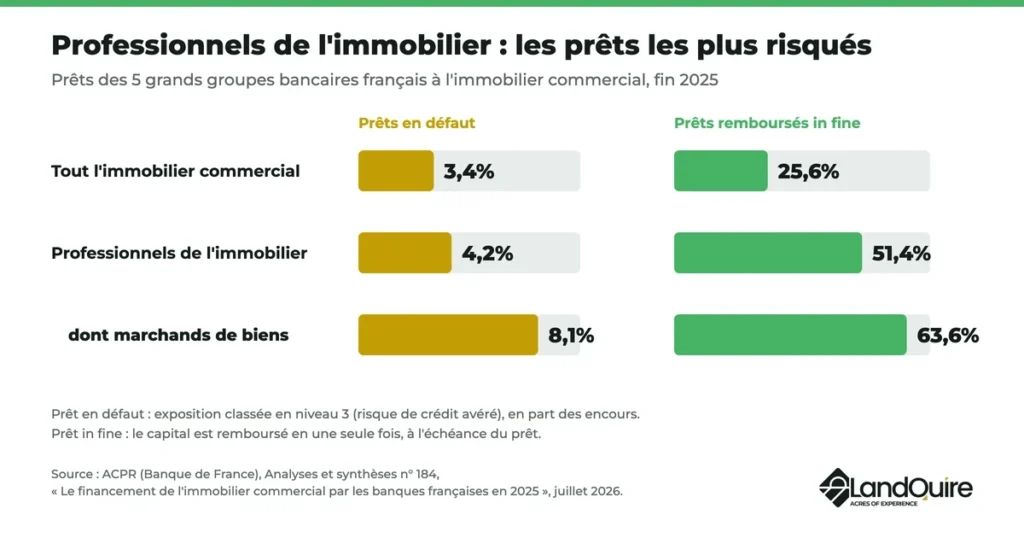
- At the end of 2025, 8.1% of bank loans to real estate developers were in default, compared with 3.4% for commercial real estate (ACPR, July 2026).
- Investment in commercial real estate fell by 37% in the first quarter of 2026 (ACPR, July 2026).
- Since 2026, interest has been taxed at a rate of 31.4%: 12.8% in income tax and 18.6% in social security contributions (impots.gouv.fr, 2026).
- As of early December 2025, France had 70 ELTIF funds, 46 of which were open to retail investors (AMF, January 2026).
- U.S. private credit stood at approximately $1,400 billion at the end of 2024 (ECB, May 2026).
What is private real estate debt?
This is real estate financing provided by investors rather than a bank, for the purpose of purchasing land, constructing a building, or refinancing a property.
In its article on global private credit, the ECB defines private credit as direct loans from non-bank entities.
An individual can access it by:
- a debt fund that provides financing for various transactions;
- one platform: real estate crowdfunding, through accredited providers, is the best-known form of this;
- unlisted bonds issued by the company involved in the transaction.
Senior, mezzanine, seller-financed: which priority?
The rank determines the order of repayment if the transaction goes wrong.
| Debt | Reimbursed | Counterparty |
|---|---|---|
| Senior | First, often secured by a mortgage | Lowest rate |
| Mezzanine | After the senior debt | Higher rate |
| Seller Credit | According to the contract: the seller is paid in part at a later date | Sale Price or Interest |
Shareholders (equity) are subordinate to all debts. A convertible bond combines the two: it starts as a loan but can become equity.
How is yield determined?
The yield is the contract's interest rate. The lower the priority and the newer the project (land, permits), the higher the yield.
Subtract fees, taxes, and any losses: an advertised rate is not a guaranteed return.
To compare investments with different durations, we use the real estate IRR.
What are the risks associated with private real estate debt?
| Risk | What triggers it | What to Check |
|---|---|---|
| Defect | Slow sales, rising costs | Borrower's Down Payment, Collateral |
| Delay | Permits, Construction Sites, Sales | Extension Clause |
| Liquidity | No market to resell in | Fund Redemption Terms and Conditions |
| Priority of claims | Mezzanine or subordinated debt | Refund Order |
| Concentration | One developer, one city | Number of funded projects |
According tothe ACPR’s study on commercial real estate financing, 51.4% of bank loans to real estate professionals are repaid in a single lump sum at maturity.
Such a repayment depends on the sale: if it is delayed, the due date is pushed back.
The ECB also notes a wave of redemption requests in U.S. semi-liquid private credit funds.
What are the tax rules for individuals in France?
Interest is subject to the single flat-rate withholding tax: 12.8% in taxes and, as of 2026, 18.6% in social security contributions, according to the impots.gouv.fr page on investment income.
You can choose the progressive tax scale (box 2OP) for all your investment income.
Example: €3,000 in interest
| Step | Calculation | Amount |
|---|---|---|
| Income Tax | 3,000€ × 12.8% | 384€ |
| Social Security Contributions | 3,000€ × 18.6% | 558€ |
| Net interest | €3,000 – €942 | €2,058 |
How is private debt regulated?
A debt fund is an alternative investment fund (AIF) regulated by the AMF.
Bonds may conceal a fund: In a July 2026 warning, the AMF notes that even a slight decline in assets can jeopardize repayment.
The ELTIF, a European long-term investment fund to be revised in 2024, will be opened to individual investors: 70 in France by early December 2025, according to the AMF’s 2026 priorities.
Private Debt or Equity: Where Does LandQuire Stand?
In a LandQuire real estate project, the investor does not provide a loan: instead, they acquire an equity stake in the project’s special-purpose company (LLC) in the United States, starting at $100,000.
Without receiving interest, he shares in the capital gains upon resale and bears the risk of loss. Some projects use a seller’s loan, which is repaid before the partners are paid.
LandQuire Management LLC also offers a convertible bond: a loan to the company, which pays interest, that converts into shares of its capital only under the circumstances specified in the contract.
The company does not repurchase shares. A sale remains possible with the manager’s consent, subject to rights of first offer and preemption.
Learn how to invest with LandQuire and about the risks of real estate investing. For comparison, read our guide to investing in real estate without property management.
Real estate tokenization breaks an asset down into tokens; on the land side, consider the difference between land banking and entitlement.
Frequently Asked Questions
Is private real estate debt risky?
Yes: the principal is not guaranteed, and the debt is difficult to resell.
Who takes out private real estate loans?
Mainly developers and real estate investors, for a short-term project: purchase, renovation, or construction, followed by resale.
Can you get your money back before the due date?
Rarely. A loan continues until it is repaid; a fund sets its exit conditions, which may be suspended.
How much should you invest in private debt?
A small portion of one's financial assets, after setting aside emergency savings, spread across several transactions.
Is private equity a form of debt?
No. Private equity firms buy equity and share in both profits and losses; lenders, on the other hand, expect to receive interest.
How does this differ from an SCPI?
An SCPI purchases leased properties and collects rent. A private lender finances a transaction and collects interest, without owning the property.
If you’d like to invest a small portion of your assets in real estate, explore our real estate opportunities in the United States or contact the LandQuire team.
This article is for informational purposes only and does not constitute personalized advice. Rates and rules are current as of the date of this update. Any unlisted investment carries a risk of capital loss.

About the Author
Thibaut Guéant, co-founder and CIO of LandQuire, founded the company in 2021 with Romain Daniellou. As a land entitlement specialist, he identifies off-market raw land, primarily in Texas, and oversees the process of obtaining zoning permits that make the land buildable before reselling it to developers.