Real Estate TRI: Definition, Calculation, and Limitations
The IRR (internal rate of return) of a real estate investment is the rate that makes the net present value of all its cash flows—purchase price, rent or distributions, and resale price—equal to zero. It summarizes the profitability of an investment as a single annual percentage, taking into account when each euro was spent and then received.

By Thibaut Guéant, co-founder and CIO of LandQuireUpdated on 12-minute read
Table of Contents
- What is IRR in real estate?
- How do you calculate the IRR of a real estate investment?
- TRI, rental yield, multiple: What are the differences?
- What are the limitations of the IRR?
- How do you perform an IRR sensitivity analysis?
- Where is IRR used in real estate?
- How do you interpret the IRR of a real estate transaction?
- Frequently Asked Questions

The IRR (internal rate of return) of a real estate investment is the rate that makes the net present value of all its cash flows equal to zero: purchase price, rent or distributions, and resale price.
It summarizes the return on an investment as a single annual percentage, taking into account when each euro was spent and then recouped.
Here is the formula, a step-by-step calculation using a hypothetical example, how it differs from rental yield and the multiple, and its limitations.
In a nutshell
- The internal rate of return is the rate at which the net present value of an investment is zero (ASPIM, October 2025).
- For an SCPI, it is calculated based on at least the last five years, never on a period of fewer than twelve months (ASPIM, October 2025).
- As of the end of 2023, the median IRR for FIPs was -2.4% and that for FCPIs was -1.1% (AMF, January 2025).
- The average distribution rate for SCPIs reached 4.92% in 2025: this is not an IRR, as it does not take into account changes in the value of the shares (ASPIM, May 2026).
What is IRR in real estate?
The internal rate of return is the discount rate at which the sum of an investment's cash flows, discounted to their present value, equals zero.
The ASPIM methodology note uses the same definition (October 2025).
The IRR Formula
The equation has a single unknown, the IRR, based on cash flows spread over n periods:
– initial investment + amount 1 ÷ (1 + IRR) + amount 2 ÷ (1 + IRR)² + … + amount n ÷ (1 + IRR)ⁿ = 0
Cash outflows (purchases, expenses, renovations) are negative; cash inflows (net rent, distributions, sales) are positive.
TRI and VAN: What's the connection?
The NPV (net present value) indicates a project’s current value by discounting its cash flows to the rate of return you require—for example, the rate of return on a risk-free investment.
The IRR works in the opposite direction: it determines the rate at which the NPV falls to zero. If the NPV is positive at the required rate of return, the investment is profitable at that rate.
How do you calculate the IRR of a real estate investment?
Let's consider a hypothetical example for educational purposes: a rental apartment that was purchased, rented out for 5 years, and then sold.
| Year | Cash Flow | Amount |
|---|---|---|
| 0 | Purchase price, including notary fees | -200,000€ |
| 1 through 4 | Rent after utilities, property tax, and insurance | +8,000€ per year |
| 5 | Last net rent and resale price, net of selling expenses | +8,000€ + 220,000€ |
| Total | Net gain over 5 years | +60,000€ |
Fictitious example for illustrative purposes, before taxes and without a loan.
Step 1: Calculate the NPV using multiple rates
We discount each cash flow: the rent for the third year, for example, is worth €8,000 ÷ (1 + rate)³ today.
| Tested discount rate | Operational VAN |
|---|---|
| 4% | +16,439€ |
| 5% | +7,012€ |
| 6% | -1,904€ |
Fictitious example; figures from LandQuire.
It changes sign between 5% and 6%, so the IRR falls between those two values.
Step 2: Find the rate that makes the NPV zero
Interpolation yields an approximate value: 5% + 7,012 ÷ (7,012 + 1,904) × 1 point, or approximately 5.8%.
The exact calculation yields an IRR of 5.78% per year: at this rate, the present value of the rent and the resale price equals the €200,000 invested.
Step 3: Check in Excel or Google Sheets
Enter the cash flows in a column (-200,000, 8,000, 8,000, 8,000, 8,000, 228,000), then enter the formula =IRR(range) in Excel or Google Sheets in French.
The TRI.PAIEMENTS function takes into account the exact date of each transaction: it is used whenever payments are not made on a fixed date.
TRI, rental yield, multiple: What are the differences?
Using the same hypothetical example, five indicators yield five different numbers.
| Indicator | Calculation Using the Example | Result | What it measures |
|---|---|---|---|
| Rental yield | 8,000€ ÷ 200,000€ | 4.0% per year | Revenue for the year, excluding sales |
| Multiple (MOIC) | (40,000€ + 220,000€) ÷ 200,000€ | 1,30x | What you get back for every €1 invested, regardless of the time spent |
| Simple average return | 60,000€ ÷ 5 ÷ 200,000€ | 6.0% per year | Average annual earnings, without a schedule |
| Annualized Return on the Multiple | 1.30 to the power of 1/5, minus 1 | 5.4% per year | The return on an investment that would pay out everything at the very end |
| SORT | The rate that makes the net present value zero | 5.8% per year | Profitability that takes into account the date of each cash flow |
Fictitious example; figures from LandQuire; before taxes.
Rental yield: income, minus expenses
The gross or net rental yield is calculated by dividing the annual rent by the initial investment. It says nothing about the capital gain or loss that the market will yield upon exit.
In the example, it comes to 4%, while the entire transaction yields 5.8% per year thanks to the sale.
Multiple: how many, but not in how long
The multiple, known as MOIC (multiple on invested capital) or TVPI in funds, is calculated by dividing the total amount you have received by the amount you have contributed.
A 1.30x multiple can be achieved in 2 years or in 10 years: only the IRR makes the difference, as shown in the graph.
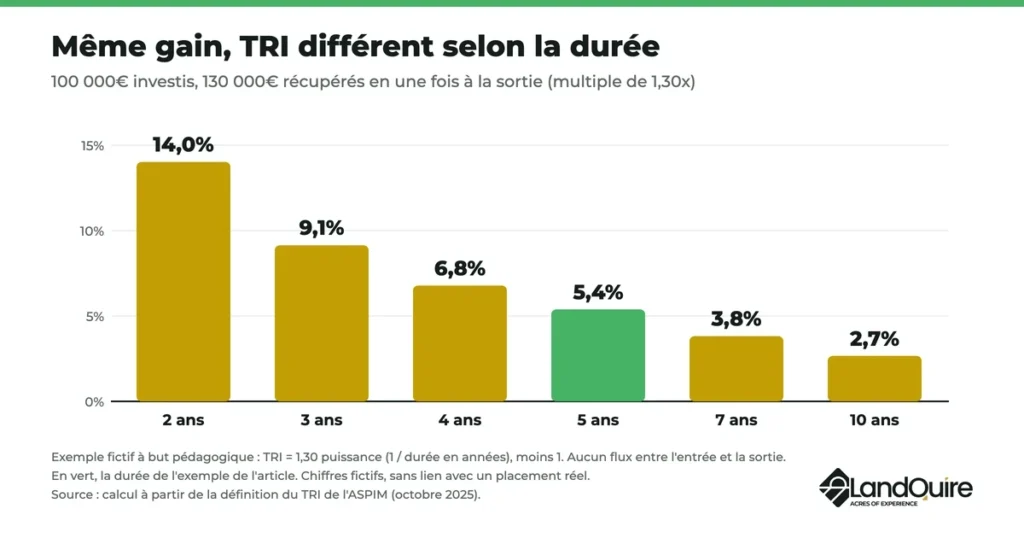
An IRR of 14% over 2 years and a multiple of 1.30x describe the same investment; if held for 10 years, that same IRR would increase the multiple to 3.7x.
A high IRR over a short period yields little in euros if you can't find an equivalent investment afterward: always look at both figures together.
What are the limitations of the IRR?
On its own, this indicator does not adequately reflect a real estate investment. There are four limitations that apply to any real estate transaction, whether or not a loan is involved.
The Reinvestment Hypothesis
The method assumes that each rent payment received is reinvested at the same rate as the IRR itself. This is rarely the case.
The modified IRR (the TRIM function in Excel) corrects this bias. In the example, when rental income is reinvested at 3%, the IRR drops to 5.6%; when left in a non-interest-bearing account, it drops to 5.4%.
Sensitivity to duration and timing
It depends on the dates as much as it does on the profit. In the example, a resale signed 3 months later, for the same amount, brings the rate down from 5.8% to 5.5%.
A sale one year later—with no rent collected during that vacant year—brings the rate down to 4.9%. For a project with no interim income, every month of delay weighs even more heavily.
Theoretical cash flows, fees, and taxes
A published IRR is often based on theoretical cash flows.
For a real estate investment trust (REIT), ASPIM considers the purchase price upon entry, the gross distributed income, and the redemption value upon exit.
These distributions are deemed to have been paid on December 31: each investor’s IRR varies depending on their investment date, fees, and taxes.
The fees have a direct impact: an additional €10,000 in acquisition costs in this example brings the rate down from 5.8% to 4.7%.
Taxation also affects net income: whether through the LMNP (furnished rental) program, a life insurance policy, or a direct investment, two investors will not achieve the same return on the same property.
Leverage
Creditleverage increases the return on equity when the transaction goes well, and wipes it out when it goes wrong.
In this example, with a balloon loan of €150,000 at 3.5% and a down payment of €50,000, the IRR on the down payment rises to 11.8%. If the property is resold for €180,000, the IRR becomes negative, at -3.0%.
How do you perform an IRR sensitivity analysis?
A sensitivity analysis recalculates the IRR by changing one assumption at a time: exit value, lease payments, time horizon, or fees.
It shows which market or project variable poses a threat to the operation.
| Modified Hypothesis (Fictitious Example) | SORT | Multiple |
|---|---|---|
| Base Scenario | 5,8% | 1,30x |
| For sale at €240,000 | 7,4% | 1,40x |
| Sold for €200,000, with no capital gain | 4,0% | 1,20x |
| For sale at €180,000 | 2,1% | 1,10x |
| Rents down 10% | 5,4% | 1,28x |
| Sale after 7 years, same amount | 5,2% | 1,38x |
| An additional €10,000 in acquisition costs | 4,7% | 1,24x |
LandQuire calculation based on a hypothetical example, before taxes and without a loan.
In this case, the resale price has a greater impact than rental income: a €20,000 decrease in resale value reduces the IRR by 1.8 percentage points, while a 10% drop in rental income reduces it by 0.4 percentage points.
Before investing, ask yourself at what resale price your internal rate of return falls below that of a guaranteed investment with the same time horizon.
Where is IRR used in real estate?
The IRR of SCPIs
Fund management companies publish this rate for each fund. According to ASPIM, it is shown for the past five years, or since the fund’s inception for a newer fund.
ASPIM also recommends publishing it for 5-, 10-, and 15-year periods in the annual report—where the 10-year IRR is listed—or in the newsletter.
According to the AMF’s fact sheet on SCPI disclosures, it allows investors to evaluate the investment’s past performance.
It takes into account changes in the value of the share and dividends for the period. The AMF reminds investors that past performance is not indicative of future results.
The payout ratio, on the other hand, measures only annual earnings: an average of 4.92% in 2025, according to ASPIM’s 2025 performance indicators, published on May 19, 2026.
The IRR of Private Equity Funds
Private equity funds report their performance in terms of IRR. The AMF’s first study on the performance of unlisted funds shows widely varying results.
At the end of 2023, the median IRR for FIPs was -2.4% and that for FCPIs was -1.1%, compared with 5% for FCPRs open to redemptions, which have a relatively short track record (AMF, January 2025).
According to the AMF, funds reserved for professional investors perform better, mainly because of incremental capital calls: money contributed later carries less weight in the calculation.
Our guide toprivate equity investments compares the liquidity, fees, and potential losses associated with these funds.
TRI Targets Club Deals
Real estate club deal operators often announce a target IRR: a projection based on assumptions about the market, construction work, and the timeline—not a promise.
Ask about the expected multiple, the investment horizon, the fees, and the worst-case scenario: without them, a target IRR is meaningless.
IRR and Private Debt
In private real estate debt, profitability is primarily measured by the interest rate; the IRR is used to compare a loan that is repaid late with a capital investment.
How do you interpret the IRR of a real estate transaction?
For a piece of land, the bulk of the cash flow generally comes from the sale, with no interim rental income: the IRR therefore becomes highly sensitive to the timing.
LandQuire, based in Hollywood, Florida, purchases land in the United States, obtains development permits, and then resells it to developers and builders.
Investors select their projects one by one through a dedicated limited liability company (LLC), with a minimum investment of $100,000.
Payments depend on sales: the bulk is generally paid upon the resale of the land, but a project sold in phases may result in several payments.
No schedule is guaranteed.
What to Look for When Interpreting a Real Estate IRR:
- Timeframe: Target duration: approximately 36 months for ongoing fundraising rounds, with no guarantees. Plan for 5 years or more;
- Fees: included in each project's budget, with no annual management fees, and itemized in the project documents;
- Liquidity: The company does not repurchase shares. A sale is possible with the manager’s consent, subject to rights of first offer and preemption;
- The source of profit: value creation through permits, explained in our guide to land appreciation.
The results of past transactions are reflected in our sold real estate projects. Past performance is not indicative of future results.
The steps for signing up are on the "How to Invest with LandQuire" page, and the risks of real estate investing are detailed on a dedicated page.
U.S. real estate remains one option among others for a small portion of one's assets.
Frequently Asked Questions
What is a good IRR in real estate?
There is no universal threshold. To evaluate an IRR, compare it to the return on a risk-free investment with the same time horizon, as well as to the risk of loss and liquidity.
A high IRR on an investment tied up for a long time isn't necessarily more profitable than a lower IRR on an investment that's readily available.
What is the difference between IRR and target IRR?
The actual IRR is calculated based on the amounts actually paid to the investor once the transaction is complete.
The target or projected IRR is based on assumptions: it may never be achieved, and a loss of principal remains possible.
Is the IRR expressed on an annual basis?
Yes, as a percentage per year, like an interest rate.
That is why the ASPIM method does not report a fund’s IRR for periods shorter than twelve months: a 2% return over three months, when annualized, would be misleading.
What does a negative IRR mean?
That the investor received less money than he paid in, taking into account the date of each payment.
At 0%, he merely broke even—no profit.
Should we compare gross or net IRR?
Always compare IRRs net of fees, and net of taxes if possible: tax treatment depends on your situation and the investment vehicle (unfurnished rental, LMNP, life insurance).
Also compare results calculated over the same time horizon, with the same end date, with and without credit.
Can we compare the IRR of an SCPI to that of a club deal?
With caution. An SCPI’s track record reflects past performance—over a 5- or 10-year period—of a diversified portfolio that can be sold under certain conditions.
A club deal typically involves a single transaction, with capital locked up until the exit.
If you’d like to invest a small portion of your assets in real estate, explore our real estate opportunities in the United States or contact the LandQuire team.
This article is for informational purposes only and does not constitute personalized investment advice. The numerical examples are fictitious and do not represent any actual investment. Past performance is not indicative of future results. Any unlisted investment carries a risk of capital loss.

About the Author
Thibaut Guéant, co-founder and CIO of LandQuire, founded the company in 2021 with Romain Daniellou. As a land entitlement specialist, he identifies off-market raw land, primarily in Texas, and oversees the process of obtaining zoning permits that make the land buildable before reselling it to developers.