Unlisted Investments: Benefits, Liquidity, and Risks

An unlisted investment involves putting your money into an asset that is not traded on a stock exchange: a company, a private debt instrument, a building, or land.
The potential return may be high, but the money remains tied up for several years and could be lost.
The AMF recommends setting aside this amount for at least 8 to 10 years and allocating only a small portion of your total assets to it.
Here are the major categories of unlisted investments, their investment horizons, their tax treatment in 2026, and their risks.
In a nutshell
- An unlisted stock “cannot be bought or sold on the stock market”; the AMF recommends setting aside the funds for at least 8 to 10 years (AMF).
- The French private equity sector raised 42.9 billion euros and invested 36.4 billion euros in 2025 (France Invest and Grant Thornton, March 2026).
- Its net IRR has been 11.3% per year since inception and 12.4% over 10 years, as of the end of 2024 (France Invest and EY, July 2025). These are past performance figures.
- FIPs and FCPIs available to the general public have median IRRs of -2.4% and -1.1% (funds active as of the end of 2023) and annual fees of 3.5% and 3.2% (AMF, January 2025).
- The FCPI tax credit is eliminated for subscriptions made on or after February 21, 2026, except for investments in innovative startups: 30% of contributions (BOFiP, August 2026).
- At LandQuire, investments in unlisted U.S. real estate start at $100,000 per project, with a 5-year term that can be extended by one year.
What is an unlisted investment?
The unlisted market includes all assets that are not traded on financial markets. It is also referred to as the private market.
Their price is not displayed continuously: it is negotiated between a buyer and a seller, or estimated by an asset management firm.
According to the AMF’s fact sheet on unlisted stocks, these securities are primarily issued by small and medium-sized enterprises seeking financing.
Shareholders retain the same rights as in a publicly traded company: the right to vote at general meetings and the right to dividends.
Investing in these securities can serve several purposes, the AMF adds: supporting a company you’re familiar with, or betting on its growth potential.
Long reserved for institutional investors (insurers, pension funds), private markets are now opening up to individual investors through funds, platforms, and project companies.
What are the major categories of unlisted companies?
There are four main categories, depending on what your money is used to fund.
Private Equity
Private equity involves acquiring stakes in privately held companies, growing them, and then selling those shares.
Private equity strategies follow the company's life cycle:
- Venture capital funds companies in the startup phase—those less than 5 years old, according to the AMF;
- Growth capital supports the development of a profitable company;
- Succession capital finances the acquisition of a company, often through a loan (LBO);
- Turnaround capital acquires struggling companies.
Private Debt
These strategies lend directly to companies or finance infrastructure projects without issuing publicly traded bonds.
The investor receives interest rather than capital gains.
Unlisted Real Estate
This category includes SCPIs, which make you a co-owner of a portfolio of rental properties.
It also includes real estate club deals, in which a small group of investors finances a single transaction.
Real estate crowdfunding involves lending money to a developer for a short period of time in exchange for a specified interest rate.
Conversely, a REIT is a U.S. real estate investment trust that is most often publicly traded: it is not a privately held company.
Land and Real Assets
Land, forests, farmland: These real assets do not always generate income, but their value may increase with use.
The U.S. real estate that LandQuire purchases, obtains permits for, and then resells belongs to this family.
All of these asset classes fall underthe umbrella of alternative investments, just like commodities.
How do you invest in unlisted companies?
There are three routes, each with very different fares.
- In real time. You purchase securities in a startup directly from the company, from a partner, or through a regulated crowdfunding platform, into a securities account or a PEA opened with your financial intermediaries.
- Through a fund. According to the AMF, an FCPR invests at least 50% of its assets in unlisted securities; an FCPI or an FIP invests at least 60% in innovative companies or regional SMEs.
- Through a project company. You become a partner in an entity that owns a single asset (building, land), as in a club deal.
Since the revision of the European ELTIF 2 regulation, effective January 10, 2024, European long-term investment funds have become more accessible to individual investors.
They must invest at least 55% of their assets in long-term assets, according to the AMF.
As of early December 2025, France had 70 ELTIFs, 46 of which were open to retail investors, according to the AMF’s 2026 Priorities Report.
Some multi-asset life insurance policies also offer unlisted funds—particularly real estate funds—as unit-linked investments.
The PEA-PME accepts securities from small and medium-sized enterprises (SMEs) and mid-sized companies, with a contribution limit of 225,000 euros, according to service-public.fr.
What are the benefits of an unlisted investment?
The primary appeal is the prospect of high returns over the long term.
According tothe France Invest and EY study on net performance, the French private equity sector posted a net IRR of 12.4% per year over a 10-year period ending in 2024.
In a comparison with listed markets from the same study, it came out at 12.7% per year over 10 years, compared with 8.9% for the CAC 40.
Funds established since 2008 that have been fully liquidated have returned 1.78 times their investors' initial investment.
These averages mask significant disparities between the top private equity firms and the rest: choosing the right management team and strategies matters more than the asset class.
Other benefits:
- Diversification: The value does not follow the daily fluctuations of the markets, and the AMF notes that it generally exhibits lower volatility than that of listed stocks;
- access to the real economy: opportunities not listed on the stock market, such as start-ups, infrastructure, real estate, or land;
- an active shareholder role: the manager supports the company or project until it is sold;
- tax incentives for certain funds, as detailed below.
The market is deep: in 2025, French teams raised 42.9 billion euros and invested 36.4 billion euros in 2,904 companies and infrastructure projects.
This is according to the 2025 annual report by France Invest and Grant Thornton.
What level of liquidity and what investment horizon should you plan for?
Exiting the investment comes at a cost. Without a regulated market, there is no guarantee of finding a buyer, and the resale price is difficult to estimate, the AMF notes.
In a fund, shares “are not tradable, so selling them takes several months,” according to the AMF fact sheet on FCPRs, FCPIs, and FIPs.
A fund can last up to 10 years, or even longer.
Unlisted real estate is no exception to the rule. At the end of 2025, €2.8 billion in SCPI shares were awaiting a buyer, representing 3.1% of the market capitalization.
This is shown in the 2025 report by ASPIM and IEIF, which notes an average payout ratio of 4.91% for that year.
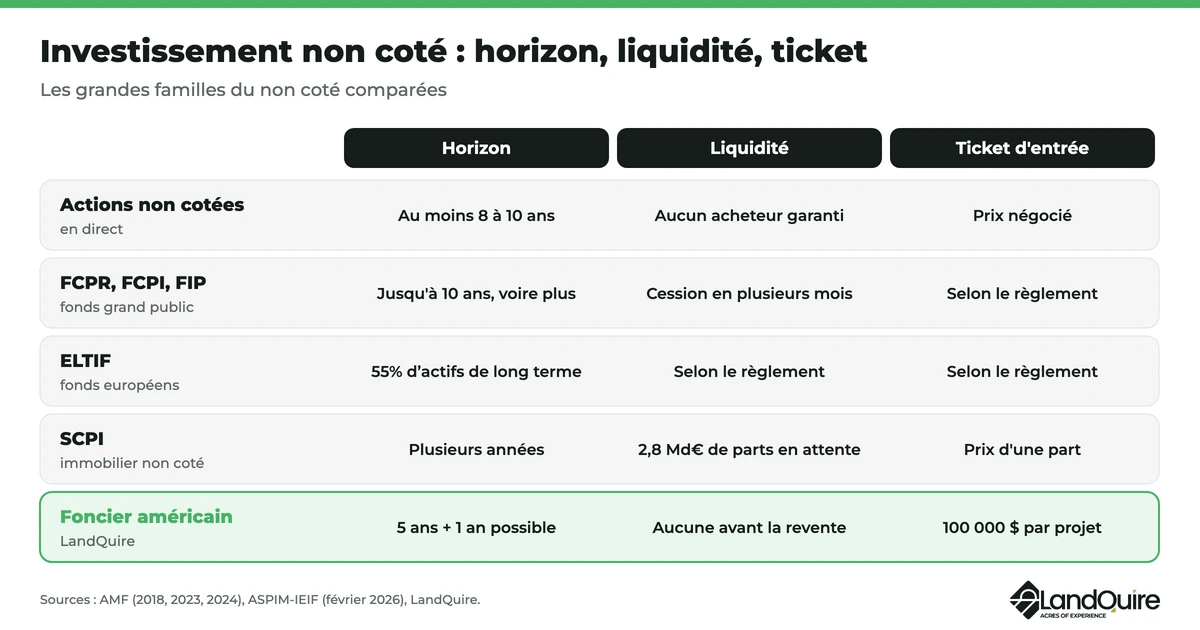
| Family | Typical Horizon | Liquidity | Admission ticket |
|---|---|---|---|
| Real-Time Unlisted Stocks | At least 8 to 10 years | No guarantee of finding a buyer | Price negotiated with the seller |
| Consumer-focused private equity funds | Up to 10 years, or even longer; a minimum of 5 years to qualify for the tax benefit | A multi-month sale; no exit before the scheduled maturity date | As specified in the fund's regulations |
| ELTIF | Several years | According to the fund's regulations | As specified in the fund's regulations |
| SCPI | Several years | Resale with no guaranteed timeline: 2.8 billion euros in shares pending as of the end of 2025 | The price of one share |
| Unlisted U.S. Real Estate (LandQuire) | Term of 5 years, extendable by one year | None prior to the resale of the land | $100,000 per project |
Sources: AMF (2018, 2023, 2024), ASPIM-IEIF (February 2026), LandQuire.
What are the risks of an unlisted investment?
The first risk is a loss of principal: The AMF reminds investors that you may lose all or part of the amount invested, as the value depends on younger, more vulnerable companies.
The bankruptcy of a portfolio holding can result in significant losses, the regulator adds.
Other risks associated with these investments:
- Illiquidity: The money remains tied up until the asset is sold or the fund is liquidated;
- Valuation: If the security is unlisted, the value shown is an estimate, and an early sale often involves a discount;
- Fees: According to the AMF, FIPs and FCPIs charge 3.5% and 3.2% per year, respectively, while other retail funds charge between 2.4% and 2.7%;
- variation in results: as of the end of 2023, the median IRRs for FIPs (-2.4%) and FCPIs (-1.1%) were negative;
- the exchange rate, for a dollar-denominated asset held by an investor in euros;
- Fraud: Make sure an intermediary is on the AMF's whitelist before signing.
These figures come from the AMF’s first study on the performance of unlisted financial asset funds, published in January 2025.
The regulator emphasizes “the risky nature of investments in funds that invest in unlisted assets.”
What will the tax treatment be for unlisted companies in 2026?
It depends on the budget and the vehicle. For a French tax resident:
- Directly, in a securities account: dividends and capital gains are subject to a single flat-rate withholding tax of 31.4%, of which 18.6% consists of social security contributions in 2026.
- "Tax-advantaged" FCPR: Distributions and capital gains are exempt from income tax if you hold the shares for 5 years and reinvest the distributed amounts; social security contributions are still due.
- FIP: The tax deduction is eliminated for subscriptions made on or after February 16, 2025, except for FIPs that invest in Corsica or overseas territories (30% of contributions).
- FCPI: The tax deduction has been eliminated as of February 21, 2026, except for FCPI funds invested in young innovative companies (JEI).
- PEA and PEA-PME: After 5 years, capital gains are exempt from income tax, but income from unlisted securities held in the plan remains taxable.
These rules are set forth in the tax guidelines on the FCPI and FIP tax credits, updated on August 27, 2026.
For an FCPI fund invested in JEIs, the tax reduction amounts to 30% of contributions, up to a limit of €75,000 per year for a single person and €150,000 for a married or civil union couple.
You must hold the shares until December 31 of the fifth year following the subscription.
An executive who sells his or her company after transferring it to a holding company may also reinvest a portion of the proceeds in private equity funds.
This is one of the permitted uses offunds underthe 150-0 B ter contribution-transfer provision.
Example with figures: €10,000 in an FCPI fund invested in JEIs
| Step | Calculation | Amount |
|---|---|---|
| Enrollment in 2026 (single person) | – | 10 000€ |
| 2026 Income Tax Credit | 10,000 × 30% | -3,000€ in taxes |
| Net cost of the investment | 10,000 – 3,000 | 7 000€ |
| Required shelf life | Through December 31, 2031 | More than 5 years |
| Costs over 8 years, order of magnitude | 10,000 × 3.2% × 8 | 2 560€ |
The tax break is guaranteed, but the fund’s performance is not: a 30% decline in the value of the shares would wipe out the tax benefit.
Fees are calculated here based on the amount invested, at the median rate reported by the AMF for FCPI funds. Please refer to the key information document for each fund.
U.S. Real Estate: An Example of an Unlisted Investment
LandQuire, founded in 2021 by Romain Daniellou and Thibaut Guéant, purchases land on the outskirts of growing U.S. cities.
The team identifies investment opportunities by analyzing all 3,143 U.S. counties using an algorithm based on more than 120 criteria.
It obtains development permits and then resells the land to developers. LandQuire has completed 50 projects, 37 of which have been sold: see our sold land projects.
Each property is managed by a dedicated project company, which LandQuire oversees from start to finish: acquisition, permitting, resale, and legal and financial management.
The grant amount is $100,000 per project. The costs are included in the project budget, with no annual management fees.
The structure is designed to last 5 years, with the option to extend it by one year. Each year, the investor receives a K-1 form; their tax matters are handled by an independent certified public accountant (CPA).
Recent offerings are made to non-U.S. residents under Regulation S.
These offerings are neither ELTIFs nor funds authorized by the AMF.
Illiquidity is accepted: the money remains invested until the land is sold.
The project is exposed to fluctuations in the dollar, delays or denials of permits, and involves a risk of loss.
This investment is intended to serve as a small diversification component alongside more liquid investment vehicles.
Our guide to investing in real estate without property management compares all the options.
What weight should unlisted securities have in a portfolio?
The AMF offers three guidelines: keep an emergency fund, invest only a small portion of your financial assets, and pay attention to fees.
Also make sure that this investment aligns with your savings goals and the level of risk you are willing to accept.
With €100,000 or more, unlisted investments come after available reserves and listed investments: see our guidelines for investing €100,000.
Diversify your unlisted investments across multiple categories, strategies, managers, and subscription years.
This diversification helps avoid dependence on a single project.
Our guide to investing compares unlisted securities with other investment options.
Frequently Asked Questions
What is an unlisted investment?
It is an investment in an asset that is not traded on a stock exchange: a company, private debt, real estate, or land.
Its price is negotiated privately or estimated by a fund manager, and the money remains tied up for several years.
What is the difference between listed and unlisted?
A publicly traded stock can be bought and sold on any trading day at a publicly quoted price.
An unlisted stock can only be sold to a buyer found through private negotiation, with no guarantee of timing or price.
What is the return on private equity?
According to France Invest and EY, the French private equity sector has posted a net IRR of 11.3% per year since its inception and 12.4% over 10 years, as of the end of 2024.
These are historical averages: The AMF reports negative median IRRs for retail-oriented FIPs and FCPIs.
How long is the money held?
The AMF recommends that investors be prepared to tie up the funds in unlisted stocks for at least 8 to 10 years.
The lifespan of a private equity fund can exceed 10 years.
What are the risks of unlisted securities?
Capital loss, illiquidity, difficulty in determining value, high fees, and—for foreign assets—exchange rate fluctuations.
The AMF recommends allocating only a small portion of one's financial assets to this.
Will it still be possible to claim tax deductions through an FCPI or an FIP in 2026?
Yes, in limited cases. FCPI funds invested in JEIs qualify for a 30% tax reduction, up to a limit of €75,000 in annual contributions for a single individual.
The Corsica and Overseas FIPs also offer a 30% tax credit; the other FIPs and FCPIs no longer qualify for this benefit.
What is an ELTIF?
A European long-term investment fund that invests at least 55% of its assets in long-term assets, according to the AMF.
The regulations governing it were relaxed in January 2024 to make it available to individuals.
Is an SCPI an unlisted investment?
Yes. Its shares are not publicly traded and can be resold without any guarantee as to the timing.
At the end of 2025, 2.8 billion euros in SCPI shares were pending withdrawal, according to ASPIM and IEIF.
Are you looking for an unlisted real asset, held by a project company, to diversify your portfolio?
Explore our real estate listings in the United States or talk to the LandQuire team to find out if a listing is a good fit for your situation.
This article is for informational purposes only and does not constitute personalized tax, legal, or investment advice.
The tax rules cited are those in effect as of the date of this update. Past performance is not indicative of future results.
Any unlisted investment carries a risk of loss and ties up your money for several years.