Investing 100,000 euros: A Comparison of Options

By Thibaut Guéant, co-founder and CIO of LandQuireUpdated on 16-minute read
Table of Contents
- Where should I start when investing 100,000 euros?
- What are the limits to consider when investing €100,000?
- How should you allocate €100,000 based on your investment horizon and profile?
- Example: Investing €100,000 in small increments
- Where can I invest 100,000 euros without risk?
- What are the tax implications for a €100,000 investment?
- Is it possible to invest €100,000 in U.S. real estate?
- Frequently Asked Questions

To invest 100,000 euros, start by setting aside an emergency fund, then fill any investment quotas before allocating the remainder based on your investment horizon.
The Livret A and LDDS accounts accept only €34,950 per person, and the PEA accepts up to €150,000 in contributions: most of the money will therefore go toward life insurance, the stock market, or real estate.
At the average rate for euro-denominated funds in 2025 (2.63%), €100,000 yields €2,630 per year, which is less than the 3.1% inflation rate recorded in September 2026.
Here's how to allocate this amount step by step based on your goals, with three sample asset allocations in euros, their returns, their risks, and a numerical example.
In a nutshell
- The Livret A savings account pays 1.7% interest and has a maximum balance of €22,950; the LDDS savings account pays the same rate and has a maximum balance of €12,000 (service-public.fr, August 2026).
- The PEA accepts €150,000 in contributions: €100,000 is deposited in full, but it only accepts eligible European stocks or ETFs (service-public.fr, May 2026).
- Under a life insurance policy, interest withdrawn after 8 years qualifies for an annual tax exemption of €4,600, or €9,200 for a couple (service-public.fr, April 2026).
- The euro-denominated funds in the policies yielded an average of 2.63% in 2025, the same as in 2024 (ACPR, 2026).
- Bank deposits are insured up to €100,000 per customer per bank: if you have €100,000 in your accounts, you’ve reached the limit (FGDR, 2026).
- Interest, dividends, and gains on securities have been subject to a flat-rate withholding tax of 31.4% since 2026 (service-public.fr, June 2026).
Where should I start when investing 100,000 euros?
A capital of 100,000€ is invested in four steps, in this order.
The order is more important than the choice of each product: it prevents you from having to sell an investment at the wrong time.
- Set aside an emergency fund. This is a reserve for unexpected events: breakdowns, job loss, or medical expenses. A common guideline is 3 to 6 months’ worth of expenses, available at any time in a savings account.
- Set aside money for specific projects. Whether it’s buying a car, home improvements, or a down payment on a home—any funds you’ll need within the next three years should be kept in capital-guaranteed investments.
- Take full advantage of the contribution limits. Regulated savings accounts, stock savings plans: their tax benefits are capped, so you might as well take advantage of them before others do.
- Invest the remainder over the long term. Stocks, bonds, real estate, ETFs in a multi-asset portfolio—and possibly a portion in private equity—depending on your goals, time horizon, and risk tolerance.
Each step answers a question: How much capital should you keep available? What return should you aim for? What level of risk should you accept?
Before the fourth step, ask yourself two questions: When will you need this money, and what temporary decline in value can you withstand without selling?
Your answers determine your investor profile: conservative, balanced, or aggressive.
They determine your investment horizon, your investment strategy, and the diversification of your portfolio—well before you choose any specific products.
In the medium term (3 to 8 years), euro-denominated funds and bonds dominate; in the long term, the stock market takes the lead.
To compare all asset classes in detail, check out our guide on where to invest in 2026.
What are the limits to consider when investing €100,000?
At this amount, five thresholds determine how the funds are allocated. Here they are, along with how they change for €100,000.
| Placement or rule | Upper limit or threshold | What this means for €100,000 |
|---|---|---|
| Livret A | €22,950, with a 1.7% return | Up to 23% of the total amount |
| LDDS | 12,000€, with a 1.7% interest rate | With the first option, €34,950 per person, or 35% of the total amount |
| PEA | €150,000 in payments | The entire amount can be invested there, but only in European stocks or eligible funds |
| Life Insurance After 8 Years | A tax deduction of 4,600€ (9,200€ for a couple); taxed at 7.5% as long as premiums remain below 150,000€ | €100,000 in bonuses remain below the €150,000 threshold |
| Deposit Insurance | €100,000 per customer and per bank | €100,000 held at a single bank is at the limit of the guarantee |
Sources: service-public.fr fact sheets (2026), FGDR (2026).
According to the Livret A information sheet on service-public.fr, the Livret A has a maximum balance of €22,950, and according to the LDDS information sheet on service-public.fr, the LDDS has a maximum balance of €12,000.
Their interest income is exempt from income tax and social security contributions: this is the natural role of the safety reserve.
According to the PEA information sheet on service-public.fr, the maximum total contributions to a stock savings plan ( PEA) are capped at €150,000.
After 5 years, capital gains are exempt from income tax; only social security contributions remain due. A withdrawal before 5 years have elapsed generally results in the closure of the plan.
For this policy, the €150,000 threshold is calculated based on the total value of all your policies, according to the service-public.fr fact sheet on life insurance taxation.
With €100,000 in premiums, withdrawals made after 8 years that exceed the tax-free allowance are taxed at 7.5%, not 12.8%.
Finally, the Deposit Insurance and Resolution Fund covers checking and savings accounts up to €100,000 per customer per bank.
The Livret A, LDDS, and LEP each have a separate government guarantee, under similar conditions.
If you keep a large amount of money in the bank, divide it between two banks.
How should you allocate €100,000 based on your investment horizon and profile?
The three allocations below detail, allocation by allocation, the conservative, balanced, and aggressive profiles from our guide “Where to Invest.”
These are examples for an individual, not personalized advice. For a conservative investor, the guaranteed portion is up to €60,000.
Each portfolio combines guaranteed investments, real estate, and stock market investments in varying proportions depending on your goals.
| Envelope | Conservative (3 to 5 years) | Balanced (ages 8 and up) | Dynamic (ages 10 and up) |
|---|---|---|---|
| Regulated Savings (Precaution) | 30 000€ | 20 000€ | 15 000€ |
| Euro-denominated funds (life insurance) | 30 000€ | 15 000€ | – |
| Bond or diversified investment units (multi-asset contract) | 20 000€ | 20 000€ | 10 000€ |
| SCPI (directly or through a contract) | 10 000€ | 20 000€ | 25 000€ |
| ETF (PEA) | 10 000€ | 20 000€ | 40 000€ |
| Unlisted (private equity, club deal, crowdfunding) | – | 5 000€ | 10 000€ |
| Guaranteed principal | 60 000€ | 35 000€ | 15 000€ |
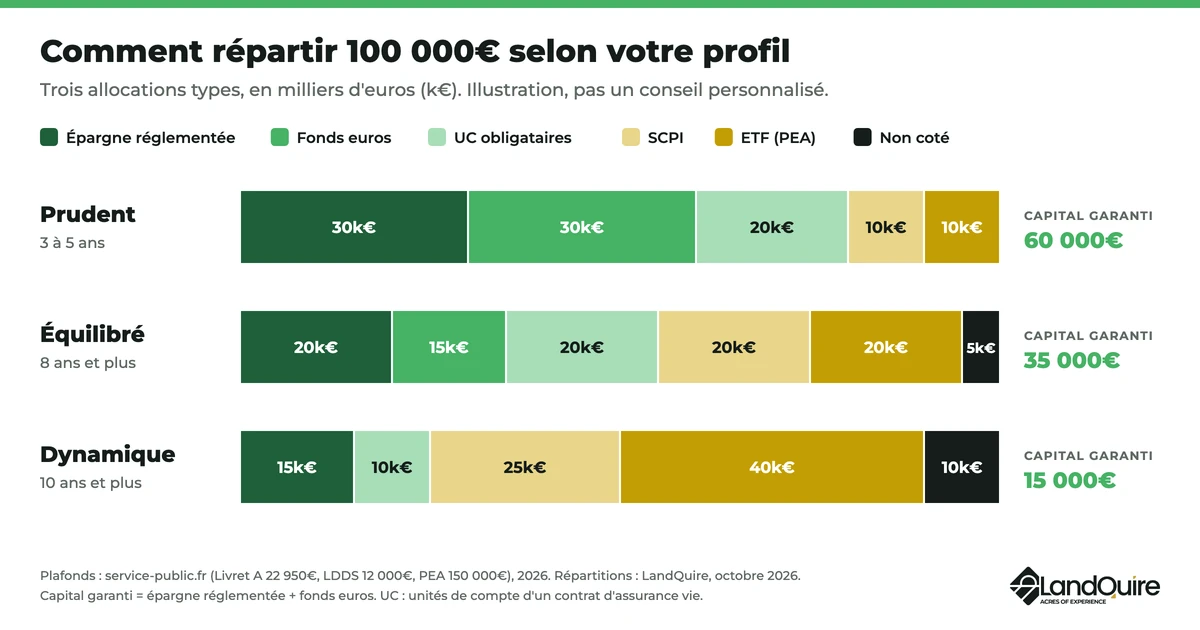
Five rules for reading this table:
- The longer the investment horizon, the lower the guaranteed return. Over a 10-year period or longer, markets have time to recover from a downturn; over a 3-year period, they do not. An aggressive investor is willing to accept sharper temporary declines.
- The stock savings plan primarily invests in ETFs. An eligible global or European ETF tracks a stock market index with low fees. Once the investment limit is reached, the investment units in a multi-asset contract or a securities account take over.
- Bonds cushion against market declines. These loans to a government or a company generate steady income, and their value fluctuates less than that of the stock markets.
- Discretionary management simplifies monitoring. In a multi-asset contract, discretionary management entrusts the asset allocation to a professional based on your profile, with additional management fees.
- Unlisted investments should remain a minority portion of your portfolio. Private equity, club deals, and real estate crowdfunding: these investments tie up funds for several years. Their risks include capital loss, reduced liquidity, and high fees. Limit them to a small portion of your portfolio.
In SCPIs, the distribution yield reached 4.91% in 2025, but the average share price fell by 3.45%, according to the 2025 annual report from ASPIM and IEIF.
For every €100,000 invested in SCPIs, this decline in share prices amounts to €3,450: the distributed yield does not tell the whole story about performance.
SCPIs provide access to real estate without the need to manage rentals; direct real estate investment requires a down payment, time, and filing a property tax return.
Expected returns and risks increase with the proportion of stocks and unlisted assets: diversification across asset classes limits year-over-year fluctuations in overall performance.
Rebalance your portfolio once a year: after a market rally, your stock holdings account for a larger portion of your strategy than intended, and your investment diversification erodes.
If you have twice that amount, find out how to invest €200,000.
Example: Investing €100,000 in small increments
Claire, 45, single, has just received 100,000€.
Her financial profile is well-balanced. She spends €2,500 a month, wants to buy a new car in two years (€15,000), and is planning for retirement in about twenty years.
| Step | Need | Selected Investment | Amount |
|---|---|---|---|
| 1. Precaution | 6 months' worth of expenses (6 × €2,500) | Livret A | 15 000€ |
| 2. Dated draft | A car in two years | LDDS (€12,000) and Livret A (€3,000) | 15 000€ |
| 3. Envelopes with a Cap | Growth Over 20 Years | Global ETF in a PEA, paid in over 12 months | 35 000€ |
| 4. Long-Term Diversified | Retirement, Business Succession | Life insurance: €15,000 in euro-denominated funds, €10,000 in SCPIs, €10,000 in unit-linked policies | 35 000€ |
| Total | 100 000€ |
Here is the return on the guaranteed portion, at current rates:
- Livret A: €18,000 × 1.7% = €306 per year, tax-free.
- LDDS: 12,000€ × 1.7% = 204€ per year, tax-free.
- Euro-denominated funds: €15,000 × 2.63% = €395 per year, before social security contributions.
That amounts to approximately €905 per year on a guaranteed €45,000. The €55,000 invested in ETFs, SCPIs, and unit-linked funds does not have a predetermined return.
Claire contributes €2,917 per month to her plan for one year (€35,000 ÷ 12): this gradual investment smooths out her entry price on the stock market.
Withdrawals from the plan will be exempt from income tax after 5 years, and withdrawals from his contract will qualify for the €4,600 tax deduction after 8 years.
Her investment strategy aligns with her goals: security for the €30,000 she may need, and a return over 20 years for the rest of her portfolio.
Where can I invest 100,000 euros without risk?
Three types of investments offer principal protection: regulated savings accounts, time deposits, and euro funds.
Their limitation is their return: it remains below the inflation rate.
These investments are suitable for a safety net and near-term projects, not for a 10-year performance goal.
Prices rose 3.1% year-over-year in September 2026, according toINSEE’s Consumer Price Index.
Out of €100,000, that amounts to €3,100 in purchasing power over the course of a year: inflation reduces the real return on capital.
Euro-denominated funds yielded an average of 2.63% in 2025 for individual policies, as reported by *La finance pour tous* based on figures from the ACPR.
This rate is net of management fees and before social security contributions, and varies from one policy to another: compare euro funds before choosing an insurer.
A completely risk-free investment of €100,000 is therefore possible, but it loses real value as long as inflation exceeds its return.
What are the tax implications for a €100,000 investment?
The tax treatment of each investment has just as much of an impact on the net return you receive as its gross return. The rules in effect in 2026:
- Interest, dividends, and capital gains on securities (term accounts, securities accounts, bonds): a single flat-rate withholding of 31.4%, consisting of 12.8% in taxes and 18.6% in social security contributions, according to the service-public.fr fact sheet on social security contributions. On €10,000 in gains, €3,140 goes toward taxes.
- Life insurance: social security contributions of 17.2%; after 8 years, a deduction of €4,600 (€9,200 for a couple), followed by a 7.5% rate on premiums below €150,000.
- PEA: After 5 years, capital gains are exempt from income tax, but social security contributions are due.
- Regulated savings accounts (Livret A, LDDS): Interest is exempt from income tax and social security contributions.
- SCPIs held directly: real estate income, taxed at the income tax rate plus 17.2% in social security contributions.
If you are in a low tax bracket, you can choose the progressive tax scale instead of the flat-rate withholding tax.
These tax benefits depend on the length of time the plan or contract has been in effect: the 5- and 8-year periods begin when the plan or contract is opened, which is why it’s advantageous to open them early.
Is it possible to invest €100,000 in U.S. real estate?
Not if that €100,000 represents the bulk of your savings.
LandQuire purchases land in the United States, obtains zoning permits, and then resells it; French-speaking investors participate on a project-by-project basis, with a minimum investment of $100,000.
Based on the European Central Bank's reference exchange rate as of October 21, 2026 (1€ = 1.1234 $), this ticket is worth approximately 89,000€.
With exactly €100,000 to invest, that would mean putting 89% of the total into a single project, a single currency, and having the capital tied up—the opposite of a diversified portfolio.
At LandQuire, U.S. real estate is viewed as a minority component of the investment portfolio.
It applies to investors whose net worth far exceeds €100,000: out of €600,000 in financial assets, this single investment accounts for about 15%.
If your €100,000 is just part of a larger, already diversified portfolio, a real estate project could be a good fit.
LandQuire manages the entire process from start to finish: sourcing, acquisition, permitting, resale, and the legal and financial management of the project company.
The selection is based on an analysis of 3,143 counties and an algorithm that considers more than 120 criteria. LandQuire has sold 37 projects (5 full-cycle portfolios and 32 land resales), as of November 19, 2026: see sold land projects.
The project company is expected to operate for approximately 36 months, with no guarantee (plan for 5 years or more), and the costs are included in the project budget, with no annual management fees.
This is a real estate investment in tangible assets, with no rental income: the return depends on the resale price of the land.
Like private equity, it is an unlisted asset that should account for only a small portion of the portfolio.
The principal is not guaranteed, and the value in euros depends on the dollar exchange rate at the time of resale.
There are also risks specific to real estate: delays or denials of permits, and a decline in local demand.
Past performance of sold projects is not indicative of future performance.
Our guide toreal estate investing in the United States details the steps, risks, and tax implications.
To develop an asset allocation strategy for your entire portfolio, check out our guide to diversifying your assets.
Frequently Asked Questions
How much return do you get on 100,000 euros invested each month?
At the average rate for euro-denominated funds in 2025 (2.63%), €100,000 yields €2,630 per year, or €219 per month before social security contributions.
With an SCPI, at the 2025 distribution rate (4.91%), gross income amounts to €409 per month, but the price of the shares may fall.
Regulated savings accounts, capped at €34,950 per person, yield only €594 per year.
These returns are for 2025 and 2026; they are not indicative of future performance.
What investment should I make with 100,000 euros?
No single investment is the right choice: combine a liquid reserve, a multi-asset portfolio, ETFs, bonds, and—depending on your investment horizon—real estate or a private equity allocation.
With €100,000, a conservative investor retains more of their guaranteed capital; an aggressive investor invests more in the stock market and real estate.
Diversification and asset allocation are more important than choosing a single product.
The allocation for each investment depends on when you will need the funds and the level of risk of capital loss you are willing to accept.
What are some risk-free investments for 100,000 euros?
In a regulated savings account, up to a limit of €34,950 per person, and then in a term deposit account or in the euro-denominated funds of one or two life insurance policies.
Spread your money among at least two banks, since the deposit insurance coverage is limited to €100,000 per customer per bank.
What should you do with 100,000 euros?
First, keep 3 to 6 months’ worth of living expenses readily available, and invest the amounts you’ll need within the next 3 years in guaranteed investments.
Then invest the rest over the long term: stocks and ETFs, multi-asset investment accounts, real estate, and possibly private equity.
How can I invest 100,000 euros in a short-term investment?
For a need that will arise in less than 3 years, opt for readily available investments: regulated savings accounts, term accounts that mature before the expense is due, and euro-denominated funds.
Avoid stocks and real estate investment trusts (SCPIs), which may lose value or be slow to sell when you need to cash them out.
Should I invest 100,000 euros in life insurance?
To a large extent, yes: Life insurance combines guaranteed euro funds, unit-linked funds, and tax benefits after 8 years, with an annual tax exemption of 4,600 euros.
With €100,000 in premiums, you remain below the €150,000 threshold that qualifies you for the 7.5% rate. With managed investment, the insurer allocates the unit-linked investments based on your profile.
Life insurance also helps prepare for the transfer of assets. Keep a contingency savings fund on hand.
Should you invest €100,000 all at once or gradually?
With guaranteed investments, a lump-sum payment is not a problem.
For the stock portion of the portfolio, investing gradually—each month for 6 to 12 months—averages out the entry price and limits the risk of buying right before a market decline.
Is it possible to live off the interest from €100,000?
No: With guaranteed investments, €100,000 yields about €200 per month before taxes. It’s supplemental income, not a salary.
Over the long term, the priority is to grow this capital by reinvesting the returns from your investments: returns accumulate year after year.
Is it possible to invest 100,000 euros in U.S. real estate?
The minimum investment at LandQuire is $100,000 per project, which is approximately €89,000 at the exchange rate on October 21, 2026.
That’s almost the entire amount: a real estate project makes sense only when those €100,000 are added to a broader, already diversified portfolio.
Is your net worth well over €100,000, and are you considering adding U.S. real estate to your portfolio?
Explore our available land listings and learn how to invest with LandQuire, step by step.
This article is for informational purposes only and does not constitute personalized tax, legal, or investment advice. The rates cited are those published as of the date of the update.
Past performance is not indicative of future results. Any investment other than guaranteed investments carries a risk of capital loss.

About the Author
Thibaut Guéant, co-founder and CIO of LandQuire, founded the company in 2021 with Romain Daniellou. As a land entitlement specialist, he identifies off-market raw land, primarily in Texas, and oversees the process of obtaining zoning permits that make the land buildable before reselling it to developers.