Investing €200,000: A Comparison of Options

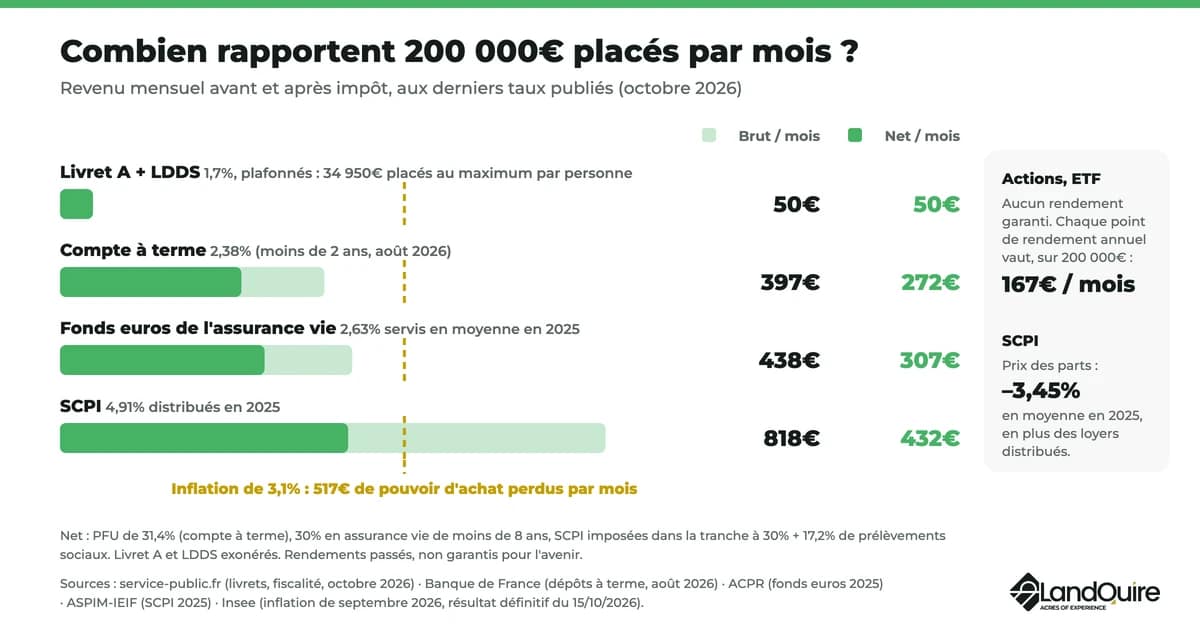
Invested in a euro-denominated fund at the 2025 average rate (2.63%), €200,000 yields €438 per month before taxes, and approximately €307 after taxes.
With SCPI, gross income amounts to €818 per month, but the price of shares may fall.
With that amount, the savings accounts fill up quickly: the Livret A and the LDDS only accept up to €34,950 per person.
Investing €200,000 therefore requires combining several investment pools and various investment options depending on your time horizon: here is a comparison of the options, their net returns, and examples of asset allocation in euros.
In a nutshell
- The Livret A and LDDS accounts earn 1.7% interest, up to a limit of €22,950 and €12,000, respectively: a maximum of €34,950 per person, or 17% of €200,000 (service-public.fr, October 2026).
- Euro-denominated life insurance funds yielded an average of 2.63% in 2025, or €438 per month before taxes on a €200,000 investment (ACPR, June 2026).
- SCPIs paid a distribution of 4.91% in 2025, or €818 per month (gross) on an investment of €200,000, but the average share price fell by 3.45% (ASPIM-IEIF, February 2026).
- New time deposit accounts with terms of less than 2 years yield an average of 2.38% for households (Bank of France, August 2026).
- Prices rose 3.1% year-over-year in September 2026 (INSEE, October 15, 2026): without any return on investment, €200,000 loses €6,200 in purchasing power over the course of a year.
- Bank deposits are insured up to €100,000 per customer per bank (FGDR): if you have more than that, spread your money across several institutions.
What difference does a capital of €200,000 make?
With €200,000, the question is no longer about finding a good investment, but about developing a strategy: allocating the funds across several portfolios and asset classes, based on your goals.
Five limitations and possibilities are game-changers.
- Regulated savings accounts are fully utilized, accounting for 17% of the total. The Livret A savings account has a maximum balance of €22,950, according to the official information on service-public.fr, and the Livret de Développement Durable et Solidaire (LDDS) has a maximum balance of €12,000, according to the LDDS information on service-public.fr. The Livret d’Épargne Populaire (LEP) pays 2.5% interest, but it is reserved for low-income earners and capped at €10,000.
- A stock savings plan ( PEA) cannot hold just any investment. The PEA is designed to hold a portfolio of shares in European companies, including those listed on the Paris Stock Exchange. Contributions are capped at €150,000; with a PEA-PME, the total can reach €225,000, according to the PEA information sheet on service-public.fr.
- The tax treatment of life insurance changes for amounts exceeding €150,000. After 8 years, withdrawals are subject to a €4,600 exemption (€9,200 for a couple) and are then taxed at 7.5%. However, the portion of earnings attributable to premiums exceeding €150,000—across all your policies—is taxed at 12.8%, according to the service-public.fr fact sheet on life insurance taxation.
- Deposit insurance is limited to €100,000 per bank. Depositing €200,000 in a single bank leaves part of your savings unprotected in the event of bankruptcy.
- New investment opportunities are becoming available. A down payment for a rental property financed with a loan, or a stake in an unlisted investment (private equity, club deal, real estate project), with a minimum investment of up to €100,000 or $100,000.
To compare all asset classes, check out our guide on where to invest. For half that amount, see how to invest €100,000.
How much income does a monthly investment of €200,000 generate?
The monthly return is calculated simply as follows: amount invested × annual return ÷ 12. On €200,000, each percentage point of return is worth €2,000 per year, or €167 per month.
A gross return of 4% thus yields €667 per month on €200,000, before taxes.
The table shows the most recently published compensation figures, before and after taxes.
| Investment | Benchmark Return | Amount Invested | Gross Monthly Income | Net monthly income | Taxation Based on Net Income |
|---|---|---|---|---|---|
| Livret A | 1,7% | €22,950 (maximum) | 33€ | 33€ | Exempt |
| LDDS | 1,7% | 12,000€ (maximum) | 17€ | 17€ | Exempt |
| Term deposit (less than 2 years) | 2.38% in August 2026 | 200 000€ | 397€ | 272€ | 31.4% PFU |
| Euro-denominated funds (life insurance) | 2.63% in 2025 | 200 000€ | 438€ | 307€ | 12.8% tax + 17.2% social security contributions |
| SCPIs held directly | 4.91% to be distributed in 2025 | 200 000€ | 818€ | 432€ | 30% tax bracket + 17.2% in social security contributions |
| Equity ETFs (PEA, CTO) | No guaranteed return | 200 000€ | Variable | Variable | PEA: No income tax after 5 years |
Sources: service-public.fr (savings accounts, taxation, October 2026), Banque de France (time deposits, August 2026), ACPR (euro-denominated funds, 2025), ASPIM-IEIF (SCPI, 2025).
Past performance is not a guarantee of future results.
Three points to keep in mind when reading this table:
- Euro-denominated funds: The 2.63% figure is net of management fees and before social security contributions, according to the ACPR report on the revaluation of life insurance policies. The net calculation is simplified: in life insurance, tax applies only to the capital gains portion of each withdrawal, and the tax exemption after 8 years can eliminate it.
- SCPI: Rental income is classified as real estate income and is taxed at the income tax rate plus 17.2% in social security contributions. In the 41% tax bracket, the net income drops to €342 per month.
- Term deposit: 2.38% is the average interest rate on new household term deposits with maturities of less than 2 years as of August 2026, according to the Banque de France’s statistics on deposit interest rates.
This income is in line with inflation: 3.1% year-over-year in September 2026, according toINSEE’s final Consumer Price Index.
Out of €200,000, that amounts to €6,200 in purchasing power per year, or €517 per month.
Before taxes, only the SCPI exceeds this threshold; after taxes, none of the investments with known rates in the table exceeds it.
Where can I invest €200,000 without risk?
Three types of investments protect your money: regulated savings accounts, term accounts, and euro-denominated life insurance funds, which are guaranteed by the insurer.
Their risk is low, but all of them are currently yielding less than the rate of inflation.
- The Livret A and LDDS savings accounts: funds available at any time, with interest exempt from income tax and social security contributions. A couple can deposit €69,900 in these accounts using two Livret A accounts and two LDDS accounts.
- A term deposit: an interest rate set at the time of opening the account, in exchange for funds that are locked in until maturity. Interest is taxed at the flat tax rate.
- Euro-denominated funds: a principal amount guaranteed by the insurer, interest accrued annually, and the tax treatment of life insurance after 8 years.
The risk associated with having a large amount of savings in a bank is that the bank might go bankrupt.
The Deposit Insurance and Resolution Fund covers checking accounts, savings accounts, and time deposits up to €100,000 per customer per bank.
The Livret A, LDDS, and LEP each have a separate government guarantee, under similar conditions.
If you have €200,000 in the bank, use at least two financial institutions.
Example: €200,000 invested with no risk of capital loss, for a single person
| Support | Amount | Compensation | Gross annual income |
|---|---|---|---|
| Livret A and LDDS (limits) | 34 950€ | 1,7% | 594€ |
| Term deposit with a maturity of less than 2 years | 65 050€ | 2,38% | 1 548€ |
| Euro-denominated funds | 100 000€ | 2,63% | 2 630€ |
| Total | 200 000€ | €4,772, or €398 per month |
After taxes and social security contributions, this portfolio yields approximately €291 per month.
It’s a solid safety net, but its actual performance is negative as long as inflation exceeds 2.4% (€4,772 ÷ €200,000).
How can I invest €200,000 in a short-term investment?
A short-term investment is for money you’ll need within less than 3 years: buying a home, home improvements, a gift, or paying taxes.
Availability is the top priority, even if it means accepting low performance.
- Date unknown: regulated savings accounts, followed by euro-denominated funds for the portion exceeding the limits.
- Known date: a time deposit that matures just before the expense is incurred.
- Money market funds: They invest in very short-term securities, and their returns track the European Central Bank’s interest rates. The ECB has been paying 2.50% on bank deposits since September 16, 2026, according to the ECB’s key interest rate table. Their value fluctuates very little, but the principal is not guaranteed.
Avoid for periods of less than 3 years: stocks, which may decline in value just when you need the money, and real estate investment trusts (SCPI), whose shares can sometimes be slow to sell.
Real estate crowdfunding is often structured over a period of 1 to 3 years, but it is not a risk-free investment: a developer may be late in making repayments or may default.
How should you allocate €200,000 based on your investment horizon and profile?
An asset allocation strategy is based on your goals: security, regular income, long-term performance, and passing on your wealth.
It also answers two questions: When will you need this money, and what temporary decline can you withstand without selling?
The three examples below—ranging from a conservative profile to a dynamic profile—are for illustrative purposes only and do not constitute personalized advice.
| Conservative (2 to 5 years) | Balanced (ages 8 and up) | Dynamic (ages 10 and up) | |
|---|---|---|---|
| Livret A and LDDS | 30 000€ | 20 000€ | 15 000€ |
| Term deposit or money market fund | 50 000€ | – | – |
| Euro-denominated funds (life insurance) | 90 000€ | 60 000€ | 20 000€ |
| Equity ETFs (PEA, life insurance, CTO) | 20 000€ | 70 000€ | 100 000€ |
| SCPI or Real Estate | 10 000€ | 35 000€ | 35 000€ |
| Unlisted (private equity, club deal, crowdfunding) | – | 15 000€ | 30 000€ |
| Gross return known in advance (regulated savings accounts, term accounts, euro-denominated funds, SCPIs) | 380€ per month | €303 per month | €208 per month |
The more dynamic the portfolio, the more its performance depends on the markets: the expected return decreases, while the expected return over the long term increases, with a higher risk of capital loss.
Regardless of your investment profile, review your asset allocation once a year: after a sharp rise in the markets, your ETF holdings may account for a larger portion of your portfolio than expected, and selling some of them will bring your portfolio back in line with your goals.
Here are a few guidelines for accommodating these amounts:
- ETFs, which are index funds with low management fees, can first be held in a PEA (with a contribution limit of €150,000), and then in unit-linked life insurance policies or a securities account (CTO), with no upper limit. An MSCI World ETF (large companies in developed countries) or an S&P 500 ETF (large U.S. companies) diversifies your equity portfolio with a single investment. Gradual investing—every month for a year—averages out the entry price.
- Bonds (loans to a government or a company) pay a coupon and repay the principal at maturity, unless the issuer defaults. Bond funds make up the conservative portion of a balanced portfolio.
- Life insurance policies can include euro funds, unit-linked products (ETFs, mutual funds), and sometimes real estate investment trusts. With €200,000, opening two policies with different insurers allows you to compare fees and investment options.
- Unlisted investments (private equity funds, real estate club deals, real estate projects): These investments require you to accept that your capital will be tied up for several years. Structured products—whose returns are tied to an index based on predetermined conditions—and Luxembourg life insurance are often offered to investors with this level of wealth: Be sure to read the exit terms and fees before purchasing.
A private equity fund invests in unlisted companies.
In a real estate club deal, a group of investors jointly finance a single transaction and share the proceeds upon resale.
In real estate crowdfunding, you lend money to a developer in exchange for a predetermined interest rate, with the possibility of late payments or default.
In all three cases, the money remains tied up until withdrawal: limit these investments to a small portion of your assets, as in the examples above.
To develop an asset allocation plan for your entire portfolio (real estate, retirement, estate planning), check out our guide to diversifying your assets.
Investing €200,000 in real estate: down payment, SCPI, or land?
Real estate can account for a large portion of €200,000. There are three approaches you can take, each with very different income potential, constraints, and tax implications.
Rental property with a down payment. Instead of paying the entire amount in cash, you can use part of the money as a down payment and borrow the rest.
The average interest rate on new mortgage loans was 3.32% in August 2026, according to the Banque de France's statistics on consumer loans.
Example: With a down payment of €50,000 and a 20-year loan of €200,000 at this interest rate, the monthly payment is €1,142 (excluding insurance), for a total of €73,961 in interest over the life of the loan.
The rent—net of expenses, property tax, and vacancy costs—must be close to that amount for the venture to be self-financing, and the remaining €150,000 should be invested elsewhere.
On the other hand, this rental investment requires time: dealing with tenants, handling repairs, and reporting rental income.
Real estate investment trusts (SCPI). You purchase shares in a portfolio of buildings managed by an investment management company, with no tenants to manage.
According to the 2025 report by ASPIM and IEIF, the average distribution rate reached 4.91% in 2025, but the average share price fell by 3.45%; the overall return was +1.46%.
Out of €200,000, this decrease amounts to €6,900, or 70% of the €9,820 distributed during the year.
ASPIM also reports instances where withdrawals have been blocked for a limited number of funds.
For other waysto invest in real estate without managing the property, see our comparison.
Land. Buy a plot of land, obtain the necessary permits to make it buildable, and then resell it: the profit comes from the resale, not from rent.
Our guide toreal estate investing in the United States details the steps and risks involved.
| Rental Property with Down Payment | SCPI | Real Estate in the United States with LandQuire | |
|---|---|---|---|
| Amount Committed | Down payment, purchase costs | Starting at a few parts | A minimum of $100,000 per project |
| Revenue | Monthly Rent | Regular, non-guaranteed distributions | No rent: profit from the resale of the land |
| Management | Tenants, Renovations | Management Company | LandQuire manages the project company |
| Duration | Free | Long-term | Contract term of 5 years, renewable for 1 year |
| Liquidity | Resale of the property | Resale of shares, which can sometimes be slow | Capital tied up until resale |
| Key Risks | Vacancy, Unpaid Bills, Renovations | Decline in share prices, slow resale | Delays or denials of permits, a decline in local demand, exchange rates |
| Taxation in France | Property income (unfurnished rentals) +17.2% | Real estate income +17.2% | France-United States Tax Treaty |
Is there room for a real estate project within a €200,000 budget?
LandQuire purchases land in the United States on the outskirts of cities with growing populations, obtains the necessary permits (zoning, subdivision), and then resells the land to homebuilders.
French-speaking investors co-invest on a project-by-project basis, with a minimum investment of $100,000.
Based on the exchange rate published by the European Central Bank on October 16, 2026 (1€ = 1.1253 $), this ticket is worth approximately 88,900€, or 44% of a principal amount of 200,000€.
It’s a highly focused approach: a single project, a single motto, and capital tied up for the entire duration of the project.
If this €200,000 represents the bulk of your savings, a real estate investment is not a minor portion of your portfolio and does not constitute a conservative strategy.
It makes more sense when the €200,000 is added to an already diversified portfolio: in a financial portfolio of €600,000, that same investment accounts for about 15%.
Risks specific to the real estate sector (delays in obtaining permits, a decline in local demand) compound this concentration, and exchange rates can go either way.
Our guide to investing in dollars explains how to transfer funds.
LandQuire has completed 50 projects in the United States, 37 of which have been sold: see our previously sold land projects.
The fees are included in each project's budget, with no annual management fees.
The project company is established for a term of five years, extendable by one year, and investors receive a report each quarter.
Each project provides for a target preferential return of 10% per year—which is not guaranteed—followed by a profit-sharing arrangement upon resale.
These investment opportunities are intended for experienced investors only: the principal is not guaranteed and may be partially lost.
What are the tax implications for a €200,000 investment?
Taxation affects net returns just as much as the choice of investment. The rules in effect in 2026:
- Interest, dividends, and capital gains on securities (term accounts, bonds, securities accounts): a single flat-rate withholding tax (PFU) of 31.4%, consisting of 12.8% income tax and 18.6% social security contributions, according to the service-public.fr fact sheet on social security contributions. You can opt for the standard tax scale if you are in a low tax bracket.
- Life insurance: Social security contributions remain at 17.2%. After 8 years, an annual deduction of €4,600 (€9,200 for a couple) applies to withdrawals.
- Real estate income (unfurnished rentals, direct investments in real estate investment trusts): income tax schedule, plus 17.2% in social security contributions.
- PEA: After 5 years, gains are exempt from income tax; only social security contributions are due.
- Livret A, LDDS, LEP: Interest exempt from income tax and social security contributions.
- Payment: In life insurance, each beneficiary receives up to €152,500 tax-free for premiums paid before age 70; beyond that age, a 20% tax applies, according to impots.gouv.fr.
For assets held in the United States, the France-U.S. tax treaty prevents double taxation on the same income.
Have your situation reviewed by a wealth management advisor or a tax attorney.
Frequently Asked Questions
How much income does a monthly investment of €200,000 generate?
Based on the most recent published returns, €200,000 yields €397 gross per month in a fixed-term deposit account (2.38%), €438 in euro-denominated funds (2.63% in 2025), and €818 in real estate investment trusts (SCPI) (4.91% distribution in 2025).
After taxes and social security contributions, expect to receive approximately €272, €307, and €432. Stocks do not have a fixed return: each percentage point of annual return is worth €167 per month.
These returns are for 2025 and 2026; they do not predict future returns.
Where can I invest €200,000 without risk?
In Livret A and LDDS accounts, up to their respective limits (€34,950 per person); in term deposit accounts; and in the euro-denominated fund of a life insurance policy.
Spread your money among at least two banks, since deposit insurance is limited to €100,000 per customer per bank.
These investments yield less than the 3.1% inflation rate recorded in September 2026.
How can I invest €200,000 in a short-term investment?
For needs that will arise within the next 3 years, prioritize liquidity: savings accounts, time deposits that mature before the expense is due, euro-denominated funds, or money market funds.
Avoid stocks and real estate investment trusts (SCPI), which may lose value or be slow to sell when you need the money.
How much interest does €200,000 earn when deposited in a bank?
With €34,950 in a Livret A savings account and an LDDS account earning 1.7%, and €165,050 in term deposit accounts earning 2.38%, €200,000 yields approximately €377 per month before taxes, and €274 after the flat tax on interest from term deposit accounts.
A checking account doesn't earn any interest.
Is it possible to live off the interest from €200,000?
Not entirely: with principal-protected investments, €200,000 yields about €300 per month after taxes. It’s a source of supplemental income.
To live off your investments, you either need a larger sum of money or must be willing to draw down part of your principal.
Should I invest €200,000 in life insurance?
Life insurance is suitable for a large portion of this amount: guaranteed euro-denominated funds, unit-linked funds, and reduced tax rates after 8 years.
It also allows up to €152,500 to be transferred to each beneficiary without any deductions, for premiums paid before age 70.
If your total premiums across all your policies exceed €150,000, a portion of your earnings will be taxed at 12.8% instead of 7.5%. Be sure to keep some emergency savings on hand as well.
Should I invest €200,000 all at once or gradually?
For capital-guaranteed investments, making a lump-sum payment is not a problem.
For the stock and ETF portfolio, a gradual investment strategy (every month for 6 to 12 months) averages out the entry price and limits the risk of buying right before a market decline.
What should you do with €200,000?
First, define your goals and your time horizon.
Keep an emergency fund on hand, and invest the money you’ll need within the next 3 years in guaranteed investments.
Then invest the rest over the long term: ETFs in a PEA or a life insurance policy, bonds, real estate (either directly or through an SCPI).
An unlisted investment vehicle can round out the portfolio (private equity, club deal, real estate crowdfunding).
The right strategy depends on your profile and your overall net worth.
Can you invest in U.S. real estate with €200,000?
Yes, the minimum investment at LandQuire is $100,000 per project, which is approximately €88,900 at the exchange rate on October 16, 2026.
That’s nearly half of €200,000: a real estate investment makes more sense when this amount is added to an already diversified portfolio.
The capital is tied up for the duration of the project, and the offering is reserved for experienced investors.
Are you considering adding U.S. real estate to your investment portfolio?
Explore our available land listings, or talk to the LandQuire team to see if a project aligns with your goals and the size of your portfolio.
This article is for informational purposes only and does not constitute personalized tax, legal, or investment advice. The rates cited are those published as of the date of the update.
Past performance is not indicative of future results. Any investment other than guaranteed investments carries a risk of capital loss.