Where should you invest in 2026 if you have €100,000 or more?

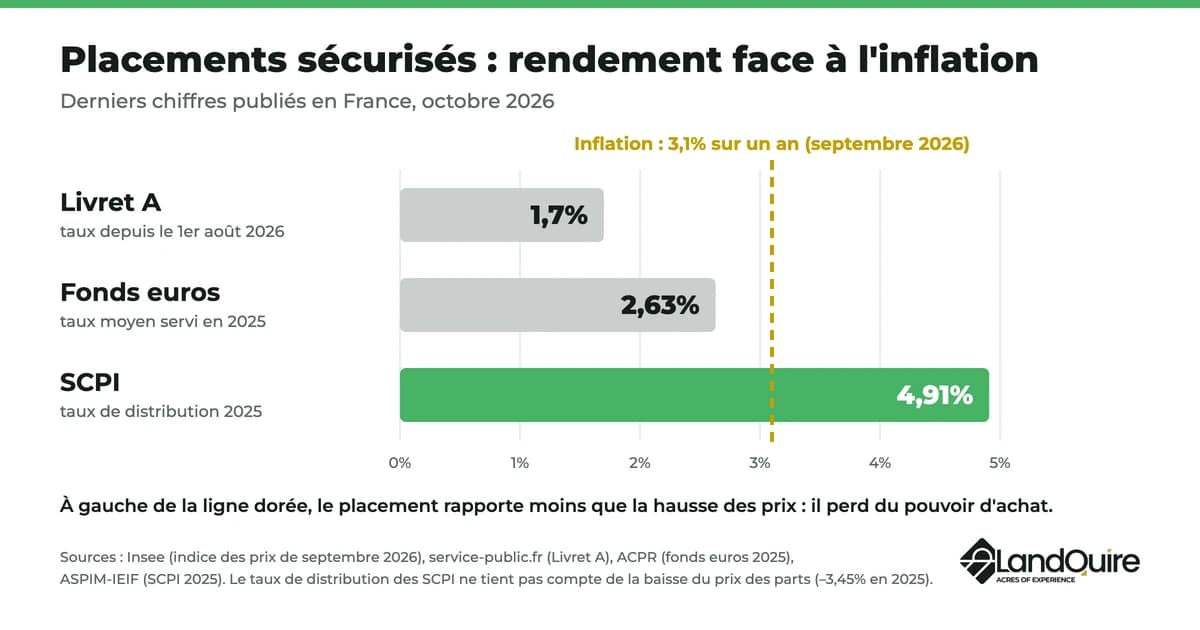
With €100,000 or more to invest, the question is no longer about finding the best product, but about building a portfolio: a safety net, a growth engine in the stock market, a portion in real estate, and a diversification component. In 2026, you’ll also need to beat inflation: prices rose 3.1% year-over-year in September, while the Livret A savings account yields 1.7%. This guide explains where to invest your money in 2026: it compares available investment options, their recent returns, risks, and tax implications, then provides examples of asset allocation based on your investor profile.
In a nutshell
- Consumer prices rose 3.1% year-over-year in September 2026 (INSEE, October 2026): an investment that yields less results in a loss of purchasing power.
- The Livret A savings account pays 1.7%, with a maximum deposit limit of 22,950€.
- Euro-denominated life insurance funds yielded an average of 2.63% in 2025 (ACPR).
- SCPIs paid out 4.91% in 2025, but the price of their shares fell by an average of 3.45% (ASPIM).
- As of January 1, 2026, the single flat-rate levy (PFU) is 31.4% on the vast majority of financial products.
- Once you exceed €100,000, the contribution limits for savings accounts and the PEA (€150,000 in contributions) are quickly reached: life insurance, regular brokerage accounts, real estate, and tangible assets take over.
What Should You Invest In in 2026? 4 Questions to Ask Yourself
There is no such thing as a one-size-fits-all investment. Each of your financial goals (buying a home, your children’s education, retirement) has its own time horizon, and the right investment depends on your investment time horizon, your goal, your risk tolerance, and your tax situation. These four criteria determine your investment strategy long before you choose specific investment vehicles.
| Criteria | A question to ask yourself | Example |
|---|---|---|
| Investment Horizon | When will you need this money? | 2 years, 8 years, 15 years |
| Objective | Are you looking for income, growth, protection, or estate planning? | Supplementing Your Retirement, Passing It On to Your Children |
| Risk tolerance | How much of a temporary decline can you withstand without selling? | -10%, -20%, -30% |
| Taxation | What tax bracket do you fall into? | Life insurance, PEA, standard securities account (CTO), PER |
Before investing, set aside an emergency fund: several months’ worth of expenses in bank savings accounts that are accessible at any time. Savings are meant to cover unexpected expenses; investing involves the risk of capital loss in exchange for the potential for higher returns over several years. Your strategy should then be to diversify your portfolio across several asset classes.
Why €100,000 Changes the Way You Invest
Once you reach this amount, investing your money becomes a matter of wealth management, not just saving.
- The limits are quickly reached. According to service-public.fr, the Livret A savings account has a deposit limit of €22,950, and the PEA has a limit of €150,000. The rest of the money can be invested in life insurance, a regular securities account, real estate, or unlisted investments.
- Taxes take a heavier toll. Of every €10,000 in earnings taxed at the flat rate of 31.4%, €3,140 goes toward taxes and social security contributions: choosing the right investment vehicle is just as important as choosing the right savings plan. The PER also allows you to deduct your contributions from your taxable income, up to a certain limit.
- The transfer comes into play. Under life insurance, each beneficiary receives up to €152,500 tax-free for premiums paid before age 70.
- New investment opportunities are becoming available. Private equity, club deals, real estate: these assets often require investments of tens of thousands of euros.
- The risk of concentration is increasing. A portfolio consisting mainly of real estate in France is dependent on a single market and a single currency. To diversify your portfolio, you need to spread your investments across asset classes, countries, and currencies.
For a detailed breakdown of this amount, see our guide to investing 100,000 euros.
Safe investments: savings accounts, euro-denominated funds, and term accounts
These investments protect principal, but their returns barely keep pace with inflation.
- Regulated savings accounts (Livret A, LDDS, LEP): savings products that are accessible at any time and tax-exempt. The Livret A has been paying 1.7% since August 1, 2026, according to the official information sheet on service-public.fr.
- Euro-denominated life insurance funds: The principal is guaranteed by the insurer. The average rate of return in 2025 is 2.63% for individual policies, unchanged from 2024, according to the ACPR report on the revaluation of life insurance policies. This return is net of management fees and before social security contributions.
- Term accounts and money market funds: a rate set in advance or close to short-term rates, for an amount whose date of use is known.
With year-over-year inflation at 3.1% in September 2026, according toINSEE’s Consumer Price Index, the real return on these investments is zero or negative. They serve as a reserve, not a driver of performance.
Investing in the Stock Market: Stocks, ETFs, and Bonds
Financial markets provide access to corporate growth, with daily liquidity. Investing in the stock market is the long-term driver of a portfolio, but it is also its most volatile component.
- Stocks allow you to own a stake in publicly traded companies, such as LVMH or Nvidia. These examples are not recommendations: a single stock can lose a significant portion of its value.
- ETFs (exchange-traded funds) track an entire index, such as the MSCI World, the S&P 500, or the CAC 40. They offer immediate diversification with low management fees.
- Bonds pay a coupon and repay the principal at maturity, unless the issuer defaults. High-yield bonds pay higher yields because the issuer is more vulnerable.
These investments are allocated across four categories:
| Envelope | Strength | Limit |
|---|---|---|
| PEA Action Plan | After 5 years, gains are exempt from income tax (social security contributions are due) | €150,000 in contributions; eligible European stocks and ETFs |
| Standard Securities Account (CTO) | No limits, access to all global markets | Income subject to the 31.4% flat tax rate |
| Life Insurance (Unit-Linked) | Tax deduction on gains after 8 years, estate planning framework | Contract fees, limited selection of investment vehicles |
| PER | Contributions deductible from taxable income, up to a certain limit | Savings are locked in until retirement, except in cases of early withdrawal |
With €100,000, a one-time investment carries the risk of buying at the peak. DCA (dollar-cost averaging) involves investing the same amount each month—for example, over 12 months—to smooth out the entry price. As the AMF points out, past performance is not indicative of future results.
Investing in Real Estate: Rental Properties, SCPIs, OPCIs, and SIICs
Real estate is a tangible asset that can become a source of regular income. There are several ways to invest in real estate:
- Direct rental real estate: Buying a property to rent out allows you to take out a loan, but it takes time (renovations, finding tenants, property management). The return is calculated net of expenses, property tax, vacancy periods, and taxes (property income or furnished rental under the LMNP scheme).
- SCPIs (real estate investment trusts): You purchase shares in a portfolio of office, retail, or residential properties managed by an investment management company. According to the 2025 report by ASPIM and IEIF, the average distribution yield reached 4.91% in 2025, but the average share price fell by 3.45%, resulting in an overall return of +1.46%.
- OPCIs and SIICs: OPCIs combine real estate and financial assets; SIICs are publicly traded real estate investment companies, the French equivalent of U.S. REITs.
If you want exposure to real estate without having to manage tenants, compare the options for investing in real estate without property management.
Alternative Investments: Private Equity, Crowdfunding, Commodities, Cryptocurrencies
Alternative investments are not directly tied to the stock market or bond markets. They enhance portfolio diversification, but at the cost of low liquidity and high risk.
- Private equity: investing in unlisted companies through funds (FCPR, FCPI, FIP) or life insurance policies. The capital is tied up for several years.
- Real estate crowdfunding: lending to a developer for 1 to 3 years, generally, at a rate specified for each project. Delays and defaults occur in some projects: see our guide to real estate crowdfunding.
- Real estate club deal: Partnering with a few investors to finance a specific project, with higher investment amounts. Learn about how it works and the risks involved in our article on real estate club deals.
- Commodities and gold: safe-haven assets in times of crisis, with no income paid out.
- Cryptocurrencies (BTC, ETH): highly volatile. Best suited for a small investment, on a platform authorized by the AMF.
For more information, our guide toalternative investments provides an overview of each asset class.
Investing in U.S. Real Estate: Diversifying in Dollars with a Tangible Asset
Investing in U.S. real estate involves purchasing undeveloped land in the United States, obtaining land entitlements, and then reselling buildable lots to developers. The profit comes from the capital gain on resale, not from rent.
This investment addresses three needs associated with a substantial estate:
- Another consideration: the asset is denominated in dollars, which diversifies a portfolio held in euros, with currency risk in both directions.
- A tangible asset: U.S. farmland is expected to be worth an average of $4,500 per acre in 2026, up 3.4% year-over-year, according to the USDA’s Land Values report.
- No rental management: no tenants, no repairs, no construction.
On the other hand, land is not a source of recurring income, the capital is tied up until it is resold, and nothing is guaranteed: the land may sell for less than expected or later than anticipated.
LandQuire is a U.S. company based in Miami, founded in 2021 by Romain Daniellou and Thibaut Guéant, that supports French-speaking investors. The minimum investment is $100,000 per project, and the project company is established for five years, with the option to extend for one year. LandQuire manages the entire process from start to finish: land search, acquisition, permitting, resale, and the legal and financial management of the project company.
With this investment, U.S. real estate is viewed more as a small portion of a financial portfolio worth several hundred thousand euros. Our guide toinvesting in U.S. real estate provides details on prices, the steps involved, and tax implications, and current opportunities are listed on the page featuring available real estate listings in the United States.
Comparison Table of Investments in 2026
| Investment | Benchmark Return | Risk | Liquidity | Recommended time frame | Main Taxation |
|---|---|---|---|---|---|
| Livret A | 1.7% since August 1, 2026 | Very low | Immediate | Short term | Exempt |
| Euro-denominated funds (life insurance) | 2.63% in 2025 | Low | Good | Ages 2 to 8 | Life Insurance Executive |
| Equity ETFs | Subject to change; no guarantee | High | High | Ages 8 and up | PEA or PFU of 31.4% |
| Obligations | Coupon set at issuance | Low to high | Average | 3 to 10 years | 31.4% PFU |
| SCPI | 4.91% distributed in 2025, unit price down 3.45% | Medium | Low | Ages 8 and up | Real estate income or life insurance |
| Rental Properties | Depending on the property, net of expenses | Medium | Low | 10 years and older | Real Estate Income or LMNP |
| Private equity | No warranty | Very high | Very low | Long-term | PFU, PEA-PME, or life insurance |
| Real estate crowdfunding | Rate announced by project | High | Void before maturity | 1 to 3 years | 31.4% PFU |
| U.S. Real Estate | Resale value, no guarantee | High | Very low | Project-based position expected to last 5 years (with a possible 1-year extension) at LandQuire | France and the United States |
| Gold and Commodities | No income, variable price | High | Invested through an ETF | Long-term | Depending on the medium |
| Cryptocurrencies | Highly variable | Very high | High | Speculative | Regulatory Framework for Digital Assets |
Sources: service-public.fr (August 2026; PFU 2026), ACPR (euro-denominated funds 2025), ASPIM-IEIF (real estate funds 2025).
How should you allocate an investment of €100,000 or more? 3 examples of asset allocation
These asset allocations are examples, not personalized advice: each profile corresponds to a different strategy. They categorize investments into three categories: safety (savings accounts, euro-denominated funds, money market funds), moderate returns (diversified unit-linked funds, real estate investment trusts, bonds), and high returns (stocks, private equity, real estate, alternative investments).
| Profile | Security | Moderate yield | Performance | Example for €100,000 |
|---|---|---|---|---|
| Prudent | 60% | 30% | 10% | €60,000 in secure investments, €30,000 in life insurance and real estate investment funds, €10,000 in ETFs |
| Balanced | 35% | 40% | 25% | €35,000 in secure investments, €40,000 in intermediate-term investments, and €25,000 in stocks and alternative investments |
| Dynamic | 15% | 35% | 50% | €15,000 in savings, €35,000 in real estate investment trusts (SCPI) and bonds, €50,000 in stocks, private equity, and real assets |
Your investment horizon also affects your asset allocation. If you’ll need this money in two years, stick with savings accounts (up to their maximum limits), a time deposit, or a money market fund. If your investment horizon exceeds 10 years, here’s an example portfolio: €20,000 in a cash reserve, €50,000 in global ETFs held in a stock savings plan or a life insurance policy, €20,000 in real estate investment trusts (SCPI), and €10,000 in alternative investments.
When assets exceed €300,000, the proportion of illiquid assets may increase, and asset transfer becomes a separate issue. Net taxable real estate assets exceeding €1,300,000 are subject to the real estate wealth tax (IFI).
Which sectors should you invest in in 2026?
Beyond asset classes, certain sectors attract a significant share of capital:
- Technology and Artificial Intelligence: Semiconductors, Data Centers, Cybersecurity.
- Health and Biotechnology: An Aging Population, Therapeutic Innovation.
- Energy: nuclear power, renewables, power grids, critical raw materials.
- Defense: Military Budgets on the Rise in Europe.
Investing in these themes typically involves sector ETFs or thematic funds, which may be ESG-certified. They should remain a satellite component of your portfolio: a trendy sector can plummet sharply if valuations are too high.
What Will the Tax Rules Be for Your Investments in 2026?
- PFU (flat tax): As of January 1, 2026, it will increase from 30% to 31.4% for the vast majority of financial products—comprising 12.8% in taxes and 18.6% in social security contributions, according to the service-public.fr fact sheet on social security contributions. You can opt for the income tax schedule if you are in a low tax bracket.
- Life insurance: After 8 years, withdrawals are subject to an annual tax exemption of €4,600 for a single person and €9,200 for a couple, according to the service-public.fr fact sheet on life insurance taxation.
- PEA: If withdrawals are made after the fifth year, the gains are exempt from income tax, according to the PEA information sheet on service-public.fr.
- Transfer: In life insurance, the portion of each beneficiary’s share exceeding €152,500 is subject to a 20% tax, for premiums not subject to inheritance tax, according to impots.gouv.fr.
- IFI: It applies to net taxable real estate assets exceeding €1,300,000 as of January 1, 2026, according to the IFI fact sheet on service-public.fr.
- Foreign Investments: Assets held in the United States are subject to both U.S. and French law; the France-U.S. tax treaty prevents double taxation.
This information is current as of the date of this article and is subject to change. Please have your situation reviewed by a financial advisor, a tax attorney, or a notary.
Mistakes to Avoid When Investing €100,000
The main risks associated with an investment of this size stem less from the markets than from the investor's decisions.
- Leaving all your money in savings accounts: With inflation at 3.1%, money earning 1.7% loses its real value.
- Investing without an emergency fund: You risk having to sell at the wrong time to deal with an unexpected expense.
- Don't be swayed by advertised returns: High-yield investments carry higher risk, without exception.
- Forget about fees and taxes: only the net return matters.
- Focusing everything on a single asset, a single country, or a single currency.
- Neglecting liquidity: real estate investment trusts, private equity, and real estate cannot be sold in a matter of days.
- Trusting an unauthorized broker: Check the AMF’s blacklists before investing.
Frequently Asked Questions
What is the best investment in 2026?
No single investment is the best choice for everyone. A global ETF is suitable for a long-term investment horizon; a real estate investment trust (SCPI) is ideal for investors who want real estate without having to manage it; and a euro fund is best for conservative savers. With €100,000 or more, the most effective approach is to combine several asset classes based on your investment horizon and risk tolerance.
Where should I invest 100,000 euros?
Start with an emergency fund, then allocate the rest among life insurance, a stock savings plan, real estate (SCPI or rental properties), and a diversification portfolio. For example, a balanced portfolio might allocate 35% to safe assets, 40% to intermediate-risk investments, and 25% to stocks and alternative assets.
How can you invest without the risk of capital loss?
Only regulated savings accounts, term accounts, and euro-denominated funds guarantee the principal. Their returns (1.7% for the Livret A, 2.63% on average for euro-denominated funds in 2025) remain close to or below the inflation rate. Any investment offering higher returns carries a risk of capital loss.
What should you invest in during a crisis?
In times of crisis, investors turn to guaranteed investments, gold, and government bonds. The best protection remains diversification: assets that do not react in the same way (stocks, real estate, commodities, and real assets denominated in dollars) limit the overall decline in the portfolio.
How much return does a €100,000 investment yield?
Over the course of a year, €100,000 invested at the average 2025 return on euro funds (2.63%) yields €2,630 before social security contributions. When invested in an SCPI at the 2025 distribution rate (4.91%), it yields €4,910 in pre-tax income, but the value of the shares may decline. Stocks do not have a fixed return.
Should you invest €100,000 all at once or gradually?
Investing gradually (DCA)—for example, every month over the course of a year—averages out the entry price on the stock market and limits the risk of investing just before a decline. For capital-guaranteed investments, a lump-sum payment does not pose this problem.
Should You Invest in Cryptocurrencies in 2026?
Cryptocurrencies such as Bitcoin remain highly volatile: they can lose a significant portion of their value in just a few weeks. If you decide to buy them, limit your investment to a small portion of your overall assets and use a platform authorized by the AMF.
Is U.S. real estate accessible to French investors?
Yes. With LandQuire, investors invest in a project-specific company—which holds full ownership of the land—starting at $100,000. The project company is established for five years, with the option to extend for one year. This is an illiquid investment, exposed to euro/dollar exchange rate fluctuations, and should be allocated only to a portion of one’s assets.
This article is for informational purposes only and does not constitute personalized investment advice. Past performance is not indicative of future results. All investments involve the risk of loss of principal.