Real Estate Tokenization: How Does It Work?
Real estate tokenization involves representing shares in a company that owns a property as tokens recorded on a blockchain. You are not buying a piece of the building; rather, you hold a security or a claim against the entity that owns it.

By Thibaut Guéant, co-founder and CIO of LandQuireUpdated on 10-minute read
Table of Contents
- What is real estate tokenization?
- How does a real estate tokenization process work?
- What is the legal framework in France and Europe?
- And in the United States, what does the SEC say?
- What benefits does real estate tokenization offer?
- What are the real risks of tokenized real estate?
- How are individuals who are residents of France taxed?
- Tokenization, private debt, land banking: Where does LandQuire fit in?
- Frequently Asked Questions

Real estate tokenization involves representing shares in a company that owns a property as tokens recorded on a blockchain.
You are not buying a portion of the building; rather, you hold a security or a claim against the entity that owns it.
In France, as in the United States, a token that represents a share of equity is generally considered a security and is subject to securities regulations.
In a nutshell
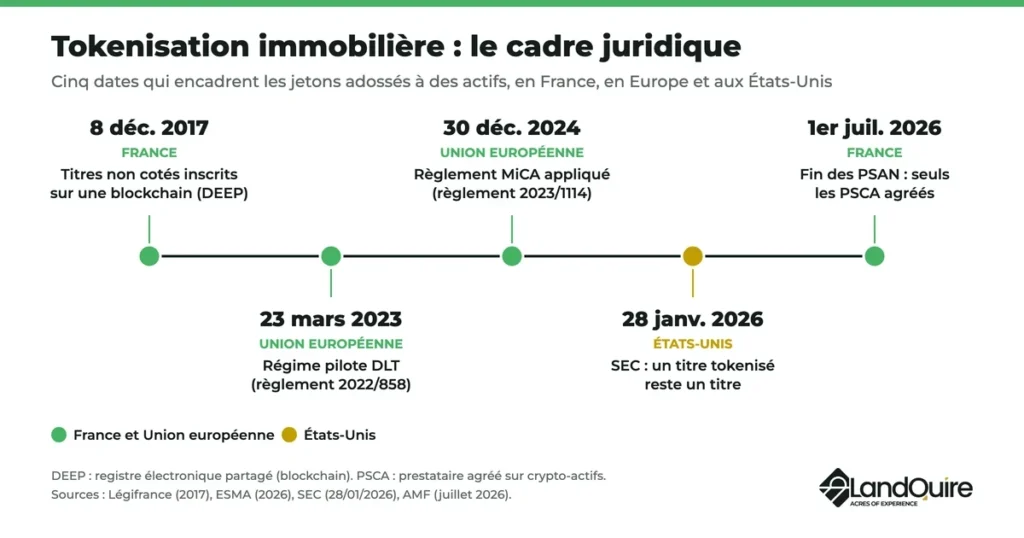
- Since 2017, the registration of securities in a shared electronic registry “constitutes registration in an account” (Ordinance of December 8, 2017, Légifrance).
- The European pilot program for blockchain-based markets has been in effect since March 23, 2023 (ESMA).
- The MiCA Regulation has applied since December 2024 to crypto-assets that are not already regulated as financial instruments (ESMA).
- As of July 1, 2026, only MiCA-authorized service providers (PSCA) may serve French clients (AMF, July 2026).
- In the United States, the form of a security’s issuance does not affect the application of federal securities regulations (SEC, January 28, 2026).
- Capital gains on non-financial tokens are subject to a 12.8% income tax rate, plus social security contributions (BOFiP, 2024).
What is real estate tokenization?
Real estate tokenization converts rights to a real estate asset into digital tokens, which are issued and traded using blockchain technology.
The most common structure consists of three tiers: an asset, an entity that owns it (such as an SAS, SCI, or LLC in the United States), and tokens that represent its shares or equity interests.
The Role of Blockchain and Smart Contracts
Blockchain is a shared ledger across multiple computers, where each transaction is recorded and cannot be deleted.
A smart contract is a program deployed on this blockchain.
It executes predefined rules: verifying that a buyer is authorized, distributing dividends in proportion to the tokens held, and blocking a transfer.
This technology automates management without changing the legal nature of the rights or the value of the asset.
What the token gives you—and what it doesn't
The token carries the rights associated with the security it represents: a share of the rent or dividends, a share of the sale price, and sometimes a vote.
This does not make you the owner of the property under the Civil Code: ownership remains with the entity that holds it.
| What the token represents | What You Own | Framework Applicable in Europe |
|---|---|---|
| Shares or units of the owning entity | A section: Dividends and Share of the Sale Price | Regulation of Financial Instruments |
| Bond or Loan to the Issuer | A Debt: Interest and Repayment | Financial Instruments or Crowdfunding |
| Non-financial token (“utility,” access to a service) | A digital asset with no rights against the issuer | MiCA Regulation |
Source: ESMA (2026), BOFiP (2019).
How does a real estate tokenization process work?
A procedure generally consists of five steps:
- The structure: An SAS or an SCI owns the property; a legal professional determines the nature of the tokens (stocks, bonds, or other).
- The issuance: The issuer creates the tokens via a smart contract, which specifies the transfer rules and the rights of each holder.
- Subscription: verification of identity and source of funds (anti-money laundering, or AML), followed by payment in euros, dollars, or crypto-assets.
- Management: The issuer manages the property and pays out rental income or interest, often automatically.
- Exit: Reselling the token on a secondary market, if one exists, or waiting for the asset to be sold.
What is the legal framework in France and Europe?
In France: Securities Registered on a Blockchain
The ordinance of December 8, 2017, published on Légifrance, allows unlisted securities to be registered in a shared electronic registry (DEEP).
According to this provision, such registration “constitutes registration in the records”: a share of an SAS may exist in the form of a token.
In Europe: DLT pilot program and MiCA regulation
Two European regulations apply:
- The DLT pilot scheme (Regulation 2022/858) has been in effect since March 23, 2023, according to ESMA’s page on this pilot scheme. It authorizes blockchain-based markets for shares of companies with a market capitalization of less than 500 million euros.
- The MiCA Regulation (2023/1114) has been fully in effect since December 2024. According to ESMA’s MiCA webpage, it applies to crypto-assets not covered by existing financial legislation.
A real estate token that grants access to a structure’s profits is most often a financial instrument; as such, it is not subject to MiCA.
An offer of this type must therefore be made through an authorized service provider, such as a crowdfunding platform (PSFP).
What the AMF Says: PSAN, PSCA, and the Whitelist
Digital asset service providers (DASPs) registered under the Pacte Act had until July 1, 2026, to obtain MiCA authorization.
Those who did not have it were automatically delisted on July 2, 2026, according to the list of delisted PSANs published by the AMF.
“From now on, ‘only authorized crypto-asset service providers (PSCA) may provide crypto-related services in France,’” statesthe AMF article on the entry into force of MiCA (July 2026).
Before investing, check the name and address of the website against the AMF’s whitelists, which list PSCA and PSFP entities.
And in the United States, what does the SEC say?
In the United States, an asset-backed token that promises a share of profits is generally considered a “security” and is subject to securities regulations.
In its January 28, 2026, statement on tokenized securities, SEC staff writes that the format in which a security is issued “does not affect” the application of federal law.
Tokens issued by a third party—rather than by the issuer of the security—pose additional risks, such as the bankruptcy of that third party.
Regulation D and Regulation S
A tokenized security that is not registered with the SEC qualifies for an exemption, just like a traditional private placement:
- Regulation D, Rule 506(c), which permits a public offering provided that all purchasers are accredited investors, as verified by the issuer;
- Regulation S, which governs offerings made outside the United States to non-U.S. residents.
According to the SEC's page on Rule 506(c), buyers receive "restricted securities," the resale of which is limited.
What benefits does real estate tokenization offer?
The platforms highlight four benefits:
- fractional ownership: a building divided into thousands of shares, accessible for just a few hundred euros;
- Liquidity: a secondary market where you can resell your tokens without having to wait for the asset to be sold;
- lower costs: fewer intermediaries to maintain the registry and distribute revenues;
- Transparency: Every transaction remains visible on the blockchain.
Their scope depends on market depth, applicable law, and the issuer's creditworthiness.
What are the real risks of tokenized real estate?
The token adds technical risks to the usual risks associated with real estate investment.
| Risk | What Might Happen | Question to Ask |
|---|---|---|
| Low effective liquidity | Few buyers in the secondary market, or resale restricted by law (“restricted” securities) | How many tokens are traded each month? |
| Platform | Bankruptcy, suspension of service, or revocation of the platform’s or issuer’s license | Is the platform on the AMF's whitelist? |
| Key Storage | Loss or Theft of the Wallet's Private Keys | Who holds the assets: you, or an authorized custodian? |
| Fraud | Fake project, fake website, property that doesn't exist | Are the articles of incorporation and the deed of title available for review? |
| Valuation | Token price is not tied to the asset's value | Has an independent expert report been published? |
| Legal | Third-party token, unclear rights | Is the token issued by the property owner himself? |
The AMF sums it up in one rule: “Never share your private keys—you run the risk of losing your cryptocurrencies.”
Our guide to real estate investment platforms details the steps you should take before choosing a broker.
How are individuals who are residents of France taxed?
Taxation is based on the nature of the token, not the technology.
According to the BOFiP guidance on digital assets, a token that has the characteristics of a financial instrument is subject to the provisions of Article 200 A of the General Tax Code.
| Token Type | Taxation of an Individual's Earnings |
|---|---|
| Financial instrument (stocks, shares, bonds) | As indicated in the title: single flat-rate withholding tax or optional tax scale |
| Digital asset (non-financial token) | 12.8% income tax or the optional tax scale, plus social security contributions; exemption if sales for the year do not exceed €305 |
Sources: BOFiP (2019 and 2024), service-public.fr (2026).
The 12.8% rate is listed in the BOFiP regarding the taxation of digital assets.
Social security contributions are added to this: 18.6% in general for income in 2026, according to the service-public.fr fact sheet on social security contributions.
Example: a capital gain of €10,000 on non-financial tokens
In 2026, a French resident sells non-financial tokens for €30,000 that he had purchased for €20,000.
| Step | Calculation | Amount |
|---|---|---|
| Capital Gain | €30,000 – €20,000 | 10,000€ |
| Income Tax | 10,000€ × 12.8% | €1,280 |
| Social Security Contributions (General Case, 2026) | 10,000€ × 18.6% | €1,860 |
| Total | 31.4% of the capital gain | 3,140€ |
For tokens that are shares, gains are taxed as securities.
Tokenization, private debt, land banking: Where does LandQuire fit in?
Tokenization is a way to own an asset, not an asset in and of itself: our guide to investing in real estate without property management compares other options.
Private real estate debt involves lending to a developer; land banking or land entitlement pertains to the land itself.
LandQuire's projects are not tokenized: its investors hold shares in a dedicated limited liability company (LLC) created for each real estate project in the United States, with a minimum investment of $100,000.
Based in Hollywood, Florida, LandQuire obtains land development permits and then resells them to developers and builders.
In practice:
- Who can invest: non-U.S. residents (Regulation S) and accredited U.S. investors (Regulation D, Rule 506(c));
- Duration: approximately 36 months for current offerings, unsecured; plan for 5 years or more;
- Liquidity: The company does not repurchase shares. A sale is possible with the manager’s consent, subject to rights of first offer and preemption.
This is an unlisted investment that carries a risk of capital loss and is intended for a small portion of your portfolio. Our page on the risks of real estate investing provides more details.
Frequently Asked Questions
Is a real estate token a title deed?
No. The token represents a share in the entity that owns the property, or a claim against it. The entity remains registered as the owner.
Can you tokenize your house or apartment?
Not directly: the transfer of a property requires a notarized deed. First, the property must be transferred to an SCI or an SAS, and then its shares must be tokenized.
What is the difference between this and an SCPI?
An SCPI is managed by a management company authorized by the AMF and owns numerous properties. A jeton often represents a single property: diversification is lower.
What happens if the platform goes bankrupt?
If the tokens are issued by the owning entity and registered in your name, your rights to them generally remain in effect.
If a third party issued or holds them, you are also dependent on that party's financial strength, the SEC notes.
Is income from a real estate token considered property income?
Not always. An SAS subject to corporate income tax pays dividends, which are taxed as investment income. Have a tax advisor review the structure.
Do you need crypto assets to invest in tokenized real estate?
No. Many platforms accept bank transfers in euros and hold the tokens for you. In that case, make sure to check who holds the wallet keys.
Would you prefer a real asset held by a project-specific LLC, without a token?
Explore our real estate listings in the United States or talk to the LandQuire team to find out if a listing is a good fit for your situation.
This article is for informational purposes only and does not constitute personalized tax, legal, or investment advice. The rules cited are those in effect as of the date of this update. Any unlisted investment carries a risk of capital loss.

About the Author
Thibaut Guéant, co-founder and CIO of LandQuire, founded the company in 2021 with Romain Daniellou. As a land entitlement specialist, he identifies off-market raw land, primarily in Texas, and oversees the process of obtaining zoning permits that make the land buildable before reselling it to developers.