Land banking or entitlement: What's the difference?
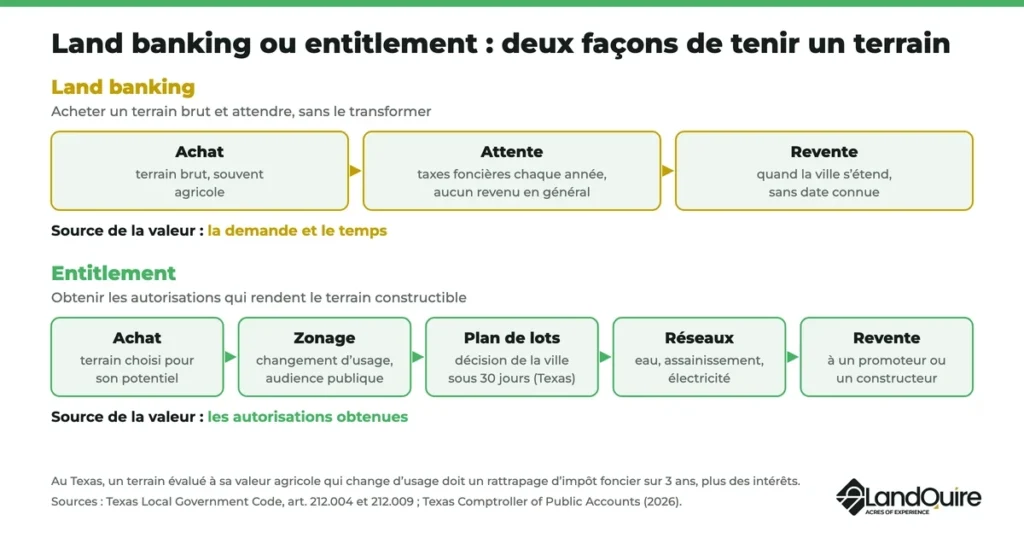
Land banking involves purchasing a parcel of land and waiting for the city to expand to it, without developing it. Entitlement involves obtaining the permits that make the land suitable for development (zoning, subdivision plan, utilities), and then reselling it to a developer.

By Thibaut Guéant, co-founder and CIO of LandQuireUpdated on 11-minute read
Table of Contents
Land banking involves buying a plot of land and waiting for the city to expand to it, without developing it.
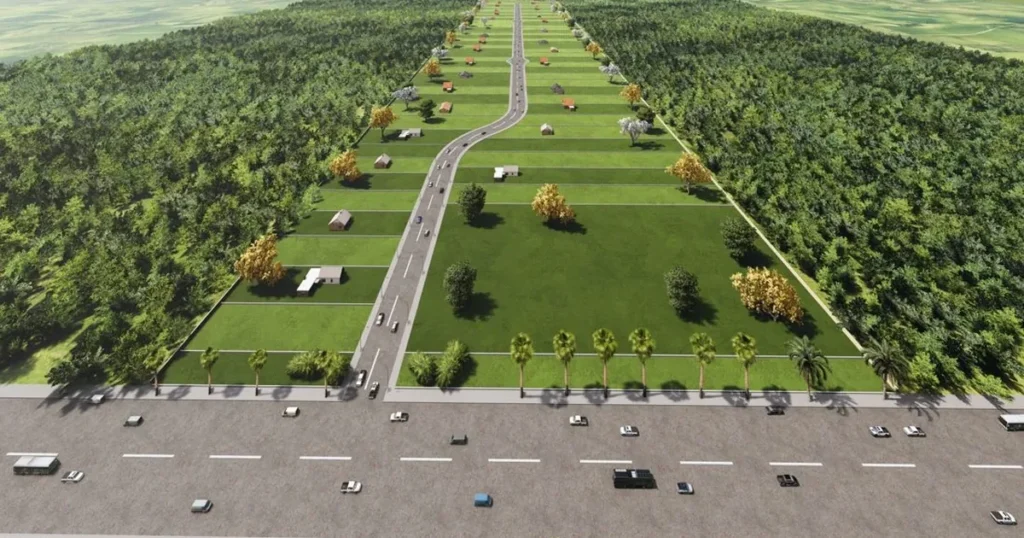
Entitlement involves obtaining the permits necessary to make the land buildable (zoning, subdivision plan, utilities), and then selling it to a developer.
The first is banking on time and demand; the second is banking on a zoning application that is seen through to the end.
Here are the differences in value, duration, costs, and risks, as well as the scams reported by regulators.
In a nutshell
- In Texas, subdividing land into lots requires an approved subdivision plan, including in areas surrounding cities within their ETJ (Texas Local Government Code, § 212.004).
- The city must rule on a subdivision plan within 30 days of its filing (Texas Local Government Code, § 212.009).
- The area of influence of a Texas city (ETJ) ranges from half a mile to five miles, depending on its population (Texas Local Government Code, § 42.021).
- A parcel of land assessed at its agricultural value that changes use is subject to back property taxes for the previous three years, plus interest (Texas Comptroller, 2026).
- The British regulator has warned of scams involving this strategy: small plots of land sold to individuals, with permits never obtained (FCA, January 2026).
- More than 300 land banks and public programs have been established in the United States over the past ten years to put vacant properties back into use (Center for Community Progress, 2026).
What is land banking?
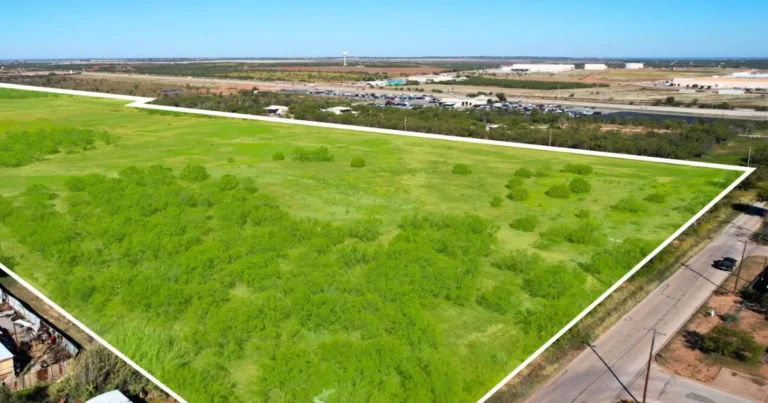
Land banking involves purchasing undeveloped land and holding onto it without developing it, waiting for the city to expand to that area.
The investor does not seek permission or carry out any work: he buys a spot and time.
The plot is often farmland or wooded, located on the outskirts of a growing city, along a major road or near an employment area.
The decision is based on data—such as population growth, new roads, and the number of driver’s licenses issued—that indicate a parcel’s potential.
Value comes from demand: as residential developments expand, real estate developers seek out land, and prices rise.
What a Land Reserve Provides
A vacant parcel generally generates no cash flow: no rent, except for a possible agricultural lease.
The return therefore depends entirely on the final selling price, at a date that no one knows in advance.
This is a long-term strategy, suitable for a buyer who can hold onto this property without needing the money in the medium term.
Some investors therefore hold a portfolio of land around several cities to spread the risk.
Public Land Banks: A Different Meaning of the Word
In the United States, a " land bank " also refers to a public agency, unrelated to private investment.
According to the Center for Community Progress, it is a public entity with the authority to redevelop vacant or dilapidated properties.
It acts in accordance with the community's objectives and may acquire property seized for unpaid property taxes.
More than 300 land banks and similar programs have been established over the past ten years: they serve urban policy, not the investment interests of individual savers.
What is land entitlement?
"Entitlement " refers to all the approvals a parcel of land receives from local authorities: authorized land use, density, subdivision into lots, and access to utility networks.
An “entitled” lot is a piece of property on which a builder knows what they can build: this is what reveals its potential and determines its value.
Details on the steps, legal deadlines, and key players can be found in our guide to land entitlement in the United States.
What Texas law requires
The Texas Local Government Code requires any landowner who subdivides a parcel of land into lots to file a subdivision plan (plat) (Section 212.004).
This rule applies within the city limits and in its catchment area. It does not apply to subdivisions of parcels larger than five acres that are serviced but lack public infrastructure.
The city must approve, approve with conditions, or reject the plan within 30 days of its submission; if no rejection with justification is issued within that period, the plan is deemed approved (Art. 212.009).
The validation steps are detailed in our article on the approval process.
The cities' area of influence (ETJ)
A land reserve is often located outside a city’s boundaries, within its extraterritorial jurisdiction (ETJ), where the city enforces its subdivision regulations.
| City Population | Extent of the ETJ around its boundaries |
|---|---|
| Fewer than 5,000 residents | Half a mile (about 800 m) |
| 5,000 to 24,999 residents | 1 mile (about 1.6 km) |
| 25,000 to 49,999 residents | 2 miles (about 3.2 km) |
| 50,000 to 99,999 residents | 3.5 miles (about 5.6 km) |
| 100,000 residents or more | 5 miles (about 8 km) |
Source: Texas Local Government Code, § 42.021, as in effect in November 2026.
Example: A parcel located 1.5 miles from a town with a population of 30,000 is within the town’s ETJ (2 miles). Its subdivision into lots therefore falls under the town’s jurisdiction.
Chapter 42 of the Texas Local Government Code has also allowed municipalities to apply for withdrawal from the ETJ since September 1, 2023 (Section 42.102).
This topic is discussed in our article onETJ in Texas.
Land banking or entitlement: What are the differences?
Both approaches start with an undeveloped lot. They differ in what the owner does between the purchase and the resale.
| Criteria | Land banking | Entitlement |
|---|---|---|
| Source of Value | Demand as the City Expands | Approvals obtained: zoning, subdivision plan, utility networks |
| Role of the Owner | Wait | Prepare the case, fund the legal work, and attend the hearings |
| Duration | No deadline; often several years | The time required for permits, which varies by city and site |
| Main risk | Growth isn't happening—or it's happening somewhere else | Rejections, delays, or conditions that reduce the number of lots |
| Porting Costs | Property taxes, insurance, maintenance—every year | The same as above, plus a surveyor, an engineer, design costs, and filing fees |
| Property taxes | Due annually; make-up payment if the agricultural assessment is lost | Payable during the project; may be made up upon a change in use |
| Liquidity | Low: A buyer comes forward when demand arises | Although limited, approved land parcels are of interest to developers and builders |
| Resale Buyer | Another investor, a developer | A developer or builder who can begin construction |
Property Taxes: The Cost of Waiting
In the United States, property tax is due every year, regardless of whether the property generates income. This is the first cost of waiting.
In Texas, agricultural land can be assessed based on its production capacity rather than its market value, according to the Texas Comptroller.
If the use changes, the owner owes a rollback tax for each of the three preceding years, plus interest.
This catch-up cost affects both strategies: it is added to the cost price when the parcel is taken out of agricultural use.
What Makes the Difference for Investors
For a land reserve, the resale price depends on a real estate market that the owner has no control over.
The value of entitlement: part of the value is created through the work done on the case.
Our article on capital gains from land explains where this profit comes from.
A city may also enter into a development agreement with the owner of a parcel of land within its ETJ, as provided for in Section 212.172.
What are the risks associated with each strategy?
Both approaches involve risks, but not in the same areas.
The Risks of the Land Reserve
- Growth is shifting: a new road or an employment zone draws housing developments elsewhere;
- The term is extended: the principal remains tied up, the annual return decreases, and property taxes accrue each year;
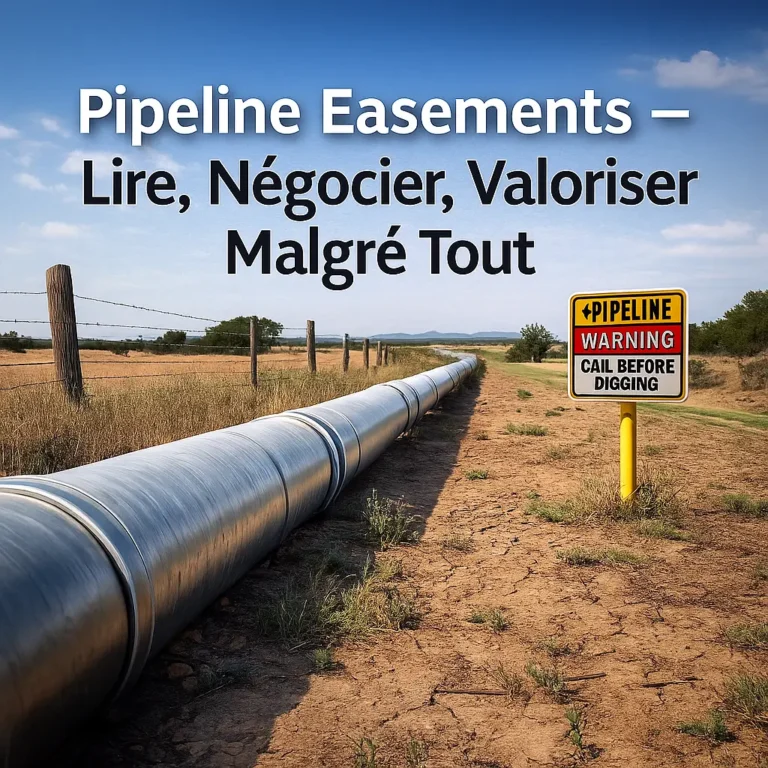
- The lot has a flaw that was discovered late: it is in a flood zone, has access issues, is subject to an easement, and lacks utility connections;
- Reselling is difficult: without authorization, it attracts fewer buyers.
The Risks of Entitlement
- the rejection of a zoning change or plan, or of conditions that reduce the number of lots;
- delays: corrections, postponed hearings, additional research;
- the cost of research and filing fees incurred before it is known whether the project will be successful;
- The market at the time of resale: demand from builders may slow down.
Our page on the risks of real estate investment goes into more detail on these points.
How can you spot a land banking scam?
This strategy has led to well-documented scams: a seller divides a property into small lots and sells them to individual buyers.
According to the FCA's webpage on these scams, the promised profits depend on a license that is often neither obtained nor even applied for.
The British regulator adds that these real estate investments are not subject to its oversight, nor to that of its ombudsman or its guarantee fund (page updated on January 19, 2026).
He recommends contacting the city hall where the lot is located to find out when construction can begin.
A case in the United States
In 2012, the SEC sued a San Diego-based company that was selling shares in companies that purchased vacant land in Nevada with the intention of reselling it later.
According to the SEC's press release, approximately $50 million had been raised from hundreds of investors.
According to the SEC, the land was resold to them at a markup that was sometimes more than five times its market value.
These are allegations as of the time of the press release, not a court ruling.
The red flags to watch for before purchasing any property are outlined in our article on real estate investment scams in the U.S.
What strategy does LandQuire follow?
LandQuire follows an entitlement model: it selects land, obtains development permits, and then resells it to developers and builders.
The company, founded in 2021 by Romain Daniellou and Thibaut Guéant and based in Hollywood, Florida, analyzes 3,143 counties using an algorithm that incorporates more than 120 criteria.
It manages each project from start to finish: sourcing, acquisition, permits, resale, and the legal and financial management of the project company.
Our "Our Method " page describes these steps, andthe Wake Village case study illustrates them in a completed project.
What You Need to Know Before You Commit
- Overview: 50 real estate projects launched since 2021, including 37 sold, 292 investors, and $42.3 million raised;
- Setbacks: four projects abandoned during the audit and two plots of land sold at a slight loss;
- Minimum investment: $100,000 per project, in a dedicated company (LLC);
- Duration: Thetarget duration is approximately 36 months for current offerings, with no guarantee. Plan for 5 years or more;
- Liquidity: The company does not repurchase shares. A sale is possible with the manager’s consent, subject to rights of first offer and preemption;
- Who can invest: non-U.S. residents (Regulation S) and accredited U.S. investors (Regulation D, Rule 506(c)).
U.S. land and real estate remain a minority component of an investment portfolio, with risks of capital loss and currency exchange rate fluctuations.
To compare this with other unlisted real estate investments, see our article on private real estate debt.
Real estate tokenization offers another way to own a share of an asset, with its own rules and risks.
Frequently Asked Questions
Is land banking legal?
Yes: Buying a plot of land and keeping it without developing it is legal in both the United States and Europe.
The problem lies in the sale of plots of land or shares to private individuals with promises of permits or profits.
How long does land banking last?
There is no standard timeframe: it all depends on the rate at which the city expands toward the lot.
An investor must be able to hold onto it for several years and pay property taxes even without any income from it.
Is a plot of land in the ETJ zoned for construction?
Not automatically. Zoning is still determined by the city within its boundaries; within the ETJ, it primarily regulates lot subdivision and access to roads.
Before buying, check the property's status with the city and county, and verify that water and sewer services are available.
Is it possible to exclude a parcel of land from a city’s ETJ?
In Texas, yes, as of September 1, 2023: owners representing a majority of the value of an area may file a petition to secede (Sec. 42.102).
It therefore falls outside the city's zoning regulations, but not those of the county.
Who buys authorized land?
Mostly real estate developers and homebuilders: approved building lots spare them the administrative risk and allow them to start construction more quickly.
Does a public land bank sell land to investors?
That is not its role: it puts vacant properties back into use in accordance with the community's objectives.
Be wary of any offer that uses this name to sell an investment.
Are you interested in investing in land that is in the process of obtaining approval?
Explore our real estate listings in the United States or contact the LandQuire team.
This article is for informational purposes only and does not constitute personalized tax, legal, or investment advice. Past performance is not indicative of future results. Investing in real estate involves the risk of capital loss and currency exchange risk.

About the Author
Thibaut Guéant, co-founder and CIO of LandQuire, founded the company in 2021 with Romain Daniellou. As a land entitlement specialist, he identifies off-market raw land, primarily in Texas, and oversees the process of obtaining zoning permits that make the land buildable before reselling it to developers.