What Should You Do After Selling Your Business?
After selling your business, the priority isn’t to reinvest quickly—it’s to secure the proceeds from the sale and then calculate the tax liability. In 2026, capital gains from the sale are taxed at a default rate of 31.4%, and the wealthiest households pay an additional tax.

By Thibaut Guéant, co-founder and CIO of LandQuireUpdated on 14-minute read
Table of Contents
- Where do you start once the business has been sold?
- How can you secure the proceeds from the sale?
- What will the capital gains tax be in 2026?
- Example: What remains after a sale of 2 million euros?
- What goals and time frame should you set before investing?
- How should the proceeds from the sale be distributed?
- Who should you consult after selling your business?
- Should we embark on a new adventure?
- What share of the proceeds from the sale does the U.S. real estate portfolio account for?
- Frequently Asked Questions

After selling your business, the priority isn't to reinvest quickly—it's to secure the proceeds from the sale and then calculate your tax liability.
In 2026, capital gains from the sale of property are taxed at a default rate of 31.4%, and the wealthiest households pay an additional tax.
Next come your needs, your investment horizon, and a diversification across several asset classes.
Here are the steps, along with a sample calculation for a €2 million transaction involving a real asset such as U.S. real estate.
In a nutshell
- Capital gains on the sale of shares are taxed at a default rate of 31.4% in 2026: 12.8% income tax (IR) and 18.6% social security contributions (impots.gouv.fr, April 2026; service-public.fr, June 2026).
- Under an optional provision of the tax schedule, shares and stock acquired before 2018 are eligible for a tax deduction ranging from 50% to 85%, depending on their age (impots.gouv.fr, April 2026).
- An SME executive who retires may deduct €500,000 from his capital gains for income tax purposes for sales completed through December 31, 2031 (impots.gouv.fr, October 2026).
- The Special Contribution on High Incomes (CEHR) adds 3% to 4% to taxable income exceeding €250,000 for a single person and €500,000 for a couple (service-public.fr, April 2026).
- Accounts and savings accounts are insured up to €100,000 per customer and per bank (FGDR, 2026).
- The AMF recommends investing only a small portion of one’s financial assets in unlisted stocks, for a minimum of 8 to 10 years (AMF, March 2025).
Where do you start once the business has been sold?
The first thing to keep in mind: don't rush into anything. The funds are disbursed all at once, but the decisions regarding their use are made over the course of several months.
A decision to reinvest too quickly is often made under pressure.
Solicitations often begin as soon as the transaction is announced: banks, advisors, investment offers. None of them justify signing a contract within the first few weeks.
What Else the Act Provides For
The process doesn't end with the signing. Review the deed with your attorney to identify what remains to be received or guaranteed:
- Payment: a portion may be paid later, through a vendor credit or an earn-out tied to future results;
- Asset and Liability Guarantee: This requires you to repay a certain amount if a debt dating from before the transaction comes to light. The amount repaid then reduces the gain reported to the tax authorities;
- Support for the buyer: a transition period—whether paid or unpaid—and often a non-compete clause that limits your ability to move on to another venture.
The First Three Months
| Period | The Actions |
|---|---|
| First Month | Place the funds received in risk-free investments at several banks; list the amounts still owed (vendor credit, earn-out) or guaranteed |
| Month 2 | Calculate your tax bill with your accountant: flat tax or progressive tax scale, tax deductions, CEHR, and CDHR |
| Month 3 | Determine your needs and time horizons, then work with your wealth management advisor and your notary to develop your investment allocation |
How can you secure the proceeds from the sale?
Spread your money across several banks. The FGDR deposit guarantee covers checking accounts and savings accounts up to €100,000 per customer per financial institution.
An enhanced guarantee is available for certain exceptional deposits: the sale of a home, an inheritance, or severance pay.
Proceeds from the sale of shares or stock are not included.
Set the tax invoice aside as soon as you receive payment. It is due the following year: in the example below, it amounts to €651,600 out of €2 million.
Choose investment vehicles that preserve your capital: term accounts, savings accounts, money market funds, and euro-denominated life insurance funds.
They keep the money readily available and allow time to make a decision without being affected by market volatility.
What will the capital gains tax be in 2026?
Capital gain is the difference between the sale price, net of expenses, and the purchase or subscription price of your shares.
For a business owner who sells his or her SAS or SARL, this gain is subject to the tax rules governing the sale of securities by individuals.
Flat tax or progressive tax bracket?
By default, capital gains are taxed at a rate of 12.8% under the income tax, according to the tax.gouv.fr fact sheet on the sale of securities.
Added to this is an 18.6% social security contribution in 2026, according to the service-public.fr fact sheet on social security contributions: this amounts to a flat tax of 31.4%.
You can choose the progressive tax scale. This option applies across the board: it covers all interest, dividends, and gains earned by the household during the year.
It provides for a holding-period deduction, limited to securities acquired or subscribed to before January 1, 2018:
| Tax Deduction | Detention | Rate |
|---|---|---|
| Under general law | Ages 2 to 8 | 50% |
| Under general law | Ages 8 and up | 65% |
| Enhanced (SMEs less than 10 years old at the time of subscription) | 1 to 4 years | 50% |
| Reinforced | Ages 4 to 8 | 65% |
| Reinforced | Ages 8 and up | 85% |
Source: impots.gouv.fr, “Sales of Movable Property” fact sheet, updated on April 8, 2026.
Social security contributions are still calculated based on earnings before the deduction. Your accountant will compare the two options before filing the return.
Retirement: The €500,000 deduction
The seller, the owner of an SME who is retiring, deducts €500,000 from his gain, whether the flat tax or the progressive tax scale is applied.
The impots.gouv.fr fact sheet on retirement for business owners specifies that the 2025 Finance Act has extended the deadline until December 31, 2031. The main conditions are:
- an SME subject to corporate income tax (IS) that has been in operation for 5 years;
- the sale of all your shares or stock that you have held for at least one year;
- management positions and at least 25 percent of the voting rights or profits during the 5 years preceding the transaction;
- cessation of all duties with the company and retirement within 2 years before or after the sale;
- No equity interest on the part of the purchaser.
The deduction applies only to income tax: social security contributions are still due on the entire gain. It is claimed using Form 2074 DIR.
Taxes on High Incomes
In the year of the transaction, the household’s taxable income (RFR) skyrockets. The special tax on high incomes is then added to the income tax.
| RFR | Single person | Married or civil union couple |
|---|---|---|
| Up to €250,000 | 0% | 0% |
| From €250,001 to €500,000 | 3% | 0% |
| From €500,001 to €1,000,000 | 4% | 3% |
| More than 1,000,000€ | 4% | 4% |
Source: service-public.fr, fact sheet on the special contribution, accessed April 15, 2026.
For an exceptional income at the start of the fiscal year, such as a gain on the sale of an asset, a smoothing system can reduce the CEHR; you must submit a request to your local tax office.
The service-public.fr fact sheet on these contributions also describes the differential contribution (CDHR), which is maintained under the 2026 Finance Act.
It guarantees a minimum tax rate of 20% for households with an adjusted gross income exceeding €250,000 (€500,000 for a couple). A 95% advance payment is due between December 1 and 15, 2026.
The calculation follows specific rules for extraordinary income: have your accountant handle it before December.
What if you had transferred your securities to a holding company?
A contribution-in-kind allows for tax deferral on the capital gain from the contribution.
If the holding company sells the securities within 3 years of the contribution, it must reinvest at least 70% of the proceeds from the sale within 3 years; otherwise, the tax deferral ends, according to the BOFiP.
Our guide tothe “apport-cession” and the “150-0 B ter” provides details on each eligible reinvestment. To invest through a structure, see how to invest via a holding company.
Example: What remains after a sale of 2 million euros?
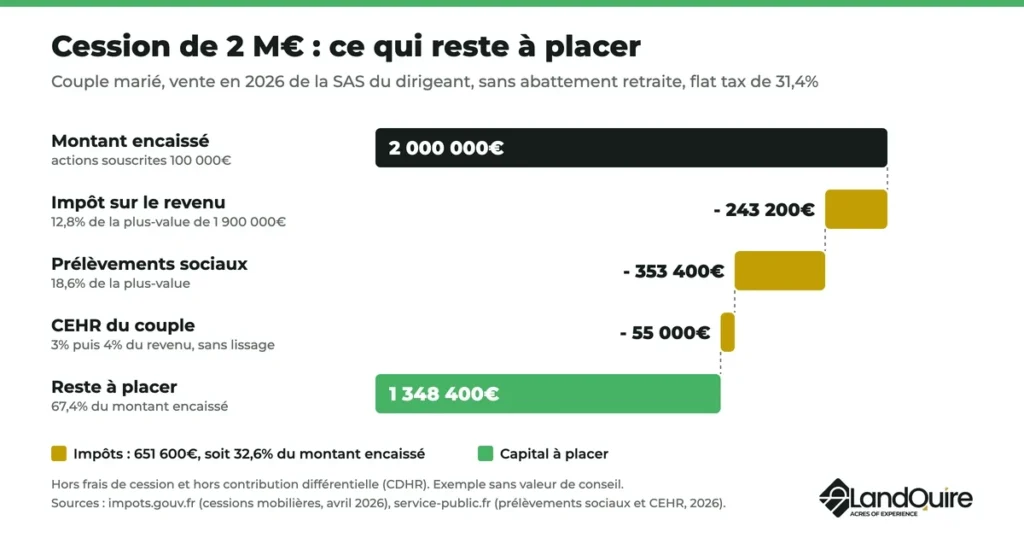
In 2026, a married couple sells all of the CEO’s shares in the SAS for €2,000,000. He had originally subscribed to them for €100,000 when the company was founded.
The executive is not retiring. Without the transaction, the facility’s net operating income would remain below €500,000; with it, it reaches €2,000,000.
| Step | Calculation | Amount |
|---|---|---|
| Amount Received | Excluding expenses | €2,000,000 |
| Capital gain on sale | €2,000,000 – €100,000 | €1,900,000 |
| IR | 1,900,000€ × 12.8% | 243,200€ |
| Social Security Contributions | 1,900,000€ × 18.6% | 353,400€ |
| Couple's CEHR, without smoothing | 3% × €500,000 + 4% × €1,000,000 | 55,000€ |
| Total Due | 32.6% of the amount received | €651,600 |
| Still to be placed | €2,000,000 – €651,600 | €1,348,400 |
Calculation based on rates from impots.gouv.fr and service-public.fr (2026), excluding fees and CDHR; please verify based on your specific situation.
With the retirement tax deduction, the income tax is calculated on €1,400,000: it comes to €179,200, which is €64,000 less. Social security contributions remain at €353,400.
Under this schedule, shares acquired before 2018 and a 65% or 85% deduction may reduce your income tax. The calculation depends on your other income.
What goals and time frame should you set before investing?
The sale changes the nature of your assets: a work tool that generated income for you becomes financial capital.
A net worth assessment begins with three questions:
- Which sources of income need to be replaced? Your executive compensation and dividends are gone. Calculate your annual cost of living, including taxes.
- What expenses should be covered? Housing, child support, a new business venture: each has a specific date and amount.
- How much risk are you willing to accept? Determine the temporary loss you could sustain without selling.
Each amount is then assigned a time horizon, which determines the available investment vehicles:
| Horizon | Role | Possible media | |
|---|---|---|---|
| Available | Under 3 years old | Planned Expenses, Taxes, Contingencies | Term accounts, savings accounts, money market funds |
| Annuities | Ages 3 to 8 | Expand Your Resources | Euro-denominated funds, bonds, rental real estate |
| Growth | Ages 8 and up | Seeking Growth | Stocks (PEA, ETFs), unit-linked funds |
| Diversification | 8 to 10 years or more, locked-in funds | Add investments that are less tied to the markets | Unlisted, private equity, real assets |
How should the proceeds from the sale be distributed?
A wealth management strategy allocates capital across multiple portfolios and asset classes, rather than putting it all into a single investment.
Here is an illustrative breakdown of the €1,348,400 in the example—rounded to €1,350,000—for a couple with a balanced profile:
| Amount | Part | |
|---|---|---|
| Cash and expenditures due within 3 years, held at several banks | 150,000€ | 11% |
| Life Insurance (Euro-denominated funds and unit-linked policies) | 500,000€ | 37% |
| PEA (European stocks, ETFs) | 150,000€ | 11% |
| Securities Account (Global ETFs, Bonds) | €220,000 | 16% |
| Real Estate (direct investments or SCPI) | €200,000 | 15% |
| Unlisted and Real Assets (private equity, club deals, real estate) | 130,000€ | 10% |
This example is not intended as investment advice; no returns are guaranteed.
Five tips for interpreting this table:
- According to the PEA information sheet on service-public.fr, the PEA has a contribution limit of €150,000 per person. Life insurance has no contribution limit.
- Gradually invest in stocks and ETFs: spreading your payments over 12 months helps smooth out your entry price. An ETF, or exchange-traded fund, tracks an index with low fees.
- Unlisted investments remain a minority. For unlisted stocks,the AMF recommends setting aside emergency savings and being able to tie up that money for at least 8 to 10 years.
- Real estate generates rental income but takes several months to sell; keep it alongside liquid investments.
- Readjust the balance every year: a bag that has risen significantly weighs more than expected.
Our guide to investing 1 million euros compares three investment profiles, and our article on asset diversification explains how to combine asset classes, currencies, and countries.
For private equity and other off-exchange investments, see our guide tounlisted investments.
Who should you consult after selling your business?
A sum of several million requires tax, legal, and wealth management guidance. Each professional has a specific role:
| Professional | His role |
|---|---|
| Certified Public Accountant | Calculates income tax (IR), the CEHR, and the CDHR advance payment; prepares Forms 2074 and 2074 DIR |
| Tax Attorney | Secures the retirement deduction, the option to use the tax schedule, or the deferral of a capital gain |
| Notary | Adjusts the matrimonial property regime, wills, gifts, and inheritance |
| Wealth Management Advisor (CGP) | Builds your investment portfolio, selects life insurance policies and investment vehicles, and monitors your strategy |
Ask each person about their compensation structure, bring them together under a single wealth management plan, and review your choices after each budget bill is passed.
When it comes to the largest fortunes, some families entrust the entire portfolio to a family office.
Should we embark on a new adventure?
Many sellers take a few months off at first to catch their breath.
What happens next varies: taking over another company, starting a new business, becoming a business angel, mentoring executives, or getting involved with a nonprofit organization.
To take over an existing business, your local Chamber of Commerce and Industry (CCI) and networks of business owners looking to sell and potential buyers can help you find a suitable business.
First, check two conditions: the non-compete clause included in the agreement and, if you are claiming the retirement tax deduction, the requirement to resign from all positions at the sold company.
What share of the proceeds from the sale does the U.S. real estate portfolio account for?
A minority stake, as part of the real asset portfolio. Real estate adds a tangible asset, another geographic region, and another currency—the dollar.
LandQuire, founded in 2021 by Romain Daniellou and Thibaut Guéant and based in Hollywood, Florida, selects land parcels in the United States.
It obtains development permits, which are the source of its revenue, and then resells the land to developers and builders.
You choose each project, with a minimum investment of $100,000.
Based on the European Central Bank’s exchange rate on November 9, 2026 (€1 = $1.1193), this ticket is worth approximately €89,300, or 7% of the example amount.
What you should know before committing:
- Selection: 3,143 counties analyzed using an algorithm based on more than 120 criteria;
- Background: 50 real estate projects launched since 2021, including 37 sold, involving 292 investors and $42.3 million raised;
- Structure: a separate limited liability company (LLC) for each project, established in your own name or through your holding company;
- Target duration: approximately 36 months for ongoing funding rounds, without guarantees. Plan for 5 years or more;
- Liquidity: The company does not repurchase shares. A sale is possible with the manager’s consent, subject to rights of first offer and preemption;
- Ongoing monitoring: one report each quarter and one K-1 form each year, after the close of the fiscal year; the tax matters for each LLC are handled by an independent CPA;
- Who can invest: non-U.S. residents (Regulation S) and accredited U.S. investors (Regulation D, Rule 506(c)).
A LandQuire real estate project does not qualify as a reinvestment of a capital contribution: it is financed with capital that you are free to invest as you choose.
The risks are real: loss of capital, euro-dollar exchange rate fluctuations, and delays or denials of approvals.
LandQuire abandoned four transactions during the audit and sold two parcels of land at a slight loss.
Our guide toreal estate investing in the U.S. outlines the steps, and the "How to Invest with LandQuire " page details the investment amount, fees, and the subscription process.
Frequently Asked Questions
Should You Set Up a Holding Company After Selling Your Business?
It no longer allows for tax deferral: a stock contribution-sale requires that you contribute your shares before the sale.
However, it can hold your investments, subject to its own tax rules and fees: your attorney and notary will compare the options.
Our dedicated article explains this choice in detail.
Does selling one's business make one liable for the IFI?
This does not apply to funds held in accounts or in securities.
The real estate wealth tax applies only to real estate, whether held directly or through corporations and funds.
It applies to net real estate assets exceeding €1,300,000 as of January 1, both in France and abroad, according to the IFI fact sheet on service-public.fr.
Reinvesting a large portion of the money in real estate could therefore help you get started in that market.
Can you stay with the company after selling it?
Yes, to assist the buyer, if the agreement so provides: employment contract, power of attorney, or consulting engagement.
However, to be eligible for the €500,000 retirement tax deduction, the seller must step down from all positions within two years of the transaction.
How can you pass on part of your assets to your children?
Each parent can give €100,000 to each child without paying any tax, and this tax exemption is renewed every 15 years, according to the gift tax schedule on service-public.fr.
Your notary will handle the transfer of assets: a manual gift, a shared gift, a division of property, or a life insurance beneficiary clause.
When do you pay capital gains tax?
The gain must be reported in the spring of the following year, along with your other income, on Form 2042 and, generally, Form 2074.
The amount due is then listed on the notice sent by the tax authority.
The only exception is the CDHR down payment, which must be paid in December of the year of the transaction, if applicable.
What should you do if part of the payment arrives late?
Don't count it as part of your investments until you've actually received the funds. A vendor loan depends on the buyer's financial strength, and an earn-out depends on future results.
Also, maintain a reserve for the asset and liability guarantee until its expiration date.
Have you sold your business and would like to invest a small portion of the proceeds in a tangible asset?
Explore our real estate listings in the United States or talk to the LandQuire team to find out if a listing is a good fit for your situation.
This article is for informational purposes only and does not constitute personalized tax, legal, or investment advice. The rates and rules cited are those in effect as of the date of this update. Past performance is not indicative of future results. Any unlisted investment carries a risk of capital loss.

About the Author
Thibaut Guéant, co-founder and CIO of LandQuire, founded the company in 2021 with Romain Daniellou. As a land entitlement specialist, he identifies off-market raw land, primarily in Texas, and oversees the process of obtaining zoning permits that make the land buildable before reselling it to developers.