Investing 1 Million Euros: Asset Allocation, Tax Implications, and Options

Investing 1 million euros is about more than just seeking the best return.
At this level, the limits on regulated investments become negligible, and the deposit insurance coverage is capped at €100,000 per bank.
The real estate wealth tax (IFI) and inheritance are also factored into the calculation.
A principal amount of 1 million euros invested at 2.63%—the average return on euro funds in 2025—yields approximately 2,192 euros gross per month.
Here's how to allocate this amount based on your profile, what returns you can expect, and how to structure your strategy.
In a nutshell
- Accounts and savings accounts are insured up to €100,000 per customer and per bank (FGDR, 2026).
- 1 million euros invested in euro-denominated funds at the average rate for 2025 (2.63%) yields 26,300 euros gross per year, or 2,192 euros per month (ACPR, June 2026).
- The IFI applies to net real estate assets exceeding €1,300,000, including shares in SCPIs and real estate companies (service-public.fr, 2026).
- Under life insurance policies, each beneficiary receives up to €152,500 tax-free for premiums paid before age 70 (impots.gouv.fr).
- A parent may give €100,000 to each child tax-free every 15 years (service-public.fr, May 2026).
- At LandQuire, investments in U.S. real estate projects start at $100,000, which is about 9% of 1 million euros.
What difference does a capital of 1 million euros make?
With 1 million euros, the question is no longer “where to invest,” but how to manage the portfolio as a whole. Three constraints arise.
The caps cover only a small portion of the total amount
The Livret A has a maximum balance of €22,950 and pays 1.7% interest per year, according to the official Livret A information sheet.
With the LDDS (€12,000), regulated savings accounts hold less than 4% of one million.
According to the PEA information sheet on service-public.fr, the PEA allows for contributions of up to €150,000. The remainder is invested through life insurance, a securities account (CTO), real estate, and unlisted securities.
The deposit insurance has a limit
"Accounts and savings accounts are covered 'up to a total of €100,000 per customer and per bank,'" notes the Deposit Insurance and Resolution Fund.
Leaving 1 million euros in a checking account therefore exposes 900,000 euros to the risk of the bank’s default.
Wealth Taxation and Estate Planning Take Center Stage
A large real estate portfolio may exceed the IFI threshold. Succession also becomes an issue: every euro invested today will, one day, be given away or inherited.
What investment strategy should you follow based on where the million came from?
A million euros rarely comes all at once without a story behind it. Its source shapes the investment strategy.
- An inheritance: Funds often come in several installments (life insurance policies, bank accounts, property). Take stock of your assets before investing: there’s no requirement to invest everything within a month.
- The sale of a company: the price can reach several million euros, sometimes held in a holding company that imposes its own rules for reinvestment.
- Accumulated savings: The portfolio already exists; the challenge is to rebalance it rather than start from scratch.
Next, set a goal for each portfolio: regular income, long-term growth, or passing on wealth. Each goal requires its own diversification strategy.
A single investment rarely serves all three of these objectives at the same time.
The time horizon is just as important as the total amount. Funds needed in the short term remain available; funds that can remain invested for more than 8 to 10 years can be allocated to more volatile or illiquid assets.
After receiving an inheritance or making a sale, a phased investment strategy reduces the risk of investing everything at the wrong time: you can spread out your purchases of securities over several months.
How much does a 1 million euro investment yield?
Monthly income is calculated simply as: principal × annual return ÷ 12. On 1 million euros, each percentage point of gross return is worth 10,000 euros per year, or 833 euros per month.
| Investment | Benchmark Return | Sum | Gross Monthly Income | Net monthly income |
|---|---|---|---|---|
| Livret A and LDDS | 1.7% (2026) | 34,950€ (upper limits) | 50€ | 50€ (exempt) |
| Euro-denominated funds (life insurance) | 2.63% (2025 average) | 1 000 000€ | 2 192€ | 1 534€ |
| SCPI Live | 4.91% (2025 dividend) | 1 000 000€ | 4 092€ | 1 710€ |
| Stocks and ETFs (PEA, CTO) | No guaranteed return | 1 000 000€ | Variable | Variable |
Sources: service-public.fr (2026), ACPR (June 2026), ASPIM-IEIF (February 2026). Gross return before taxes; past returns are not a guarantee of future performance.
Euro-denominated funds are projected to yield 2.63% in 2025, “net of charges on assets under management and before social security contributions,” according to the ACPR’s report on the revaluation of contracts.
Net income is subject to a 12.8% income tax and 17.2% in social security contributions.
In practice, the tax applies only to the capital gains portion of each redemption, and the €4,600 exemption (€9,200 for a couple) applies after 8 years.
The distribution rate for real estate investment trusts is 4.91% in 2025, according to the ASPIM and IEIF report.
These rental payments constitute real estate income: the net amount is subject to a marginal tax rate of 41% and social security contributions of 17.2%, which is common for this level of wealth.
How can you generate a steady income with 1 million euros?
To generate a steady stream of income, combine fixed-income investments (euro funds, bonds, private debt) with income-generating investments (SCPIs, dividend-paying stocks).
Example: An investment of 1 million euros split equally between euro-denominated funds (2.63%) and SCPIs (4.91%) yields a gross annual return of 37,700 euros, or 3,142 euros per month before taxes.
Private debt pays interest but offers no guarantee of principal; it remains a risky asset class.
Can you live off a million in annuity income?
Withdrawing 3% per year from a principal of this size yields €30,000, or €2,500 per month before taxes.
This withdrawal rate is sustainable only if the principal generates at least that much in returns, after adjusting for inflation.
Inflation reached 3.1% year-over-year in September 2026, according tothe INSEE price index.
For every 1 million euros invested, that’s 31,000 euros in purchasing power to be restored each year.
Investments with a known rate of return are not enough: a portion of the portfolio must be allocated to growth assets in order to generate regular income without depleting the initial principal.
How should you allocate 1 million euros based on your profile?
An allocation is based on three questions: When will you need this money? What level of temporary decline are you willing to accept? And how much of it can remain tied up for several years?
With 1 million euros, the illiquid portion (real estate, unlisted securities, real assets) can be larger than with 100,000 euros, since the safety margin remains comfortable in absolute terms and the investment horizon is longer.
| Prudent | Balanced | Dynamic | |
|---|---|---|---|
| Reserves (savings accounts, time deposits, money market accounts), held at multiple financial institutions | 150,000€ (15%) | 100,000€ (10%) | 50,000€ (5%) |
| Life Insurance with Euro-Denominated Funds and Bonds | €400,000 (40%) | 250,000€ (25%) | 150,000€ (15%) |
| Listed Stocks and ETFs (PEA, CTO, unit-linked funds) | 200,000€ (20%) | 300,000€ (30%) | €400,000 (40%) |
| Real Estate (SCPI, Direct) | 200,000€ (20%) | 200,000€ (20%) | 150,000€ (15%) |
| Unlisted and Real Assets (private equity, private debt, real estate) | 50,000€ (5%) | 150,000€ (15%) | 250,000€ (25%) |
The asset allocation examples provided are for illustrative purposes only and do not constitute personalized advice.
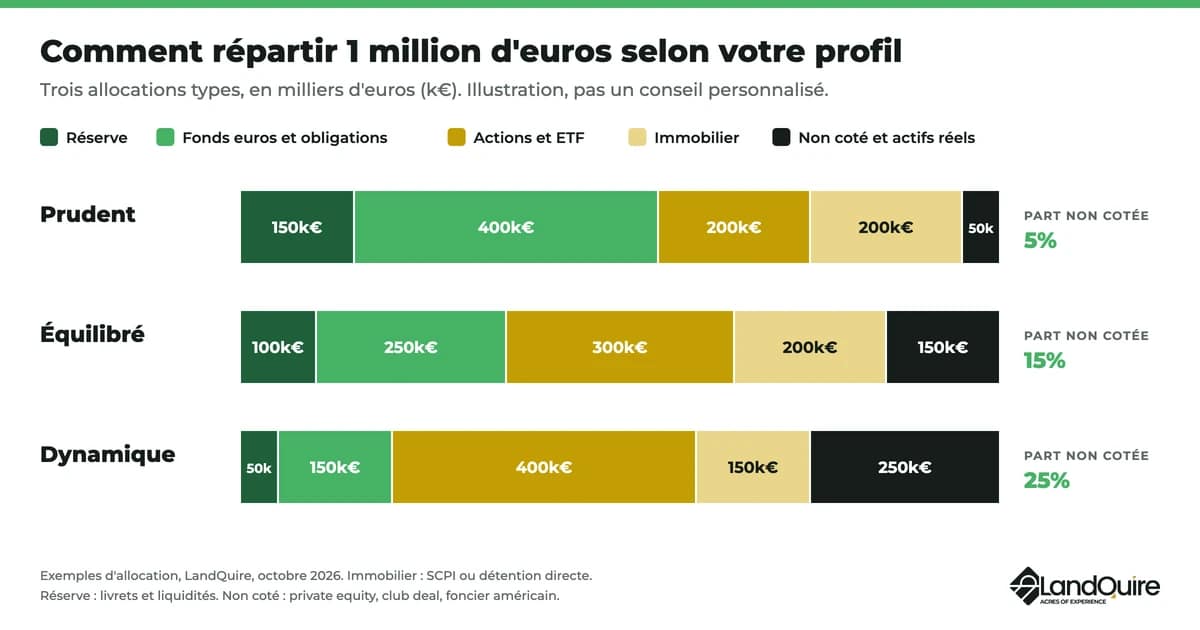
These guidelines also apply to portfolios of 2 or 3 million euros: beyond that amount, it makes sense to expand diversification to include every asset class, including private debt and private equity.
These investment strategies build on those outlined in our guide to investing, which is designed for investments of €100,000 or more. The difference lies in the role of unlisted securities and the management of the IFI.
Example: The balanced profile, envelope by envelope
| Envelope | Amount | Why |
|---|---|---|
| Livret A, LDDS, and term deposit accounts at two financial institutions | 100 000€ | Available reserve, covered by the deposit insurance |
| PEA | 150 000€ | European stocks: Capital gains are exempt from income tax after 5 years |
| Life insurance: €250,000 in euro-denominated funds and bonds, €150,000 in equity-based units | 400 000€ | Taxation After 8 Years, Transfer Outside of an Estate |
| SCPI | 200 000€ | Real estate income, to be included in the IFI |
| Unlisted and Real Assets | 150 000€ | Including a real estate project in the United States ($100,000, approximately €90,000) |
| Total | 1 000 000€ |
The €400,000 in life insurance can be spread across more than one life insurance policy and more than one insurer.
Some financial advisors also offer Luxembourg life insurance, a policy often reserved for high-net-worth individuals.
For details on the €100,000 limits, see our guide on investing €100,000; for a medium-sized investment, see our guide on investing €200,000.
What assets are included in the IFI?
The IFI applies only to real estate assets: you are subject to it if your net taxable real estate assets exceed €1,300,000 as of January 1, 2026.
The tax bracket then starts at €800,000: 0.50% up to €1,300,000, 0.70% up to €2,570,000, 1% up to €5 million, 1.25% up to €10 million, and 1.50% above that amount.
A discount applies to amounts between €1,300,000 and €1,400,000.
This is according to the IFI information sheet on service-public.fr, verified on March 6, 2026.
| Included in the IFI | The following are not included in the IFI |
|---|---|
| Primary residence, with a 30% deduction | Stocks, ETFs, Bonds |
| Rental properties, building lots, farmland | Euro-denominated funds, savings accounts, time deposit accounts |
| Shares in SCPIs and real estate companies, based on the value of their properties | Real estate used in a company’s operating activities |
| Real estate units of account in a life insurance policy, for the real estate portion | Business Assets Subject to Certain Conditions |
| Real Estate Located Abroad for a French Tax Resident | Justified real estate debts (they are deductible) |
Land owned by a project company is generally included in the tax base, based on the value of the real estate asset.
A stake of less than 10% of the capital may, under certain conditions, be excluded from this requirement: have your situation reviewed.
Our article on the France-U.S. tax treaty explains that U.S. real estate remains subject to the IFI tax in France.
Example with figures: real estate assets worth €1,320,000
| Step | Calculation | Amount |
|---|---|---|
| Primary residence valued at €900,000, after the deduction | 900,000 × 70% | 630 000€ |
| Rental Apartment | – | 400 000€ |
| SCPI Shares | – | 200 000€ |
| Share in a real estate project in the United States | – | 90 000€ |
| Net taxable real estate assets | 1 320 000€ | |
| Gross IFI | 500,000 × 0.50% + 20,000 × 0.70% | 2 640€ |
| Discount | 17,500 – 1,320,000 × 1.25% | 1 000€ |
| IFI Due | 2,640 – 1,000 | 1 640€ |
Investing the same €200,000 in ETFs rather than in real estate investment trust shares would reduce the tax base to €1,120,000, below the threshold: no IFI would be due.
The allocation is therefore also determined with regard to tax considerations.
Private banking, wealth management advisor, or investment management mandate: Who can help you?
For portfolios of one million euros or more, many investors delegate all or part of their investment decisions. There are three options available.
| Formula | What She Does | To be verified |
|---|---|---|
| Private Banking | Wealth management services offered through a financial institution: investments, loans, and advisory services | Percentage of fresh, homemade products |
| Wealth Management Advisor (CGP) | Whether the advice is independent or not, selection of contracts and funds from multiple firms | Status of Financial Investment Advisor (CIF), Compensation Structure |
| Management Agreement | A professional manages your portfolio according to an agreed-upon strategy and objectives | Risk profile specified in the mandate, reporting, performance after fees |
According to the AMF’s FAQ on financial intermediaries, “a management mandate allows you to entrust the management of your securities portfolio to a financial intermediary.”
A CIF must be registered with ORIAS: check for the “REGISTERED” notation before signing.
Family offices generally cater to much larger fortunes, involving multiple generations and a family business to manage.
Holding Company, General Partnership, or Asset Separation: How Should You Structure It?
The structure depends on the source of the funds and your succession plans.
- A holding company is primarily beneficial to the business owner. If the owner transfers his or her shares to a holding company before selling them, the capital gains tax is deferred, provided that a portion of the proceeds is reinvested: this is known asthe “150-0 B ter” contribution-and-sale arrangement.
- A civil law partnership pools real estate or financial assets, organizes their management through a manager, and allows for the issuance of shares over time.
- A division of ownership separates the usufruct (the income) from the bare ownership (the property itself). You can transfer the bare ownership and retain the income.
Example: Transferring bare ownership of €200,000 to a child
The value of the bare ownership interest depends on the age of the usufructuary. At age 65, it is worth 60% of the property’s value, according to the scale set forth inArticle 669 of the General Tax Code (CGI), as explained in the BOFiP.
| Step | Gift of Full Ownership | Gift of Bare Ownership (Donor Aged 65) |
|---|---|---|
| Selected value | 200 000€ | 200,000 × 60% = 120,000€ |
| Parent-Child Deduction | 100 000€ | 100 000€ |
| Taxable portion | 100 000€ | 20 000€ |
| Gift Taxes | 18 194€ | 2 194€ |
The fees follow the schedule published on service-public.fr: 5% up to €8,072, then 10%, 15%, and 20% up to €552,324.
Upon the parent’s death, the usufruct ends and the child becomes the full owner. Your notary will confirm the tax treatment of this step.
How do you prepare to transfer 1 million euros?
Three tools work together, each with its own limitations.
- Life insurance. For premiums paid before age 70, each beneficiary receives €152,500 tax-free; beyond that age, a 20% tax applies, according to the tax.gouv.fr fact sheet on life insurance upon death.
- Premiums paid after age 70. Amounts exceeding €30,500 are subject to estate tax, regardless of the type of policy. Spouses and civil union partners are exempt from both this tax and estate tax.
- Gifts. The €100,000 exemption per parent and per child is renewed every 15 years.
With two children, two parents, and premiums paid before age 70, these combined deductions make it possible to pass on a large portion of a million within the established tax framework, rather than leaving it all as an inheritance.
For amounts exceeding €15,932 per taxable share, the tax rate for direct descendants rises to 20 percent: planning ahead can help reduce the tax bill.
What role do unlisted companies and U.S. real estate play?
Unlisted assets (private equity, private debt, unlisted real estate, real assets) are particularly suitable for a portion of the portfolio that can remain invested for several years.
Private equity provides financing for unlisted companies, whether for growth or business succession; past performance of private equity funds is not indicative of future results.
Real estate private equity—which buys, renovates, and then resells buildings—follows the same logic.
The target return comes at the cost of tying up capital for several years and the risk of a loss of principal.
Our guide toprivate equity investments provides details on its categories, liquidity, and risks.
A real estate club deal is one such form; a REIT—which is usually publicly traded—is not one of them.
The LandQuire Model
LandQuire, founded in 2021 by Romain Daniellou and Thibaut Guéant, purchases land on the outskirts of growing U.S. cities.
The team analyzes all 3,143 U.S. counties using an algorithm based on more than 120 criteria.
It obtains development permits and then resells the land to developers and builders.
LandQuire has completed 50 projects, 37 of which have been sold: see our sold real estate projects.
Each plot is managed by a project company established for a term of 5 years, which may be extended by one year.
The grant amount is $100,000 per project, or approximately €89,800 at the ECB exchange rate as of October 28, 2026 (€1 = $1.1133).
In a €1 million allocation, one project accounts for about 9% of the capital, and two projects account for about 18%. U.S. real estate remains a minor component of the portfolio.
It provides exposure to the dollar and a real asset, but the money remains tied up until the land is sold.
Each subscription requires the signing of the private placement memorandum (PPM) and a subscription agreement.
Risks: exchange rate fluctuations, delays or denials of approvals, and potential loss of principal.
The guide to real estate investing in the U.S. outlines the steps, and our page on asset diversification places this asset class alongside others.
Frequently Asked Questions
How much does 1 million euros earn if invested each month?
Based on the average return on euro-denominated funds in 2025 (2.63%), a €1 million investment yields €2,192 gross per month, or approximately €1,534 after income tax and social security contributions.
With an SCPI (4.91% distributed in 2025), gross income amounts to €4,092 per month, but it is taxed as real estate income.
Is it possible to live off the interest from 1 million euros?
A 3% annual withdrawal rate yields €2,500 per month before taxes on €1 million.
To be sustainable, the portfolio must yield at least this rate plus inflation (3.1% year-over-year as of September 2026, according to INSEE). Beyond that, each withdrawal erodes the principal.
Where can I invest 1 million euros safely?
No investment can hold 1 million euros without risk: regulated savings accounts have a cap, and deposit insurance is limited to 100,000 euros per institution.
Euro-denominated funds guarantee the principal, but their 2025 return (2.63%) remains below the inflation rate.
What should you do with a 1 million euro inheritance?
Start by preparing the inventory and the estate declaration, then set aside some funds as a reserve.
Next, define a strategy based on your goals (income, growth, succession) before investing.
Spreading out stock purchases over several months reduces the risk of buying at the wrong time.
Should I invest 1 million euros in life insurance?
A life insurance policy is often the primary vehicle for tax planning after 8 years and for estate planning: €152,500 per beneficiary, tax-free, for premiums paid before age 70.
Spreading payments across more than one policy and more than one insurer limits the risk associated with any single insurer.
Do you need to go through a private bank to invest 1 million?
It is not mandatory. A private bank, an ORIAS-registered financial advisor, or a power of attorney are all suitable options, depending on whether you want to delegate or make the decisions yourself.
Compare fees, the advisor's status, and the variety of products offered.
Do you have to pay the IFI if you have 1 million euros invested?
Only real estate counts: stocks, ETFs, euro-denominated funds, and savings accounts are not included in the IFI.
You are subject to this requirement if your net real estate assets exceed €1,300,000 as of January 1, including shares in real estate companies.
How can you pass on 1 million euros to your children?
By combining gifts (€100,000 per parent per child, every 15 years), life insurance (€152,500 per beneficiary), and the division of ownership.
A notary will determine the optimal order based on your age, your goals, and the number of children you have—especially when the amount exceeds a few million euros.
Is it possible to invest 1 million euros in U.S. real estate?
It is not advisable to invest all of your capital there: the performance of a single asset should not determine the performance of your overall portfolio.
At LandQuire, the minimum investment for a project is $100,000, which is approximately 9% of 1 million euros.
It is a dollar-denominated diversification portfolio that is illiquid for the duration of the project.
Would you like to set aside a portion of your money for a real asset denominated in dollars?
Explore our real estate listings in the United States or talk to the LandQuire team to find out if a listing is a good fit for your situation.
This article is for informational purposes only and does not constitute personalized tax, legal, or investment advice.
The tax rules cited are those in effect as of the date of this update. Past performance is not indicative of future results.
Any unlisted investment carries a risk of capital loss and ties up your money for several years.