Escrow in the United States: How Does an Escrow Account Work When Buying Real Estate?
Escrow is the escrow account used in real estate purchases in the United States: steps involved, parties involved by state, fees, and precautions against wire transfer fraud.

By Thibaut Guéant, co-founder and CIO of LandQuireUpdated on 9-minute read
Table of Contents
- What is escrow in a real estate purchase in the United States?
- Who handles the escrow: the title company, the escrow company, or the attorney?
- How does an escrow process work, step by step?
- U.S. escrow or French notary: What are the differences?
- How much does escrow cost in the United States?
- How Can You Prevent Wire Transfer Fraud During the Closing?
- What should a foreign buyer check?
- And at LandQuire, how do funds flow?
- Frequently Asked Questions
An escrow account is a holding account used in real estate purchases in the United States: a neutral third party holds the funds and documents related to the transaction until the terms of the sale are met.
It is either a title company, an escrow company, or an attorney, depending on the state. At closing, they collect the payment, have the deed recorded with the county, and then pay the seller.
In a nutshell
- The closing is handled by a title company, an escrow company (especially in the West), or an attorney (CFPB, 2024).
- In Texas, a buyer of a parcel of land must remit the earnest money deposit to the escrow agent within 3 days (Texas Real Estate Commission, Standard Contract 2026).
- In Texas, the state sets the title insurance premium: $2,756 for a $500,000 policy (Texas Department of Insurance, 2026 rate schedule).
- In Southern California, escrow services are primarily provided by companies licensed by the California Department of Real Estate (DFPI).
- When the seller is a foreign national, the buyer generally withholds 15% of the purchase price under FIRPTA (IRS, 2026).
- Email hacking to divert wire transfers cost victims $3.05 billion in 2025 (FBI IC3, 2025 report).
What is escrow in a real estate purchase in the United States?
An escrow (or trust account) involves entrusting funds and documents to a trusted third party: they are released only once the written conditions have been met, which ensures security for both parties.
According to the California Department of Real Estate’s fact sheet for first-time homebuyers, escrow begins when the buyer and seller reach an agreement and ends upon completion of the purchase.
The escrow officer verifies that the terms of the contract have been met before any transfer takes place, and then prepares the final settlement statement for the transaction.
The word has two other meanings:
- a loan escrow account: an account held by the lender, funded by monthly payments, that is used to pay property taxes and insurance, according to the CFPB, the federal consumer financial protection agency;
- Non-real estate escrow: holding funds in escrow for a sale on an online platform, for source code (escrow), or for a cryptocurrency transaction.
Who handles the escrow: the title company, the escrow company, or the attorney?
It depends on the state. The CFPB's page on closing describes a settlement agent who coordinates the sale and files the deed with the county.
| State or region | Who usually acts as the escrow agent? | Who issues the approval? |
|---|---|---|
| Texas | A title company, through its escrow officer | Texas Department of Insurance |
| Southern California | An independent escrow company | Department of Financial Protection and Innovation (DFPI) |
| Northern California | A title company | California Department of Insurance |
| Some Eastern states | A lawyer (closing attorney) | State-Specific Rules |
Sources: CFPB (2024), Texas Department of Insurance (2024), California Department of Real Estate.
In Texas, the escrow officer—appointed by a title agent—is licensed by the Texas Department of Insurance: be sure to verify the license before making any payment.
How does an escrow process work, step by step?
The purchase agreement sets out the timeline for the transaction, and the agent follows escrow instructions agreed upon by both parties.
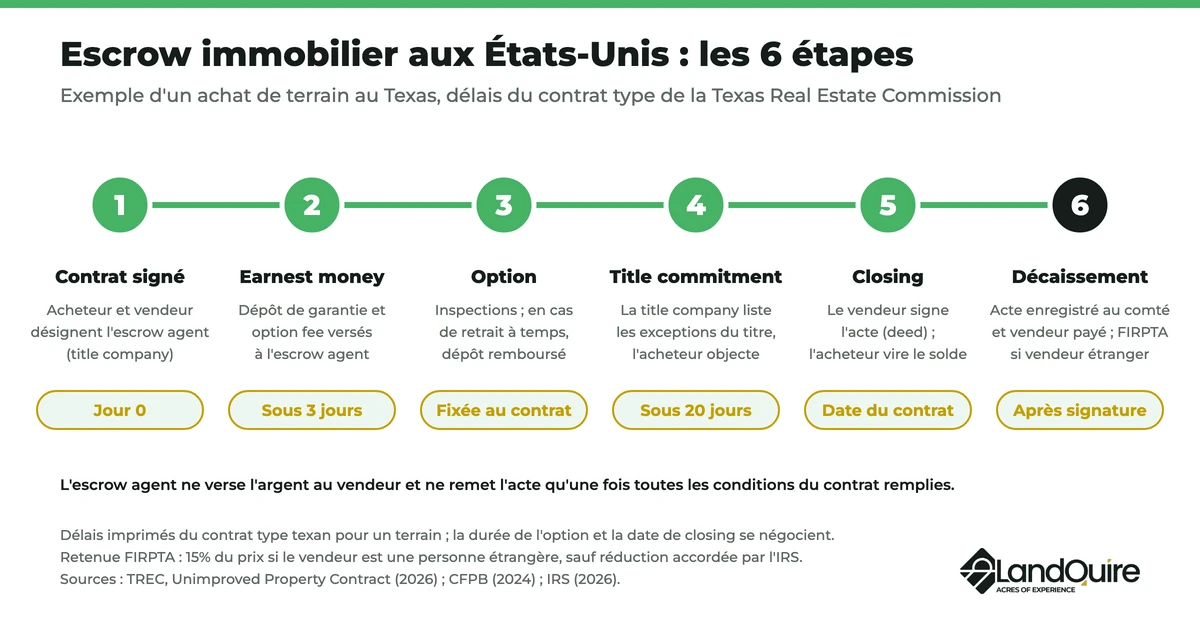
Example using the Texas Real Estate Commission's contract template for a parcel of land:
| Phase | What's Going On | Time Limit for the Texas Standard Contract |
|---|---|---|
| 1. Signed contract | The offer is accepted; the parties appoint the escrow agent and the title company | Effective Date |
| 2. Opening of the escrow account | The buyer deposits the earnest money (security deposit) and the option fee into the agent's escrow account | Within 3 days |
| 3. Option Period | Inspections: If the offer is withdrawn in time, the earnest money is refunded, but the option fee remains with the seller. | Specified in the contract |
| 4. Title commitment | The title company lists the encumbrances on the title; the buyer may raise an objection | Within 20 days |
| 5. Closing | The seller signs the deed, and the buyer pays the balance | Agreed date, or 7 days after the objections are withdrawn |
| 6. Disbursement | The deed is recorded with the county, and the funds are released to the seller, after any applicable FIRPTA withholding | After the signing |
Sources: TREC, Unimproved Property Contract (2026); CFPB (2024).
The earnest money is applied toward the purchase price at closing.
You are responsible for any exceptions listed in the title commitment (easements, mining rights, liens); our guide to title commitments in Texas provides details on these.
U.S. escrow or French notary: What are the differences?
In France, the notary—a public official—authenticates the deed and holds the security deposit.
| United States (escrow) | France (notary) | |
|---|---|---|
| Who holds the funds? | Escrow officer, title company, or attorney | Notary, public official |
| Buyer's Deposit | Earnest money, negotiated amount | Often 5% to 10% of the price of a building lot |
| Deed of Sale | Deed, recorded in the county | Notarized document signed at the notary's office |
| Rate | State-set title insurance premium in Texas; escrow fees are not regulated | Regulated fees, which are the same for all notaries |
| Deadline | Closing date specified in the contract | Usually 3 or 4 months for a building lot |
Sources: service-public.fr (2025–2026), Texas Department of Insurance (2024), CFPB (2024).
In France, the service-public.fr information sheet on the preliminary agreement to sell land recommends depositing this amount into the notary’s escrow account.
In the United States, title insurance protects against title defects that existed prior to the purchase but were unknown at closing: see our guide to title insurance in the U.S.
How much does escrow cost in the United States?
In Texas, the title insurance premium is the same at all title companies—which are regulated by the state—and covers title search, title review, and closing.
Escrow and registration fees are added to this amount and vary by agent, according to the Texas Department of Insurance’s frequently asked questions.
The contract template splits the escrow fees equally.
In California, the Department of Real Estate estimates that closing costs for a homebuyer range from 3% to 7% of the purchase price.
Example: A $500,000 piece of land in Texas
| Post | Calculation | Amount |
|---|---|---|
| Earnest money (assumption) | 1% of the price, within 3 days | 5 000 $ |
| Owner's Title Insurance | ($500,000 − $100,000) × 0.494% + $780 | 2 756 $ |
| Escrow Fees | Split equally | Based on a quote |
| Balance transferred at closing | $500,000 − $5,000 | $495,000, plus fees |
| FIRPTA Withholding Tax, if the seller is a foreign national | 15% of the price, based on the seller's share | 75 000 $ |
Source: Texas Department of Insurance rate schedule, effective March 1, 2026. Who pays the premium is subject to negotiation.
How Can You Prevent Wire Transfer Fraud During the Closing?
According to the 2025 annual report from IC3, an FBI division, email hacking resulted in $3.05 billion in losses.
The report cites a victim who received an email—sent via a hacked account in the name of the “title company”—instructing them to transfer more than $1.3 million to a fraudulent account.
It’s a familiar scenario, according tothe IC3’s real estate alert: a change in the account announced just before closing.
Good safety habits:
- Have any wire transfer instructions confirmed by phone, using a number you have found yourself;
- Check the sender's address and the domain name;
- If you have any doubts after making a transfer, call your bank first: time is of the essence.
What should a foreign buyer check?
- The escrow agent: their license and contact information, which you found yourself.
- The property: zoning, easements, access, flooding, and mining rights, based on our real estate due diligence checklist.
- Resale: In general, a nonresident is subject to a 15% withholding tax on the sale price, according to the IRS’s FIRPTA page. Our FIRPTA guide for nonresidents explains how to reduce this tax.
- How to Buy: On Your Own or With a Professional—Compare the Two Options for Buying Land in the U.S.
Overview: Our Guide toReal Estate Investing in the U.S.
And at LandQuire, how do funds flow?
LandQuire purchases land in the United States, obtains development permits, and then resells it to developers and builders: 50 projects have been launched since 2021, 37 of which have been sold.
Each parcel of land is purchased by a dedicated company (LLC), for which LandQuire provides legal and financial management. This company holds full ownership of the land.
LandQuire does not use its own escrow account.
In some offerings, the title company handling the purchase holds the subscription funds until the closing; the PPM specifies where the money goes.
Next, the funds are deposited into the company's account. You receive a report every quarter and a K-1 form every year, after the fiscal year ends.
The minimum investment is $100,000 per transaction, for a minority stake in the property, with the risk of capital loss. Learn how to invest with LandQuire.
Frequently Asked Questions
What does "escrow" mean in French?
"Escrow" translates to "escrow" or "fiduciary deposit": a trusted third party holds the funds until the sale is completed.
Who opens the escrow account?
In California, the seller typically opens the escrow account, but the buyer may also do so, according to the Department of Real Estate.
What happens to the earnest money if the sale falls through after the option period?
If the buyer fails to fulfill their obligations, the seller may keep it as compensation for damages; if the seller fails to fulfill their obligations, the buyer may reclaim it.
A dispute is first referred to mediation, with costs shared (mediation clause in the standard contract), and the agent may require the written consent of both parties before releasing the funds.
Does earnest money earn interest?
No, in principle: the Texas contract template specifies that the agent does not owe interest on this deposit.
Are all online escrow platforms the same?
No: An escrow platform holds the payment for an online sale (domain name, vehicle) in escrow. A real estate purchase is handled through the licensed agent designated in the contract.
Does escrow protect against all risks?
No. It ensures the transaction is secure: the money and the deed are not transferred until the conditions are met.
It does not cover title defects (which is the role of title insurance), the buildability of the land (which is the role of due diligence), or a wire transfer sent to a fraudulent account.
Are you considering investing in U.S. real estate without handling the purchase yourself?
Explore our land listings in the United States or talk to the LandQuire team to find out if a listing is right for you.
This article is for informational purposes only and does not constitute personalized legal, tax, or investment advice.
Any real estate investment carries the risk of a loss of principal.

About the Author
Thibaut Guéant, co-founder and CIO of LandQuire, founded the company in 2021 with Romain Daniellou. As a land entitlement specialist, he identifies off-market raw land, primarily in Texas, and oversees the process of obtaining zoning permits that make the land buildable before reselling it to developers.