McDonald’s and Real Estate: A Strategy That Has Become a Real Estate Empire
McDonald's is first and foremost a franchisor: it owns or leases the land and buildings for its restaurants, and then leases them to its franchisees.

By Thibaut Guéant, co-founder and CIO of LandQuireUpdated on 8-minute read
Table of Contents
- Why is McDonald’s often referred to as a real estate company?
- How much does McDonald’s earn from rent?
- How many properties does McDonald’s own?
- How does McDonald’s choose its locations?
- What does the McDonald’s model reveal about land value?
- What can a retail investor take away from this?
- How can I invest in real estate in the United States with LandQuire?
- Frequently Asked Questions
McDonald’s sells hamburgers, but it is first and foremost a franchisor: by the end of 2025, approximately 95% of its 45,356 locations worldwide were operated by franchisees.
In most cases, the franchisor owns or leases the land and building on a long-term basis and then leases them to franchisees.
In 2025, these rent payments ($10.4 billion) exceeded sales from its own restaurants ($9.7 billion). Here’s what this real estate strategy teaches investors.
In a nutshell
- 45,356 restaurants in more than 100 countries by the end of 2025, with a franchise rate of approximately 95% (McDonald’s, 2025 10-K report).
- Its rental revenue reached $10.4 billion in 2025, accounting for 38.8% of its $26.9 billion in total revenue (2025 10-K).
- In its consolidated markets, the company owned approximately 56% of the land and 80% of the buildings at its sites as of the end of 2025 (10-K 2025).
- Its real estate holdings are reported on the balance sheet at $8.2 billion at purchase cost, compared with $7.3 billion a year earlier (10-K 2025).
- Current leases provide for at least $31.5 billion in future minimum payments, including $3 billion in 2026 (2025 10-K).
Why is McDonald’s often referred to as a real estate company?
Because its business model combines two roles: franchisor, which licenses the brand, and landlord, which leases the location of each restaurant.
Its Form 10-K annual report for fiscal year 2025, filed with the SEC, distinguishes between two cases:
- the traditional franchise, a lease combined with a license: franchisees pay an initial fee, followed by rent and royalties calculated as a percentage of their sales, with a minimum threshold;
- Licensed markets, including China and Japan: the licensee provides the land and capital.
Where does this strategy come from?
The idea that turned McDonald’s into a real estate empire is generally credited to Harry Sonneborn, Ray Kroc ’s right-hand man in financial matters during the 1950s.
The 2016 film *The Founder*, which is about Ray Kroc, attributes a famous line to him: “You’re not in the burger business—you’re in the real estate business.”
For this fast-food chain, hamburgers are the driving force behind the brand; according to the 10-K, the company’s real estate holdings support the chain’s performance.
How much does McDonald’s earn from rent?
In 2025, $10.4 billion: this is its largest source of revenue, which has been growing since 2023, surpassing sales from its company-owned stores.
| McDonald’s Revenue (in millions of dollars) | 2023 | 2024 | 2025 |
|---|---|---|---|
| Rental income | 9,8 | 10,0 | 10,4 |
| Royalties | 5,5 | 5,6 | 6,0 |
| Sales from Company-Owned Stores | 9,7 | 9,8 | 9,7 |
| Admission Fees and Other Revenues | 0,4 | 0,5 | 0,7 |
| Total Revenue | 25,5 | 25,9 | 26,9 |
| Share of Rental Income | 38,6% | 38,6% | 38,8% |
Source: McDonald’s, Form 10-K for fiscal year 2025. Amounts are rounded.
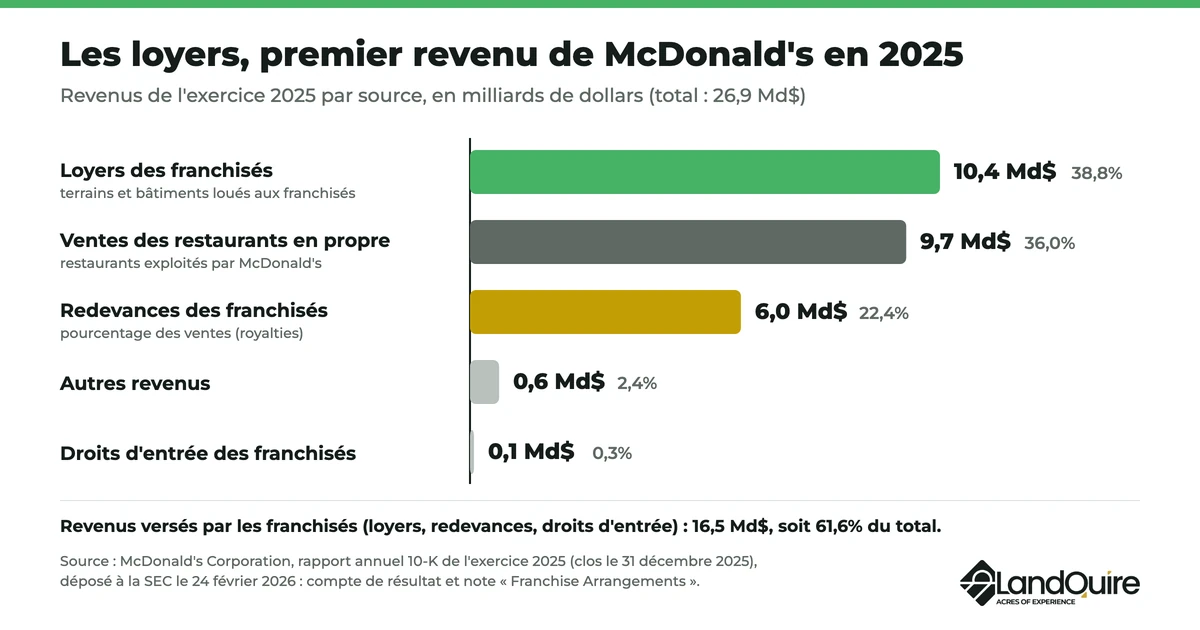
Even when you include all the payments made by franchisees ($16.5 billion), the total amounts to 61.6% of revenue—far from the 75% figure often cited.
In terms of margins, the impact is more pronounced: in 2025, the brand’s franchised locations accounted for approximately 90% of the restaurants’ profit margin.
How many properties does McDonald’s own?
The 10-K does not provide the number of parcels or the land area in acres, but rather a percentage of the sites owned and a balance sheet value.
As of the end of 2025, McDonald’s owned approximately 56% of the land and 80% of the buildings at its locations in its consolidated markets. It leases the remainder under long-term leases.
| Balance Sheet, at Cost (Md$) | Late 2024 | Late 2025 |
|---|---|---|
| Lots | 7,3 | 8,2 |
| Buildings on privately owned land | 20,5 | 22,2 |
| Buildings on Leased Land | 13,4 | 15,5 |
| Net fixed assets, all-inclusive | 25,3 | 28,2 |
Source: McDonald’s, Form 10-K for fiscal year 2025.
This strategic land reserve is recorded at purchase cost, not at market value: a parcel purchased decades ago retains its original price.
How does McDonald’s choose its locations?
According to its 10-K, the company selects locations that are convenient for customers and offer sustainable sales and profit potential as part of its growth strategy.
To assess the potential of each location, the selection criteria are based on an analysis of vehicle and pedestrian traffic in the targeted areas, census data, and other information.
Owning or leasing the property on a long-term basis ensures him a stable right to occupy the premises. After 20 years as a franchisee, he either renews his contract with the same franchisee or another one, or closes the restaurant.
What does the McDonald’s model reveal about land value?
His real estate strategy shows that, in the restaurant business, the location outlives the operator: the franchisee changes, the menu changes, but the property remains.
- Location is key: a strategic location along a major thoroughfare, in the city center, or in growing areas, continues to attract demand.
- The landlord has a safety net: the minimum amount specified in the lease is still due even if sales decline.
- Land is a lasting asset: buildings wear out and depreciate, but land does not.
In the U.S. market, the average value of farmland, including buildings, reached $4,500 per acre in 2026 (up 3.4% year-over-year), compared with $2,520 in 2012.
These figures come from the “Land Values 2026” report by the USDA, the U.S. Department of Agriculture.
An average figure doesn't guarantee anything for a specific parcel: our article on land appreciation explains what determines a property's value.
What can a retail investor take away from this?
A simple real estate strategy for your assets: own the land rather than the business.
| Franchisees (Operations) | McDonald’s (real estate) | |
|---|---|---|
| Fund | Furnishings, signage, seating, decor | Land and Building |
| Pay or receive | Pay the rent, fees, property taxes, insurance, and maintenance | Collect the rent and fees |
| After 20 years | Contract Renewed or Not | Take care of the property and the building |
Source: McDonald’s, Form 10-K for fiscal year 2025.
Individual investors do not replicate this business model exactly as it is: it requires capital, a reliable tenant, and time.
There are three avenues for diversification:
- listed real estate companies and REITs, which lease commercial real estate to retailers, often in shopping districts: see our guide to REITs;
- direct investment in a parcel of land, the value of which is realized upon resale: see our comparison of land versus rental property;
- a joint real estate transaction in which a professional handles the analysis, selection, purchase, permitting, and resale of a parcel of land.
To choose a broker, our guide helps you compare real estate investment platforms.
In any case, real estate remains a source of diversification, representing a minority portion of your assets.
How can I invest in real estate in the United States with LandQuire?
Founded in 2021 in Miami and based in Hollywood, Florida, LandQuire operates under a different model: it works directly on the land itself, without any operators or tenants.
In its projects, value comes from obtaining development permits, followed by resale to developers and builders, particularly in the Texas real estate market.
37 projects sold (5 full-cycle portfolios and 32 land resales), as of November 19, 2026. Land selection is based on an analysis of 3,143 counties and more than 120 criteria.
The Offer at a Glance
- One company per property: one LLC per project, with LandQuire handling the legal and financial management.
- Minimum investment: $100,000 per project, either in your own name or through your holding company.
- Who can invest: Non-U.S. residents (Regulation S) and accredited U.S. investors (Regulation D, Rule 506(c)).
- Target duration: approximately 36 months for ongoing fundraising efforts, without guarantees. Plan for 5 years or more.
- Reporting: one report each quarter and a K-1 form each year, after the fiscal year-end.
The risks are real: loss of capital, euro-dollar exchange rates, and delays or denials of approvals.
LandQuire terminated six projects before completion and sold two properties at a slight loss.
The steps involved in making an investment are detailed in “How to Invest with LandQuire”; our guide toreal estate investing in the U.S. compares other options.
Frequently Asked Questions
Is McDonald’s the world’s largest landowner?
Its annual report does not include this ranking, and the total area of this landholding is not listed there.
Does McDonald’s own its restaurants in France?
The 10-K does not provide data by country.
In France, the real estate investment company McDonald’s Real Estate France has been registered since 2011.
Its stated business activity: leasing of land and other real estate, according tothe State Business Directory.
Is McDonald’s a REIT?
No: The company describes itself as “primarily a franchisor” and is listed on the New York Stock Exchange.
For investors, the stock provides exposure to the company’s entire business model—including its restaurant operations—not just its real estate holdings.
Does McDonald’s make money from the locations it rents?
Yes: it subleases them to franchisees, with a minimum rent based on its own lease.
These sites are projected to have $15.6 billion in future minimum payments, compared with $15.8 billion for the sites under ownership.
Is McDonald’s continuing to invest in real estate?
Yes: Opening restaurants is one of the pillars of its strategy.
Its capital expenditures reached $3.4 billion in 2025, up from $2.8 billion in 2024, driven by network expansion (43,477 locations at the end of 2024, 45,356 at the end of 2025).
Does an empty lot generate rent like a McDonald’s restaurant?
Generally speaking, no, except for agricultural leases: its value is realized upon resale, often after obtaining the necessary permits, with no guarantee of capital appreciation.
Would you like to invest a small portion of your assets in real estate itself?
Explore our real estate listings in the United States or contact the LandQuire team.
This article is for informational purposes only and does not constitute personalized investment advice. McDonald’s is a registered trademark and is not affiliated with LandQuire.
Past performance is not indicative of future results. Any real estate investment involves the risk of capital loss.

About the Author
Thibaut Guéant, co-founder and CIO of LandQuire, founded the company in 2021 with Romain Daniellou. As a land entitlement specialist, he identifies off-market raw land, primarily in Texas, and oversees the process of obtaining zoning permits that make the land buildable before reselling it to developers.


