U.S. Real Estate Market: Forecasts for 2027
The U.S. housing market is entering 2027 in a slump: in October 2026, sales of existing homes fell to their lowest level since August 2010. Prices are still holding steady (+0.4% year-over-year), but 30-year mortgage rates are above 7%.

By Thibaut Guéant, co-founder and CIO of LandQuireUpdated on 12-minute read
Table of Contents
- What will the U.S. real estate market look like at the end of 2026?
- Why are home sales declining?
- Did the predictions for 2026 come true?
- What does the Federal Reserve foresee for 2027?
- What do the new construction figures show?
- What are the possible scenarios for the U.S. real estate market in 2027?
- What should you keep in mind when investing from France?
- Real Estate in a Slowing Market
- Where is LandQuire located?
- Frequently Asked Questions
The U.S. housing market is entering 2027 on a slow note: in October 2026, sales of existing homes fell to their lowest level since August 2010.
Prices are still holding steady (+0.4% year-over-year), but a 30-year mortgage costs more than 7%.
For 2027, the Federal Reserve forecasts declining inflation and a stable policy rate.
Here are the official figures and forecasts from U.S. agencies, and what they mean for an investor living in France.
In a nutshell
- Sales of existing homes fell 8.8% year-over-year, to an annual rate of 3.75 million in October 2026, the lowest level since August 2010 (NAR, November 2026).
- The median price of an existing home is $416,700, up 0.4% year-over-year (NAR, November 2026).
- As of November 12, 2026, the interest rate on a 30-year fixed-rate mortgage was 7.11%, compared with 6.24% a year earlier (Freddie Mac).
- Fed members project a median policy rate of 4.1% at the end of 2026 as well as at the end of 2027, and inflation falling from 3.7% to 2.3% (Federal Reserve, September 2026).
- Housing starts fell 7.4% year-over-year in September 2026 (Census Bureau, October 2026).
- Home prices rose 2.4% year-over-year in August 2026, according to the FHFA index (October 2026).
What will the U.S. real estate market look like at the end of 2026?
Sales of existing homes have been declining since the summer. According to the National Association of Realtors' report on October 2026 sales, they fell 5.5% from the previous month.
Year-over-year, the decline reached 8.8 percent, at an annual rate of 3.75 million transactions. The country's four major regions are all seeing a decline.
Lawrence Yun, the organization’s chief economist, attributes this decline to borrowing costs, which have returned to their highest levels since 2000—give or take a month—in 2023.
Prices That Hold Steady
The price of an existing home reached $416,700 in October 2026 (median price). It rose 0.4% year-over-year: this marks the 40th consecutive month of growth, which has nearly come to a standstill.
Supply is rising slowly. The inventory of homes for sale stands at 1.59 million, representing 5.1 months’ supply at the current sales pace, compared with 4.4 months a year ago.
| Region | Median price in October 2026 | Year-over-year change | Year-over-Year Sales |
|---|---|---|---|
| Northeast | $519,600 | +3,2% | -4,1% |
| Midwest | $324,300 | +1,5% | -8,2% |
| South (including Texas and Florida) | $360,900 | -0,4% | -8% |
| West | $624,300 | 0% | -14,5% |
| United States | $416,700 | +0,4% | -8,8% |
Source: National Association of Realtors, October 2026 Existing-Home Sales Report.
The South remains the least expensive region after the Midwest. Prices there have fallen slightly year-over-year (-0.4%).
Why are home sales declining?
The most expensive credit since 2000—or almost
Mortgage rates are weighing on demand.
The 30-year fixed-rate mortgage averaged 7.33% in October 2026, compared with 6.25% a year earlier, according to Freddie Mac figures cited by the association.
It has dropped slightly since then. Accordingto Freddie Mac's weekly survey of mortgage rates, it stood at 7.11% as of November 12, 2026, its lowest level in seven weeks.
A year earlier, it was 6.24%. Freddie Mac publishes this rate every Thursday: it’s the first indicator to watch.
Financing that puts a strain on household budgets
Accessibility is declining. The association’s accessibility index fell to 100.7 in October 2026, down from 107.3 a year earlier, with declines in all four regions.
According to the NAR’s quarterly report on prices by metropolitan area, the monthly payment for a typical home, with a 20% down payment, was $2,251 in the third quarter of 2026.
It accounts for 24.1% of a typical family’s income. For a first-time homebuyer with a 10% down payment, that share rises to 36.3% of their income.
Did the predictions for 2026 come true?
Forecasts for the U.S. real estate market are often revised, and analyzing them in hindsight is instructive.
In June 2026, the NAR projected a 4% increase in transactions in the existing-home market and a 4% rise in prices over the year.
It also projected an average rate of 6.5%, according to its press release on the outlook for the second half of 2026.
In October, sales fell 8.8% year-over-year, prices rose 0.4%, and mortgage rates stood at 7.33%. The rise in interest rates was enough to reverse the trend.
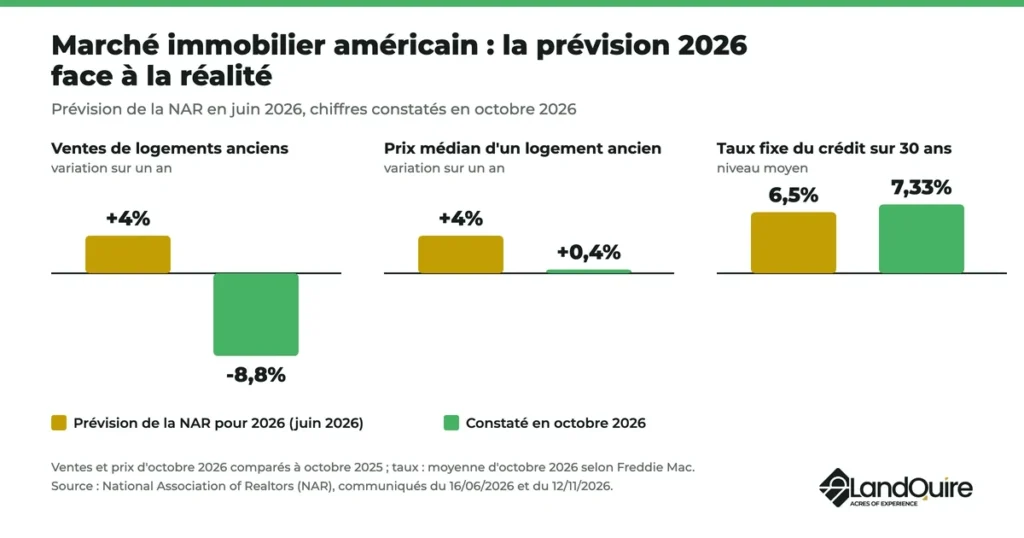
The lesson for 2027: an organization’s forecast is a scenario, not a commitment. It depends primarily on the cost of capital, which no one can predict with precision.
What does the Federal Reserve foresee for 2027?
The Fed publishes its members' projections every quarter. According to the Federal Reserve's September 2026 economic projections, here is their median scenario.
| Indicator (median of projections) | 2026 | 2027 | Long-term |
|---|---|---|---|
| Real GDP Growth | 2,3% | 2,4% | 2% |
| Unemployment Rate | 4,1% | 4,1% | 4,2% |
| Inflation (PCE Index) | 3,7% | 2,3% | 2% |
| Key interest rate at year-end | 4,1% | 4,1% | 3,2% |
Source: Federal Reserve, Summary of Economic Projections, September 17, 2026. Growth and inflation: change from the fourth quarter to the fourth quarter.
Easing inflation is the baseline scenario for 2027. However, the policy rate is not expected to fall: the median forecast remains at 4.1% at the end of 2027, above the current range.
On October 28, 2026, the Fed kept this rate between 3.75% and 4%, according to its monetary policy statement.
Two members voted for a rate hike. The committee believes that inflation “remains high.”
Why This Is Crucial for Real Estate
The cost of mortgages does not automatically follow the benchmark interest rate; rather, it depends on expectations regarding inflation and monetary policy.
If inflation declines as expected, an easing of interest rates remains possible; if it holds steady, borrowing costs will remain high.
Housing is a major contributor to inflation. According to the Bureau of Labor Statistics’ press release on the October 2026 price index, the housing component rose 0.3% from the previous month.
It alone accounts for more than 30% of the monthly increase in the overall index (+0.4%).
What do the new construction figures show?
Housing starts are slowing down. According to Census Bureau statistics on housing construction, they reached an annual rate of 1,221,000 in September 2026.
That is 7.4% less than a year earlier. Single-family homes account for 859,000 of them.
Building permits, which indicate construction activity in the coming months, fell 3% year-over-year to 1,400,000.
The supply of new homes is greater than that of existing homes.
According to Census Bureau figures on new home sales, 676,000 homes were sold at an annualized rate in September 2026 (down 5.3% from a year earlier).
Their median sales price, $400,400, is lower than that of existing homes. The inventory of new homes for sale is equivalent to 8.4 months at the current sales pace.
| Indicator, September 2026 | Level (annual rate) | Year-over-year |
|---|---|---|
| Building Permit | 1,400,000 | -3% |
| New Construction Starts | 1,221,000 | -7,4% |
| Completed Housing Units | 1,192,000 | -14% |
| New Home Sales | 676,000 | -5,3% |
| Median price of a new home | $400,400 | -3,9% |
Source: U.S. Census Bureau and HUD, press releases dated October 20 and 27, 2026.
The costs of building a house—from the land to the finishing touches—are detailed in our guide to the cost of building a house in Texas.
What are the possible scenarios for the U.S. real estate market in 2027?
Factors That Will Shape the Market
Price forecasts for 2027 are revised on a monthly basis, just like those for 2026. Four factors, tracked each month, will determine the scenario.
| Factor | Status as of the end of 2026 | What Could Support the Market in 2027 | Key metric to monitor |
|---|---|---|---|
| Mortgage Rates | 7.11% over 30 years | A decline in interest rates | Freddie Mac, every Thursday |
| Inflation and the Fed | PCE inflation is projected to be 3.7% in 2026 | Inflation at around 2.3%, as projected | Fed Projections, BLS |
| Housing Supply | 5.1 months of inventory in the existing housing market | Fewer properties for sale, prices more open to negotiation | Real Estate Agents, Census |
| Demographics | 0.5% population growth | A Resurgence in Immigration | Census Bureau |
Latent demand is the optimists' argument.
According to Lawrence Yun, the job market is holding up, and demand could pick up again if interest rates were to fall; only 2% of transactions are distressed sales.
Population growth is slowing. According to the Census Bureau’s 2025 population estimates, the United States’ population grew by only 0.5% between July 2024 and July 2025.
Net immigration fell from 2.7 million to 1.3 million people. Texas (+391,243 residents) and Florida (+196,680) remain at the top of the list, however.
Where is the market holding up?
Prices continue to rise in most cities: the association reports an increase in 78% of major cities in the third quarter of 2026, and a decrease in 21%.
In nearly every city in Florida, prices have started to rise again. In Texas, Beaumont-Port Arthur has seen a 9.9% increase year-over-year.
The FHFA Price Index confirms this resilience: a year-over-year increase of 2.4% in August 2026, ranging from 0.5% in the Mountain region to 4.4% in the East North Central region.
For a breakdown by state, see our articles on real estate in Texas and on land in Texas or Florida.
What should you keep in mind when investing from France?
There are fewer foreign buyers.
According to the NAR's 2026 report on foreign buyers, they purchased 67,100 homes from April 2025 to March 2026, 14% fewer than a year earlier.
The total amount is $45.3 billion. Florida (20%) and Texas (12%) are among the top three destinations.
Nearly one in two foreign buyers pays in cash (48%), compared with 28% of all buyers. The cost of financing is therefore less of a burden for them.
Beyond tax considerations, there are three key factors for investors living in France:
- The dollar: The value converted to euros depends on the exchange rate, both when buying and selling; see our article on investing in dollars;
- Thelong-term outlook: A slowing market calls for a long-term perspective and patience when it comes to reselling;
- Local trends: The differences between regions and cities are more pronounced than national trends.
Our guide to real estate in the U.S. compares different investment options (rental properties, SCPIs, REITs, and land).
Our guide to investing in the U.S. covers the procedures, tax implications, and risks.
Real Estate in a Slowing Market
The real estate market is driven by factors other than the resale of existing homes.
A plot of land increases in value when it obtains its development permits (zoning, subdivision, utilities).
Developers need approved land to begin construction projects in areas where the population is growing. That is the principle behind real estate investment in the United States.
The slowdown is also affecting this market: fewer new construction starts could mean fewer buyers for land and longer resale times.
Where is LandQuire located?
LandQuire is an American company based in Hollywood, Florida, founded in 2021. It analyzes all 3,143 U.S. counties using an algorithm that takes more than 120 criteria into account.
It purchases land, obtains development permits, and then resells it to developers and builders. It has launched 50 real estate projects since 2021, 37 of which have been sold.
Investors invest on a project-by-project basis in a dedicated company (LLC), with a minimum investment of $100,000 per project.
The offerings are open to non-U.S. residents (Regulation S) and accredited U.S. investors (Regulation D, Rule 506(c)).
Target duration: approximately 36 months for ongoing fundraising efforts, without guarantees. Plan for 5 years or more.
It is one option among others, for a small portion of your assets.
You may lose some or all of your investment: please read our information on the risks of real estate investing.
To view current land acquisitions, check out our land listings in the United States. If you have any questions, please contact the LandQuire team.
Frequently Asked Questions
Will real estate prices fall in the United States in 2027?
Official figures do not show a widespread decline at the end of 2026: prices for existing homes rose another 0.4% year-over-year, and the FHFA index rose 2.4%.
Local declines are possible: 21% of metropolitan areas saw prices fall in the third quarter of 2026.
Will mortgage rates go down in 2027?
There is no guarantee of that. The Fed projects that the federal funds rate will remain stable at 4.1% by the end of 2027, with inflation falling to 2.3%.
A decline in borrowing costs will depend primarily on whether inflation actually falls.
Is there a real estate crisis in the United States?
Transactions are at their lowest level since 2010, yet there has been no default crisis.
Prices continue to rise, and distressed sales (including foreclosures) account for only 2% of transactions (NAR, October 2026).
What is the average price of a house in the United States?
The median price of an existing home was $416,700 in October 2026 (NAR). The median price of a new home was $400,400 in September 2026 (Census Bureau).
The differences are significant: $324,300 in the Midwest, $624,300 in the West.
Where can I find official statistics on the U.S. real estate market?
The National Association of Realtors (NAR) publishes a monthly report on existing-home sales and prices, while the Census Bureau reports on new-home sales and housing starts.
Freddie Mac releases its mortgage rate every Thursday, the FHFA releases its price index every month, and the Fed releases its projections every quarter.
Are foreign buyers still buying in the United States?
Yes, but fewer: 67,100 housing units from April 2025 to March 2026—the second-lowest level since 2009, according to the real estate agents' association.
Canadians, Mexicans, and Chinese lead the way; buyers from the United Kingdom account for 4% of purchases.
Should we wait until 2027 to invest in U.S. real estate?
No one can predict the best time. The decision depends on your investment horizon, the portion of your portfolio involved, and your tolerance for foreign exchange risk.
A financial advisor can help you make a decision.
This article is for informational purposes only and does not constitute personalized investment, tax, or legal advice. The figures and forecasts are those published by the organizations cited as of the date of the update; they are not LandQuire’s forecasts. Past performance is not indicative of future results. All investments involve the risk of loss of principal.

About the Author
Thibaut Guéant, co-founder and CIO of LandQuire, founded the company in 2021 with Romain Daniellou. As a land entitlement specialist, he identifies off-market raw land, primarily in Texas, and oversees the process of obtaining zoning permits that make the land buildable before reselling it to developers.