Investing 150,000 euros: What are the options?
To invest 150,000 euros, keep an emergency fund in savings accounts, allocate the bulk of your funds to life insurance and a PEA, and then divide the remainder among the stock market, real estate, and unlisted securities based on your investment horizon. At this amount, two thresholds align perfectly: the PEA allows contributions of up to €150,000, and life insurance maintains its reduced tax rate on premiums up to €150,000.

By Thibaut Guéant, co-founder and CIO of LandQuireUpdated on 16-minute read
Table of Contents
- What difference does a capital of 150,000 euros make?
- How much income does a monthly investment of 150,000 euros generate?
- What are the best investments for 150,000 euros?
- How should you allocate 150,000 euros based on your profile?
- What are the tax implications for 150,000 euros in investments?
- What unlisted, dollar-denominated investments can I make with 150,000 euros?
- What kind of property can you buy in the U.S. with 150,000 euros?
- Frequently Asked Questions

To invest 150,000 euros, keep an emergency fund in savings accounts, allocate the bulk of your funds to life insurance and a PEA, and then divide the remainder among the stock market, real estate, and unlisted securities based on your investment horizon.
At this amount, two thresholds are met exactly: the PEA allows contributions of up to €150,000, and the life insurance policy maintains its reduced rate on premiums up to €150,000.
At the rate offered by euro-denominated funds in 2025 (2.63%), a 150,000-euro investment yields 329 euros gross per month before taxes—less than what inflation erodes from it.
Here is the monthly return on the investment, a comparison of the best investment options, three asset allocation strategies in euros, tax implications, and the limited role of unlisted securities.
In a nutshell
- The Livret A and LDDS accounts accept up to 34,950 euros per person, earning 1.7% interest, which is 23% of 150,000 euros (service-public.fr, August 2026).
- The PEA has a contribution limit of €150,000: it can accept the full amount (service-public.fr, May 2026).
- Life insurance gains are taxed at 7.5% after 8 years, provided that the premiums do not exceed €150,000 (service-public.fr, April 2026).
- Euro-denominated funds yielded an average return of 2.63% in 2025, before social security contributions, or €3,945 per year on an investment of €150,000 (ACPR, 2026).
- The flat tax rate is 31.4% on interest and dividends received in 2026, of which 18.6% is for social security contributions (service-public.fr, June 2026).
- Prices rose 3.4% year-over-year in October 2026 (INSEE, November 13, 2026): €5,100 in purchasing power per year for €150,000.
What difference does a capital of 150,000 euros make?
With 150,000 euros, you can move from a single investment to an asset allocation strategy: multiple tax brackets and multiple asset classes (cash, bonds, stocks, real estate).
It is also an investment strategy, guided by your goals.
It's a significant amount.
Accordingto the INSEE study on household wealth, half of all households reported more than €205,100 in gross wealth in 2024, including their primary residence.
At this level, the limits don't apply yet: they serve as guidelines to help you allocate your money to the right tax bracket without paying too much in taxes.
The thresholds set at 150,000 euros
| Placement or rule | Upper limit or threshold | Share of €150,000 |
|---|---|---|
| Livret A and LDDS (one person) | €34,950 in total | 23% |
| LEP (low-income) | 10,000€ | 7% |
| Deposit Insurance | €100,000 per customer per branch | 67% per institution |
| PEA | €150,000 in payments | 100% |
| Life Insurance: 7.5% Tax Rate After 8 Years | €150,000 in premiums, across all contracts | 100% |
| PER: Tax-Deductible Contributions (Employee) | 10% of business income in 2025, up to €37,680 | No more than 25% per year |
Sources: service-public.fr (2026), FGDR (2026).
What these thresholds change:
- The Stock Savings Plan (PEA) accepts eligible European stocks and ETFs. According to the service-public.fr fact sheet on this plan, its €150,000 limit can accommodate the entire amount; after five years, the gains are exempt from income tax.
- Life insurance policies include guaranteed euro-denominated funds and unit-linked funds, the value of which fluctuates. The €150,000 threshold applies to all of your policies, according to the service-public.fr fact sheet on life insurance taxation.
- The retirement savings plan (PER) has no contribution limit, but the tax deduction does, according to the PER fact sheet on service-public.fr. The money remains locked in until retirement, with some exceptions.
How much should you keep in a contingency fund?
Emergency savings cover unexpected expenses: job loss, repairs, and medical bills. They must be accessible at all times.
According to the Banque de France's personal finance portal, it amounts to 2 to 6 months' worth of income, most often 3 months.
- Example: With a net monthly salary of €4,000, the reserve ranges from €8,000 to €24,000; it is held in a Livret A savings account and an LDDS savings account.
- Projects within the next 3 years (home improvements, home purchase): Keep this money in a risk-free investment that matures before you need to make the purchase.
- For amounts exceeding €100,000 in accounts and savings accounts at the same bank, the Deposit Insurance Fund no longer covers the excess; coverage is limited to €100,000 per customer per institution.
How much return would 150,000 euros yield if invested each month?
The calculation fits on one line: principal × annual return ÷ 12. On 150,000 euros, each percentage point of return yields 1,500 euros per year, or 125 euros per month.
A 3% annual return thus yields €4,500 gross, while a 5% return yields €7,500 gross—before taxes and without any guarantee: the higher the target return, the greater the risk of capital loss.
The table reflects the most recent published salary figures, before and after taxes, for a French tax resident.
| Investment | Reference Rate | Gross Monthly Income | Net monthly income | Taxation Based on Net Income |
|---|---|---|---|---|
| Livret A and LDDS (up to €34,950) | 1,7% | 50€ | 50€ | Exempt |
| Term Deposit (up to 2 years) | 2.53% in September 2026 | 316€ | 217€ | 31.4% flat tax |
| Euro-denominated funds (life insurance) | 2.63% in 2025 | 329€ | 230€ | 12.8% tax + 17.2% social security contributions (before age 8) |
| SCPIs held directly | 4.91% to be distributed in 2025 | 614€ | 324€ | 30% tax bracket + 17.2% in social security contributions |
| ETF (securities account or PEA) | No guaranteed return | Variable | Variable | No income tax after 5 years in the plan |
Sources: service-public.fr (2026), Banque de France (November 2026), ACPR (2026), ASPIM-IEIF (February 2026). Past performance is not a guarantee of future results.
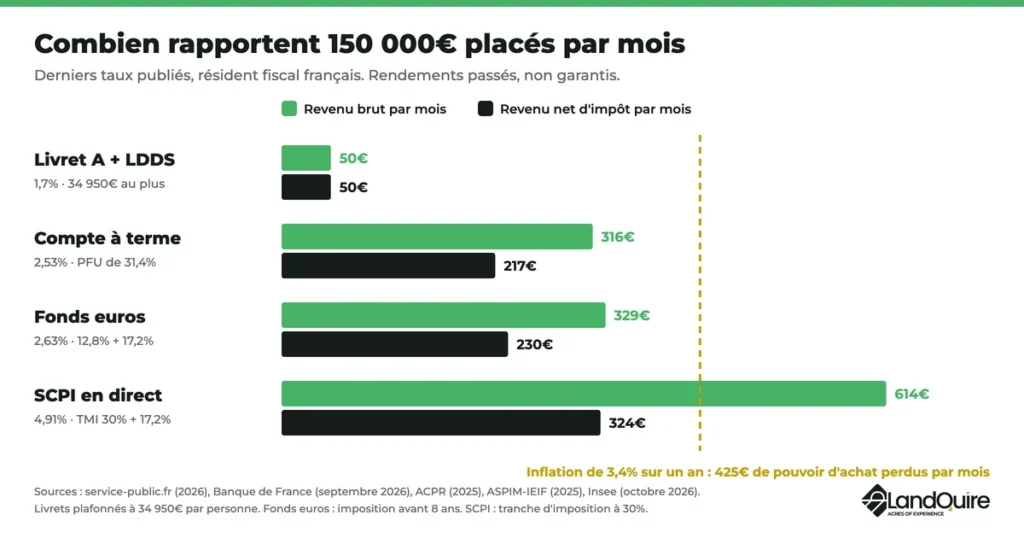
How to read this table:
- Term deposit: 2.53% is the interest rate on term deposits with a maturity of up to 2 years opened by households in September 2026, according to the Banque de France’s statistics on deposit interest rates.
- Flat tax: Interest is subject to the single flat-rate withholding tax of 31.4% on 2026 income, of which 18.6% consists of social security contributions, according to the service-public.fr fact sheet on social security contributions.
- Euro-denominated funds: 2.63% is the rate of return for 2025 on individual contracts, net of fees and before social security contributions, as published bythe ACPR in its study on the 2025 revaluation.
- SCPIs: They paid out a 4.91% dividend in 2025, but the price of shares fell by an average of 3.45%, according to the 2025 annual report from ASPIM and IEIF. On an investment of €150,000, this decline amounts to €5,175.
These returns should be compared to inflation: 3.4% year-over-year as of October 2026, according to INSEE’s final figures, representing a loss of €425 in purchasing power each month.
What kind of annuity can you get with 150,000 euros?
Without touching the principal, the annuity remains modest: €329 gross per month before taxes, based on the 2025 tax rate for euro-denominated funds.
To receive a higher annuity, you must draw down the principal. The duration of the annuity then depends on the monthly withdrawal amount and the rate obtained.
| Monthly pension | Non-earning capital | Capital invested at 2.63% per year |
|---|---|---|
| 750€ | 16 years and 8 months | 21 years and 11 months |
| 1,000€ | 12 years and 6 months | 15 years and 2 months |
| 1,250€ | 10 years | 11 years and 7 months |
Calculation is based on pre-tax figures and excludes inflation, using the 2025 rate for euro-denominated funds (ACPR); returns in subsequent years are not guaranteed.
What are the best investments for 150,000 euros?
There is no such thing as the best investment in absolute terms: every investment involves a trade-off between return, risk of capital loss, and liquidity.
The best investments for you are the ones that align with your goals and time horizon. This table compares them.
| Investment | Benchmark Profitability | Risk of Capital Loss | Availability | Investment Horizon |
|---|---|---|---|---|
| Livret A and LDDS | 1,7% | None | Immediate | Short term |
| Term Account | 2.53% (September 2026) | None | Upon maturity | Short- or medium-term |
| Euro-denominated funds | 2.63% (2025) | None; principal guaranteed by the insurer | Redemption at Any Time | Medium term (3 to 8 years) |
| ETFs and unit-linked funds | Varies depending on the market | High | Sale in a few days | Ages 8 and up |
| SCPI | 4.91% distributed (2025) | Actual: Share prices down 3.45% in 2025 | Resale Not Guaranteed | 8 to 10 years old |
| Direct Rental Properties | Depending on the property, rent, and credit | Actual | It takes several months to sell | 10 years and older |
| Private Equity and Unlisted Companies | No warranty | High | Stalled for several years | At least 8 to 10 years |
Sources: service-public.fr, Banque de France, ACPR, ASPIM-IEIF, AMF (2025–2026). Past performance is not indicative of future results.
The higher the expected return, the greater the volatility and the longer the lock-in period: that is why people combine several types of investments, such as regulated savings accounts, life insurance, the stock market, and real estate.
Private equity and real estate aim for higher long-term returns, with no guarantees.
Investing in Rental Real Estate with 150,000 Euros
150,000 euros can be used as a down payment on a rental property financed by a loan: this is the leverage provided by the loan, which allows you to purchase a property that costs more than your down payment.
The profitability of this investment depends on the purchase price, rent, the interest rate on the loan, and the tax treatment of real estate income, which is subject to social security contributions of 17.2%.
The risks are specific to this market: vacancies, unpaid rent, repairs, rental management, and properties that don't sell within a few days.
SCPIs and other unmanaged real estate investments eliminate the need to manage tenants, with smaller investment amounts, but without leverage or a choice of property.
How should you allocate 150,000 euros based on your profile?
Your investment strategy depends on your goals (supplementing your income, saving for retirement, passing on wealth), your investment horizon, and the temporary decline in value you are willing to tolerate without selling.
A short-term investment horizon calls for risk-free investments; a long-term investment horizon leaves more room for stocks and real estate.
The three investment allocations below reflect the profiles in our guide on where to invest. These are examples for a single person; they are not personalized advice.
| Envelope | Conservative (3 to 5 years) | Balanced (ages 8 and up) | Dynamic (ages 10 and up) |
|---|---|---|---|
| Regulated savings accounts (A and LDDS) | 35,000€ | 30,000€ | 20,000€ |
| Term Account | 15,000€ | – | – |
| Euro-denominated funds (life insurance) | 40,000€ | 22,500€ | 10,000€ |
| Bond or Diversified Investment Units | 25,000€ | 30,000€ | 20,000€ |
| SCPI | 15,000€ | 25,000€ | 20,000€ |
| ETF (traded on the stock exchange) | 20,000€ | 35,000€ | 65,000€ |
| Unlisted (private equity, club deal, real assets) | – | 7,500€ | 15,000€ |
| Secure section | 90,000€ (60%) | 52,500€ (35%) | 30,000€ (20%) |
| Illiquid (unlisted) portion | 0% | 5% | 10% |
Rounded amounts: The deposit limits for the Livret A and LDDS accounts total €34,950 per person. Each allowance should be adjusted to fit your situation.
How this amount changes our interpretation of the table:
- Essentially, two envelopes are all you need. The life insurance policy covers €50,000 to €65,000, and the stock savings plan covers €20,000 to €65,000: everything falls within their €150,000 thresholds, excluding a securities account.
- The ETF allocation is gradually growing. An ETF, or exchange-traded fund, tracks a market index such as the MSCI World with low management fees; it is the part of the portfolio that drives long-term returns.
- SCPIs are also available through life insurance policies in the form of unit-linked products: they provide access to real estate and leased real estate assets (offices, retail spaces, healthcare facilities), with rental income not subject to the standard tax rate.
- The illiquid portion (private equity, club deal) remains a minority stake: €7,500 to €15,000, or 5% to 10% of the capital, which is not guaranteed.
- Rebalance your portfolio once a year: after a rally in the financial markets, your stock holdings may account for a larger portion of your portfolio than expected.
For a smaller amount, our article on investing 100,000 euros explains the order in which to fill out the forms.
To compare returns, consider investing 200,000 euros, and then investing 300,000 euros, when the limits begin to take effect.
Our guide to diversifying your assets helps you determine the proportion of each asset class in your portfolio and in your overall assets.
What are the tax implications for 150,000 euros in investments?
Each investment vehicle has its own minimum term and tax treatment upon withdrawal: the date when you’ll need each euro determines where to invest it.
| Investment | Time Limit | Taxation of Gains in 2026 |
|---|---|---|
| Livret A and LDDS | None | Exempt from income tax and social security contributions |
| Term account, securities account (CTO) | Free | 31.4% flat tax |
| PEA | 5 years | After 5 years: no income tax, but social security contributions are due |
| Life Insurance | 8 years | After 8 years: a tax exemption of €4,600 (€9,200 for a couple), followed by social security contributions of 7.5% and 17.2% |
| PER | Retirement | Deducted contributions taxed at the applicable tax rate upon lump-sum withdrawal |
| Unlisted | Ages 5 to 10 and older | Depending on the product |
Source: service-public.fr (2026), rules for French tax residents.
Example: €50,000 in a time deposit account for one year
A saver deposits €50,000 into a one-year time deposit account at the rate for September 2026 published by the Banque de France.
| Step | Calculation | Amount |
|---|---|---|
| Gross interest | 50,000€ × 2.53% | €1,265 |
| Income Tax | 1,265€ × 12.8% | 162€ |
| Social Security Contributions | 1,265€ × 18.6% | 235€ |
| Net interest | €1,265 − €397 | 868€ |
| Loss of purchasing power | 50,000€ × 3.4% inflation | 1,700€ |
This investment is safe, but it does not protect the principal from the effects of inflation: it is meant to set aside money for a future expense, not to grow your money.
Conversely, after 8 years, withdrawals from a life insurance policy are exempt from income tax up to €4,600 per year; only social security contributions remain due.
The PER, for taxpayers subject to taxation
The PER is of particular interest to those whose marginal tax rate (TMI) is 30% or higher.
An employee who earned €80,000 net in 2025 can deduct €8,000 in payments in 2026; in the 30% tax bracket, the tax savings amount to €2,400.
The amounts deducted are taxed upon withdrawal.
What unlisted, dollar-denominated investments can I make with 150,000 euros?
The unlisted market includes companies, real estate, and land that are not traded on the stock exchange. Your money remains tied up there for several years.
For private equity investments, as with other unlisted assets, the AMF fact sheet on unlisted stocks provides two guidelines.
Invest “only a small portion of your financial assets” in it, and be able to set that money aside for at least 8 to 10 years.
With prices ranging from €7,500 to €15,000, the options are still on the lower end:
- private equity funds (FCPR, FCPI, FIP) and ELTIF funds, which are often offered as unit-linked life insurance products and spread risk across multiple companies. Private equity, or investment capital, finances unlisted companies: past performance is not indicative of future results;
- unlisted real estate held by real estate funds or SCPIs, rather than a direct property investment, which would tie up a large portion of the funds;
- A "club deal," in which a few investors finance a single transaction: the investment amount is often too high for this group.
Our guide toprivate investments compares their liquidity, fees, and risks.
Should you hold assets in dollars?
An ETF tracking a global or U.S. index already exposes your portfolio to the dollar: a decline in the dollar against the euro reduces its value in euros, even if stock prices rise.
Before making any direct investment in the United States, read our guide to investing in dollars, which explains currency exchange and money transfers.
What kind of property can you buy in the U.S. with 150,000 euros?
Let's be clear: with a total of 150,000 euros, none.
LandQuire was founded in 2021 in Miami by Romain Daniellou and Thibaut Guéant; it is based in Hollywood, Florida.
It buys land in the United States, obtains development permits, and then resells it to developers and builders.
Investors select their projects one by one, with a minimum investment of $100,000 per project.
What a $100,000 ticket is worth in 150,000 euros
Based on the European Central Bank's reference exchange rate as of November 17, 2026 (1€ = 1.0989 $), this ticket is worth approximately 91,000€, or 61% of 150,000€.
That’s six times the unlisted investment amount for the dynamic profile (€15,000). Investing 61% of one’s money in a single piece of land—which would be tied up for several years—would concentrate all the risk on a single project.
This investment is justified only if these €150,000 are just a portion of an already diversified portfolio: for it to account for 10% of financial assets, approximately €910,000 must be invested.
If this applies to you, here's what you need to know before committing:
- Track record: 50 real estate projects launched since 2021, including 37 sold, 292 investors, and $42.3 million raised. See our sold real estate projects, keeping in mind that past performance is not indicative of future results;
- Structure: a separate limited liability company (LLC) for each project, established in your own name or through your holding company;
- Duration: Thetarget duration is approximately 36 months for current offerings without guarantees; plan for 5 years or more;
- Liquidity: The company does not repurchase shares; a sale is possible with the manager’s consent, subject to rights of first offer and preemption;
- Who can invest: The offerings are open to non-U.S. residents (Regulation S) and accredited U.S. investors (Regulation D, Rule 506(c)).
The risks are real: loss of capital, euro-dollar exchange rate fluctuations, and delays or denials of permits. Our page on real estate investment risks details them.
The steps, fees, and required documents are described on our " How to Invest with LandQuire" page.
Frequently Asked Questions
What can you do with 150,000 euros?
Start by setting aside an emergency fund equal to 3 to 6 months' worth of income and the money needed for your projects that will take less than 3 years to complete.
Next, open a life insurance policy and a PEA to establish a starting point, then invest the rest according to your goals, time horizon, and risk tolerance.
Where can I invest 150,000 euros safely?
The Livret A savings account and the LDDS (€34,950 per person), time deposit accounts, and the euro-denominated fund in a life insurance policy: these investment vehicles guarantee the principal for short- or medium-term goals.
With €34,950 in savings accounts and the rest in accounts earning 2.53%, the total yields approximately €292 gross per month and €216 after taxes.
Spread your deposits across at least two banks.
How should a couple invest €150,000?
The contribution limits are doubled: two Livret A savings accounts and two LDDS savings accounts can each receive €69,900, and two PEA savings plans can each receive up to €300,000 in contributions.
The annual life insurance deduction after 8 years increases to €9,200 for a married or civil union couple.
Should you invest €150,000 all at once?
The secured portion can be invested immediately.
To ease the financial burden, making a monthly payment for a year averages out the initial investment: €2,917 per month for the balanced portfolio (€35,000 ÷ 12).
This gradual investment strategy, known as DCA, reduces the risk of buying just before a market decline, though it does not eliminate it.
Should I invest 150,000 euros in life insurance?
You may do so, since the total amount does not exceed the €150,000 premium threshold.
But risk is concentrated in a single asset class: keep some emergency savings on hand and a separate portfolio in the stock market.
Euro funds protect your principal; ETFs aim for higher long-term returns.
Choose a plan with low management fees that includes a euro-denominated fund, ETFs, and—if you wish—unit-based real estate investment trusts (SCPIs) for the real estate portion.
Do I need to go through a financial advisor to invest €150,000?
It's not required. A wealth management advisor can help you determine your profile and build an asset allocation plan based on your tax and family situation.
In a managed investment strategy, or discretionary management, investment decisions are entrusted to an investment management firm.
Be sure to compare the total fees, which reduce returns every year: A 1% annual fee costs €1,500 each year on a €150,000 investment.
Do you already have a diversified portfolio and want to allocate a small portion of your investments to an unlisted real asset?
Explore our real estate listings in the United States or talk to the LandQuire team to find out if a listing is a good fit for your situation.
This article is for informational purposes only and does not constitute personalized tax, legal, or investment advice. The rates and rules cited are those in effect as of the date of this update. Past performance is not indicative of future results. Any investment other than guaranteed savings carries a risk of capital loss.

About the Author
Thibaut Guéant, co-founder and CIO of LandQuire, founded the company in 2021 with Romain Daniellou. As a land entitlement specialist, he identifies off-market raw land, primarily in Texas, and oversees the process of obtaining zoning permits that make the land buildable before reselling it to developers.